Addiction is often misunderstood as a sudden turning point—something that happens when a person loses control. In reality, it usually begins much earlier, developing quietly over time before it becomes visible. This process is gradual, influenced by emotional, psychological, and environmental factors that build beneath the surface. By the time substance use becomes an obvious concern, many of these underlying patterns are already in place. Recognizing the true timeline of addiction is essential for identifying early warning signs, intervening sooner, and improving both prevention and recovery efforts.
The Real Timing of Addiction: When It Actually Begins
When people think about addiction, they often point to a moment—the first drink, the first use, the first time something “went too far.”
But addiction rarely begins there.
By the time substance use becomes noticeable, something has often already been building beneath the surface. The real timing of addiction is not a single event—it’s a process that unfolds gradually, often long before anyone recognizes it.
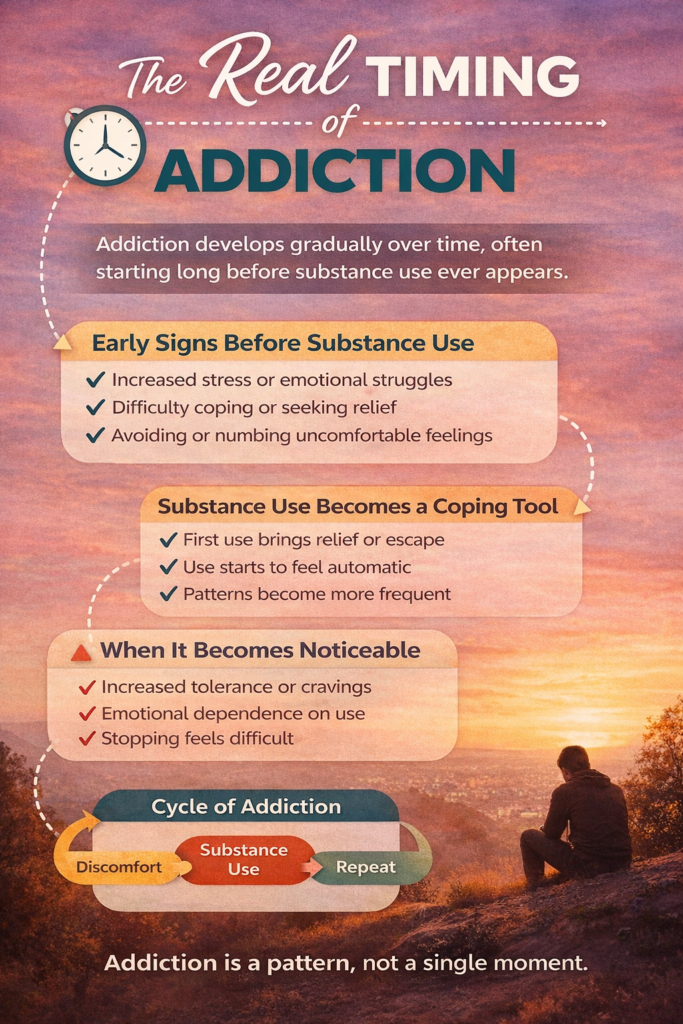
The Early Stage: Before Substance Use
Addiction can begin in subtle, often overlooked ways:
- Difficulty coping with stress or emotions
- Feeling disconnected, overwhelmed, or numb
- Learning to avoid or suppress uncomfortable feelings
- Seeking relief rather than resolution
At this stage, there may be no substance involved at all. But the foundation is being set—the need for escape, relief, or control.
The First Use: A Turning Point, Not a Beginning
The first use of a substance is often seen as the start of addiction. In reality, it’s more of a turning point.
What matters is not just the use itself, but what it does:
- Does it reduce anxiety or emotional pain?
- Does it create a sense of relief or control?
- Does it feel like a solution to something internal?
If the answer is yes, the brain begins to make a connection:
this helps → this works → use it again
The Reinforcement Phase: Learning the Pattern
With repeated use, the brain starts to reinforce the behavior.
The cycle begins to take shape:
discomfort → substance → relief → repeat
At this point:
- Use becomes more intentional
- The person may begin to rely on substances in specific situations
- The connection between emotion and substance strengthens
This stage can still appear controlled from the outside.
The Shift: From Choice to Pattern
Over time, the behavior becomes less about choice and more about habit.
- The brain starts to expect the substance
- Cravings may develop
- Emotional tolerance decreases without the substance
- Use becomes more frequent or automatic
This is where addiction starts to become more visible—but it has already been developing.
The Later Stage: When It Becomes Noticeable
By the time addiction is clearly recognized:
- The pattern is established
- The brain has adapted to the substance
- Stopping feels difficult, both physically and emotionally
From the outside, it may seem like addiction “suddenly” appeared.
In reality, it has been building over time.
Why Understanding Timing Matters
Seeing addiction as a process—not a moment—changes how we respond to it.
It helps explain:
- Why don’t people “just stop”
- Why early experiences matter
- Why are emotional and psychological factors central
It also reduces blame. Addiction isn’t simply a bad decision—it’s often the result of patterns that developed gradually.
A Different Perspective
What if addiction doesn’t start with the substance—but with the need it fulfills?
The substance is often the response, not the origin.
The real timing of addiction begins when:
- Relief becomes necessary
- Avoidance becomes habitual
- External solutions replace internal processing
Understanding this opens the door to earlier awareness and more effective prevention.
Closing Thought
Addiction doesn’t begin in a single moment—it develops over time, often quietly and unnoticed.
The earlier we recognize the patterns beneath it,
the more opportunities there are to interrupt the cycle before it fully takes hold.
Because by the time addiction is visible,
it has already been forming for much longer than it seems.
Understanding the Timeline: Self-Management Strategies for Addiction Awareness
Addiction doesn’t happen all at once—it develops over time, often in ways that are easy to miss.
The earlier stages can feel subtle: increased stress, emotional avoidance, or relying on certain behaviors for relief. By the time substance use becomes a clear problem, the underlying patterns have often already taken root.
Understanding the real timing of addiction is not just about awareness—it’s about learning how to recognize and manage those patterns before they fully develop or escalate.
Self-management plays a key role in that process.
Why Timing Matters in Self-Management
When addiction is viewed as a process rather than a single event, it becomes easier to identify points of intervention.
Self-management helps you:
- Recognize early warning signs
- Understand your personal patterns
- Interrupt cycles before they become automatic
- Build healthier responses to stress and emotion
This approach shifts the focus from reacting to addiction → to preventing and managing its development.
1. Identify Early Emotional Patterns
Before substance use becomes central, emotional patterns often emerge:
- Avoiding discomfort
- Feeling overwhelmed or disconnected
- Seeking quick relief from stress
Self-awareness starts here.
Ask yourself:
- “How do I usually respond to stress?”
- “Do I avoid certain feelings?”
Recognizing these early tendencies helps you understand where the cycle begins.
2. Track Your Triggers and Responses
Addiction often follows patterns—even if they’re not obvious at first.
Keeping track of:
- Stressful situations
- Emotional states
- Urges to escape or numb
can reveal connections over time.
For example:
stress → urge for relief → specific behavior
Awareness of this pattern creates the opportunity to respond differently.
3. Pause Between Urge and Action
One of the most powerful self-management tools is the ability to pause.
Instead of reacting immediately:
- Take a breath
- Wait briefly before acting
- Notice what you’re feeling
This small gap interrupts the automatic cycle and gives you a choice.
4. Build Alternative Coping Strategies Early
If substances or behaviors become the primary way to cope, the pattern strengthens.
Replacing them early with healthier alternatives is key:
- Physical movement (walking, stretching)
- Talking to someone
- Writing or reflecting
- Practicing relaxation techniques
The goal isn’t to eliminate discomfort—it’s to respond without reinforcing the addictive cycle.
5. Recognize the Shift from Choice to Habit
A critical point in the timing of addiction is when behavior shifts from intentional to automatic.
Signs of this shift include:
- Using or engaging in behaviors without much thought
- Feeling like you “need” it to cope
- Increased frequency or reliance
Noticing this shift early allows you to step back and reassess before the pattern deepens.
6. Strengthen Emotional Awareness
Many addictive patterns are rooted in difficulty identifying or processing emotions.
Developing emotional awareness helps you:
- Understand what you’re actually feeling
- Reduce the need to escape those feelings
- Respond more intentionally
Even simple steps like naming emotions (“stressed,” “frustrated,” “tired”) can make a difference.
7. Reflect on the Function, Not Just the Behavior
Instead of focusing only on what you’re doing, ask:
- “What is this behavior doing for me?”
- “What am I trying to change or avoid?”
This shifts attention to the underlying need, which is where real change happens.
8. Accept That Awareness Is Ongoing
Understanding the timing of addiction isn’t a one-time realization.
Patterns can reappear, especially during stress or life changes. Self-management involves ongoing awareness, not perfection.
The goal is not to catch everything early every time—
It’s to become more aware over time.
A Different Perspective
Addiction isn’t just about a substance—it’s about the relationship between discomfort and response.
Self-management allows you to:
- Notice that the relationship
- Understand when it begins
- Change how it unfolds
This turns the timeline of addiction into an opportunity—not just a risk.
Closing Thought
The real timing of addiction starts earlier than most people realize—but so does the opportunity to intervene.
Every moment of awareness, every pause, and every alternative choice weakens the cycle before it strengthens.
Because the earlier you understand the pattern,
the more power you have to change it.
Seeing It Sooner: Family Strategies for Understanding the Timeline of Addiction
For many families, addiction seems to appear suddenly.
One day, everything feels manageable, and the next, the problem is clear and overwhelming. This sudden shift can leave families asking: “How did this happen so quickly?”
But addiction rarely begins where it becomes visible.
It develops over time—often quietly, gradually, and beneath the surface. Understanding this timeline can help families respond earlier, more effectively, and with greater compassion.
Why Timing Matters for Families
When addiction is viewed as a single event, it’s easy to miss the early signs.
But when families understand it as a process, they begin to notice:
- Changes in emotional patterns
- Subtle shifts in behavior
- Increasing reliance on certain coping mechanisms
This awareness allows families to support their loved one before the pattern becomes deeply established.
1. Recognize Early Emotional and Behavioral Changes
Before substance use becomes obvious, there are often early indicators:
- Increased stress or irritability
- Withdrawal from family or activities
- Difficulty coping with everyday challenges
- Avoidance of emotional conversations
These changes may seem minor on their own, but over time, they can signal that something is building.
2. Pay Attention to Coping Patterns
Addiction is often rooted in how someone copes with discomfort.
Families can observe:
- Does your loved one avoid stress or face it?
- Do they rely on distractions, substances, or isolation for relief?
- Are they seeking quick fixes rather than long-term solutions?
Understanding these patterns helps identify where the cycle may begin.
3. Start Conversations Early—Without Accusation
Timing matters in communication.
Waiting until the problem becomes severe can make conversations more difficult and defensive.
Instead, approach early with curiosity:
- “I’ve noticed you seem more stressed lately—how are you doing?”
- “I’m here if something’s been weighing on you.”
This opens the door to support without creating pressure or conflict.
4. Focus on Support, Not Control
When families notice early signs, the instinct may be to intervene strongly or try to control behavior.
However, control can lead to resistance.
Support looks like:
- Offering help without forcing it
- Listening more than directing
- Encouraging healthy coping rather than demanding change
This approach maintains trust, which is essential for long-term influence.
5. Understand the Shift from Choice to Pattern
One of the most important parts of addiction timing is recognizing when behavior shifts:
- From occasional to frequent
- From intentional to automatic
- From choice to perceived need
Families who notice this shift early can respond before the pattern becomes deeply ingrained.
6. Avoid Minimizing Early Signs
It’s common to dismiss early changes as:
- “Just stress”
- “A phase”
- “Not a big deal yet.”
While not every change leads to addiction, consistent patterns should not be ignored.
Taking early signs seriously doesn’t mean overreacting—it means staying aware.
7. Encourage Healthy Alternatives Early
Families can play a role in reinforcing healthier coping strategies:
- Encouraging open communication
- Supporting structured routines
- Promoting activities that reduce stress
These alternatives can reduce reliance on substances before that reliance develops.
8. Take Care of the Family System
Addiction doesn’t develop in isolation—it affects and is affected by the family environment.
Families can strengthen their role by:
- Maintaining clear boundaries
- Reducing conflict where possible
- Seeking their own support or education
A stable environment makes early intervention more effective.
A Shift in Perspective
Addiction doesn’t begin with a crisis—it begins with a pattern.
When families shift from:
- “We’ll deal with it when it gets serious.”
to - “Let’s understand what’s happening early.”
They gain the opportunity to respond sooner, with less urgency and more clarity.
Closing Thought
You don’t have to wait until addiction is obvious to offer support.
The earlier the patterns are recognized,
the more space there is to interrupt them.
Because addiction may take time to develop—
But so does awareness, connection, and the ability to change its course.
Community Awareness: Understanding the Timeline of Addiction Through Shared Support
Addiction is often recognized too late—when the consequences are already visible, and the patterns are deeply established. But addiction doesn’t begin at that point. It develops gradually, shaped by emotional, social, and environmental factors over time.
Communities play a powerful role in this timeline.
By increasing awareness, providing resources, and creating supportive environments, communities can help individuals recognize and respond to early signs—long before addiction becomes severe.
Why Community Matters in Addiction Timing
Individuals and families don’t always have the full perspective needed to recognize early patterns. Subtle changes can be overlooked, minimized, or misunderstood.
Community resources help bridge that gap by:
- Providing education about how addiction develops
- Offering early intervention opportunities
- Reducing stigma that prevents people from seeking help
- Creating access to support before crisis points
When communities understand addiction as a process, they help shift the focus from reaction → to prevention.
1. Community Education and Awareness Programs
Workshops, seminars, and outreach programs help people understand:
- The early emotional and behavioral signs of addiction
- The progression from coping → to dependence
- The role of stress, trauma, and environment
Education makes early patterns more visible.
When people know what to look for, they are more likely to recognize changes in themselves or others.
2. Schools and Youth Programs: Early Recognition
Schools and youth organizations are often the first places where early signs appear.
Community-based programs can:
- Teach emotional regulation and coping skills
- Promote awareness of substance use risks
- Provide safe spaces for expression and support
Early education can interrupt patterns before they develop into long-term behaviors.
3. Access to Mental Health Services
Community mental health resources play a critical role in addressing the underlying factors that contribute to addiction.
Accessible services allow individuals to:
- Process stress, trauma, and emotional difficulties
- Develop healthier coping strategies
- Receive support before turning to substances
The earlier support is available, the less likely unhealthy patterns are to form.
4. Peer Support and Recovery Networks
Community support groups and recovery networks provide:
- Shared experiences and understanding
- Insight into how addiction develops over time
- Real-life examples of early warning signs
Hearing others’ stories often helps individuals recognize their own patterns sooner.
5. Reducing Stigma to Encourage Early Help-Seeking
One of the biggest barriers to early intervention is stigma.
Communities that openly discuss addiction as a process—not a failure—create an environment where people feel safer seeking help early.
Reducing stigma:
- Encourages honesty about struggles
- Increases willingness to access resources
- Supports earlier conversations about concerns
6. Outreach and Prevention Programs
Community outreach initiatives—especially in high-risk areas—can provide:
- Screening and early identification
- Education on coping and stress management
- Connections to local support services
These programs bring resources directly to individuals who may not seek them on their own.
7. Creating Supportive Environments
Communities influence behavior through their culture and environment.
Supportive communities:
- Promote healthy coping strategies
- Encourage connection rather than isolation
- Provide safe spaces for discussion and growth
This environment can reduce the likelihood that individuals turn to substances for relief.
A Shift from Reaction to Prevention
When addiction is only addressed at its most visible stage, opportunities for early support are missed.
Community strategies help shift the approach:
- From crisis response → to early awareness
- From isolation → to connection
- From misunderstanding → to education
This shift changes outcomes—not just for individuals, but for entire communities.
Closing Thought
The real timing of addiction begins long before it’s recognized—but so does the opportunity to respond.
Communities that invest in awareness, education, and accessible support create a powerful impact:
They make early understanding possible.
Because when people are supported early,
The course of addiction doesn’t just get treated—
It can be changed.
Frequently Asked Questions
Here are some common questions:
1. What is meant by the “real timing” of addiction?
The “real timing” of addiction refers to the gradual process by which addiction develops. It’s not a sudden event, but a series of emotional, psychological, and behavioral changes that occur over time, often starting long before substance use becomes visible or problematic.
2. When does addiction actually begin?
Addiction begins long before someone first uses a substance. It starts with emotional struggles, stress, and the gradual development of unhealthy coping mechanisms. These early signs may go unnoticed, but they set the foundation for addiction to take hold.
3. What are the early signs that addiction is developing?
Before substance use becomes a coping tool, early signs of addiction may include:
- Increased stress or emotional struggle
- Difficulty coping with emotions or seeking relief
- Avoiding uncomfortable feelings or situations
- A reliance on temporary distractions or numbing methods
These signs indicate that someone may be at risk of developing addiction, though the substance use itself hasn’t started yet.
4. How does substance use become part of the addiction cycle?
Substance use often begins as a way to manage emotional pain or discomfort. Initially, substances may provide relief, but as use continues, they become a habitual way to cope. Over time, the behavior becomes automatic and more frequent, leading to emotional dependence on the substance for relief.
5. When do the signs of addiction become more noticeable?
Addiction becomes more noticeable when:
- Tolerance to substances develops (i.e., the person needs more to achieve the same effect)
- Cravings and emotional dependence on the substance increase
- Stopping substance use becomes increasingly difficult
- Behavioral patterns of substance use become more obvious and frequent
At this stage, addiction is more recognizable, but by then, it has often already become a deeply ingrained pattern.
6. How does addiction become a cycle?
Addiction creates a cycle where discomfort or emotional pain leads to substance use, which temporarily relieves that discomfort, only for the cycle to repeat. This cycle becomes self-reinforcing, where the person uses substances more often to cope with feelings, and eventually, it becomes harder to break free.
7. Why is addiction considered a pattern, not a single event?
Addiction is a pattern because it involves ongoing emotional struggles and coping mechanisms that build over time. Rather than a single moment of choice, addiction is the result of repeated behaviors, emotional suppression, and substance reliance that develop gradually.
8. How can recognizing the real timing of addiction help with prevention?
By understanding the gradual progression of addiction, individuals and families can recognize early warning signs before the pattern becomes established. Early intervention, emotional support, and healthier coping strategies can interrupt the cycle before it fully takes hold.
9. Can someone stop addiction after it becomes noticeable?
Yes, addiction can be stopped, but it typically requires intervention, therapy, and a commitment to breaking the cycle. Recognizing the pattern and seeking support early in the addiction timeline increases the chances of successful recovery.
10. Is it possible to identify addiction early and prevent it?
Yes, with awareness, education, and early intervention, addiction can be prevented. By addressing emotional struggles and unhealthy coping mechanisms before substance use becomes a primary coping tool, individuals can prevent addiction from developing.
11. How does emotional pain contribute to the timing of addiction?
Emotional pain, unresolved stress, and an inability to process feelings are key drivers in the development of addiction. When individuals struggle to cope with these emotions, substances may initially seem like a solution, but over time, they reinforce the cycle of emotional numbing and dependency.
12. What role does family play in recognizing the timing of addiction?
Families play a critical role in noticing early signs of emotional distress, changes in behavior, or unhealthy coping patterns. By recognizing these signs, families can encourage healthier coping strategies and intervene before the addiction cycle becomes entrenched.
13. Can addiction be stopped if it’s already become a cycle?
Yes, it’s possible to break the addiction cycle even after it’s developed. However, recovery typically requires professional help, support systems, and a strong commitment to personal growth. Recognizing the cycle is the first step in addressing and stopping it.
14. What is the most important takeaway about the real timing of addiction?
Addiction is a process that develops over time, often long before substances are used as a coping tool. Recognizing the early signs and emotional struggles behind addiction can lead to earlier interventions, healthier coping strategies, and a greater chance of recovery.
Conclusion
Addiction doesn’t emerge in a single moment; it builds over time, often in ways that are subtle and easy to overlook. By recognizing the gradual development of addiction, we can intervene earlier—whether through self-awareness, family support, community resources, or professional care. The real timing of addiction is about understanding that it’s not just the moment of first use that matters, but the long-term emotional, psychological, and behavioral patterns that precede it. By addressing these patterns, we can disrupt the cycle of addiction before it fully takes hold, offering more hope for recovery and prevention.
Video: This Is How Addiction Actually Begins #AddictionRecovery #Facts