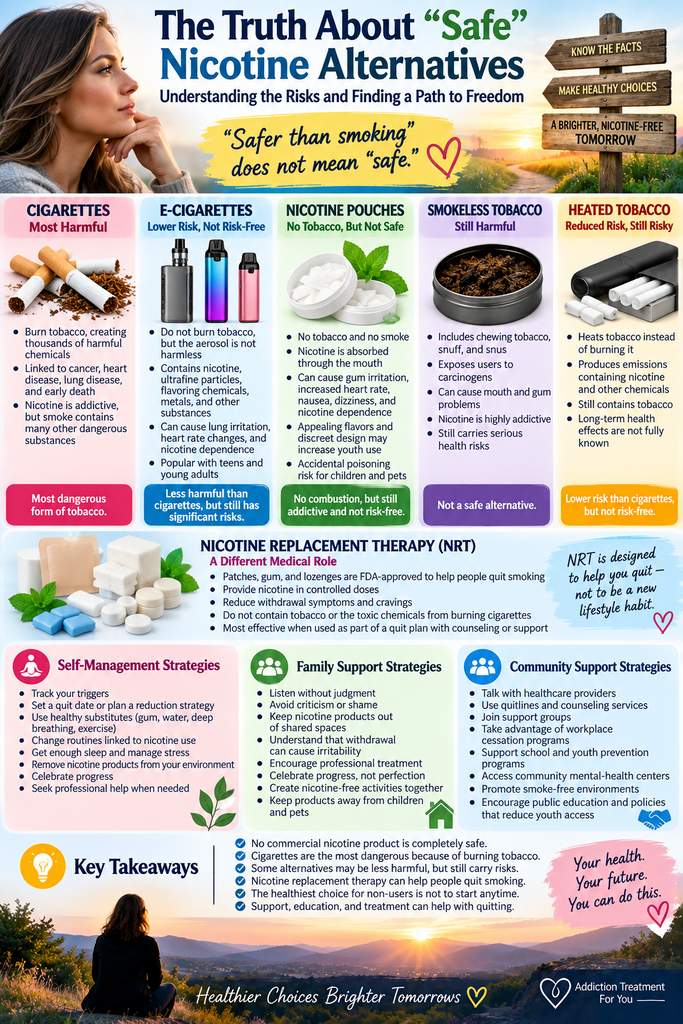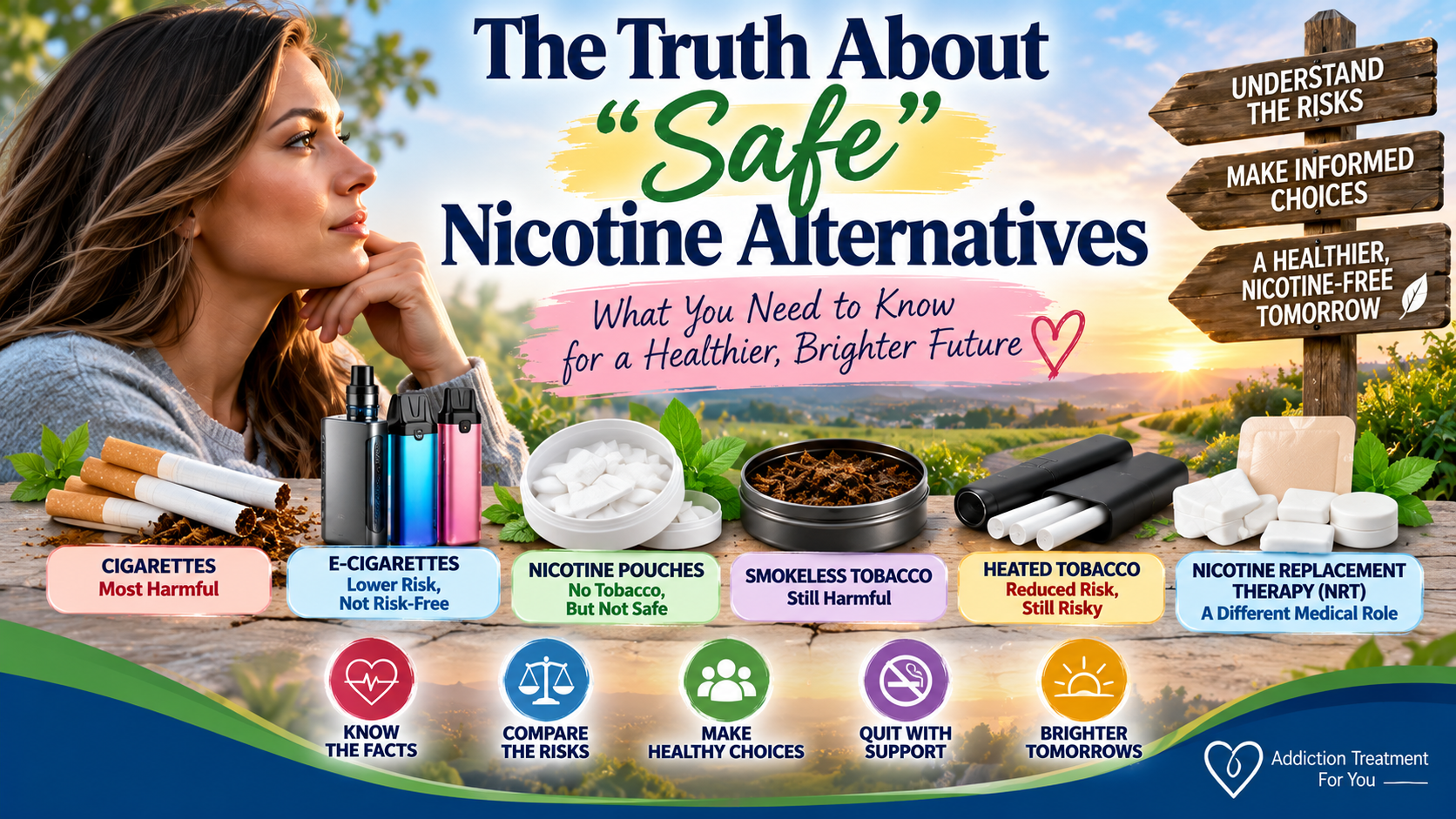
Cigarette smoking is well known for causing cancer, cardiovascular disease, lung disease, and premature death. As awareness of these dangers has increased, products such as e-cigarettes, nicotine pouches, heated tobacco, smokeless tobacco, and other nicotine products have often been promoted or perceived as alternatives to cigarettes. But does being safer than smoking mean a product is actually safe?
The answer is no. Risk exists on a spectrum. Some nicotine products may expose users to fewer toxic substances than combustible cigarettes, but that does not make them harmless. At the same time, FDA-approved nicotine-replacement therapies such as patches, gum, and lozenges have an established role in helping adults quit smoking.
Understanding these differences can help people make better-informed decisions about nicotine use and recovery.
Why Cigarettes Are So Dangerous
Nicotine contributes strongly to tobacco dependence, but nicotine is not responsible for most of the cancer and lung disease caused by cigarettes. Burning tobacco creates smoke containing thousands of chemicals, including numerous toxic and cancer-causing substances.
This distinction is important because someone attempting to quit cigarettes may mistakenly believe that every nicotine-containing product carries the same risk.
They do not.
Completely eliminating combustible tobacco provides the greatest health benefit. For people who are not currently using nicotine or tobacco, however, the healthiest option is not to start.
Are E-Cigarettes a Safe Alternative?
E-cigarettes do not burn tobacco in the same way cigarettes do, but their aerosol is not simply harmless water vapor. Depending on the product, users may be exposed to nicotine, ultrafine particles, volatile organic compounds, metals, flavoring chemicals, and other substances.
Potential concerns include:
- Nicotine dependence.
- Exposure to potentially harmful chemicals.
- Cardiovascular effects.
- Respiratory irritation.
- Accidental nicotine poisoning.
- Unknown consequences of very long-term use.
- Increased concern when adolescents and young adults use these products.
For an adult who smokes cigarettes, completely switching away from combustible cigarettes may reduce exposure to many harmful chemicals. However, using cigarettes and e-cigarettes together may preserve significant health risks rather than eliminating them.
What About Nicotine Pouches?
Nicotine pouches have become increasingly popular because they do not require smoking, inhaling aerosol, or spitting tobacco. The pouch sits between the gum and lip while nicotine is absorbed through the mouth.
Because there is no combustion, users avoid many toxins produced by cigarette smoke. But nicotine pouches are not risk-free.
Possible concerns include:
- Nicotine dependence.
- Gum and mouth irritation.
- Increased heart rate and blood pressure.
- Nausea, dizziness, or hiccups.
- Exposure to potentially high nicotine concentrations.
- Accidental ingestion by children.
- Continuing dependence instead of eventually becoming nicotine-free.
Their flavors, small size, and discreet appearance may also make them particularly appealing to younger users.
Smokeless and Heated Tobacco Are Not Harmless
Products such as chewing tobacco, snuff, snus, and heated tobacco are sometimes perceived as safer because they do not produce traditional cigarette smoke.
Reduced exposure to certain toxins does not mean zero exposure.
Smokeless tobacco can expose users to carcinogens and is associated with nicotine dependence and oral-health problems. Heated-tobacco products still contain tobacco and produce emissions containing nicotine and other chemicals.
The safest tobacco product remains no tobacco product.
Nicotine Replacement Therapy Is Different
Nicotine patches, gum, and lozenges deserve an important distinction.
These products were developed specifically to help people stop smoking. They provide nicotine without exposing users to the toxic products created by burning cigarettes and are generally used in controlled doses as part of a quit-smoking strategy.
Nicotine-replacement therapy can:
- Reduce withdrawal symptoms.
- Reduce cigarette cravings.
- Provide nicotine more slowly than cigarettes.
- Help people gradually separate nicotine use from smoking behaviors.
- Increase the likelihood of successfully quitting when used appropriately.
Other evidence-based smoking-cessation medications are also available. A healthcare professional can help determine which approach is appropriate based on medical history and the person’s pattern of tobacco use.
Why Nicotine Can Be Difficult to Quit
Nicotine activates reward pathways in the brain and can reinforce repeated use. With continued exposure, the brain adapts, and stopping can produce withdrawal symptoms.
These may include:
- Strong cravings.
- Irritability.
- Anxiety or restlessness.
- Difficulty concentrating.
- Changes in appetite.
- Sleep disturbances.
- Low mood.
Withdrawal is uncomfortable, but symptoms generally improve with time. Understanding that cravings are temporary can make them easier to manage.
Self-Management Strategies
Breaking nicotine dependence involves more than simply throwing away a product. People often associate nicotine with driving, coffee, work breaks, stress, social situations, or certain emotions.
Helpful self-management strategies include:
- Identify your triggers. Track when, where, and why you use nicotine.
- Create a quit plan. Choose a quit date or develop a structured reduction strategy with professional guidance.
- Change routines. If coffee triggers nicotine use, temporarily change where or when you drink it.
- Delay cravings. Give an urge several minutes before acting on it. Cravings rise and eventually decline.
- Use healthy substitutes. Try sugar-free gum, water, walking, deep breathing, or another activity that keeps your hands and attention occupied.
- Remove nicotine products from your environment.
- Protect sleep and manage stress.
- Celebrate progress. A nicotine-free day, week, or month represents meaningful progress.
- Consider evidence-based cessation treatment. Counseling and approved medications can significantly improve the likelihood of quitting.
A lapse does not have to become a complete return to regular use. Identify what triggered it, adjust the plan, and continue.
Family Support Strategies
Nicotine dependence can be misunderstood by families because the substance is legal and its use may appear routine. Criticism and shame rarely make quitting easier.
Families can help by:
- Asking how they can support the quit attempt.
- Avoiding lectures or ridicule.
- Keeping cigarettes, vapes, and other nicotine products out of shared spaces.
- Recognizing that irritability may temporarily increase during withdrawal.
- Participating in nicotine-free activities together.
- Celebrating progress rather than demanding perfection.
- Encouraging professional cessation treatment.
- Keeping nicotine products safely away from children and pets.
Families should also establish reasonable boundaries. Supporting someone’s recovery does not require purchasing nicotine products or enabling continued use.
Community Support Strategies
People attempting to quit nicotine should not have to depend entirely on willpower.
Community resources can include:
- Primary-care clinicians.
- Pharmacists.
- Tobacco-cessation counselors.
- Behavioral-health professionals.
- Quitlines.
- School and college prevention programs.
- Workplace cessation programs.
- Community health centers.
- Peer-support programs.
Public-health efforts also play an important role by educating people about nicotine dependence, limiting youth access, supporting smoke-free environments, and making evidence-based cessation treatment easier to obtain.
Protecting Adolescents and Young Adults
Nicotine exposure is particularly concerning during adolescence because the brain continues developing into young adulthood. Sweet flavors, attractive packaging, discreet designs, and high nicotine concentrations may make experimentation easier.
Parents should approach suspected nicotine use with conversation rather than immediate punishment.
Ask what product the teenager is using, how frequently they use it, what situations trigger use, and whether they experience cravings or withdrawal. Understanding the pattern makes it easier to develop an appropriate cessation strategy.
Pediatricians and other healthcare professionals can also help families determine appropriate treatment.
Harm Reduction Versus Being Nicotine-Free
Harm reduction recognizes that someone who cannot immediately stop smoking may benefit from reducing exposure to the most dangerous form of tobacco—combustible cigarettes.
However, harm reduction and complete abstinence are not the same goal.
For someone who currently smokes, moving completely away from cigarettes can substantially reduce exposure to harmful combustion products. For someone who does not currently use tobacco or nicotine, starting vaping or nicotine pouches does not provide a health benefit.
The appropriate question is therefore not simply:
“Is this product safe?”
A better question is:
“Compared with what?”
The Bottom Line
No commercial nicotine product is completely risk-free. Cigarettes remain especially dangerous because burning tobacco creates a toxic mixture responsible for enormous preventable illness and death. Some noncombustible nicotine products may expose users to fewer harmful chemicals than cigarettes, but lower risk should never be confused with no risk.
FDA-approved nicotine-replacement therapies are different because they are designed specifically to help people quit smoking and have established evidence supporting their use.
For people trying to become tobacco- or nicotine-free, recovery can involve self-management strategies, family encouragement, community resources, counseling, and evidence-based medications.
The goal is not to shame someone for using nicotine. The goal is to understand dependence, compare risks accurately, provide effective treatment, and help each person move toward better health—one decision at a time.
Frequently Asked Questions
Here are some common questions:
1. Are there any completely safe nicotine products?
No nicotine product is completely risk-free. However, risks vary considerably. Combustible cigarettes are especially dangerous because burning tobacco produces toxic and cancer-causing chemicals. FDA-approved nicotine replacement therapies (NRT), such as patches, gum, and lozenges, have a different role because they are designed to help people stop smoking.
2. Are e-cigarettes safer than cigarettes?
E-cigarettes generally expose users to fewer harmful chemicals than combustible cigarettes, but this does not make vaping harmless. E-cigarette aerosol can contain nicotine, ultrafine particles, metals, volatile chemicals, and other potentially harmful substances. Long-term health effects are still being studied.
3. Is vaping just harmless water vapor?
No. E-cigarettes produce an aerosol, not harmless water vapor. The aerosol can contain nicotine and other chemicals that users inhale into their lungs.
4. Are nicotine pouches safe because they do not contain tobacco?
Nicotine pouches avoid tobacco combustion, but they are not risk-free. They can cause nicotine dependence and may produce mouth or gum irritation, nausea, dizziness, hiccups, and cardiovascular effects. Some products also contain substantial amounts of nicotine.
5. Are nicotine pouches safer than cigarettes?
Because nicotine pouches do not burn tobacco, they avoid many toxic substances produced by cigarette smoke. That does not mean they are harmless. The risk comparison is especially important: switching completely from cigarettes may reduce exposure to combustion-related toxins, while starting nicotine pouches when you previously used no nicotine creates unnecessary exposure and risk of dependence.
6. Is smokeless tobacco a safe substitute for cigarettes?
No. Chewing tobacco, snuff, and similar products can cause nicotine dependence and expose users to carcinogens. They are also associated with oral and dental health problems.
7. What about heated-tobacco products?
Heated-tobacco products heat tobacco rather than burning it like a conventional cigarette. They may reduce exposure to certain harmful chemicals compared with cigarette smoke, but they still expose users to nicotine and potentially harmful substances. Reduced exposure does not mean zero risk.
8. Is nicotine what causes most smoking-related cancers?
Nicotine is primarily responsible for maintaining tobacco dependence, but it is not the main cause of most smoking-related cancers. Many of the greatest dangers of cigarettes come from toxic chemicals created when tobacco burns.
9. Why is nicotine addictive?
Nicotine affects brain reward pathways and can reinforce repeated use. With continued exposure, the brain adapts. When nicotine is stopped, withdrawal symptoms such as cravings, irritability, restlessness, difficulty concentrating, sleep problems, and low mood may occur.
10. Is nicotine especially concerning for teenagers?
Yes. Adolescence is an important period of brain development, and nicotine exposure can lead to dependence. Young people may also be attracted to products because of flavors, discreet designs, social influences, and misconceptions that non-cigarette nicotine products are harmless.
11. What is nicotine replacement therapy?
Nicotine replacement therapy, or NRT, provides controlled amounts of nicotine without exposing someone to cigarette smoke. Common forms include nicotine patches, gum, and lozenges. These products are designed to reduce withdrawal symptoms and cravings while helping people quit smoking.
12. Is nicotine replacement therapy safer than smoking?
For adults who smoke, FDA-approved NRT is substantially safer than continuing to smoke cigarettes because it avoids the toxic products of tobacco combustion. Use it according to product directions or healthcare guidance.
13. Is using nicotine gum the same as using nicotine pouches?
No. Although both can deliver nicotine through the mouth, nicotine gum is an FDA-approved smoking-cessation medication with established dosing instructions. Commercial nicotine pouches are consumer nicotine products and should not automatically be considered smoking-cessation medications.
14. What does “harm reduction” mean with nicotine?
Harm reduction involves reducing exposure to the most dangerous aspects of tobacco use when immediate abstinence is not achievable. For someone who smokes cigarettes, completely moving away from combustible tobacco can reduce exposure to many harmful chemicals. The eventual goal may still be freedom from tobacco or nicotine.
15. Is smoking and vaping at the same time a good strategy?
Dual use may not provide the health improvement someone expects, particularly when cigarette smoking continues. Completely stopping combustible cigarettes provides much greater benefit than simply adding another nicotine product while continuing to smoke.
16. What self-management strategies can help someone quit nicotine?
Identify triggers, establish a quit plan, remove nicotine products from the environment, change routines associated with nicotine, exercise, protect sleep, manage stress, and develop alternatives for cravings. Evidence-based medications and counseling can further improve the chances of quitting successfully.
17. How can family members support someone trying to quit?
Families can listen without judgment, avoid criticism, keep nicotine products out of shared spaces, recognize that withdrawal may temporarily cause irritability, encourage professional help, participate in nicotine-free activities, and celebrate progress rather than expecting perfection.
18. What community resources can help someone quit?
Primary-care professionals, pharmacists, tobacco-treatment specialists, behavioral-health professionals, quitlines, community health centers, workplace cessation programs, and support groups can all help. Combining behavioral support with appropriate cessation medication can be particularly effective.
19. What happens if someone slips and uses nicotine after quitting?
A lapse does not erase previous progress. Instead of seeing it as a complete failure, identify the trigger, decide what you could handle differently next time, and return to the quit plan. Tobacco dependence often requires repeated attempts before long-term abstinence is achieved.
20. Should someone who has never smoked start vaping or using nicotine pouches because they are safer than cigarettes?
No. A product being less harmful than cigarettes does not create a health benefit for someone who does not currently use nicotine. For non-users, the healthiest choice is not to start.
21. What is the most important message about “safe” nicotine alternatives?
Think in terms of relative risk rather than simply “safe” or “dangerous.” Cigarettes are particularly harmful because of tobacco combustion. Some noncombustible products may present lower risks, but lower risk is not the same as harmless. FDA-approved cessation medications occupy a different category because they are specifically intended to help people quit.
22. What is the ultimate goal?
For someone who smokes, the immediate priority is eliminating combustible cigarette use. For many people, the longer-term goal can be freedom from tobacco and nicotine dependence altogether. Treatment, education, family encouragement, and community support can make that goal more achievable.
Video: Don’t Get Fooled by ‘Safe’ Nicotine Products #facts #health