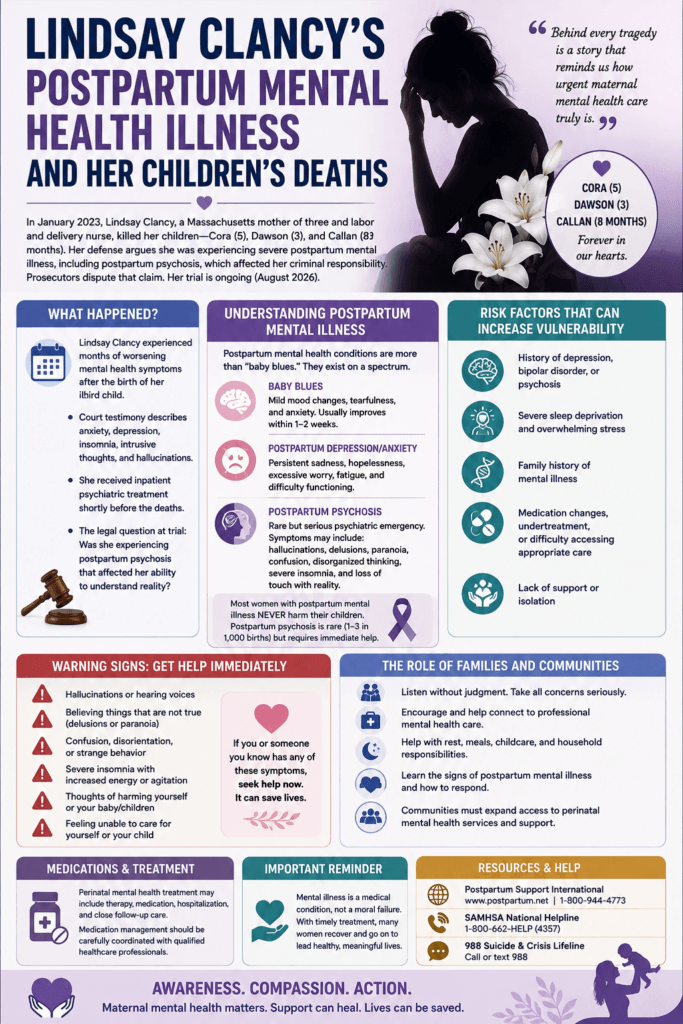
The Lindsay Clancy case has drawn national attention to severe postpartum mental illness following the tragic deaths of her three young children in Massachusetts in January 2023. The case has raised difficult questions about postpartum depression, postpartum psychosis, psychiatric treatment, medication management, family awareness, and the healthcare system’s ability to recognize a rapidly developing psychiatric crisis. Clancy’s defense has argued that severe postpartum mental illness affected her mental state and criminal responsibility, while prosecutors have disputed that explanation. Because the legal proceedings and competing interpretations of her condition must be distinguished from established facts, the tragedy should not be reduced to a simple claim that postpartum mental illness caused the deaths. Instead, the case provides an opportunity to increase awareness of severe postpartum psychiatric symptoms and the importance of timely professional intervention.
Lindsay Clancy: Mental Health, Psychiatric Medications, and the Deaths of Her Children
The Lindsay Clancy case is a devastating example of why severe postpartum mental illness requires rapid recognition, careful assessment, and coordinated treatment. Clancy, a Massachusetts mother and labor-and-delivery nurse, is charged with killing her three children—Cora, 5, Dawson, 3, and Callan, 8 months—in January 2023. Her criminal trial is ongoing in August 2026. Her defense acknowledges that she killed the children but argues that she was not criminally responsible because she was experiencing severe postpartum mental illness, including postpartum psychosis. Prosecutors dispute that characterization, arguing that her actions were intentional and planned.
Mental Health Problems Before the Tragedy
Evidence presented in the case describes months of significant psychiatric symptoms following the birth of Clancy’s third child. She sought professional help for symptoms that included anxiety, depression, insomnia, hopelessness, intrusive thoughts, and eventually reported hallucinations. She also received inpatient psychiatric treatment shortly before the deaths. Her diagnosis and mental state at the time of the killings remain central disputed issues in the trial.
Postpartum psychosis is different from ordinary postpartum emotional changes and postpartum depression. It is a rare psychiatric emergency that can involve hallucinations, delusions, paranoia, severe confusion, disorganized thinking, and loss of contact with reality. Although most people experiencing postpartum mental health conditions never harm themselves or their children, untreated psychosis can create an emergency in which safety is seriously compromised.
Psychiatric Medications and the Question of Addiction
The medication history in this case is complicated. A Boston Globe review of court records found that Clancy was prescribed 13 different psychiatric medications and received more than 30 prescriptions during the four months preceding the children’s deaths. These included antidepressants, antipsychotics, benzodiazepines, sedating medications, and a mood stabilizer. However, medications were repeatedly started, stopped, or adjusted, so this does not mean she was simultaneously taking all 13 medications.
It is also important not to state as established fact that “addiction caused her to kill her children.” There has been concern in the case about benzodiazepine dependence or addiction, and testimony has addressed Clancy’s own worries about becoming addicted to certain medications. Her defense has also argued that overmedication and psychiatric treatment contributed to her deterioration. But these claims are disputed, and the evidence does not establish a simple causal chain of medication addiction → homicide.
Postpartum Psychosis and Criminal Responsibility
A psychologist who treated Clancy after the deaths testified for the defense that she had bipolar disorder and postpartum psychosis and was not criminally responsible at the time of the killings. Prosecutors have challenged that conclusion and presented evidence they argue demonstrates planning, awareness, and purposeful behavior. Ultimately, whether Clancy met Massachusetts’ legal standard for lack of criminal responsibility is a question for the jury—not something that can be concluded solely from a psychiatric diagnosis.
Lessons for Maternal Mental Health Care
The case highlights several broader issues:
- Severe postpartum psychiatric symptoms require urgent assessment.
- Hallucinations, delusions, severe confusion, suicidal thinking, or thoughts of harming a baby or child should be treated as emergencies.
- Multiple psychiatric medications and prescribers require careful medication reconciliation and coordination.
- Families should communicate significant behavioral changes to healthcare professionals.
- Postpartum mental healthcare should extend beyond routine screening for depression and include awareness of less common but potentially severe conditions such as postpartum psychosis.
- Mental illness should not automatically be equated with violence. The overwhelming majority of people with mental illness do not kill their children or other people.
The Larger Message
The deaths of Cora, Dawson, and Callan Clancy should not be reduced to a simple story that psychiatric medications, addiction, or postpartum depression alone caused the tragedy. The evidence being examined in court involves severe mental illness, possible postpartum psychosis, extensive psychiatric treatment, numerous medication changes, questions about care coordination, and disputed questions of criminal responsibility.
The most important public-health lesson is the need to recognize severe postpartum psychiatric deterioration early and respond aggressively when symptoms suggest psychosis or danger. Postpartum psychosis is a medical emergency, but with prompt psychiatric treatment, recovery is possible.
Self-Management Strategies to Understand Lindsay Clancy’s Postpartum Mental Health Illness and Her Children’s Deaths
The Lindsay Clancy case can be used to increase awareness of severe postpartum mental illness, but it is important to avoid concluding that postpartum mental illness automatically leads to violence. Clancy killed her three children in January 2023; at her ongoing 2026 trial, her defense argues that postpartum psychosis and other severe mental illness made her not criminally responsible, while prosecutors dispute that conclusion.
Learn the Difference Between Postpartum Conditions
Understanding the spectrum of postpartum mental health conditions can help people recognize when symptoms have progressed beyond ordinary adjustment difficulties.
- Learn the difference between the “baby blues,” postpartum depression, anxiety, bipolar disorder, and postpartum psychosis.
- Recognize postpartum psychosis as a rare but serious psychiatric emergency.
- Understand that psychosis can involve hallucinations, delusions, paranoia, confusion, disorganized behavior, severe insomnia, and impaired insight.
- Remember that most people experiencing postpartum mental health conditions do not harm their children.
The American College of Obstetricians and Gynecologists describes postpartum psychosis as rare—about 1–3 cases per 1,000 births—and requiring immediate psychiatric help.
Recognize Significant Changes Early
Self-awareness is especially important when symptoms begin changing rapidly.
- Track significant changes in mood, anxiety, sleep, thinking, and behavior.
- Take severe insomnia seriously, particularly when accompanied by unusual thinking or behavioral changes.
- Do not dismiss hallucinations, paranoia, severe confusion, or loss of contact with reality.
- Tell healthcare professionals about thoughts of suicide, harming oneself, or harming a child.
- Encourage trusted family members to speak up when they notice dramatic changes.
Keep a Mental Health Symptom Record
During periods of significant postpartum distress, keeping a simple record can help clinicians understand how symptoms are developing.
Record:
- Hours of sleep.
- Anxiety and mood changes.
- Intrusive or frightening thoughts.
- Medication changes.
- Unusual beliefs or perceptions.
- Hallucinations or severe confusion.
- Thoughts of self-harm or harming others.
Clancy’s case has included evidence describing substantial mental health deterioration, including insomnia and thoughts of harming herself, before the children’s deaths.
Understand Intrusive Thoughts Versus Psychosis
Not every frightening thought means someone will act on it. Intrusive thoughts can occur with postpartum anxiety or depression and may be deeply upsetting to the person experiencing them.
Psychosis is different because an individual may lose the ability to accurately interpret reality. Delusions or hallucinations can make situations appear real when they are not. ACOG specifically recommends immediate medical attention when postpartum psychosis is suspected.
Monitor Medications Carefully
Postpartum psychiatric treatment can involve medications, and medication management should be coordinated with qualified clinicians.
- Keep an updated medication list.
- Know why each medication was prescribed.
- Take medications according to medical instructions.
- Report significant side effects or behavioral changes.
- Do not abruptly discontinue psychiatric medication without clinical guidance.
- Make sure different healthcare professionals know what other medications are being taken.
Medication treatment is an important component of managing many perinatal psychiatric conditions, but treatment should be individualized and monitored.
Protect Sleep
Sleep disruption can be particularly important in severe postpartum psychiatric illness.
- Establish regular opportunities for uninterrupted sleep.
- Accept assistance with nighttime childcare when available.
- Tell a clinician when severe insomnia persists despite exhaustion.
- Pay particular attention when reduced sleep occurs alongside agitation, unusual energy, confusion, paranoia, or hallucinations.
Create an Emergency Safety Plan
Someone experiencing severe postpartum psychiatric symptoms should not be expected to manage the situation entirely through self-help.
A safety plan can identify trusted people to contact, the treating clinician, the nearest emergency department, childcare arrangements, and what family members should do if symptoms rapidly worsen. When psychosis, suicidal intent, or immediate danger to a child is suspected, emergency psychiatric evaluation is necessary.
Avoid Stigma and Overgeneralization
The Clancy case is extraordinarily serious, but it should not create the impression that mothers with postpartum depression or other mental illnesses are dangerous. Postpartum psychosis is uncommon, and treatment can be effective. A recent AP report highlighting the Clancy case also describes recovery from postpartum psychosis with psychiatric treatment and family support.
Turn the Tragedy Into Awareness
The strongest self-management lesson from this case is not that postpartum illness inevitably causes violence. Dramatic changes in sleep, thinking, perception, mood, or safety require attention.
Recognizing symptoms, documenting changes, communicating openly with clinicians, involving supportive family members, following treatment recommendations, and responding urgently to psychosis can help protect both mother and children. Postpartum psychosis is a psychiatric emergency—but it is also a treatable condition, and early recognition can make a critical difference.
Family Support Strategies to Understand Lindsay Clancy’s Postpartum Mental Health Illness and Her Children’s Deaths
The Lindsay Clancy case highlights the importance of families recognizing severe changes in a mother’s mental health after childbirth and knowing when ordinary emotional support is no longer enough. Clancy killed her three children in January 2023. At her ongoing August 2026 trial, her defense argues that postpartum psychosis and other severe mental illness affected her criminal responsibility, while prosecutors dispute that she was psychotic at the time.
Learn the Warning Signs of Postpartum Psychosis
Families should understand the difference between postpartum depression and postpartum psychosis. Postpartum psychosis is rare but extremely serious and can involve hallucinations, delusions, paranoia, confusion, disorganized thinking, and poor insight. It requires immediate medical attention.
- Learn about postpartum depression, anxiety, bipolar disorder, and psychosis before a crisis develops.
- Take hallucinations, delusions, severe confusion, paranoia, or dramatic behavioral changes seriously.
- Pay attention to severe or rapidly changing symptoms.
- Do not assume unusual behavior is simply exhaustion or the normal stress of having a new baby.
Listen When a Mother Says Something Is Wrong
Family members are often among the first people to notice changes. Testimony in Clancy’s current trial has described family members observing significant mental health difficulties and her seeking help before the children’s deaths.
- Take statements about suicide or harming oneself or others seriously.
- Listen without immediately criticizing or dismissing frightening thoughts.
- Encourage honest communication about hallucinations, unusual beliefs, or severe anxiety.
- Help communicate important observations to healthcare professionals.
Pay Attention to Sleep
Severe sleep disruption can accompany serious postpartum psychiatric illness.
- Help provide opportunities for restorative sleep.
- Share nighttime childcare responsibilities when possible.
- Watch for a mother who sleeps very little yet becomes increasingly confused, agitated, unusually energetic, or disconnected from reality.
- Report dramatic sleep and behavioral changes to clinicians.
Help Coordinate Professional Care
Severe postpartum illness can make organizing treatment overwhelming.
- Help schedule and attend appointments when welcomed.
- Maintain an accurate medication and treatment list.
- Make sure clinicians are aware of major behavioral changes.
- Encourage communication among obstetric, primary care, psychiatric, and other treating professionals.
- Help with transportation, childcare, meals, and household responsibilities.
NIMH specifically identifies practical support, help attending appointments, and encouragement to communicate with healthcare professionals as important ways families can assist someone experiencing perinatal depression.
Develop a Family Safety Plan
Families should establish in advance what they will do if symptoms become dangerous.
- Identify which clinician or treatment program to contact.
- Decide who can temporarily care for the children.
- Know where emergency psychiatric evaluation is available.
- Do not leave a severely psychotic person solely responsible for children until professionally evaluated.
- Treat immediate threats of suicide or harm to a child as emergencies.
ACOG recommends immediate medical attention when postpartum psychosis is suspected and immediate risk assessment when someone reports self-harm or suicidal thoughts.
Avoid Blaming All Mothers With Postpartum Illness
The Clancy case is an extreme tragedy and should not be used to suggest that postpartum depression or other maternal mental illnesses normally lead to violence. Postpartum psychosis itself is rare, and recovery is possible with appropriate treatment. A mother who recently described her own postpartum psychosis publicly reported recovering with hospitalization, medication, and strong family support.
Support Recovery After a Psychiatric Crisis
Family involvement should continue after immediate symptoms improve.
- Encourage continued psychiatric follow-up.
- Help maintain medication and therapy routines when prescribed.
- Support adequate sleep and reduced stress.
- Watch for recurrence of concerning symptoms.
- Encourage the mother to communicate openly rather than hide symptoms because of shame or fear.
- Recognize that recovery may require substantial time and ongoing professional care.
The family lesson from the Lindsay Clancy tragedy is not that relatives should be expected to diagnose postpartum psychosis themselves. Families can instead learn the warning signs, believe significant changes are worth investigating, communicate observations to clinicians, help protect children during a severe psychiatric crisis, and obtain emergency evaluation when reality testing or safety deteriorates. Postpartum psychosis is a psychiatric emergency, but early recognition, professional treatment, and strong family involvement can contribute to recovery.
Community Resource Strategies to Understand Lindsay Clancy’s Postpartum Mental Health Illness and Her Children’s Deaths
The Lindsay Clancy case has brought national attention to postpartum psychosis and gaps that can occur in maternal mental healthcare. Her defense argues that severe postpartum mental illness affected her criminal responsibility for the deaths of her three children, while prosecutors dispute that position; her trial remains ongoing. The case should therefore be used for education without assuming that every disputed clinical or legal claim has been established.
Maternal Mental Health Education Programs
Communities can increase awareness of postpartum depression, anxiety, bipolar disorder, and postpartum psychosis.
- Provide prenatal and postpartum mental health education.
- Teach families to recognize hallucinations, delusions, paranoia, severe confusion, unusual behavior, and extreme sleep disturbance.
- Explain the differences between postpartum depression and postpartum psychosis.
- Emphasize that postpartum psychosis is rare but constitutes a psychiatric emergency.
- Reduce stigma surrounding mothers who disclose frightening psychiatric symptoms.
The American College of Obstetricians and Gynecologists states that postpartum psychosis requires immediate psychiatric help and usually hospitalization.
Hospitals and Obstetric Healthcare Systems
Healthcare systems can strengthen the connection between obstetric and psychiatric care.
- Screen for perinatal mental health conditions.
- Develop procedures for rapidly evaluating severe psychiatric symptoms.
- Coordinate obstetric, primary care, psychiatric, and pediatric services.
- Improve communication during transitions between inpatient and outpatient care.
- Educate clinicians about postpartum psychosis and bipolar-spectrum symptoms.
- Establish clear emergency referral pathways.
ACOG provides clinical resources specifically designed to improve detection, assessment, and treatment of perinatal mental health conditions.
Community Mental Health Centers
Community behavioral health organizations can provide important follow-up after delivery.
- Offer psychiatric evaluations.
- Provide psychotherapy and medication management.
- Establish rapid-access appointments for postpartum psychiatric symptoms.
- Coordinate care after psychiatric hospitalization.
- Include partners and families in treatment when appropriate.
- Connect mothers with higher levels of care when symptoms become severe.
Postpartum Support Organizations
Postpartum Support International provides education, peer support, provider referrals, support groups, and specialized resources for postpartum psychosis. Its Postpartum Psychosis Task Force also brings together professionals and people with lived experience to improve education and awareness.
Communities can use organizations like this to connect families with:
- Postpartum mental health education.
- Peer-support groups.
- Local support coordinators.
- Provider directories.
- Postpartum psychosis resources.
- Support for partners and other family members.
Emergency and Crisis Services
Communities need clear pathways for situations involving psychosis or immediate safety concerns. Postpartum Support International advises that someone experiencing active postpartum psychosis should not be left alone with a child and should receive emergency assistance because impaired reality testing can create safety risks.
Hospitals, emergency departments, psychiatric crisis teams, obstetric practices, and community mental health organizations should therefore have procedures for rapidly evaluating severe postpartum psychiatric symptoms.
Family and Caregiver Education
Community programs should educate partners, grandparents, relatives, and other caregivers—not only mothers.
Families can learn how to recognize behavioral changes, communicate observations to clinicians, support adequate sleep, assist with childcare, keep medication information organized, and respond appropriately when someone’s ability to interpret reality appears impaired.
Peer-Support Programs
Survivors of postpartum psychosis can provide perspectives that clinical education alone cannot offer. Peer programs can reduce isolation and show families that severe postpartum psychiatric illness can be treated.
Postpartum Support International offers specialized support groups and access to people with lived experience of postpartum psychosis.
Professional Training
Communities can also invest in education for physicians, PAs, nurses, midwives, therapists, social workers, emergency clinicians, and other professionals.
Training should emphasize recognizing psychosis, assessing safety, distinguishing different postpartum psychiatric conditions, coordinating medications and care, involving families appropriately, and knowing when emergency psychiatric evaluation is necessary.
Use the Clancy Case Carefully
Community education should avoid presenting the tragedy as evidence that mothers with postpartum mental illness are generally dangerous. Most individuals experiencing postpartum psychosis do not harm themselves or anyone else, and recovery is possible. Recent reporting prompted by the Clancy trial has highlighted survivors who recovered through psychiatric treatment and strong family support.
The larger community lesson from the Lindsay Clancy case is the importance of building a maternal mental health safety net. Obstetric providers, hospitals, mental health professionals, pediatric practices, peer-support organizations, families, and emergency services should be able to recognize severe symptoms and communicate with one another before a psychiatric crisis escalates. The goal is not to associate postpartum mental illness with violence, but to make sure that mothers experiencing severe symptoms receive timely, coordinated, and appropriate care.
Frequently Asked Questions
Here are some common questions:
1. Who is Lindsay Clancy?
Lindsay Clancy is a Massachusetts mother and former labor-and-delivery nurse who killed her three children—Cora, Dawson, and Callan—in January 2023. She has pleaded not guilty to murder charges, and her criminal trial remains ongoing as of August 2026.
2. Did Lindsay Clancy experience mental health problems before the deaths?
Evidence presented at trial describes significant psychiatric difficulties in the months before the deaths. Family members testified about severe anxiety, paranoia, insomnia, suicidal thinking, and concerns about harming her children. She also sought psychiatric treatment before the tragedy.
3. What is postpartum psychosis?
Postpartum psychosis is a rare and severe psychiatric condition that can develop after childbirth. Symptoms can include hallucinations, delusions, paranoia, confusion, disorganized thinking, dramatic mood changes, and loss of contact with reality. It requires urgent psychiatric evaluation.
4. Did Lindsay Clancy have postpartum psychosis?
That remains a central point of contention in her trial. Defense experts have testified that she experienced postpartum psychosis and severe mental illness. Prosecutors dispute that conclusion and have presented testimony that her treating clinicians did not observe psychosis or mania before the killings.
5. What does Clancy’s defense argue?
Her attorneys acknowledge that she killed the children but argue that severe postpartum mental illness prevented her from appreciating the wrongfulness of her actions or being criminally responsible under Massachusetts law.
6. What do prosecutors argue?
Prosecutors contend that Clancy intentionally planned and carried out the killings and understood what she was doing. They have challenged the defense’s postpartum psychosis explanation and presented evidence they say demonstrates purposeful behavior.
7. Did Clancy seek help before the tragedy?
Yes. Evidence presented at trial indicates that she contacted multiple healthcare professionals, received psychiatric treatment, sought emergency assistance, and was psychiatrically hospitalized. Her defense argues that her care was fragmented, while prosecutors emphasize that she had access to substantial mental healthcare.
8. Were psychiatric medications involved?
Clancy received multiple psychiatric medications during the months preceding the deaths, and medication management has become an important issue at trial. Her defense has raised concerns about overmedication and fragmented prescribing, while prosecutors have emphasized that she sometimes did not follow treatment recommendations. These disputes do not establish that psychiatric medications caused the killings.
9. Was prescription medication addiction responsible for the children’s deaths?
That has not been established. Evidence has shown that Clancy worried about becoming dependent on or addicted to some medications, but it would be inaccurate to conclude that medication addiction caused the deaths. The case involves much broader and disputed questions concerning severe mental illness, medication treatment, and criminal responsibility.
10. What warning signs had family members observed?
Family testimony has described worsening anxiety, paranoia, severe insomnia, suicidal thoughts, fear of being alone, and thoughts about harming her children. These types of major psychiatric changes warrant professional assessment, particularly during the postpartum period.
11. Does postpartum depression usually progress to postpartum psychosis?
No. Postpartum depression and postpartum psychosis are different conditions, although symptoms can sometimes overlap and diagnostic evaluation can be complex. Experiencing postpartum depression does not mean a mother will develop psychosis.
12. Does postpartum mental illness make mothers dangerous to their children?
No. Most mothers experiencing postpartum depression, anxiety, or other mental health conditions do not harm their children. The Clancy case is an extreme tragedy and should not be generalized to millions of women experiencing treatable postpartum mental health problems.
13. Why is sleep important in postpartum mental health?
Severe sleep disruption can accompany or worsen psychiatric instability, particularly in individuals vulnerable to bipolar-spectrum illness or psychosis. Persistent inability to sleep combined with confusion, unusual energy, paranoia, hallucinations, or dramatic behavioral changes deserves urgent medical attention.
14. Can postpartum psychosis be treated?
Yes. Postpartum psychosis is a psychiatric emergency, but recovery is possible. Treatment may involve hospitalization, psychiatric medication, protection of sleep, close monitoring, and ongoing psychiatric and family support. Recent coverage of the Clancy trial has also highlighted women who experienced postpartum psychosis and recovered with treatment.
15. What should families do if a mother reports hallucinations or delusions?
Take the symptoms seriously and obtain urgent professional evaluation. A person experiencing psychosis may have an impaired ability to recognize that something is wrong, so family observations can be particularly important.
16. Why shouldn’t families wait for symptoms to become severe?
Postpartum psychiatric conditions can sometimes deteriorate rapidly. Early intervention gives clinicians an opportunity to evaluate symptoms, protect the mother and children, establish treatment, and determine whether hospitalization or another intensive level of care is necessary.
17. What does the Lindsay Clancy case teach healthcare professionals?
The case raises important questions about recognizing severe postpartum psychiatric symptoms, medication management, communication among clinicians, transitions between levels of care, family involvement, and responding when a patient reports suicidal or child-harm thoughts. However, conclusions about whether specific failures caused this tragedy should await the legal and evidentiary findings.
18. What is the most important lesson from this tragedy?
The broader lesson is awareness without stigma. Severe postpartum psychiatric symptoms should never be dismissed, but postpartum mental illness should not automatically be associated with violence. Families and healthcare professionals should recognize major changes in sleep, mood, thinking, perception, and behavior and respond quickly when safety or reality testing becomes compromised.
Conclusion
The deaths of Lindsay Clancy’s children represent a devastating tragedy, but the case also emphasizes the importance of recognizing severe postpartum psychiatric deterioration before a crisis escalates. Hallucinations, delusions, severe confusion, dramatic behavioral changes, extreme sleep disturbance, suicidal thinking, or thoughts of harming others require urgent professional assessment. Families and communities can help by reducing stigma, listening when mothers report frightening symptoms, supporting coordinated maternal mental healthcare, and establishing clear pathways to emergency psychiatric services. At the same time, postpartum mental illness should never be broadly equated with violence; most mothers experiencing postpartum depression or other psychiatric conditions do not harm their children. Greater awareness, early identification, appropriate treatment, family involvement, and coordinated healthcare can help protect mothers and children while supporting recovery from serious postpartum mental illness.
Video: Lindsay Clancy’s Descent into Madness #postpartumpsychosis #truecrime