A toxic workplace can affect far more than an employee’s job satisfaction. Persistent bullying, harassment, discrimination, intimidation, retaliation, and emotional manipulation can create an unhealthy environment that damages mental health, relationships, productivity, and professional confidence. In some situations, toxic workplace behavior can also lead to serious legal consequences for employees, supervisors, and employers.
However, not every unpleasant or unfair workplace experience is illegal. Understanding the difference between inappropriate conduct and unlawful behavior is essential for protecting employee rights and determining when legal action may be appropriate.
Toxic work environments can contribute to chronic stress, anxiety, depression, sleep disturbances, and unhealthy coping behaviors, including excessive alcohol or substance use. Employees may feel trapped between protecting their financial security and preserving their emotional well-being.
This article explores the legal consequences of toxic workplace behavior in the United States, along with practical self-management, family support, and community strategies to help affected individuals protect their rights, improve their mental health, and rebuild professional confidence.
Understanding Toxic Behavior in the Workplace
Toxic workplace behavior refers to repeated or serious actions that undermine an employee’s psychological safety, dignity, or ability to perform their job effectively.
Examples include:
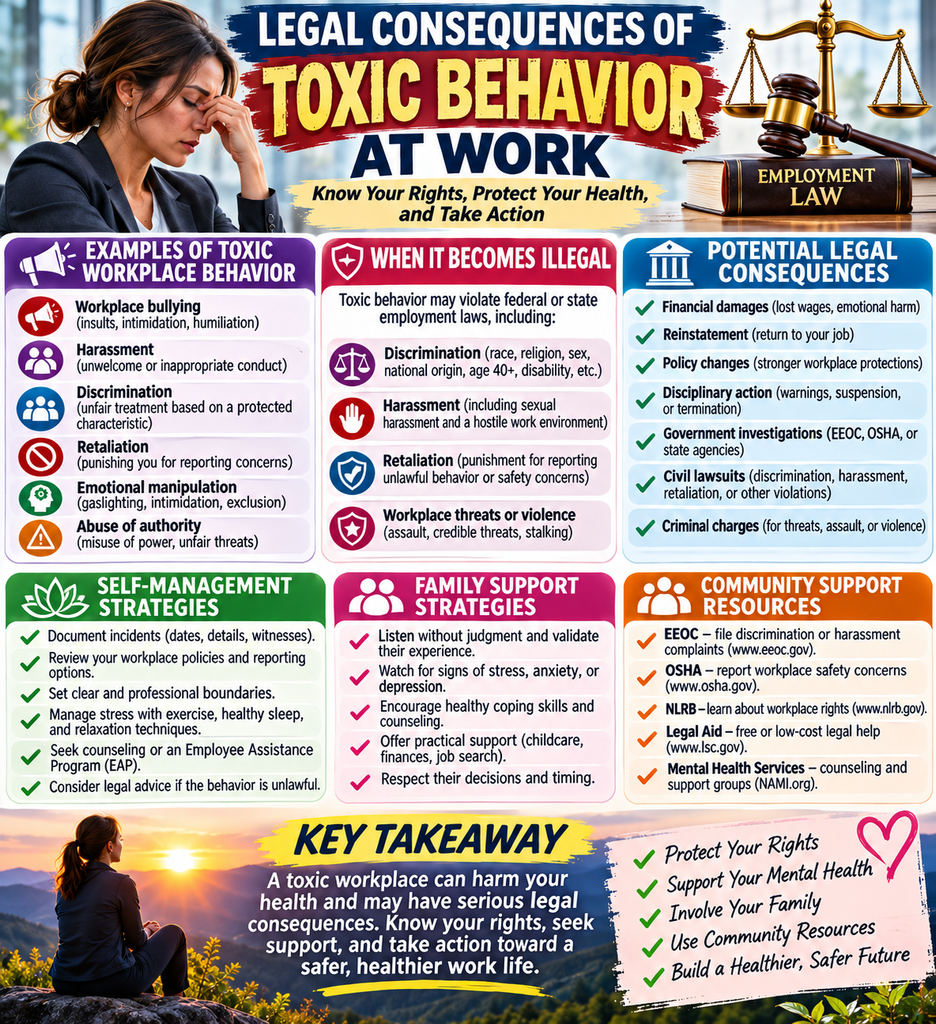
- Workplace bullying: Repeated humiliation, insults, threats, or deliberate intimidation.
- Sexual harassment: Unwelcome sexual advances, inappropriate comments, or conduct creating an unlawfully hostile work environment.
- Discrimination: Adverse treatment based on legally protected characteristics such as race, religion, sex, national origin, age, or disability.
- Retaliation: Punishing employees for engaging in legally protected activities, such as reporting discrimination.
- Emotional manipulation: Gaslighting, deliberate exclusion, or undermining an employee’s confidence.
- Abuse of authority: Supervisors using their positions to intimidate, threaten, or unfairly control employees.
- Workplace sabotage: Intentionally withholding essential information, interfering with assignments, or damaging someone’s professional reputation.
Although these behaviors may be harmful, their legal consequences depend on the circumstances, applicable laws, and available evidence.
When Does Toxic Workplace Behavior Become Illegal?
Under U.S. employment law, toxic conduct may become unlawful when it violates federal, state, or local workplace protections.
Discrimination and harassment
Federal laws enforced by the Equal Employment Opportunity Commission (EEOC) prohibit certain forms of employment discrimination and harassment.
Protected characteristics under various federal laws include:
- Race and color
- Religion
- Sex, including pregnancy, sexual orientation, and transgender status, subject to applicable law and current legal interpretation
- National origin
- Age 40 or older
- Disability
- Genetic information
For example, repeatedly targeting an employee with severe racial insults may constitute unlawful harassment.
Unlawful hostile-work-environment harassment generally involves unwelcome conduct connected to a legally protected characteristic that is sufficiently severe or pervasive to alter employment conditions. A single extremely serious incident can sometimes meet that standard.
Workplace retaliation
Retaliation may occur when an employer takes materially adverse action against someone because they engaged in protected activity.
Examples include:
- Demoting an employee after a discrimination complaint
- Reducing work hours to punish legally protected reporting
- Threatening termination after participation in an EEOC investigation
- Assigning punitive duties because an employee requested a legally protected accommodation
Not every workplace complaint receives the same legal protection. Whether retaliation is unlawful depends on what was reported, the law involved, and the circumstances.
Workplace threats and violence
Physical assault, credible threats, stalking, and certain forms of intimidation may violate criminal laws or create civil liability.
Employers may also have occupational safety obligations when workplace violence creates recognized hazards.
Legal Consequences for Employers and Employees
Toxic workplace conduct that violates applicable laws can result in significant consequences.
| Potential consequence | How it may apply |
|---|---|
| Financial damages | Compensation for lost wages, emotional harm, or other legally recoverable losses |
| Reinstatement | Returning an unlawfully terminated employee to their position |
| Policy changes | Required improvements to harassment prevention, reporting, or workplace procedures |
| Disciplinary action | Warnings, suspension, or termination of employees responsible for misconduct |
| Government investigations | Reviews by the EEOC, OSHA, or state enforcement agencies |
| Civil lawsuits | Legal claims involving discrimination, retaliation, assault, or other actionable misconduct |
| Criminal charges | Possible prosecution for conduct such as assault, stalking, or criminal threats |
Punitive damages may be available in some cases, subject to legal restrictions. Individual supervisors can also face personal liability under certain state laws or legal claims, although federal employment discrimination laws generally impose liability on employers rather than individual supervisors.
Important: The availability of remedies depends on the jurisdiction, the specific legal claim, employer coverage, and the facts of the case.
Mental Health Consequences of Toxic Workplace Environments
Toxic workplace experiences can cause significant psychological and physical stress.
Employees may experience:
- Persistent anxiety or fear before work
- Depression, hopelessness, or reduced self-esteem
- Difficulty sleeping and chronic fatigue
- Headaches, muscle tension, and digestive problems
- Emotional exhaustion and occupational burnout
- Social withdrawal and relationship conflicts
- Increased reliance on alcohol, cannabis, sedatives, or other substances to manage distress
Chronic stress can activate physiological stress-response systems, contributing to sleep disruption, heightened arousal, and difficulty regulating emotions.
Although workplace stress can worsen existing mental health conditions, exposure to a toxic environment does not automatically establish a psychiatric diagnosis.
Individuals experiencing persistent symptoms should consider an assessment by a qualified healthcare or mental health professional.
Self-Management Strategies: Protecting Yourself From Workplace Toxicity
Employees can take proactive steps to protect their mental health, document concerning behavior, and evaluate available options.
Document workplace incidents
Maintain a factual, organized record of incidents.
Include:
- Dates, times, and locations
- Names of individuals involved
- Exact statements or descriptions of conduct
- Names of witnesses
- Relevant emails, messages, or written communications
- Any professional, financial, or emotional consequences
Preserve records lawfully. Avoid taking confidential patient, client, personnel, or proprietary information in violation of privacy requirements or other applicable laws.
Understand workplace policies
Review your employer’s policies on discrimination, harassment, retaliation, workplace safety, and complaint procedures.
Determine whether reporting can occur through human resources, compliance personnel, a supervisor outside your chain of command, or an independent reporting channel.
Establish professional boundaries
Communicate respectfully and clearly when workplace behavior becomes inappropriate.
Examples include:
- “I would like our conversations to remain professional.”
- “Please provide the expectations for this assignment in writing.”
- “I am uncomfortable with these comments and would like them to stop.”
When threats, violence, or serious harassment are involved, prioritize safety rather than confronting the individual directly.
Seek professional support
Mental health counseling can help employees manage anxiety, emotional distress, and feelings of helplessness.
Evidence-informed approaches may include cognitive behavioral therapy, stress-management techniques, mindfulness, and problem-solving therapy.
An Employee Assistance Program (EAP), when available, may offer confidential counseling referrals and other resources. Employees should verify the program’s confidentiality policies and limits.
Know when to seek legal advice
Consider consulting an employment attorney if you experience suspected unlawful discrimination, harassment, retaliation, wage violations, or threats.
An attorney can explain your rights, applicable filing deadlines, and whether an internal complaint, administrative charge, or lawsuit may be appropriate.
Family Support Strategies: Helping a Loved One Experiencing Workplace Toxicity
Workplace distress often extends beyond the workplace. Family members may notice changes in mood, communication, sleep, confidence, and social engagement.
Supportive relationships can help affected employees regain emotional stability and make informed decisions.
Listen without judgment
Allow your loved one to describe their experiences without minimizing their concerns.
Helpful responses include:
- “That sounds stressful. I’m here to listen.”
- “What kind of support would help you most?”
- “Would you like help exploring your options?”
Avoid immediately insisting that the person quit, confront their supervisor, or take legal action.
Recognize signs of emotional distress
Family members should pay attention to persistent sadness, irritability, sleep disruption, increased substance use, or withdrawal from previously enjoyable activities.
These changes may indicate that professional support would be beneficial.
Encourage healthy coping strategies
Families can support recovery by:
- Promoting consistent sleep and regular physical activity
- Encouraging healthy meals and relaxation
- Spending time together outside work-related discussions
- Supporting counseling when needed
- Avoiding criticism or blame
- Helping with practical tasks during periods of intense stress
Supporting financial and career planning
Leaving a harmful workplace can create financial uncertainty.
Families can work together to develop a realistic plan involving savings, health insurance, alternative employment, and access to professional advice.
A supportive family environment can reduce isolation while preserving the employee’s autonomy over employment and legal decisions.
Community Support Strategies: Building a Safer Workplace Culture
Community organizations, healthcare professionals, legal advocates, and employers all play roles in preventing workplace mistreatment.
Community legal resources
Legal aid organizations and employment law clinics may provide free or reduced-cost assistance to eligible individuals.
Workers can also seek information from government agencies about their legal protections.
Mental health organizations
Community mental health centers and advocacy organizations can provide counseling referrals, educational materials, and peer support.
Organizations such as the National Alliance on Mental Illness (NAMI) offer resources for people experiencing mental health challenges and their families.
Workplace education and prevention
Employers can promote healthier workplace environments through:
- Clear anti-harassment and anti-retaliation policies
- Accessible and impartial reporting procedures
- Consistent investigations of complaints
- Training on respectful communication and professional conduct
- Protection against retaliation
- Accountability for supervisors and leadership
- Regular assessments of workplace culture
Training alone is insufficient without consistent leadership accountability and effective reporting mechanisms.
Professional and employee advocacy groups
Professional associations, worker centers, and labor organizations may help employees understand workplace standards and available protections.
Collective action concerning working conditions may also be protected under federal labor law in certain circumstances, including for some nonunion employees.
The Connection Between Toxic Workplaces and Substance Use
Some individuals respond to workplace distress by increasing alcohol or drug use to manage anxiety, insomnia, or emotional exhaustion.
Although substances may temporarily reduce uncomfortable feelings, repeated use can increase the risk of dependence, worsening mental health symptoms, and impaired occupational functioning.
The relationship between workplace stress and substance use is complex. Workplace toxicity does not inevitably lead to addiction, and substance use disorders have multiple biological, psychological, and social contributors.
Healthier alternatives to substance-based coping
- Identify stressful situations and emotional triggers.
- Use relaxation exercises, physical activity, or counseling.
- Avoid relying on alcohol or nonprescribed substances for sleep or anxiety.
- Seek assessment when substance use becomes difficult to control.
- Explore evidence-based treatment when a substance use disorder is present.
- Develop a practical safety and employment plan if workplace conditions are harmful.
For individuals already in recovery, workplace conflict may increase relapse vulnerability. Maintaining treatment appointments, recovery support, and a relapse-prevention plan can provide additional protection.
How to Report Toxic Workplace Behavior
Reporting options depend on the type of misconduct.
Equal Employment Opportunity Commission (EEOC)
Handles many federal employment discrimination, harassment, and retaliation complaints.EEOC official website
Occupational Safety and Health Administration (OSHA)
Addresses covered workplace safety hazards and certain whistleblower retaliation complaints.OSHA official website
National Labor Relations Board (NLRB)
Protects certain employees engaging in legally protected collective activity about workplace conditions.NLRB official website
Legal Services Corporation
Helps people locate nonprofit legal aid programs that may offer employment-related assistance. Find legal assistance
Important filing deadlines: Many federal discrimination claims require filing an EEOC charge within 180 days, extended to 300 days in some circumstances. Federal employees generally must contact an agency EEO counselor within 45 days of the alleged discriminatory action. Other claims have different deadlines, and internal employer complaints do not necessarily extend them.
Employees should seek timely guidance rather than assume they can wait until an internal investigation is complete.
Rebuilding Confidence After Leaving a Toxic Workplace
Recovering from workplace mistreatment may require time, emotional support, and practical planning.
Some employees experience persistent self-doubt, distrust of authority, or fear of returning to similar work environments.
Recovery strategies include:
- Reestablishing daily routines and personal goals
- Identifying strengths and professional accomplishments
- Participating in counseling when distress persists
- Reconnecting with supportive family members and friends
- Pursuing professional development or career mentoring
- Evaluating prospective employers’ workplace cultures
- Establishing healthy boundaries in future positions
Leaving a toxic workplace is not always immediately possible. Recovery and self-protection can begin while an employee remains employed, provided safety and legal considerations are addressed.
Conclusion: Workplace Respect Is Both a Health and Legal Concern
Toxic workplace behavior can undermine emotional well-being, damage professional relationships, and contribute to long-term psychological distress. When misconduct involves unlawful discrimination, harassment, retaliation, threats, or other legal violations, employers and individuals may face significant consequences.
Protecting employees requires more than recognizing inappropriate conduct. It involves understanding legal rights, documenting concerns, seeking appropriate support, and creating workplace systems that promote fairness and accountability.
Self-management strategies can help employees maintain emotional stability and make informed decisions. Families can provide encouragement, practical assistance, and emotional support. Community organizations, legal professionals, and mental health services can offer additional resources for protection and recovery.
No employee should have to sacrifice their health, dignity, or personal safety to earn a living. A respectful workplace benefits employees, families, employers, and the broader community.
Frequently Asked Questions and Answers
Understanding Toxic Workplace Behavior
1. What is considered toxic behavior in the workplace?
Toxic workplace behavior includes actions that create an intimidating, disrespectful, hostile, or psychologically harmful work environment. Examples include persistent bullying, verbal abuse, discrimination, harassment, manipulation, intimidation, and retaliation.
Although these behaviors can negatively affect employee well-being, not every toxic action violates employment law.
2. Is a toxic work environment illegal?
Not necessarily. A workplace may be unhealthy or poorly managed without violating the law.
Toxic behavior may become illegal when it involves prohibited discrimination, unlawful harassment, retaliation for protected activity, workplace violence, or other violations of federal, state, or local laws.
3. What is the difference between workplace bullying and harassment?
Workplace bullying generally involves repeated intimidation, humiliation, verbal abuse, or mistreatment.
Unlawful workplace harassment involves conduct that meets specific legal standards, often because it is connected to a protected characteristic such as race, sex, religion, age, or disability.
Bullying may be harmful without being illegal, although certain state laws or other legal protections may apply.
4. Can verbal abuse at work lead to legal consequences?
Yes, depending on the circumstances. Verbal abuse involving discriminatory slurs, unlawful threats, or sufficiently severe or pervasive harassment connected to a protected characteristic may violate the law.
Ordinary rudeness, isolated insults, and disagreements are generally not enough to establish a federal harassment claim.
5. What qualifies as a legally hostile work environment?
A legally hostile work environment generally involves unwelcome conduct based on a protected characteristic that is sufficiently severe or pervasive to alter the conditions of employment and create an abusive working environment.
Examples may include repeated racial insults, serious sexual harassment, or threatening discriminatory conduct.
The legal standard is more specific than simply feeling uncomfortable or disrespected at work.
Legal Rights and Employer Responsibilities
6. Can an employee sue an employer for toxic workplace behavior?
Yes, if the employee has a legally recognized claim, such as unlawful discrimination, harassment, retaliation, or another actionable violation.
However, an employee generally cannot successfully sue solely because a supervisor is unpleasant or coworkers are difficult.
Some claims require filing an administrative charge before proceeding to court.
7. What legal consequences can employers face for workplace harassment?
Depending on the circumstances, employers may face:
- Financial damages
- Back pay or lost benefits
- Reinstatement or other employment remedies
- Government investigations
- Court orders requiring corrective action
- Attorney’s fees and litigation expenses
- Punitive damages when legally permitted
Liability and available remedies depend on the applicable law, the employer’s conduct, and the facts of the case.
8. Can a supervisor be personally sued for workplace bullying?
Sometimes. Individual liability depends on state law and the legal claim.
Federal employment discrimination statutes generally impose liability on covered employers rather than individual supervisors. However, supervisors may face personal liability for certain conduct, such as assault, defamation, or violations covered by particular state laws.
9. Is workplace retaliation illegal?
Retaliation is illegal when an employer takes materially adverse action against an employee because the employee engaged in activity protected by applicable law.
Examples may include demotion, termination, threats, or punitive schedule changes following a legally protected discrimination complaint.
Not every complaint about unfair treatment is legally protected, so the nature of the complaint matters.
10. Can an employee be fired for reporting workplace harassment?
An employer generally cannot lawfully terminate an employee for reporting discrimination or harassment when the report constitutes protected activity.
However, filing a complaint does not automatically protect an employee from legitimate disciplinary action unrelated to the report.
Employees who believe they were fired in retaliation should promptly seek guidance about filing deadlines and available remedies.
11. Can an employer be held responsible for bullying by coworkers?
Potentially. An employer may be liable when coworker misconduct constitutes unlawful harassment, and the employer knew or should have known about it but failed to take appropriate corrective action.
Different liability standards may apply when misconduct involves supervisors.
12. Can workplace threats or intimidation result in criminal charges?
Yes. Depending on state law and the circumstances, assault, stalking, credible threats, or workplace violence may result in criminal prosecution.
Employees experiencing immediate danger should contact emergency services or appropriate workplace security personnel.
13. Can employees receive compensation for emotional distress caused by workplace harassment?
Yes, in some successful legal claims. Compensation may be available for emotional suffering, mental anguish, and other legally recognized injuries.
The employee generally must establish an actionable legal violation and meet applicable evidentiary requirements. Damage caps and other limitations may apply.
Reporting and Protecting Yourself
14. How should an employee document toxic workplace behavior?
Employees should maintain an accurate record of concerning incidents.
Important information includes:
- Dates and times
- Locations
- Names of individuals involved
- Specific statements or actions
- Witnesses
- Relevant emails or messages
- Reports made to management
- Responses from supervisors or human resources
Employees should preserve evidence lawfully and avoid improperly removing confidential workplace information.
15. Should employees report toxic behavior to human resources?
Human resources is often an appropriate reporting channel, especially when conduct violates workplace policies or involves suspected harassment.
Employees should review their employer’s reporting procedures and consider alternative reporting channels when HR or management is involved in the alleged misconduct.
Internal reporting does not necessarily stop legal filing deadlines.
16. What should an employee do if HR ignores a harassment complaint?
Employees can consider documenting the response, using an alternative internal reporting channel, consulting an employment attorney, or contacting an appropriate government agency.
The correct next step depends on whether the conduct potentially violates employment discrimination, safety, labor, or other laws.
17. How long does an employee have to file a workplace discrimination complaint?
For many federal private-sector discrimination claims, the EEOC filing deadline is 180 calendar days, which may extend to 300 days when qualifying state or local laws apply.
Federal employees generally must initiate contact with an agency EEO counselor within 45 days.
Different deadlines apply to other legal claims. Employees should not assume that an internal investigation extends these time limits.
18. Can employees report workplace mistreatment anonymously?
Some employers offer anonymous reporting systems, but confidentiality and anonymity cannot always be guaranteed.
Government agencies have different procedures. For example, OSHA whistleblower retaliation complaints generally cannot be filed anonymously, and an investigation may require notifying the employer.
Employees should understand the reporting process before submitting sensitive information.
Mental Health and Self-Management
19. How does a toxic workplace affect mental health?
Prolonged workplace mistreatment may contribute to anxiety, depression, insomnia, emotional exhaustion, reduced self-esteem, and physical stress symptoms.
Some employees develop difficulty concentrating, fear of returning to work, or social withdrawal. Persistent symptoms may warrant evaluation by a healthcare or mental health professional.
20. Can toxic workplace stress contribute to substance abuse or addiction?
Yes. Some individuals may use alcohol, prescription medications inappropriately, or other substances to cope with chronic stress, anxiety, or sleep difficulties.
However, workplace stress does not automatically cause addiction. Substance use disorders develop through interactions among biological, psychological, and environmental factors.
Early intervention, counseling, and healthy coping strategies may reduce the risk of worsening substance use.
21. What self-management strategies help employees cope with workplace toxicity?
Employees can protect their emotional well-being by:
- Documenting concerning workplace incidents.
- Establishing clear professional boundaries.
- Practicing relaxation and stress-management techniques.
- Maintaining healthy sleep, exercise, and nutrition.
- Seeking counseling or Employee Assistance Program services.
- Consulting appropriate legal professionals when necessary.
- Developing a financial and career plan if leaving becomes necessary.
Employees should prioritize personal safety and avoid confronting threatening individuals alone.
Family and Community Support
22. How can family members support someone experiencing workplace harassment?
Families can provide emotional reassurance, practical assistance, and encouragement without pressuring the employee to make immediate decisions.
Helpful strategies include listening without judgment, recognizing signs of emotional distress, encouraging professional counseling, and assisting with financial or career planning.
Respecting the employee’s independence is essential.
23. What community resources are available for employees experiencing workplace toxicity?
Several organizations offer legal information, workplace protections, and mental health support.
- Equal Employment Opportunity Commission (EEOC): www.eeoc.gov — Employment discrimination, harassment, and retaliation.
- Occupational Safety and Health Administration (OSHA): www.osha.gov — Workplace safety and certain whistleblower protections.
- National Labor Relations Board (NLRB): www.nlrb.gov — Protected collective activity concerning workplace conditions.
- Legal Services Corporation: www.lsc.gov — Information about locating legal aid.
- National Alliance on Mental Illness (NAMI): www.nami.org — Mental health education and support resources.
Prevention and Recovery
24. What can employers do to prevent toxic workplace behavior and legal liability?
Employers can establish safer and more respectful workplaces by implementing:
- Clear anti-discrimination and anti-harassment policies.
- Confidential reporting options where feasible.
- Prompt, impartial investigations.
- Consistent disciplinary procedures.
- Leadership accountability.
- Employee education and professional development.
- Anti-retaliation protections.
- Accessible mental health and employee support resources.
Prevention requires more than written policies. Employers must consistently enforce standards and respond appropriately to complaints.
25. Can employees recover emotionally and professionally after leaving a toxic workplace?
Yes. Many employees gradually rebuild their confidence, emotional well-being, and professional identity after leaving harmful work environments.
Recovery may involve psychotherapy, supportive relationships, career mentoring, healthy boundaries, and renewed professional goals.
Some individuals experience lingering anxiety, distrust, or emotional exhaustion. Recovery timelines vary, and professional treatment may be helpful when symptoms persist.
Leaving an unhealthy workplace can be an important step, but employees should consider their financial, legal, and personal circumstances when deciding how to proceed.
Video: