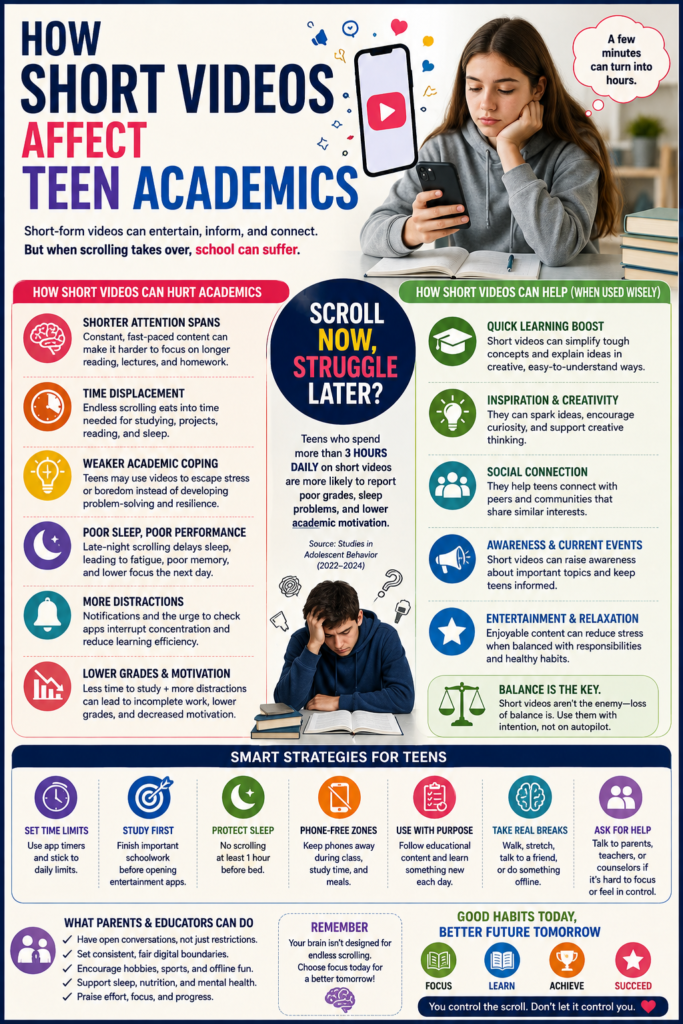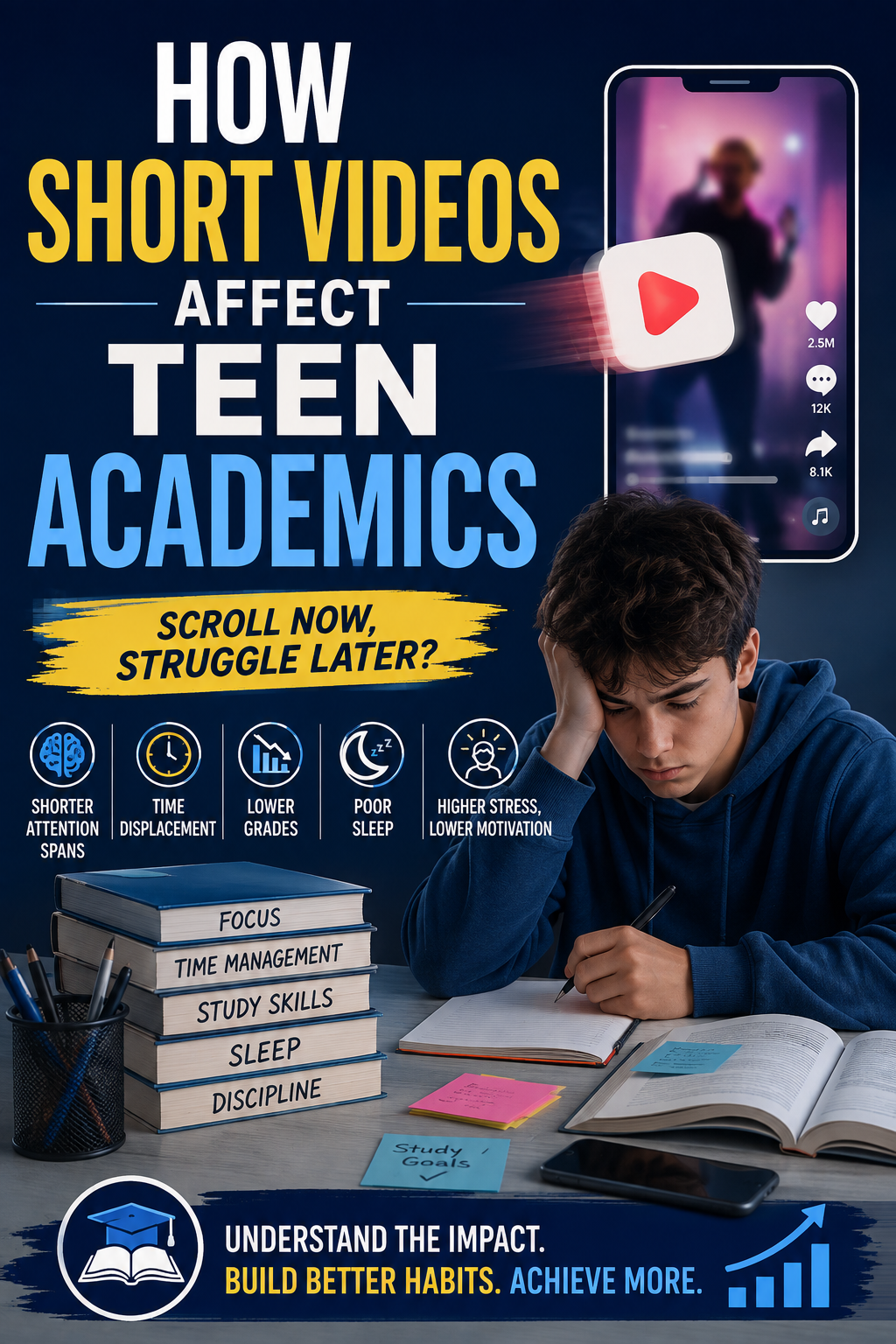
Short-form videos have become a routine part of teenage life, providing entertainment, social connection, creativity, and quick access to educational information. However, frequent or difficult-to-control scrolling may compete with the skills students need for academic success, including sustained attention, time management, adequate sleep, frustration tolerance, and effective coping with school-related stress. Rapidly changing content and endless scrolling can make it easy for a brief break to turn into prolonged screen time, potentially contributing to procrastination and interrupted study. Short videos are not inherently harmful, but understanding when and how they interfere with learning can help teenagers develop healthier digital habits.
How Short Videos Affect Teen Academics
Short-form videos on platforms such as TikTok, Instagram Reels, and YouTube Shorts have become a major part of teenagers’ digital lives. These videos can provide entertainment, social connection, creativity, and even educational information. However, concerns are growing about how frequent or difficult-to-control short-form video use may affect attention, study habits, sleep, academic coping, and school performance. Importantly, short-video use does not automatically cause academic problems; the relationship depends on frequency, timing, content, individual vulnerabilities, and how video use competes with other activities.
Reduced Sustained Attention
Short videos provide rapidly changing content, often delivering something new every few seconds. Constant exposure to this environment may make slower academic activities feel less stimulating by comparison.
Teenagers who become accustomed to rapid digital stimulation may find it more challenging to:
- Read lengthy assignments.
- Listen to extended lectures.
- Complete repetitive homework.
- Remain focused when rewards are delayed.
- Study without repeatedly checking your phone.
However, attention problems can also lead teenagers to use short videos more frequently, so the relationship can work in both directions.
Procrastination and Time Displacement
A teenager may intend to watch videos for a few minutes but continue scrolling much longer. The endless-scroll design makes natural stopping points less obvious.
When short-video use displaces academic activities, teenagers may have less time for:
- Homework and studying.
- Reading.
- Preparing for examinations.
- Long-term projects.
- Extracurricular activities.
- Sleep.
The problem is therefore not simply screen time. What the screen time replaces matters.
Academic Coping Skills
School requires students to tolerate frustration, manage deadlines, organize responsibilities, and continue working even when tasks are difficult or boring.
If short videos repeatedly become an immediate escape whenever academic stress occurs, a behavioral pattern can develop:
Difficult assignment → stress or boredom → scrolling → temporary relief → delayed work → greater stress.
Over time, relying on digital distractions as the primary response to academic discomfort may interfere with the development of healthier coping strategies.
Sleep and School Performance
Late-night scrolling is particularly important. Short-form videos can delay bedtime because teenagers may lose track of time or find it hard to stop.
Insufficient sleep can contribute to:
- Daytime fatigue.
- Difficulty concentrating.
- Memory problems.
- Irritability.
- Reduced motivation.
- Difficulty learning new information.
A teenager who stays awake scrolling may therefore experience academic problems the following day, even if video use does not directly impair learning.
Multitasking Can Interfere With Learning
Watching short videos while studying can repeatedly interrupt concentration. Switching between homework and entertainment requires the brain to continually redirect attention.
Studying for an hour while checking videos every few minutes is different from an uninterrupted hour of focused study. Frequent interruptions can make learning less efficient and increase the time needed to complete assignments.
Mental Health and Academic Stress
Problematic short-video use may also interact with anxiety, depression, loneliness, ADHD symptoms, body-image concerns, and academic stress. For some teenagers, scrolling becomes a coping mechanism for uncomfortable emotions.
This creates an important question for parents and educators: rather than asking only “How many hours are you on your phone?”, ask “What is the phone helping you avoid or manage?”
Short Videos Can Also Support Learning
Short-form video is not inherently harmful. Educational videos can introduce concepts, demonstrate skills, encourage creativity, and make difficult information more approachable.
The challenge is to use short videos as a learning tool rather than letting them replace deeper learning. A 60-second explanation may introduce a concept, but mastering complex subjects usually requires sustained reading, practice, problem-solving, discussion, and repetition.
Helping Teens Develop Healthier Digital Habits
Families and schools can encourage teenagers to establish phone-free study periods, disable unnecessary notifications, keep phones away during homework, maintain consistent sleep routines, and take intentional, rather than algorithm-driven, breaks.
Teens also need alternatives for managing academic discomfort. Exercise, brief walks, relaxation techniques, breaking assignments into smaller tasks, tutoring, counseling, and asking teachers for assistance can build stronger coping skills.
Ultimately, the concern is not that short videos are destroying teenagers’ ability to learn. A more evidence-conscious interpretation is that excessive or poorly controlled use can compete with sleep, sustained attention, studying, and healthy coping. Helping teenagers learn when to scroll, when to stop, and how to tolerate the slower rewards of learning may be more effective than simply banning short-form videos.
Self-Management Strategies to Understand How Short Videos Affect Teen Academics
Short-form videos can provide entertainment, social connection, and educational content, but excessive or hard-to-control scrolling may compete with studying, sleep, concentration, and healthy ways to manage academic stress. Self-management does not necessarily require eliminating short videos. The goal is to help teenagers recognize their digital habits and develop greater control over when and why they use them.
Track Short-Video Habits
Understanding personal patterns is the first step toward changing them.
- Check daily screen-time reports.
- Notice how often short-video apps are opened while studying.
- Track how long a planned five-minute break actually lasts.
- Identify whether scrolling increases during exams, difficult assignments, boredom, or stress.
- Compare screen use with sleep and homework completion.
Create Phone-Free Study Periods
Frequent interruptions can make sustained learning more difficult.
- Place the phone outside immediate reach during homework.
- Turn off nonessential notifications.
- Use scheduled study periods followed by intentional breaks.
- Avoid switching repeatedly between homework and short videos.
- Complete one academic goal before opening entertainment apps.
Identify Emotional Triggers
Scrolling can become a quick escape from uncomfortable academic emotions.
Ask yourself:
“Why do I want to scroll right now?”
The answer might be boredom, frustration, anxiety, loneliness, exhaustion, or difficulty understanding an assignment. Identifying the trigger makes it easier to address the actual problem instead of automatically escaping into videos.
Replace Scrolling With Healthier Academic Coping
When schoolwork becomes difficult:
- Break large assignments into smaller tasks.
- Take a brief walk or stretch.
- Practice slow breathing or another relaxation technique.
- Ask a teacher, parent, tutor, or classmate for help.
- Start with a manageable portion of the assignment.
- Reward yourself after completing a specific goal.
These strategies teach the brain that discomfort can be managed without immediately abandoning the task.
Protect Sleep
Late-night short-video use can interfere with sleep, which in turn can affect attention, memory, mood, and academic performance.
- Establish a regular bedtime.
- Create a screen-free period before sleep.
- Keep the phone away from the bed when practical.
- Avoid beginning an endless-scroll session when already tired.
- Notice whether nighttime scrolling is making it difficult to wake up for school.
Use Technology to Control Technology
Phones contain tools that can help reduce automatic use.
- Set app limits.
- Disable unnecessary notifications.
- Use Focus or Do Not Disturb modes during schoolwork.
- Remove distracting apps from the home screen.
- Turn off autoplay features when available.
- Schedule specific times for entertainment.
Practice Sustained Attention
Concentration can be strengthened through practice.
Start with manageable periods of uninterrupted reading, studying, writing, or problem-solving and gradually increase the duration. Activities such as reading books, playing music, creating art, exercising, or completing puzzles can also provide opportunities to practice sustained engagement.
Make Short Videos Work for Learning
Not all short-form content is academically harmful.
- Follow credible educational creators.
- Use short videos to introduce difficult concepts.
- Verify important information using textbooks or reliable educational sources.
- Take notes instead of passively scrolling.
- Use videos as a starting point rather than a replacement for deeper study.
Watch for Loss of Control
A teenager may need additional support when short-video use repeatedly interferes with sleep, grades, relationships, responsibilities, or emotional well-being—or when attempts to reduce use consistently fail.
Parents, teachers, school counselors, or mental health professionals can help determine whether academic difficulties are related to digital habits or whether underlying concerns such as anxiety, depression, ADHD symptoms, learning difficulties, or significant academic stress also need attention.
The goal of self-management is intentional use rather than automatic scrolling. Teens can learn to enjoy short videos while protecting sustained attention, frustration tolerance, sleep, organization, and coping skills necessary for academic success.
Family Support Strategies to Understand How Short Videos Affect Teen Academics
Families can help teenagers develop a healthier relationship with short-form videos without treating all screen use as harmful. TikTok, Instagram Reels, YouTube Shorts, and similar content can provide entertainment, creativity, social connection, and educational information. Problems are more likely when scrolling repeatedly interferes with studying, sleep, responsibilities, relationships, or healthy ways of coping with academic stress.
Create Open Conversations About Screen Use
Parents can approach the subject with curiosity rather than immediately criticizing or confiscating devices.
- Ask teens what they enjoy about short-form videos.
- Discuss when scrolling becomes difficult to stop.
- Ask whether videos help them escape boredom, anxiety, or academic pressure.
- Talk about how screen habits may affect homework and sleep.
- Avoid labeling every teenager who frequently watches videos as “addicted.”
Establish Family Digital Boundaries
Clear and consistent expectations can help teenagers learn self-control.
- Create phone-free homework periods.
- Establish device-free family meals.
- Set reasonable expectations for recreational screen time.
- Encourage devices to remain outside the bedroom during sleep when practical.
- Develop rules together so teens understand the reasons behind them.
Protect Homework Time
Families can create an environment that supports sustained concentration.
- Provide a quiet study space.
- Reduce television and other household distractions during homework.
- Encourage teens to silence unnecessary notifications.
- Support planned study periods followed by intentional breaks.
- Discourage switching repeatedly between homework and entertainment apps.
Help Teens Recognize Academic Stress
Sometimes scrolling is the symptom rather than the underlying problem. A teenager struggling with school may use short videos to temporarily avoid uncomfortable emotions.
Families should watch for:
- Procrastination.
- Fear of failure.
- Difficulty concentrating.
- Academic anxiety.
- Falling grades.
- Sleep problems.
- Frustration with difficult assignments.
Instead of simply asking, “Why are you always on your phone?”, parents might ask, “Is something about your schoolwork making you want to avoid it?”
Teach Healthier Coping Strategies
Families can help teenagers develop alternatives to automatic scrolling.
- Encourage exercise and outdoor activities.
- Break difficult assignments into manageable steps.
- Help establish realistic study schedules.
- Encourage relaxation techniques during stressful periods.
- Support hobbies that require sustained attention.
- Encourage teens to ask teachers or tutors for help when needed.
Model Healthy Digital Behavior
Teenagers notice how adults use technology.
- Put adult phones away during important conversations.
- Avoid constantly checking notifications during family activities.
- Establish shared screen-free periods.
- Demonstrate intentional rather than automatic technology use.
- Avoid expecting teenagers to follow digital rules that adults consistently ignore.
Protect Healthy Sleep
Families should pay particular attention to nighttime scrolling.
- Establish consistent sleep schedules.
- Encourage a screen-free period before bedtime.
- Discuss how inadequate sleep affects memory, concentration, and mood.
- Consider a central overnight charging location for family devices.
- Avoid using phone removal as punishment when collaborative sleep routines may work better.
Recognize Positive Uses of Short Videos
Not every short video is a waste of time. Teens may use short-form content for education, creativity, humor, hobbies, current events, or social connection.
Parents can ask teens to share useful or interesting videos and discuss what they learned. This turns digital media into an opportunity for communication rather than creating an automatic conflict between parents and technology.
Watch for More Serious Problems
Families should consider additional support when short-video use repeatedly interferes with school performance, sleep, relationships, physical activity, or responsibilities, or when a teenager becomes unable to control their use despite repeated attempts.
It is also important to consider whether underlying ADHD symptoms, anxiety, depression, learning difficulties, bullying, or academic pressure may be contributing to the behavior.
The goal of family support should not simply be “less screen time.” A more useful goal is helping teenagers develop self-regulation, sustained attention, healthy sleep, frustration tolerance, and effective academic coping skills. When families combine reasonable boundaries with communication and positive role modeling, teens can learn to enjoy short-form videos without allowing scrolling to take control of their academic lives.
Community Resource Strategies to Understand How Short Videos Affect Teen Academics
Community resources can help teenagers and families understand how frequent use of short-form video may affect concentration, sleep, study habits, emotional regulation, and academic performance. Schools, healthcare professionals, libraries, youth organizations, and mental health services can work together to promote healthy digital habits without portraying all technology use as harmful.
School-Based Programs
Schools are well positioned to teach healthy technology habits because students regularly use digital devices for both education and entertainment.
- Provide digital wellness and media-literacy education.
- Teach students how notifications and frequent interruptions can disrupt studying.
- Establish appropriate phone-free learning periods.
- Teach time-management and study skills.
- Provide academic tutoring for struggling students.
- Encourage students to distinguish educational screen use from recreational scrolling.
School Counselors and Mental Health Services
Problematic scrolling may sometimes be connected to difficulties beyond technology itself.
- Screen for anxiety, depression, ADHD symptoms, sleep problems, bullying, and academic stress when appropriate.
- Help students identify emotional triggers for excessive scrolling.
- Teach stress-management and emotional-regulation skills.
- Provide individual or group counseling.
- Refer families for additional behavioral health services when needed.
Healthcare Professionals
Pediatricians and primary care professionals can incorporate digital habits into adolescent health discussions.
- Ask about recreational screen use and social media habits.
- Assess whether device use is interfering with sleep, school, exercise, or relationships.
- Screen for associated mental health concerns when indicated.
- Educate families about healthy sleep and technology routines.
- Refer teens for specialized assessment when academic or behavioral problems become significant.
Libraries and Educational Programs
Libraries can provide technology-positive alternatives to passive scrolling.
- Offer homework assistance and tutoring.
- Provide quiet study environments.
- Promote reading and sustained-attention activities.
- Teach digital and media literacy.
- Offer workshops on identifying credible online information.
- Provide technology-based educational programs that encourage active rather than passive learning.
Youth and Recreation Programs
Community activities can provide rewarding experiences away from continuous digital stimulation.
- Encourage participation in sports and exercise.
- Offer art, music, theater, and creative programs.
- Provide volunteer opportunities.
- Develop clubs based on shared interests.
- Create safe opportunities for face-to-face social interaction.
Parent Education Programs
Parents may need guidance about technology just as much as teenagers do.
Community organizations can teach families how to establish realistic screen boundaries, recognize problematic use, protect sleep, communicate without constant conflict, and model healthier technology behavior themselves.
Digital Literacy Programs
Teens should understand how short-form platforms are designed to maintain engagement.
- Teach how recommendation algorithms influence what users see.
- Discuss endless scrolling and autoplay.
- Explain how notifications encourage repeated checking.
- Teach students to recognize persuasive design.
- Encourage intentional decisions about when and why they open an app.
Understanding these features can help teenagers recognize that maintaining attention is not simply a matter of willpower.
Academic Support Services
When a teenager is struggling academically, reducing screen time alone may not solve the problem.
- Provide tutoring and homework assistance.
- Teach organizational and time-management skills.
- Evaluate possible learning difficulties.
- Offer study-skills workshops.
- Help students break large assignments into manageable goals.
- Provide accommodations when clinically and educationally appropriate.
Community Mental Health Resources
Professional support may be appropriate when short-video use becomes difficult to control or significantly interferes with daily functioning.
Mental health professionals can evaluate whether excessive scrolling is associated with anxiety, depression, ADHD, loneliness, family conflict, or other concerns and develop an individualized treatment plan.
Build a Community Culture of Digital Balance
Communities should avoid framing the issue as a conflict between technology and teenagers. Short-form videos can educate, entertain, inspire creativity, and strengthen social connections. The concern arises when digital behavior repeatedly displaces important developmental activities.
An effective community strategy brings together schools, families, healthcare professionals, libraries, mental health providers, and youth organizations to help teens develop digital self-regulation. The goal is not simply fewer minutes on a screen but better sleep, concentration, academic coping, physical activity, relationships, and intentional technology use.
Frequently Asked Questions
Here are some common questions:
1. How can short-form videos affect teenagers academically?
Frequent or poorly controlled short-video use may compete with homework, reading, sleep, and sustained studying. The effects vary considerably depending on how much, when, and why a teenager uses the platforms.
2. Do short videos cause shorter attention spans?
It is more accurate to say that frequent exposure to rapidly changing content may be associated with attention difficulties in some teens. Research does not establish that short videos permanently shorten every teenager’s attention span, and teens with existing attention difficulties may also be more drawn to this type of content.
3. Why can short videos make studying more difficult?
Short videos provide frequent novelty and immediate stimulation, while studying often requires sustained effort and delayed rewards. Switching repeatedly between the two can interrupt concentration and make homework less efficient.
4. Can short-video use contribute to procrastination?
Yes. A teenager may intend to scroll for only a few minutes but end up scrolling much longer. When scrolling becomes an escape from difficult or boring assignments, procrastination can increase.
5. How can short videos affect academic coping skills?
If teens repeatedly use scrolling to escape frustration, boredom, or academic anxiety, they may have fewer opportunities to practice coping skills such as problem-solving, asking for help, tolerating frustration, and breaking difficult assignments into manageable steps.
6. Can short videos affect grades?
Heavy or problematic use can be associated with poorer academic outcomes, particularly when it replaces studying, disrupts concentration, or reduces sleep. However, screen use is only one of many factors affecting grades.
7. How does nighttime scrolling affect school performance?
Late-night scrolling can delay bedtime and reduce sleep. Inadequate sleep can contribute to fatigue, irritability, difficulty concentrating, reduced motivation, and problems with learning and memory.
8. Is multitasking between homework and short videos effective?
Usually not. Repeatedly switching between entertainment and academic work can fragment attention. A teenager may spend more time completing an assignment while learning less effectively.
9. Are all short-form videos harmful?
No. Short videos can provide educational information, creativity, humor, social connection, and exposure to new ideas. The concern is primarily with excessive, compulsive, or poorly timed use.
10. Can short videos actually help students learn?
Yes, when used appropriately. A brief video can introduce a scientific concept, demonstrate a math technique, teach vocabulary, or stimulate curiosity. However, complex learning usually requires deeper reading, practice, discussion, and problem-solving.
11. How much short-video use is too much?
There is no single number that defines problematic use for every teenager. A more useful question is whether scrolling is repeatedly interfering with sleep, schoolwork, physical activity, relationships, responsibilities, or emotional well-being.
12. Why do teens have difficulty stopping?
Short-video platforms often provide continuous content, personalized recommendations, notifications, and few natural stopping points. These features can encourage users to continue watching longer than intended.
13. What can teenagers do to control their scrolling?
They can establish phone-free study periods, disable unnecessary notifications, set app limits, keep phones away during homework, protect bedtime, and decide in advance when they will use entertainment apps.
14. What should parents do?
Parents can establish reasonable boundaries while maintaining open communication. Instead of focusing exclusively on punishment or confiscating devices, families can discuss what the teenager gets from scrolling and whether stress, anxiety, boredom, loneliness, or academic difficulties are contributing to excessive use.
15. When should parents be concerned?
Additional support may be appropriate when a teenager repeatedly loses sleep, misses assignments, experiences declining grades, withdraws from other activities, becomes unable to reduce use, or experiences significant emotional distress related to their digital habits.
16. Could another condition be contributing to excessive scrolling?
Yes. Anxiety, depression, ADHD symptoms, learning difficulties, loneliness, bullying, sleep problems, or academic stress may contribute to problematic digital behavior. Addressing the underlying issue may be more effective than focusing exclusively on screen time.
17. Should parents completely ban short-form videos?
A complete ban is not always necessary or practical. Teaching teenagers to regulate their own technology use may provide more lasting benefits, although stronger restrictions may sometimes be appropriate when use seriously interferes with functioning.
18. What is the most important message for teens?
Short-form videos are not automatically the enemy of academic success. The goal is intentional rather than automatic use. Teens who learn when to scroll, when to stop, how to protect their sleep, and how to remain engaged with challenging schoolwork can enjoy digital media while developing the attention and coping skills they need academically.
Conclusion
Short-form videos can be useful educational and recreational tools when they are used intentionally and in balance with other activities. Problems may develop when scrolling repeatedly replaces studying, sleep, physical activity, relationships, or healthier ways of coping with academic stress. Rather than focusing only on reducing screen time, families, schools, and communities can help teenagers strengthen self-regulation, sustained attention, study habits, and emotional coping skills. Establishing phone-free study periods, protecting sleep, managing notifications, and addressing underlying academic or mental health concerns can make technology easier to manage. The goal is not to eliminate short videos from teenagers’ lives but to help young people control their digital habits instead of allowing those habits to control their education.
Video: Breaking the Cycle: How to Limit Screen Time and Boost Grades #AcademicStress #TeenAcademics