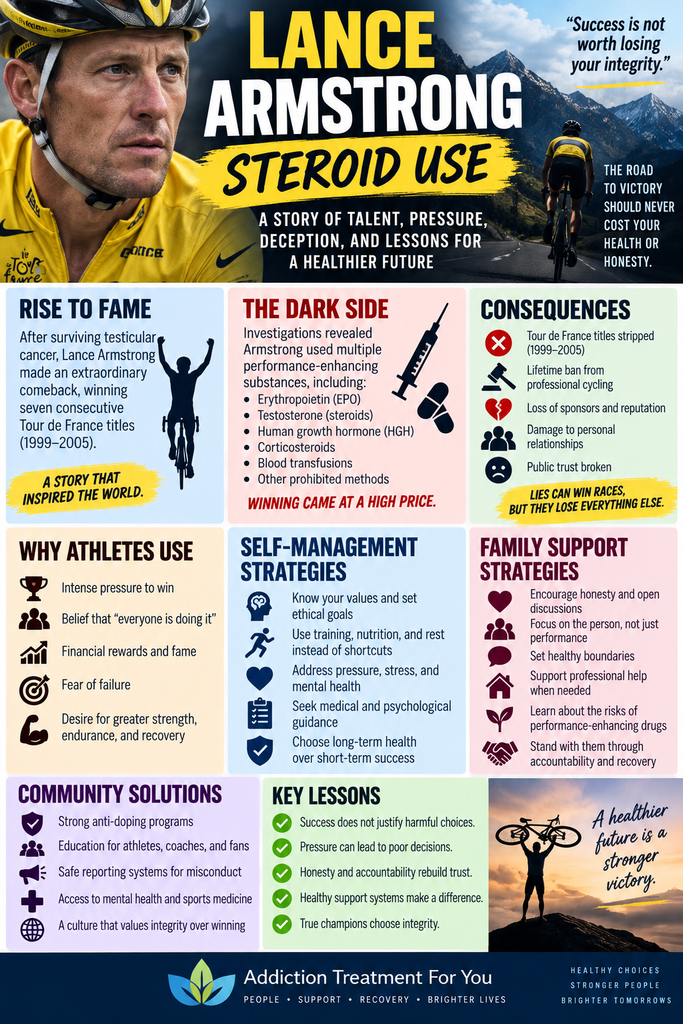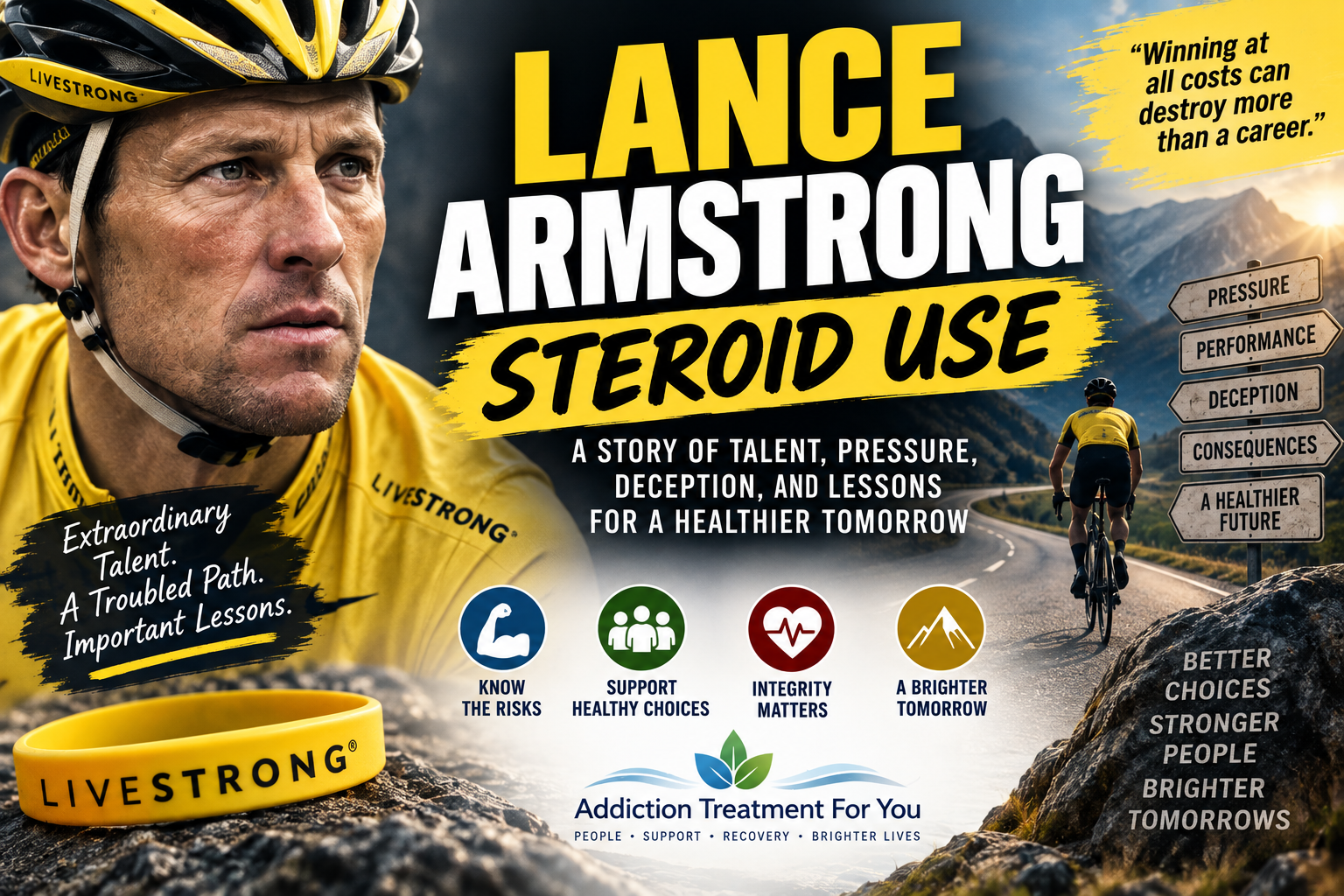
Lance Armstrong was once one of the most celebrated athletes in professional cycling. A survivor of testicular cancer, he returned to elite competition and won seven consecutive Tour de France titles from 1999 through 2005. His story became an international symbol of perseverance. Years later, however, the achievements that helped create his heroic public image became inseparable from one of the most significant doping scandals in sports history.
Although Armstrong’s story is often described simply as “steroid use,” the reality was broader. The U.S. Anti-Doping Agency (USADA) documented the use of prohibited substances and methods, including erythropoietin (EPO), testosterone, corticosteroids, blood transfusions, and other prohibited practices. In 2013, Armstrong publicly admitted to using EPO, testosterone, blood transfusions, and other banned substances or methods during his Tour de France victories.
Armstrong’s journey provides an opportunity to discuss not only performance-enhancing drugs but also the psychological pressures surrounding competition, secrecy, rationalization, accountability, family relationships, and the role communities play in creating—or challenging—unhealthy environments.
From Cancer Survivor to Cycling Superstar
Armstrong’s rise was extraordinary. After being diagnosed with advanced testicular cancer, he underwent treatment and eventually returned to professional cycling. His comeback became much larger than sports. Millions of people viewed him as proof that devastating circumstances could be overcome.
But behind that inspirational public story was a very different reality.
USADA’s investigation eventually assembled more than 1,000 pages of evidence, including sworn testimony from riders and other individuals as well as documentary and scientific evidence. The agency concluded that Armstrong had participated extensively in a sophisticated doping program associated with the U.S. Postal Service cycling team.
What Performance-Enhancing Substances Did Armstrong Use?
In his televised interview with Oprah Winfrey in January 2013, Armstrong acknowledged using banned substances and blood doping during his seven Tour de France victories. He specifically acknowledged EPO, testosterone, blood transfusions, and other prohibited substances.
The substances and methods associated with the case included:
- EPO (erythropoietin): A hormone that increases red blood cell production and can improve the body’s ability to transport oxygen.
- Testosterone: An anabolic-androgenic steroid that can influence muscle development, recovery, and performance.
- Human growth hormone (HGH): Another prohibited performance-enhancing substance Armstrong acknowledged using.
- Corticosteroids: Drugs that have legitimate medical uses but are restricted under certain circumstances in competitive sports.
- Blood transfusions: A method of increasing oxygen-carrying red blood cells rather than a steroid or conventional drug.
Calling the scandal simply “steroid abuse” therefore misses an important distinction: Armstrong’s doping involved multiple performance-enhancing drugs and prohibited methods, not steroids alone.
The Psychology of Winning at All Costs
One of the most valuable lessons from Armstrong’s story involves rationalization.
During his confession, Armstrong reflected on the mentality he had carried from surviving cancer into professional cycling. He described a ruthless, relentless, “win at all costs” attitude that became destructive when applied to competition.
This does not excuse doping. It helps us understand how unhealthy thinking can develop.
People may gradually justify risky or unethical behavior by telling themselves:
- “Everyone else is doing it.”
- “I need this to compete.”
- “I can’t afford to lose.”
- “I’ve worked too hard to stop now.”
- “I’ll only do it temporarily.”
- “The consequences won’t happen to me.”
Once someone’s identity, livelihood, and reputation become connected to winning, admitting a problem can feel increasingly threatening.
Secrecy Can Become Its Own Trap
Armstrong denied doping allegations for years before eventually admitting that his story had become what he described as one large repeated lie.
This aspect of his story has relevance beyond professional sports. Whether the hidden behavior involves substances, gambling, compulsive behavior, performance-enhancing drugs, or another problem, secrecy can create additional problems.
The person is no longer managing only the original behavior. They may also have to maintain explanations, protect their reputation, avoid detection, and respond to people questioning what is happening.
Breaking that pattern requires accountability.
Self-Management Strategies
Armstrong’s story can help athletes and others recognize how achievement-focused environments may distort decision-making. Healthy self-management means developing strategies before pressure becomes overwhelming.
Helpful approaches include:
- Identify personal values. Decide what matters beyond winning, appearance, money, or recognition.
- Recognize rationalization. Pay attention when “I deserve this” or “everyone does it” becomes justification for dangerous behavior.
- Separate self-worth from performance. Losing a competition or experiencing a career setback does not make someone a failure.
- Use healthy performance strategies. Training, nutrition, sleep, recovery, and evidence-based medical care should replace dangerous shortcuts.
- Seek professional guidance. Athletes should discuss medications, supplements, and performance concerns with qualified medical professionals familiar with anti-doping regulations.
- Accept accountability. Recovery from harmful behavior involves recognizing choices rather than continually blaming circumstances.
- Address underlying emotions. Fear of failure, perfectionism, insecurity, anger, and pressure may need psychological support.
- Build an identity outside achievement. Relationships, hobbies, education, service, and personal development can provide meaning beyond competition.
Family Support Strategies
Armstrong later spoke emotionally about the scandal’s effect on his family. His experience illustrates that the consequences of harmful behavior rarely remain limited to one individual.
Families can help someone facing performance-enhancing drug use or another problematic behavior by:
- Discussing concerns calmly and directly.
- Encouraging honesty rather than maintaining secrecy.
- Avoiding placing someone’s entire worth on athletic success.
- Encouraging medical and psychological evaluation when needed.
- Learning about performance-enhancing substances and their risks.
- Establishing boundaries around deception and unsafe behavior.
- Supporting healthy goals rather than unrealistic expectations.
- Encouraging accountability without permanently defining the person by past behavior.
- Seeking family counseling when trust has been seriously damaged.
Supporting someone does not mean protecting them from every consequence. Sometimes experiencing appropriate consequences is an important part of recognizing the seriousness of one’s decisions.
Community Support Strategies
Armstrong’s case also demonstrates why individual responsibility is only one part of the conversation. USADA’s investigation described a broader team doping system involving multiple participants and extensive evidence.
Communities and sports organizations can reduce these risks by creating environments in which ethical behavior is genuinely supported.
Important community strategies include:
- Strong and independent anti-doping programs
- Confidential methods for athletes to report concerns
- Coaches who emphasize health and ethical competition
- Education about steroids and other performance-enhancing substances
- Access to sports medicine professionals
- Mental-health services for athletes
- Protection for whistleblowers
- Peer mentoring
- Clear consequences for doping
- Programs helping athletes transition into life after competition
The goal should be to create a culture in which asking for help does not automatically mean losing one’s identity or community.
Accountability Versus Shame
There is an important difference between accountability and shame.
Accountability says, “I made harmful choices, and I am responsible for addressing the consequences.”
Shame says, “Because I made harmful choices, I am permanently worthless.”
Effective behavioral change requires accountability without assuming that a person’s worst decisions must define the remainder of their life.
Armstrong’s actions had substantial consequences. His Tour de France results were disqualified, and he received a lifetime ban from sanctioned competition under USADA’s decision.
Understanding the pressures surrounding his choices does not absolve him of responsibility for them. Instead, it helps families, athletes, and communities identify conditions that may contribute to similar behavior in others.
What Can We Learn From Lance Armstrong?
Armstrong’s story demonstrates how success can sometimes reinforce unhealthy behavior rather than expose it. If prohibited behavior continues producing victories, recognition, and financial rewards, a person may have powerful incentives to continue.
His journey offers several broader lessons:
- Extraordinary talent does not eliminate vulnerability to poor decisions.
- Success can sometimes hide harmful behavior.
- Performance-enhancing drug use can involve psychological and social pressures as well as physical risks.
- Repeated dishonesty can damage relationships as seriously as the original behavior.
- Healthy support systems should value the person rather than only the person’s achievements.
- Organizations must create environments where ethical choices are possible and protected.
- Accountability is essential to rebuilding trust.
Conclusion
Lance Armstrong’s story is more complicated than the simple narrative of an athlete who “used steroids.” His documented doping involved EPO, testosterone, blood manipulation, and other prohibited substances or methods within a larger competitive environment. Eventually, the consequences included lost titles, a lifetime ban, damaged relationships, and a dramatically altered public legacy.
For individuals, the lesson is to recognize unhealthy rationalizations before they become entrenched. For families, it is to support the person without enabling deception. For communities and athletic organizations, it is about creating cultures where health, integrity, and psychological well-being matter as much as winning.
Armstrong’s journey ultimately demonstrates a lesson applicable far beyond cycling: achievement without healthy boundaries can be destructive, while meaningful change begins with honesty, accountability, and a willingness to make different choices.
Frequently Asked Questions
Here are some common questions:
1. Did Lance Armstrong use steroids?
Yes. Lance Armstrong admitted in 2013 that he used banned performance-enhancing substances during his cycling career. These included testosterone, an anabolic-androgenic steroid, as well as EPO and other prohibited methods. His doping history therefore involved considerably more than steroids alone.
2. What performance-enhancing drugs did Lance Armstrong use?
According to the U.S. Anti-Doping Agency (USADA), the evidence against Armstrong involved substances and methods including EPO, testosterone, corticosteroids, human growth hormone, and blood transfusions.
3. What is EPO?
Erythropoietin, commonly called EPO, is a hormone that stimulates red blood cell production. Increasing red blood cells can increase the amount of oxygen delivered to working muscles, potentially improving endurance. Misusing EPO for athletic performance can carry serious health risks.
4. Why did Lance Armstrong use performance-enhancing drugs?
Armstrong described professional cycling as an intensely competitive environment and acknowledged developing a “win at all costs” mentality. Pressure, ambition, and normalization of doping within a competitive environment can help explain someone’s decisions, but they do not remove personal responsibility for those decisions.
5. Did Lance Armstrong admit that he doped?
Yes. In a highly publicized 2013 interview with Oprah Winfrey, Armstrong acknowledged using banned performance-enhancing substances and methods during all seven of his Tour de France victories.
6. How long did Armstrong deny using performance-enhancing drugs?
Armstrong denied doping allegations for many years before his 2013 admission. The prolonged deception became a major part of the scandal because the consequences extended beyond drug use to questions of honesty, intimidation, accountability, and public trust.
7. Did Lance Armstrong lose his Tour de France titles?
Yes. Armstrong was stripped of his seven Tour de France titles from 1999 through 2005. USADA also imposed a lifetime ban and disqualified his competitive results dating back to August 1, 1998.
8. Was Lance Armstrong addicted to steroids?
There is an important distinction between performance-enhancing drug use and addiction. Public evidence establishes Armstrong’s extensive doping, but that does not by itself establish that he had a steroid use disorder or another substance use disorder. A clinical diagnosis requires more than evidence that someone repeatedly used a prohibited substance.
9. What are some risks associated with anabolic steroid misuse?
Nonmedical anabolic-androgenic steroid use can affect multiple body systems. Potential problems include cardiovascular complications, liver problems, hormonal changes, reproductive effects, and psychiatric symptoms. Risk varies according to the substances involved, doses, duration, and individual medical factors.
10. What self-management strategies can athletes use to avoid performance-enhancing drug misuse?
Athletes can reduce risk by:
- Establishing personal values that place health and integrity above winning.
- Recognizing perfectionism and fear of failure.
- Working with qualified sports medicine professionals.
- Checking medications and supplements against anti-doping requirements.
- Using evidence-based training, nutrition, sleep, and recovery.
- Seeking counseling for excessive performance pressure.
- Building an identity outside athletic achievement.
- Challenging thoughts such as “everyone else is doing it.”
- Asking for help before risky behavior becomes normalized.
11. How can families support an athlete who is using steroids or other performance-enhancing substances?
Families can encourage honest conversations without making athletic performance the person’s entire identity. They can express concerns about health and behavior, encourage medical or psychological evaluation, maintain appropriate boundaries, and avoid covering up harmful conduct.
Family members should also remember that support and accountability can coexist. Caring about someone does not require protecting that person from every reasonable consequence of their behavior.
12. How can communities prevent performance-enhancing drug misuse?
Athletic organizations, schools, and communities can establish strong anti-doping policies while also addressing the pressures that contribute to risky decisions.
Helpful strategies include:
- Education about performance-enhancing substances
- Confidential reporting systems
- Access to sports medicine
- Mental-health services
- Ethical coaching
- Protection for whistleblowers
- Clear anti-doping standards
- Healthy alternatives for improving performance
- Programs emphasizing long-term health rather than winning at any cost
13. What role did cycling culture play in Armstrong’s case?
USADA characterized the U.S. Postal Service team’s doping operation as highly organized and sophisticated. Armstrong’s case therefore illustrates how unhealthy organizational cultures can normalize behavior that individuals might otherwise recognize as dangerous or unethical.
This context is important for prevention, but it does not eliminate individual responsibility.
14. What is the difference between accountability and shame?
Accountability means acknowledging harmful choices, accepting reasonable consequences, and working to change future behavior. Shame defines the entire person according to those choices.
For behavioral change, the goal should be accountability without assuming that a person’s worst decisions permanently determine their worth.
15. What can young athletes learn from Lance Armstrong’s story?
His experience demonstrates that winning does not necessarily mean succeeding in a healthy or sustainable way. Athletic accomplishments can disappear, but the effects of decisions on health, relationships, and reputation may remain much longer.
Young athletes should be taught that integrity is part of athletic performance—not an obstacle to it.
16. Can someone stop using performance-enhancing drugs and rebuild their life?
Yes. People can change harmful behaviors, but the appropriate approach depends on what substances they have been using and whether psychological or physical dependence has developed. Medical supervision can be important because abruptly stopping certain substances may produce significant physical or psychological symptoms.
Rebuilding also involves more than stopping a substance. It can require addressing performance pressure, repairing relationships, accepting consequences, and developing healthier goals.
17. What is the biggest lesson from Lance Armstrong’s doping scandal?
Perhaps the broadest lesson is that success can sometimes hide unhealthy behavior rather than prove that everything is going well. Armstrong reached the highest levels of his sport while participating in prohibited doping.
For individuals, families, and communities, his story emphasizes prevention through education, ethical decision-making, healthy coping strategies, supportive relationships, and systems that make it safer to speak up when something is wrong.
Video: Why The World Turned On Lance Armstrong #cycling #scandal #shorts