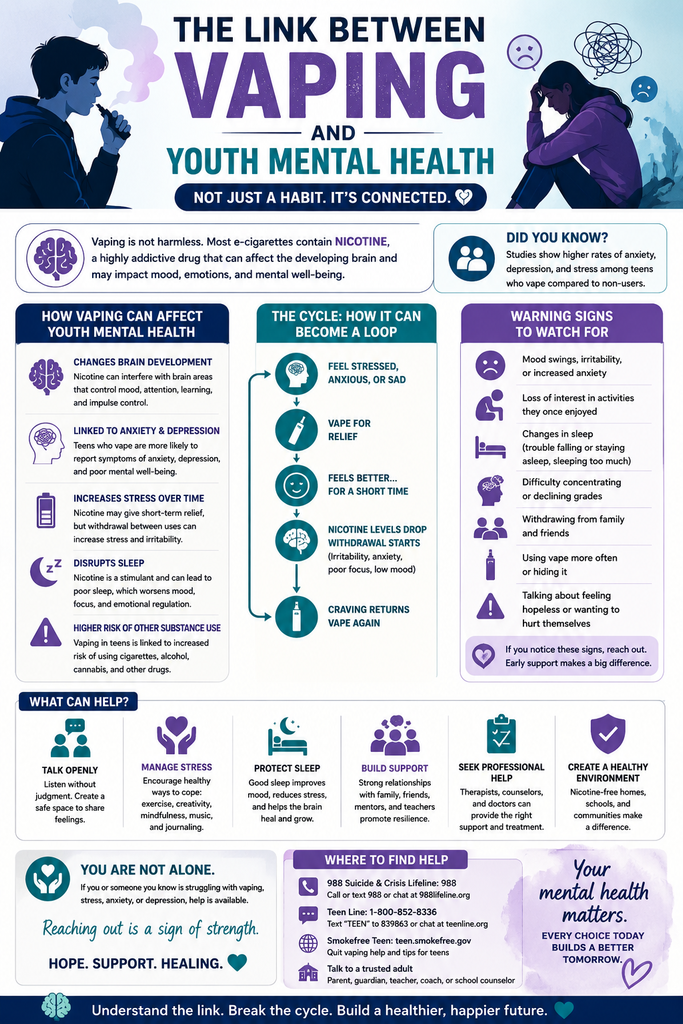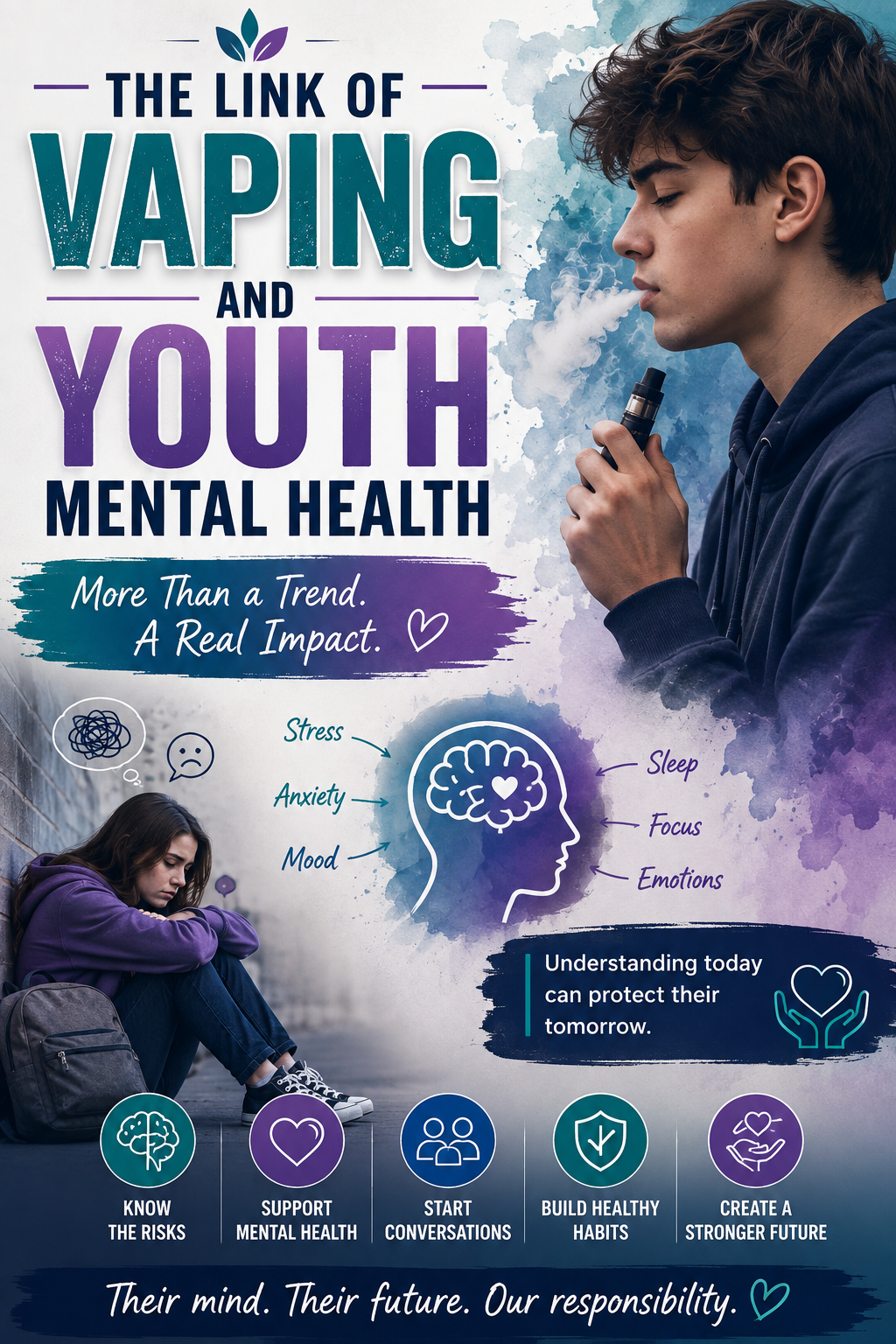
Youth vaping has become an important public health concern, particularly because of its relationship with mental health and nicotine dependence. Adolescents experiencing stress, anxiety, depression, loneliness, or social pressure may be more likely to use vaping as a way to cope with uncomfortable emotions. At the same time, repeated nicotine exposure can lead to dependence, and withdrawal may contribute to irritability, anxiety, difficulty concentrating, sleep problems, and strong cravings. Because adolescence is a critical period of brain and emotional development, understanding this relationship is essential. Rather than assuming that vaping directly causes every mental health problem, parents, educators, and healthcare professionals should recognize that the connection can work in both directions and address nicotine use and emotional well-being together.
Vaping and Youth Mental Health: Understanding the Link
Vaping has become an important youth health concern, particularly because nicotine use and mental health symptoms frequently overlap during adolescence. The relationship is complex and likely bidirectional: young people experiencing anxiety, depression, stress, or emotional difficulties may be more likely to vape, while nicotine dependence and withdrawal can contribute to irritability, anxiety, difficulty concentrating, sleep disruption, and mood changes. This does not mean vaping alone causes every mental health problem, but the association deserves attention.
Nicotine and the Developing Brain
Most e-cigarettes contain nicotine, a highly addictive substance. Because the adolescent brain continues developing into young adulthood, repeated nicotine exposure can affect neural systems involved in attention, learning, impulse control, mood, and reward.
Nicotine rapidly activates the brain’s reward system and increases dopamine signaling. With repeated exposure, the brain adapts, and a teenager may begin to experience cravings and dependence. Eventually, vaping may shift from experimentation or social behavior to something the young person feels they need simply to feel normal.
Vaping, Anxiety, and Stress
Young people sometimes report vaping because nicotine temporarily makes them feel calmer or helps them deal with stress. However, this can create a misleading cycle.
Stress or anxiety → vaping → temporary relief → nicotine levels fall → withdrawal symptoms → more anxiety or irritability → craving → vaping again
The temporary relief may therefore represent, at least partly, the relief of nicotine withdrawal rather than treatment of the original anxiety. This can reinforce continued vaping.
Vaping and Depression
Research has consistently found an association between youth e-cigarette use and depressive symptoms. However, association does not automatically establish cause and effect. Depression could increase vulnerability to nicotine use, nicotine dependence could contribute to worsening emotional symptoms, or shared factors—such as chronic stress, peer influences, family difficulties, or other substance use—could contribute to both.
For this reason, a teenager who regularly vapes and develops persistent sadness, loss of interest, social withdrawal, sleep changes, or declining functioning should be evaluated for both nicotine dependence and mental health concerns.
Nicotine Withdrawal Can Look Like Mental Health Symptoms
Once dependence develops, going without nicotine can produce symptoms including irritability, restlessness, anxiety, difficulty concentrating, sleep problems, depressed mood, and strong cravings.
This creates an important clinical challenge. A teenager may believe, “Vaping helps my anxiety,” when nicotine withdrawal between vaping episodes may actually be contributing to some of that distress.
Sleep and Academic Functioning
Nicotine is a stimulant and may interfere with healthy sleep. Poor sleep can subsequently affect concentration, memory, emotional regulation, academic performance, and resilience to stress.
A cycle can develop in which a young person is tired and stressed, uses nicotine to feel more alert or emotionally regulated, sleeps poorly, and then experiences greater stress the following day.
Social Media and Peer Influence
Youth vaping does not occur in isolation. Friends, social environments, flavored products, perceptions that vaping is less harmful than smoking, and exposure to vaping-related content can influence experimentation.
Adolescents may also associate vaping with social acceptance, independence, stress relief, or identity, making cessation more complicated than simply removing access to an e-cigarette.
Why Screening for Both Issues Matters
When a teenager vapes regularly, healthcare professionals should consider screening for nicotine dependence as well as depression, anxiety, sleep difficulties, other substance use, and psychosocial stressors.
Similarly, when treating a teenager for anxiety or depression, clinicians should ask about vaping and other nicotine products. Treating mental health symptoms without recognizing nicotine dependence can leave an important contributor to the teenager’s distress unaddressed.
Helping Young People Stop Vaping
Effective support should avoid relying solely on punishment or fear. Young people can benefit from understanding nicotine dependence, identifying triggers, developing coping strategies, learning how to handle peer pressure, receiving family support, and working with healthcare professionals when necessary.
Parents can help by maintaining open communication, establishing clear expectations around nicotine use, creating a nicotine-free home, encouraging healthy sleep and physical activity, and taking changes in mental health seriously.
Key Takeaway
The connection between youth vaping and mental health is not as simple as saying vaping directly causes anxiety or depression. The relationship can operate in both directions. Mental health difficulties may increase vulnerability to vaping, while nicotine dependence, withdrawal, disrupted sleep, and repeated cycles of craving and relief can potentially intensify emotional distress.
For prevention and recovery, the most effective question may therefore be not only “How do we get this teenager to stop vaping?” but also “What emotional, social, or behavioral need is vaping serving, and how can we help them meet that need in a healthier way?”
Self-Management Strategies to Understand the Link Between Vaping and Youth Mental Health
Self-management can help young people recognize how nicotine use, cravings, withdrawal, stress, mood, sleep, and social influences interact. Because the relationship between vaping and mental health can work in both directions, the goal is not simply to stop vaping but to understand what vaping is doing for the young person and develop healthier ways to meet those needs.
1. Track vaping and mood patterns. Keep a simple daily record of when vaping occurs, how the person felt beforehand, what triggered the urge, and how they felt afterward. Patterns may reveal that vaping increases during anxiety, boredom, loneliness, anger, social situations, or academic stress.
2. Identify personal triggers. Common triggers include stress, seeing friends vape, driving, social media, parties, boredom, conflict, and certain routines. Identifying triggers makes it possible to prepare alternative responses before cravings occur.
3. Understand the nicotine cycle. Nicotine can produce temporary pleasurable or calming sensations, but repeated exposure can lead to dependence. When nicotine levels decline, withdrawal may cause irritability, anxiety, restlessness, difficulty concentrating, sleep problems, and cravings. Vaping again temporarily relieves these symptoms, reinforcing the cycle.
4. Distinguish stress relief from withdrawal relief. A young person may believe, “Vaping calms my anxiety.” Sometimes nicotine appears calming because another dose temporarily reduces withdrawal symptoms. Recognizing this pattern can help separate underlying mental health symptoms from nicotine-related discomfort.
5. Develop healthier stress-management strategies. Physical activity, music, creative activities, mindfulness, breathing exercises, journaling, spending time outdoors, and talking with supportive people can provide alternatives to vaping. The best coping strategy is one the young person will realistically use when stressed.
6. Use a craving-management plan. When a craving appears, delay acting on it and switch activities. Drinking water, taking a walk, chewing gum, texting a supportive person, practicing slow breathing, or moving to a vape-free environment can help. Cravings generally rise and fall rather than remaining at maximum intensity indefinitely.
7. Protect sleep. Establish consistent sleep and wake times and reduce nicotine use, caffeine, and excessive screen exposure around bedtime. Sleep should be monitored because poor sleep can worsen irritability, anxiety, concentration, and emotional regulation.
8. Create a vape-free environment. Removing vaping devices, chargers, pods, and other reminders can reduce environmental triggers. Spending more time in places where vaping is prohibited can also make impulsive use more difficult.
9. Prepare for social pressure. Young people can practice short responses such as, “No thanks, I’m quitting.” They can also spend more time with friends who support their decision. A plan for parties and other high-risk situations can reduce spontaneous vaping.
10. Set realistic goals and track progress. Goals might include identifying triggers, delaying the first vape of the day, creating a quit plan, reaching a quit date, or remaining nicotine-free. Progress should also be measured through improvements in coping, sleep, concentration, confidence, and control over cravings.
11. Monitor mental health during quitting. Irritability, anxiety, difficulty concentrating, and mood changes can occur during nicotine withdrawal. However, persistent or severe depression, anxiety, major behavioral changes, or significant deterioration in daily functioning should not automatically be attributed to withdrawal. A healthcare or mental health professional should evaluate concerning symptoms.
12. Ask for support rather than managing everything alone. Self-management does not mean self-treatment. Parents, caregivers, school counselors, healthcare professionals, and behavioral-health clinicians can help young people develop an appropriate vaping-cessation plan and evaluate co-occurring mental health concerns.
Key Takeaway
Understanding youth vaping requires looking at the entire cycle: trigger → craving → vaping → temporary reward or relief → nicotine withdrawal → renewed craving. At the same time, anxiety, depression, stress, sleep problems, and social pressures may influence when and why a young person vapes.
Teaching young people to recognize these connections can replace an automatic response—“I feel stressed, so I need to vape”—with a healthier question: “What am I feeling, what triggered it, and what can I do instead?”
Family Support Strategies to Understand the Link Between Vaping and Youth Mental Health
Families can play an important role in helping young people understand how vaping, nicotine dependence, stress, anxiety, depression, sleep, and social influences may interact. Because the relationship between vaping and mental health can work in both directions, family support should address both nicotine use and the emotional or behavioral reasons that may contribute to it.
1. Learn about nicotine dependence. Parents and caregivers should understand that most youth vaping involves nicotine exposure and that dependence can develop. Nicotine withdrawal may produce irritability, anxiety, restlessness, difficulty concentrating, sleep problems, and cravings. Recognizing withdrawal symptoms can help families respond more constructively.
2. Talk about vaping without immediately judging. Instead of beginning with accusations, families can ask what the young person likes about vaping, when they use it most, and what they feel before and after vaping. These conversations may reveal stress, peer pressure, anxiety, boredom, loneliness, or other triggers.
3. Look beyond the vaping behavior. Vaping may sometimes function as an unhealthy coping strategy. Families should consider whether the young person is experiencing academic pressure, bullying, relationship problems, family conflict, trauma, anxiety, depression, or social isolation. Stopping nicotine use without addressing the underlying problem may leave the original need unresolved.
4. Watch for changes in mental health. Families can watch for persistent sadness, excessive worry, severe irritability, social withdrawal, loss of interest in activities, significant changes in sleep, declining school performance, or difficulty functioning. These symptoms should not automatically be blamed on vaping or adolescence.
5. Understand the vaping-withdrawal cycle. A young person may say, “Vaping helps my anxiety.” Nicotine can produce temporary effects that feel calming, but repeated use can lead to dependence. When nicotine levels fall, withdrawal can create anxiety and irritability, and another vaping episode temporarily relieves those symptoms. Families can help young people recognize this cycle without dismissing genuine anxiety.
6. Establish clear and consistent boundaries. Families should communicate that vaping is not acceptable while maintaining reasonable and predictable consequences. Boundaries work best when paired with education and support rather than humiliation or threats.
7. Maintain a nicotine-free home. Parents and caregivers can reduce access to vaping products and avoid keeping nicotine products easily accessible. Adults who use nicotine should also recognize that their behavior may influence how young people perceive nicotine use.
8. Support healthier coping strategies. Encourage physical activity, sports, hobbies, music, art, relaxation techniques, outdoor activities, adequate sleep, and supportive friendships. Families can participate in some of these activities together, making healthy coping part of everyday life rather than simply an instruction to the young person.
9. Help manage social triggers. Friends and social environments can strongly influence vaping. Families can discuss how to respond when someone offers a vape and help develop realistic exit strategies for high-risk situations. Encourage relationships with peers who respect nicotine-free choices.
10. Support quitting rather than demanding perfection. Nicotine dependence can make quitting difficult. Cravings and withdrawal symptoms do not necessarily mean the young person lacks motivation. Families can recognize progress, help identify what triggered setbacks, and encourage another attempt when necessary.
11. Avoid shame and stigmatizing labels. Calling a young person an “addict,” “bad kid,” or “failure” can damage communication and discourage honesty. Families can clearly disapprove of vaping while separating the behavior from the person’s identity.
12. Seek professional assessment when appropriate. A pediatrician, primary-care clinician, behavioral-health professional, or adolescent substance-use specialist can evaluate nicotine dependence and mental health symptoms. Professional support is particularly important when vaping is frequent, quitting attempts repeatedly fail, other substances are involved, or significant depression, anxiety, behavioral changes, or declining functioning are present.
13. Develop a family quit-support plan. Families can work with the young person and healthcare professionals to identify, when appropriate, a quit date or reduction strategy, triggers, coping alternatives, supportive people, and ways to manage cravings. The plan should also specify what to do if mental health symptoms worsen.
14. Celebrate improvements beyond quitting. Progress may include fewer vaping episodes, greater honesty, improved sleep, better coping with stress, stronger school participation, healthier friendships, and willingness to seek help. Recognizing these changes reinforces the broader purpose of recovery.
Key Takeaway
Families should approach youth vaping as both a nicotine issue and a potential mental health signal, without assuming that one automatically causes the other. The most helpful response combines clear boundaries with curiosity, communication, monitoring, healthy alternatives, and professional support when needed.
Instead of asking only, “How do we make our teenager stop vaping?”, families can also ask, “What does vaping provide for them, what triggers it, and what healthier coping skills and support can replace it?” Addressing both nicotine dependence and emotional well-being gives young people a stronger foundation for lasting change.
Community Resource Strategies to Understand the Link Between Vaping and Youth Mental Health
Community resources can help young people and families understand the connection between vaping, nicotine dependence, and mental health. Because stress, anxiety, depression, social pressures, and nicotine use can influence one another, effective community support should address both vaping behavior and emotional well-being rather than treating them as completely separate issues.
1. Connect youth with healthcare professionals. Pediatricians, family medicine clinicians, school-based health centers, and adolescent health providers can screen for vaping, nicotine dependence, anxiety, depression, sleep problems, and other substance use. Screening both areas can identify young people who need additional support.
2. Use school-based prevention and intervention programs. Schools can provide education about nicotine and the developing brain while helping students understand how stress, peer pressure, social media, and emotional difficulties may influence vaping. School nurses, counselors, psychologists, and social workers can also identify behavioral or academic changes and provide referrals.
3. Provide youth-focused vaping cessation resources. Young people should have access to cessation programs specifically designed for adolescents. These programs can teach craving management, trigger identification, coping strategies, problem-solving, and ways to handle peer pressure without relying on nicotine.
4. Integrate mental health and nicotine support. Community behavioral-health organizations can assess whether anxiety, depression, trauma, ADHD, or other concerns coexist with vaping. Treatment plans should address both conditions when appropriate rather than assuming that stopping vaping will automatically resolve every emotional problem.
5. Strengthen peer-support opportunities. Youth-led prevention groups, mentoring programs, school clubs, and appropriately designed peer-support programs can make nicotine-free behavior socially rewarding. Young people may respond particularly well when healthy choices are supported by peers rather than communicated exclusively by adults.
6. Expand healthy recreational alternatives. Community centers, sports programs, libraries, arts organizations, volunteer programs, and after-school activities provide structured environments where young people can develop friendships and manage stress without nicotine. These activities can be especially valuable when boredom or social isolation contributes to vaping.
7. Educate parents and caregivers. Community organizations can provide workshops explaining vaping devices, nicotine dependence, withdrawal symptoms, warning signs, mental health concerns, and effective communication strategies. Parent education should emphasize that irritability or anxiety during quitting may reflect nicotine withdrawal but that persistent mental health symptoms still deserve evaluation.
8. Address social media and misinformation. Schools, healthcare organizations, and community campaigns can teach media literacy so young people recognize misleading claims about vaping. Prevention messages should provide accurate health information rather than relying primarily on frightening images or exaggerated claims that teenagers may dismiss.
9. Train community professionals. Teachers, coaches, counselors, youth leaders, healthcare professionals, and other adults who regularly interact with adolescents can learn to recognize signs of vaping, nicotine dependence, withdrawal, and emotional distress. Early recognition can lead to earlier intervention.
10. Build referral networks. Communities can create coordinated pathways that connect schools, healthcare practices, behavioral health providers, cessation programs, and family services. A teenager identified as vaping at school, for example, should have a clear pathway to appropriate assessment and support rather than receiving discipline alone.
11. Use evidence-based public resources. Families and community organizations can use resources from CDC’s youth tobacco information and Smokefree Teen to support education and quitting. These resources can supplement—not replace—individual medical or behavioral-health evaluation when symptoms are significant.
12. Evaluate community prevention efforts. Schools and community organizations should examine whether their programs actually reduce vaping, increase cessation attempts, improve knowledge, and connect young people with appropriate mental health services. Programs should be adjusted based on outcomes rather than simply repeated because they have traditionally been used.
Key Takeaway
Communities can address youth vaping more effectively by recognizing that nicotine dependence and mental health are interconnected. Healthcare professionals, schools, behavioral-health providers, families, peer programs, and youth organizations can work together to identify nicotine use early, address underlying stress or psychiatric symptoms, teach healthier coping strategies, and provide practical cessation support.
The community goal should extend beyond telling young people “don’t vape.” A stronger approach helps them understand why they vape, how nicotine can affect their mood and behavior, how mental health can influence nicotine use, and where they can obtain support to change both.
Frequently Asked Questions
Here are some common questions:
1. Is there a connection between youth vaping and mental health?
Yes. Research has found associations between youth vaping and mental health concerns such as anxiety, depression, stress, and emotional difficulties. However, the relationship is complex. Mental health problems may increase the likelihood of vaping, while nicotine dependence and withdrawal may also contribute to emotional symptoms.
2. Does vaping cause anxiety or depression in teenagers?
It is not accurate to say that vaping alone causes every case of anxiety or depression. The relationship can be bidirectional. Young people experiencing emotional distress may be more likely to vape, while nicotine dependence, withdrawal, sleep disruption, and other vaping-related factors may contribute to worsening symptoms.
3. Why might young people vape when they feel stressed?
Nicotine can produce short-term changes in the brain that some young people interpret as relaxation or stress relief. Vaping may also become a learned coping behavior associated with difficult emotions, school stress, social pressure, or boredom.
4. Why can vaping seem to relieve anxiety?
Once nicotine dependence develops, declining nicotine levels can cause withdrawal symptoms such as anxiety, irritability, and restlessness. Vaping again temporarily reduces these symptoms. The young person may therefore interpret withdrawal relief as anxiety relief, reinforcing continued nicotine use.
5. How does nicotine affect the developing brain?
The adolescent brain continues developing into young adulthood. Nicotine exposure can affect brain systems involved in attention, learning, impulse control, mood, and reward. Adolescents can also become dependent on nicotine.
6. What mental health symptoms should parents watch for?
Families should pay attention to persistent sadness, excessive anxiety, severe irritability, social withdrawal, loss of interest in activities, significant sleep changes, declining school performance, difficulty concentrating, or major behavioral changes. These symptoms deserve attention whether or not vaping is involved.
7. Can nicotine withdrawal affect a young person’s mood?
Yes. Nicotine withdrawal can cause irritability, anxiety, restlessness, difficulty concentrating, sleep disturbances, depressed mood, and strong cravings. These symptoms can make quitting uncomfortable, especially during the early stages.
8. Can vaping interfere with sleep?
Nicotine is a stimulant and can interfere with healthy sleep patterns. Poor sleep can contribute to irritability, difficulty concentrating, reduced academic performance, stress, and problems with emotion regulation.
9. How can parents tell whether anxiety comes from vaping or an anxiety disorder?
It may be difficult to determine without a professional assessment, as both can occur simultaneously. Families can track when symptoms occur in relation to vaping, cravings, and nicotine withdrawal, but persistent or significant anxiety should be evaluated by a healthcare or mental health professional rather than automatically attributed to nicotine.
10. Can young people become addicted to vaping?
Yes. Many vaping products contain nicotine, which is highly addictive. Warning signs of dependence can include strong cravings, difficulty stopping, vaping shortly after waking, increasing use, continuing despite consequences, and experiencing withdrawal symptoms when unable to vape.
11. Does vaping help teenagers cope with mental health problems?
Although a young person may experience temporary relief, vaping is not an evidence-based treatment for anxiety, depression, or other mental health disorders. Using nicotine as an emotional coping strategy can contribute to dependence and make it harder to develop healthier coping skills.
12. What healthier coping strategies can replace vaping?
Physical activity, breathing exercises, mindfulness, music, art, journaling, hobbies, adequate sleep, supportive friendships, and talking with trusted adults can help manage stress. A counselor or therapist can teach additional strategies when emotional difficulties are significant.
13. Should parents punish a teenager for vaping?
Clear boundaries and appropriate consequences may be necessary, but punishment alone does not address nicotine dependence or the reasons behind vaping. Families should also explore triggers, peer influences, stress, mental health symptoms, and the teenager’s readiness to quit.
14. Should vaping and mental health problems be treated together?
When both are present, addressing both is important. A young person receiving treatment for anxiety or depression should be asked about nicotine use, while someone seeking help for vaping should also be screened for relevant mental health concerns.
15. Where can young people get help quitting vaping?
A pediatrician, primary care clinician, school-based health professional, counselor, or adolescent behavioral health provider can help determine an appropriate approach to cessation. Smokefree Teen also provides youth-oriented information and tools for quitting.
16. Can mental health improve after quitting vaping?
Some young people may notice improvements in areas such as feeling less controlled by cravings or having fewer nicotine-withdrawal cycles. However, quitting nicotine is not a substitute for mental health treatment. Persistent depression, anxiety, trauma symptoms, or other psychiatric concerns should continue to receive appropriate care.
17. What is the most important message for families?
Avoid assuming that vaping is simply a “bad habit” or that every emotional problem is caused by vaping. Instead, ask why the young person is vaping, what triggers the behavior, whether nicotine dependence has developed, and whether underlying mental health concerns need attention.
Conclusion
The relationship between youth vaping and mental health is complex, but recognizing the connection can lead to earlier and more effective intervention. Helping young people requires more than simply telling them to stop vaping; it involves identifying triggers, understanding the emotional or social needs vaping may be serving, treating nicotine dependence, and addressing co-occurring mental health concerns when present. Families, schools, healthcare professionals, and community organizations can support young people by encouraging open communication, healthy coping strategies, nicotine-free environments, and access to appropriate cessation and mental health services. By addressing both vaping behavior and emotional well-being, young people can develop healthier ways to manage stress, strengthen resilience, and reduce their dependence on nicotine.
Video: Vaping’s Hidden Dangers #vapingconsequences #teenmentalhealth