The phrase “addicted politician” can easily become a sensational label, but substance use disorder (SUD) is a health condition that can affect people in every profession and level of society—including elected officials. A politician experiencing addiction may face many of the same challenges as anyone else: cravings, impaired control, secrecy, relationship difficulties, health consequences, relapse, and fear of stigma. Public office, however, can add extraordinary pressures, including constant scrutiny, demanding schedules, political conflict, travel, public criticism, and concerns about career consequences.
Rather than assuming that a particular politician has an addiction without reliable evidence, it is more useful to examine how substance use disorder could affect a person serving in public office and what recovery and accountability might look like.
The “Addicted” Politician? Exploring Substance Use and Public Office
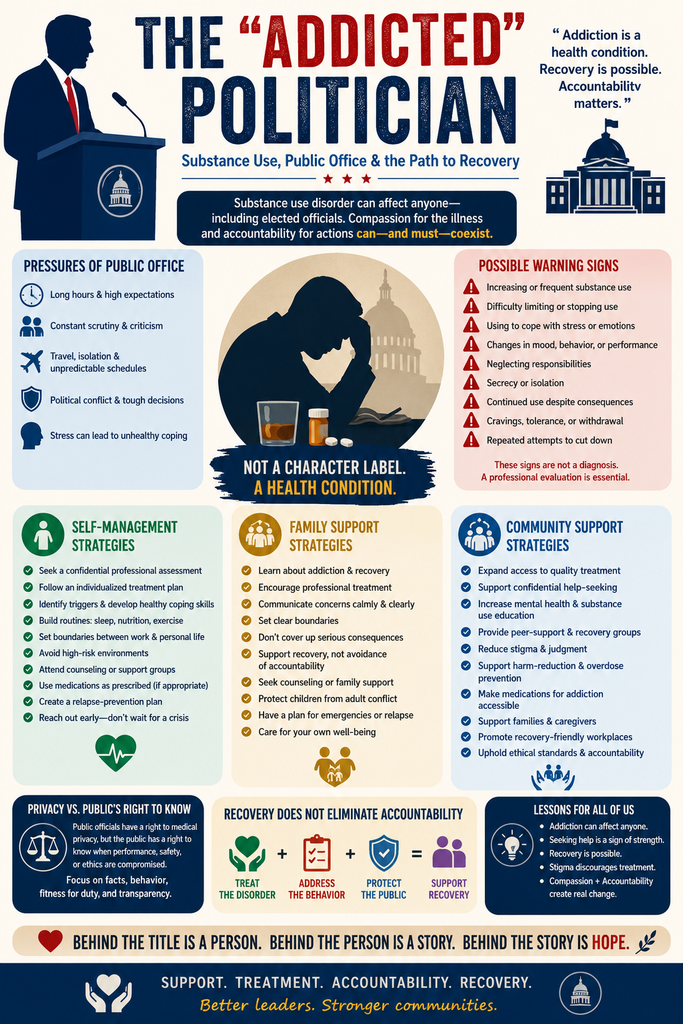
Substance Use and the Pressures of Public Office
Political careers can involve long workdays, high expectations, limited privacy, intense competition, and continual evaluation by the public and media. These pressures do not cause addiction by themselves, but chronic stress may contribute to unhealthy coping behaviors in vulnerable individuals.
Alcohol or other substances might initially be used to relax, sleep, socialize, manage anxiety, or temporarily escape stress. Repeated use can become increasingly problematic, particularly when the person begins relying on a substance to function or cope.
Possible warning signs of a developing problem may include:
- Increasing or frequent substance use
- Difficulty limiting or stopping use
- Using substances to manage stress or emotions
- Changes in mood, behavior, sleep, or performance
- Neglecting personal or professional responsibilities
- Increasing secrecy or isolation
- Continuing substance use despite significant consequences
- Experiencing cravings, tolerance, or withdrawal
- Repeated attempts to cut down without lasting success
These signs are not enough to diagnose someone from a distance. A qualified healthcare professional should evaluate suspected substance use disorder.
When Addiction and Public Responsibility Intersect
Substance use disorder deserves appropriate healthcare rather than humiliation. At the same time, elected officials hold positions of public trust. Compassion for an illness and accountability for behavior can coexist.
A substance use disorder does not automatically mean someone is incapable of serving in public office. The more important questions concern whether substance use is impairing judgment, interfering with responsibilities, creating safety concerns, or contributing to unethical or unlawful behavior.
Treatment addresses the health condition. Accountability addresses the consequences of a person’s actions. Neither needs to eliminate the other.
Self-Management Strategies
For a public official experiencing substance-related problems, acknowledging the problem may be particularly difficult because disclosure could have personal, professional, and political consequences. Nevertheless, early intervention can prevent problems from becoming more severe.
Helpful self-management strategies can include:
- Seek a confidential assessment from an addiction professional.
- Develop an individualized treatment and recovery plan.
- Identify occupational and emotional triggers for substance use.
- Establish healthy boundaries between work and personal life.
- Build regular routines for sleep, nutrition, exercise, and stress management.
- Avoid environments strongly associated with previous substance use.
- Develop alternatives for coping with criticism, anxiety, anger, and exhaustion.
- Participate consistently in counseling or recovery support.
- Take prescribed addiction medications appropriately when clinically indicated.
- Develop a relapse-prevention plan before a crisis occurs.
- Identify trusted people who can recognize early warning signs.
- Seek immediate professional assistance following a return to substance use rather than hiding it.
Recovery should not depend entirely on willpower. Substance use disorders often require structured, evidence-based treatment and continuing support.
Family Support Strategies
Addiction rarely affects only one person. Spouses, partners, children, parents, and other relatives may experience fear, anger, embarrassment, confusion, or exhaustion. When the individual is a public figure, family members may also face unwanted media attention.
Families can support recovery while maintaining appropriate boundaries.
Helpful strategies include:
- Learn about substance use disorders and recovery.
- Encourage professional treatment rather than attempting to manage the addiction alone.
- Communicate concerns calmly and specifically.
- Avoid covering up serious consequences of substance use.
- Establish clear boundaries concerning unacceptable behavior.
- Separate support for recovery from protection against accountability.
- Consider individual or family counseling.
- Protect children from unnecessary exposure to adult conflicts.
- Develop a family plan for emergencies or relapse.
- Respect appropriate medical privacy.
- Seek support for caregivers and family members themselves.
Supporting someone does not require tolerating dangerous, abusive, deceptive, or destructive behavior.
Community Support Strategies
Recovery becomes more sustainable when people have access to treatment and supportive communities. This principle applies regardless of whether someone works in a factory, hospital, school, corporate office, or government building.
Communities can help by:
- Expanding access to evidence-based addiction treatment.
- Supporting confidential pathways for professionals seeking help.
- Increasing access to mental health and substance use screening.
- Providing peer-recovery programs and mutual-help groups.
- Educating the public about substance use disorders.
- Reducing stigma surrounding treatment and recovery.
- Supporting harm-reduction and overdose-prevention programs.
- Making medications for substance use disorders accessible when appropriate.
- Offering resources to affected families.
- Encouraging recovery-friendly workplaces.
- Promoting ethical systems for addressing impairment in safety-sensitive positions.
Public discussion also matters. Media organizations, political opponents, and citizens can scrutinize an official’s conduct without turning addiction itself into a character insult.
Privacy Versus the Public’s Right to Know
Addiction involving an elected official raises a complicated question: How much does the public deserve to know?
Public officials retain legitimate interests in medical privacy. However, voters also have an interest in knowing about circumstances that substantially interfere with an official’s ability to perform public responsibilities or create significant safety, ethical, or legal concerns.
A balanced approach focuses less on speculation about diagnoses and more on observable conduct, fitness for duty, transparency where legitimately required, and accountability for decisions made while holding office.
Recovery Does Not Eliminate Accountability
One of the most important lessons in discussing addiction and political leadership is that explanation is not the same as excuse.
Substance use can contribute to impaired judgment, impulsivity, secrecy, and poor decision-making. However, a diagnosis does not automatically absolve one of responsibility for misconduct. If laws, ethical standards, or professional responsibilities have been violated, appropriate accountability may still be necessary.
Likewise, accountability should not prevent someone from receiving treatment.
A healthier framework is:
Treat the disorder. Address the behavior. Protect the public. Support recovery.
Challenging the “Addicted Politician” Label
Calling someone an “addict” can reduce an entire person to a medical condition. Person-first language such as “a person with a substance use disorder” emphasizes that addiction is something a person experiences rather than their complete identity.
This distinction is especially important in politics, where stigmatizing labels can become political weapons.
Public conversations should therefore distinguish among verified facts, allegations, observable behavior, and medical diagnoses. Unless a politician has publicly disclosed a diagnosis or reliable documentation establishes it, outsiders should not diagnose that individual based on rumors, photographs, speeches, political disagreements, or unusual behavior.
What the Public Can Learn
Substance use disorder does not respect social status, education, income, occupation, political party, or professional achievement. A person can appear highly successful while privately struggling with alcohol or other drugs.
The broader lessons include:
- Professional success does not provide immunity from addiction.
- Chronic stress can make healthy coping strategies especially important.
- Seeking treatment should not automatically be interpreted as weakness.
- Recovery and public accountability can exist simultaneously.
- Families need support as well as the person experiencing addiction.
- Relapse can signal the need to reassess treatment rather than abandon recovery.
- Public figures should not be diagnosed through political speculation.
- Stigma can discourage people from seeking treatment early.
- Recovery is possible even when substance use has caused serious consequences.
Conclusion
The idea of the “addicted politician” raises questions that extend far beyond politics. It forces society to consider how we respond when substance use disorder affects someone with significant authority and responsibility. Neither stigma nor denial provides an adequate solution.
A person in public office who develops a substance use disorder deserves access to evidence-based treatment, family support, and opportunities for recovery. At the same time, public responsibilities require appropriate standards of safety, ethical behavior, transparency, and accountability.
Ultimately, addiction should not become a partisan weapon or a reason to abandon accountability. It should remind us that substance use disorders can affect anyone. By combining self-management, supportive families, accessible community resources, evidence-based treatment, and responsible accountability, recovery can be supported while preserving the trust required of those who serve the public.
Frequently Asked Questions
Here are some common questions:
1. What does the term “addicted politician” mean?
It is an informal and potentially stigmatizing phrase referring to a politician who has or is suspected of having a substance use disorder (SUD). A more appropriate description is “a politician or public official with a substance use disorder.” Addiction is a treatable health condition and should not be assumed without credible evidence.
2. Can politicians develop substance use disorders?
Yes. Addiction can affect people regardless of education, income, occupation, social status, or political affiliation. Holding public office does not protect someone from developing problems involving alcohol or other drugs.
3. Does the stress of political office cause addiction?
Not necessarily. Addiction develops through a combination of biological, psychological, social, and environmental factors. However, chronic stress, long working hours, travel, public criticism, isolation, and occupational pressure may contribute to unhealthy coping behaviors in vulnerable individuals.
4. What are possible warning signs of substance use disorder?
Warning signs may include increasing substance use, unsuccessful attempts to cut down, cravings, tolerance, withdrawal, secrecy, relationship problems, declining performance, and continued use despite harmful consequences. These signs require professional assessment and should not be used to diagnose a public figure from afar.
5. Should the public know if a politician has an addiction?
Public officials retain legitimate medical privacy. However, the public may have a valid interest when a health condition substantially affects an official’s ability to perform their duties, creates safety concerns, or contributes to unethical or unlawful conduct. The appropriate balance depends on the circumstances.
6. Can a politician continue serving while receiving addiction treatment?
Potentially. Having a substance use disorder does not automatically make someone incapable of holding public office. Fitness to serve depends on factors such as functioning, safety, responsibilities, treatment progress, and applicable legal or ethical requirements.
7. Does addiction excuse misconduct by a politician?
No. Addiction may help explain certain behaviors, but it does not automatically excuse misconduct. Treatment and accountability can coexist. A person can receive compassionate healthcare while remaining responsible for actions that harm others or violate laws or ethical standards.
8. How can politicians manage addiction and recovery?
Recovery may involve professional assessment, counseling, medications when clinically appropriate, peer support, healthy routines, stress management, identifying triggers, avoiding high-risk situations, and developing a relapse-prevention plan. Treatment should be individualized.
9. How can family members support a politician experiencing addiction?
Families can learn about addiction, encourage professional treatment, communicate concerns clearly, establish healthy boundaries, participate in counseling when appropriate, and develop plans for relapse or emergencies. Families should support recovery without covering up dangerous or harmful behavior.
10. What role does the community play in recovery?
Communities can reduce stigma, improve access to evidence-based treatment, provide peer-recovery services, support families, expand overdose-prevention resources, and create environments where seeking treatment is viewed as responsible rather than shameful.
11. Should political opponents use someone’s addiction against them?
Legitimate concerns about behavior, judgment, safety, ethics, or fitness for office can be scrutinized. However, using a medical condition simply to shame or dehumanize someone reinforces stigma and may discourage other people from seeking treatment.
12. Is relapse proof that treatment has failed?
No. A return to substance use can occur during recovery and may indicate that treatment needs to be resumed, intensified, or modified. It should be taken seriously, especially when someone’s responsibilities affect public safety or decision-making.
13. Can someone recover from addiction and remain an effective leader?
Yes. Recovery is possible, and a history of substance use disorder does not automatically determine someone’s future capabilities. Effective recovery usually requires ongoing attention to health, coping strategies, support systems, and personal accountability.
14. Why is person-first language important?
Terms such as “person with a substance use disorder” separate the individual from the illness. Labels such as “addict” can reinforce stereotypes and imply that addiction defines the person’s entire identity.
15. How can the public distinguish legitimate concerns from political speculation?
Focus on verified information and observable conduct rather than rumors. Changes in appearance, unusual speech, political decisions, photographs, or social-media claims are not sufficient evidence to diagnose substance use disorder.
16. What is the central lesson of the “addicted politician” discussion?
Addiction can affect anyone—even people holding positions of considerable authority. Society does not have to choose between compassion and accountability. A responsible response can treat the disorder, address harmful behavior, protect the public, support families, and encourage recovery.
Video: The Reality of Addiction in Public Office 🏛️ #awareness #shorts