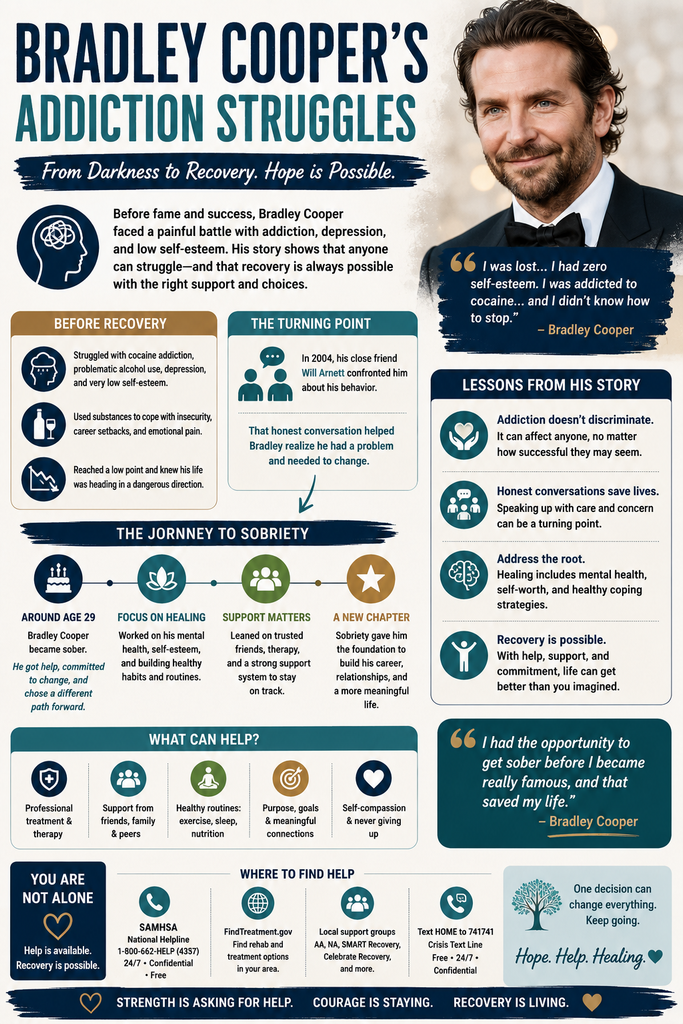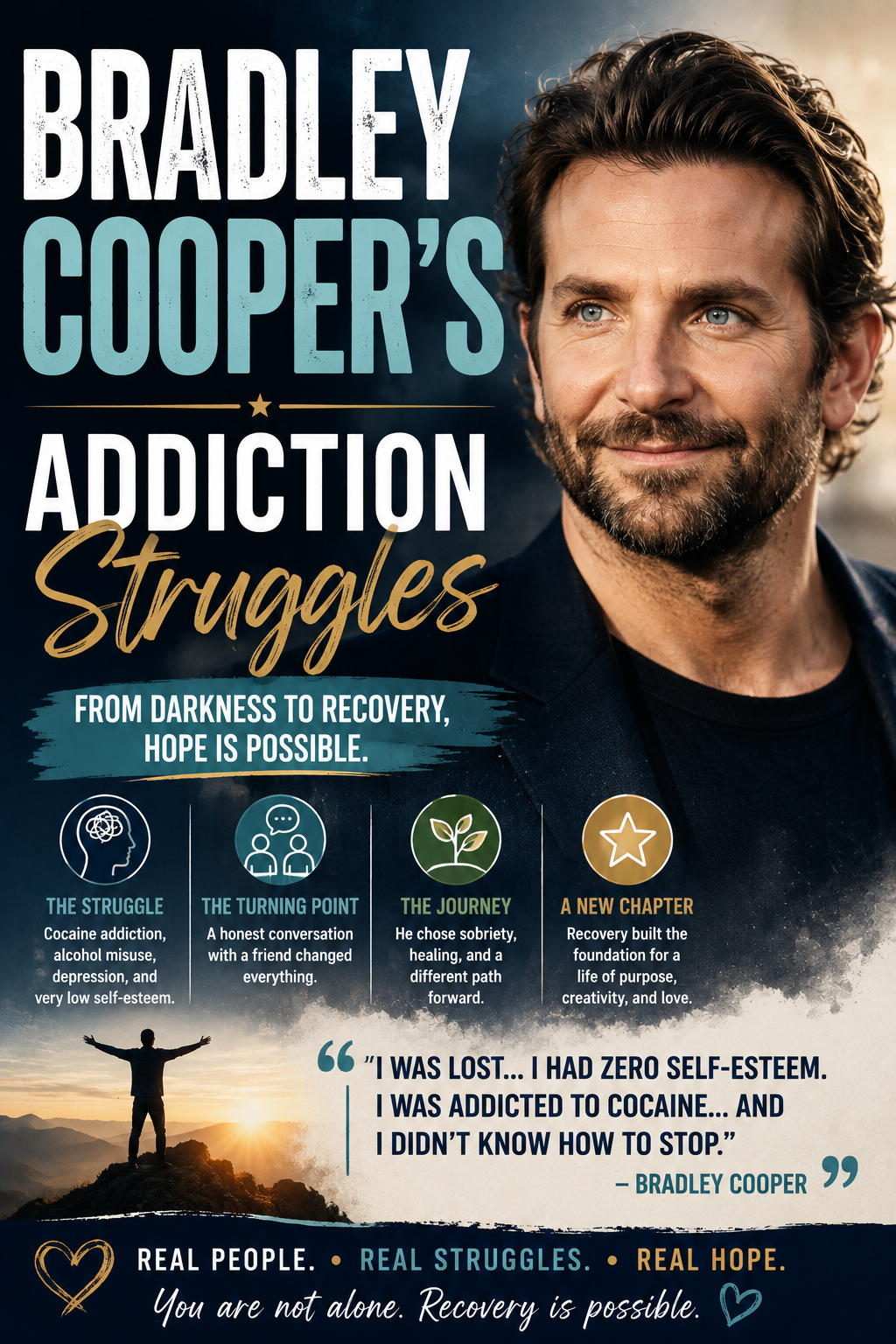
Bradley Cooper’s experience with addiction demonstrates that substance use disorders can affect anyone, regardless of talent, ambition, career potential, or eventual success. Before becoming an internationally recognized actor and filmmaker, Cooper has publicly described struggling in his twenties with cocaine addiction, problematic alcohol use, depression, and extremely low self-esteem. He has explained that professional uncertainty and emotional difficulties contributed to a period in which his substance use and behavior became increasingly concerning. A significant turning point came when his friend Will Arnett confronted him about what he was observing, helping Cooper recognize the seriousness of his situation. Cooper has said that he became sober around age 29, illustrating how self-awareness, supportive relationships, and a willingness to change can become important components of recovery.
Bradley Cooper’s Addiction Recovery Story
Bradley Cooper has spoken publicly about struggling with cocaine addiction, alcohol use, depression, and very low self-esteem during his late twenties, before he became one of Hollywood’s most recognizable actors. His story is particularly useful for addiction education because it illustrates how substance use can coexist with professional ambition and outward success—and how an honest intervention from someone close can become a turning point.
Addiction Before Fame
During a 2022 appearance on the SmartLess podcast, Cooper described himself as feeling lost and having “zero self-esteem.” He said he had become addicted to cocaine and was struggling emotionally after career difficulties surrounding his departure from Alias.
Years earlier, Cooper had also described dangerous behavior associated with that period. In a 2012 interview reported by CBS News, he recalled deliberately hitting his head against a concrete floor at a party and eventually needing hospital treatment. Looking at the direction his life was taking, he became afraid he would destroy his potential.
His experience demonstrates an important principle in addiction medicine: serious substance problems are not always obvious from someone’s career, appearance, intelligence, or social status.
Will Arnett’s Intervention
One of the most significant people in Cooper’s recovery story was his friend Will Arnett.
Cooper has described a conversation with Arnett in 2004 as a major turning point. Arnett confronted him about his behavior rather than ignoring what was happening. Cooper later said the conversation helped him recognize for the first time that he had a problem with drugs and alcohol and put him on the path toward changing his life.
More than two decades later, Cooper again credited Arnett with helping him get sober, emphasizing the importance of that difficult conversation.
This part of his story offers an important lesson for families and friends: support sometimes requires compassionate honesty rather than silence or enabling.
Getting Sober at 29
Cooper has said he became sober at approximately 29 years old, years before The Hangover made him an international star. By 2012, he reported that he no longer drank alcohol or used drugs and described sobriety as having helped him considerably.
The timing became significant to him. Cooper later reflected that he had the opportunity to work through many of these problems before enormous fame became part of his everyday life.
Recovery Was About More Than Removing Cocaine and Alcohol
Cooper’s account also demonstrates why addiction recovery often involves more than eliminating the substance.
His descriptions of that period included low self-esteem, feeling worthless, depression, insecurity, and excessive concern about how other people perceived him.
From a recovery perspective, this distinction matters. Stopping alcohol or drugs addresses substance exposure, but sustainable recovery may also require addressing the emotional, psychological, interpersonal, and environmental factors surrounding substance use.
Sobriety and His Career
Cooper’s major professional breakthrough came after he was already sober. The Hangover was released in 2009, followed by increasingly prominent work in acting, writing, producing, and directing.
His trajectory challenges the idea that alcohol or drugs are necessary for creativity, confidence, or success. In Cooper’s case, he has publicly connected sobriety with being able to move forward rather than describing substances as essential to his artistic development.
Recovery Also Influenced His Understanding of Addiction
Cooper later directed and starred in A Star Is Born, portraying musician Jackson Maine, whose story involves severe alcohol and substance problems. While an actor’s personal history should not be treated as identical to a fictional character’s experience, Cooper’s public openness about his own recovery provides meaningful context for his engagement with addiction-related themes.
His recovery experience has also become part of a larger public conversation about sobriety. Rather than presenting addiction solely as scandal or personal weakness, his account emphasizes recognition of a problem, relationships, behavioral change, and long-term recovery.
What Bradley Cooper’s Story Can Teach About Addiction
Several broader recovery principles can be drawn from what Cooper himself has publicly disclosed: addiction can affect successful people; emotional distress and substance use can occur together; friends can play an important role in recognizing concerning behavior; accepting feedback can become a turning point; sobriety does not prevent professional achievement; and long-term recovery is possible.
At the same time, Cooper’s experience should not be treated as a universal recovery formula. He has publicly shared portions of his story, but that does not establish every detail of his treatment. People with substance use disorders may need professional assessment, medications when appropriate, behavioral therapy, residential or outpatient treatment, peer recovery services, family support, or combinations of these approaches.
Key Takeaway
Bradley Cooper’s recovery story is ultimately less about celebrity and more about recognition, connection, and change. During his twenties, he has said that cocaine addiction, alcohol problems, depression, and profound insecurity were threatening his life and potential. A trusted friend was willing to confront what he saw; Cooper became receptive to change, and he achieved sobriety before reaching the highest levels of his career.
His experience provides a useful message for addiction education: a person’s lowest period does not have to determine the rest of their life. Recovery can create the stability needed to rebuild relationships, pursue goals, and develop a different relationship with oneself.
Self-Management Strategies to Understand Bradley Cooper’s Addiction Struggles
Bradley Cooper has publicly discussed experiencing cocaine addiction, problematic alcohol use, depression, and very low self-esteem during his twenties. He has described becoming sober at about age 29 and credited his friend Will Arnett with helping him recognize that his substance use had become a serious problem. His experience can be used as an educational example of how self-awareness, support, behavioral change, and addressing emotional difficulties can contribute to recovery.
1. Recognize when substance use is becoming harmful. One important recovery skill is honestly evaluating the consequences of alcohol or drug use. Changes in relationships, work performance, physical health, mood, finances, judgment, or personal safety can indicate that substance use is becoming increasingly problematic.
2. Examine what is underneath the substance use. Cooper has publicly discussed struggling with low self-esteem and depression during the period when he was using cocaine and alcohol. Substance use can sometimes become a way of escaping insecurity, rejection, loneliness, stress, or emotional pain. Self-management involves asking not only, “What am I using?” but also, “What am I trying not to feel?”
3. Listen when trusted people express concern. Cooper has credited Will Arnett with confronting him about his behavior and helping him recognize that he had a problem. Feedback from trusted friends or family members can provide perspective when substance use has become normalized by the person experiencing it.
4. Identify personal triggers. Keeping track of situations that increase cravings can reveal patterns. Triggers might include rejection, career difficulties, social environments, loneliness, conflict, stress, or certain people and places. Once triggers are recognized, healthier responses can be planned in advance.
5. Develop healthier ways to manage difficult emotions. Exercise, counseling, mindfulness, hobbies, creative activities, structured routines, and supportive relationships can provide alternatives to using substances for emotional regulation. The objective is to develop several coping strategies rather than relying on a single one.
6. Separate self-worth from achievement. Cooper’s account is particularly relevant because he has discussed insecurity surrounding his career before achieving major success. Recovery can involve learning that professional recognition, appearance, money, or social approval cannot reliably regulate self-esteem. Developing a more stable sense of identity may reduce the urge to escape difficult feelings through substances.
7. Build a supportive recovery network. Recovery does not need to be managed alone. Trusted friends, family members, healthcare professionals, therapists, addiction specialists, and peer-support communities can provide different forms of assistance. Cooper’s description of Arnett’s influence demonstrates how a single honest relationship can become a powerful catalyst for change.
8. Create structure in everyday life. Consistent sleep, meals, physical activity, work responsibilities, treatment appointments, and alcohol- and drug-free activities can reduce unstructured periods associated with cravings and impulsive decisions.
9. Protect recovery during success as well as hardship. Stress is not limited to negative experiences. Career advancement, money, celebrations, travel, and increased social opportunities can also expose people to alcohol or drugs. Long-term self-management requires maintaining recovery practices even when life appears to be going well.
10. Address mental health alongside addiction. Cooper has discussed depression and low self-esteem in connection with this period of his life. When depression, anxiety, trauma, or another psychiatric condition occurs alongside a substance use disorder, professional evaluation and appropriate treatment of both can be important.
11. View setbacks as information rather than identity. Recovery is not defined by perfection. When setbacks occur, examining the trigger, emotional state, environment, and decisions leading up to the event can help strengthen the recovery plan. A person’s substance-use history does not need to become their permanent identity.
12. Seek professional help when self-management is insufficient. Self-management strategies complement—not replace—professional addiction treatment. Depending on the substance and severity, treatment may include behavioral therapy, medications, withdrawal management, outpatient or residential services, and peer recovery support. Abruptly stopping some substances, particularly heavy alcohol use, can also require medical supervision.
Key Takeaway
The most useful lesson from Bradley Cooper’s publicly described experience is not that people should copy a celebrity’s specific path to sobriety. Instead, his story illustrates several broader recovery principles: recognize the problem, listen to people who care about you, examine the emotional drivers behind substance use, develop healthier coping mechanisms, and accept support.
Cooper’s later professional success also demonstrates an important recovery message: sobriety does not require giving up ambition, creativity, or achievement. Recovery can instead provide the stability necessary to pursue those goals without relying on alcohol or drugs.
Family Support Strategies to Understand Bradley Cooper’s Addiction Struggles
Bradley Cooper has publicly described struggling with cocaine addiction, problematic alcohol use, depression, and very low self-esteem during his twenties. He has also credited his friend Will Arnett with confronting him about his behavior and helping him recognize that he needed to change. His experience offers several useful lessons for families supporting someone with a substance use disorder (SUD).
1. Learn to recognize addiction as a health condition. Families should understand that addiction involves changes in reward, motivation, judgment, and behavior. Viewing SUD solely as a failure of willpower can increase blame and stigma while making productive conversations more difficult.
2. Look beyond outward success. Cooper’s experience demonstrates that career potential, intelligence, financial resources, or social status do not protect someone from addiction. Families should pay attention to behavioral and emotional changes rather than assuming someone is fine because they continue working or functioning.
3. Address concerning behavior directly. Cooper has described Arnett’s honest confrontation as an important turning point. Families sometimes avoid discussing substance use because they fear conflict or damaging the relationship. Calmly describing specific behaviors and consequences can be more helpful than remaining silent.
4. Use concern rather than humiliation. A productive conversation might focus on observable changes—such as increased substance use, missed responsibilities, dangerous behavior, isolation, or mood changes—rather than labels such as “addict,” “failure,” or “irresponsible.” The objective is to encourage insight and treatment, not win an argument.
5. Understand what may be underneath the substance use. Cooper has publicly discussed low self-esteem and depression during this period. Families can consider whether alcohol or drugs are being used to cope with rejection, loneliness, anxiety, trauma, depression, stress, or feelings of inadequacy. Addressing these issues may be an important part of recovery.
6. Encourage professional evaluation. Family support cannot substitute for addiction or mental health treatment. Families can help identify qualified clinicians, arrange transportation, assist with appointments when appropriate, and encourage participation in treatment, while allowing healthcare professionals to manage clinical decisions.
7. Support treatment for co-occurring mental health concerns. When depression, anxiety, trauma, or another psychiatric condition accompanies substance use, both problems deserve attention. Families should take significant changes in mood, sleep, functioning, or behavior seriously rather than assuming every symptom is caused by substance use.
8. Establish healthy boundaries. Supporting someone does not require accepting dangerous or destructive behavior. Families may need boundaries concerning substances in the home, money, transportation, aggression, childcare, or other responsibilities. Boundaries should protect safety and family functioning rather than serve primarily as punishment.
9. Avoid enabling behaviors. Repeatedly providing money for substances, covering up consequences, making excuses to employers, or rescuing someone from every consequence may unintentionally make continued substance use easier. Families can remain compassionate while declining to participate in behaviors that sustain addiction.
10. Create a recovery-supportive environment. When appropriate, families can reduce exposure to alcohol or drugs at home, plan substance-free activities, encourage healthy routines, and respect the person’s recovery boundaries. Social gatherings do not have to revolve around alcohol.
11. Recognize that recovery belongs to the individual. Families can encourage, support, and establish boundaries, but they cannot force another person to remain sober. Cooper’s story illustrates the importance of receiving honest feedback, but ultimately he had to recognize the problem and make changes himself.
12. Support long-term recovery, not only the initial crisis. Addiction recovery does not necessarily end when substance use stops. Maintaining healthy relationships, coping with stress, managing mental health, avoiding triggers, and continuing appropriate treatment may remain important for years.
13. Take care of the family as well. Addiction can affect the entire household. Family members may experience fear, anger, exhaustion, guilt, or a loss of trust. Counseling, family therapy, education, peer-support groups, and maintaining personal routines can help relatives protect their own well-being.
Key Takeaway
One of the strongest family lessons from Bradley Cooper’s publicly shared recovery story comes from the role of honest human connection. Someone close to him recognized concerning behavior and was willing to address it rather than ignore it.
Families can apply that principle by combining compassion with accountability: recognize the problem, communicate concerns clearly, address underlying emotional difficulties, encourage professional treatment, establish healthy boundaries, and remain supportive of long-term recovery.
The goal is not for families to become therapists or control another person’s sobriety. Their role is to help create an environment in which honesty is possible, treatment is encouraged, harmful behavior is not enabled, and recovery has room to grow.
Community Resource Strategies to Understand Bradley Cooper’s Addiction Struggles
Bradley Cooper has publicly discussed struggling with cocaine addiction, problematic alcohol use, depression, and low self-esteem during his twenties. He has also credited Will Arnett with helping him recognize his substance-use problems. While Cooper’s personal experience should not be treated as a universal treatment model, his story can help communities discuss how early intervention, mental healthcare, supportive relationships, and recovery resources can help people experiencing addiction.
1. Improve access to addiction treatment. Communities need accessible services where individuals can receive screening, assessment, and individualized treatment for substance use disorders (SUDs). Depending on clinical needs, treatment may involve outpatient counseling, intensive outpatient programs, residential treatment, withdrawal management, medications for certain SUDs, or combinations of services.
2. Connect addiction and mental health services. Cooper has publicly discussed depression and low self-esteem during the period when he struggled with substances. Community behavioral-health programs should screen for both SUD and mental health conditions so that depression, anxiety, trauma, and other concerns can be addressed alongside substance use.
3. Strengthen peer recovery programs. Recovery community organizations and peer recovery specialists can provide practical guidance, encouragement, and connection from people with lived experience. Peer support can complement professional healthcare and reduce the isolation that often accompanies addiction.
4. Educate communities about warning signs. Schools, workplaces, healthcare organizations, community centers, and other organizations can provide education about changes that may accompany problematic substance use, such as increasing intoxication, behavioral changes, declining functioning, secrecy, relationship difficulties, or continued use despite harmful consequences.
5. Teach people how to have supportive conversations. Cooper’s description of Arnett’s intervention demonstrates how a trusted person’s concern can sometimes become a turning point. Community education can teach people to describe concerning behavior, express concern without humiliation, encourage professional help, and maintain appropriate boundaries.
6. Reduce stigma surrounding addiction. Celebrity recovery stories can help challenge the assumption that addiction affects only certain types of people. SUD can affect individuals regardless of education, occupation, income, or social status. Community messaging should emphasize that addiction is treatable and seeking help should not be viewed as a personal failure.
7. Expand community mental health resources. Counseling centers, community mental health clinics, crisis services, and primary-care practices can provide opportunities to identify depression, anxiety, trauma, and other problems that may contribute to substance use. Earlier mental health intervention may reduce reliance on alcohol or drugs as coping mechanisms.
8. Engage healthcare professionals in screening. Primary-care clinicians, emergency departments, behavioral-health professionals, and other healthcare settings can screen for risky substance use and provide brief intervention or referral to appropriate treatment. Healthcare encounters may provide opportunities to identify problems before a severe crisis develops.
9. Provide recovery-friendly social opportunities. Community centers, volunteer organizations, fitness programs, recreational groups, faith communities, and recovery organizations can provide substance-free opportunities for connection. Building relationships and meaningful activities can help individuals develop identities and routines that are not centered around alcohol or drugs.
10. Support families and friends. Community services should also assist the people surrounding someone with addiction. Family education, counseling, and peer-support programs can teach relatives about addiction, communication, boundaries, enabling behaviors, treatment options, and long-term recovery.
11. Connect people with reliable treatment directories. In the United States, FindTreatment.gov can help individuals and families locate mental health and substance-use treatment services. Community organizations can incorporate reliable treatment directories into outreach rather than expecting families to navigate complicated treatment systems alone.
12. Develop recovery-supportive workplaces. Cooper’s story also illustrates that substance problems can occur while someone is pursuing a demanding career. Workplaces can provide confidential employee assistance programs, behavioral-health benefits, appropriate medical leave, and recovery-supportive policies that encourage employees to seek treatment before problems become more severe.
13. Create coordinated systems of continuing care. Recovery may involve several community resources simultaneously, including primary care, addiction treatment, psychiatric services, therapy, peer support, housing assistance, employment resources, and family services. Coordinating these resources can reduce gaps in care.
Key Takeaway
Bradley Cooper’s story provides a useful starting point for discussing an important community principle: people experiencing addiction need pathways to help, not simply recognition that a problem exists.
A supportive friend may initiate an important conversation, but communities must provide somewhere for that conversation to lead. Accessible addiction treatment, mental healthcare, peer recovery services, supportive workplaces, family education, stigma reduction, and continuing care create that pathway.
The broader lesson is that recovery becomes more achievable when individuals do not have to navigate addiction alone. A community that recognizes substance use problems early, responds without stigma, and connects people with appropriate professional and social support can create stronger opportunities for long-term recovery.
Frequently Asked Questions
Here are some common questions:
1. What substances did Bradley Cooper struggle with?
Cooper has publicly discussed being addicted to cocaine and having problems involving alcohol during his twenties. He has described this period as occurring before his major rise to fame.
2. When did Bradley Cooper’s addiction problems occur?
His most serious publicly discussed struggles occurred during his twenties. Cooper has said he became sober around age 29, before The Hangover made him internationally famous.
3. What emotional problems did Cooper experience during this period?
Cooper has described having extremely low self-esteem and feeling lost. He has also discussed depression and insecurity surrounding his career and sense of self-worth. These experiences demonstrate why mental health and substance use frequently need to be considered together.
4. Did career difficulties contribute to his struggles?
Cooper has described experiencing professional uncertainty during this period, including difficulties surrounding his time on Alias. Career problems were part of the broader emotional context he has discussed, although it would be inappropriate to attribute his addiction to any single event.
5. Who helped Bradley Cooper recognize his addiction?
His friend Will Arnett played an important role. Cooper has described a conversation in which Arnett confronted him about his behavior as a major turning point that helped him recognize that he had a problem.
6. Why was that conversation so important?
People experiencing addiction may minimize or normalize their behavior. A trusted person’s specific, compassionate observations can sometimes help someone recognize consequences they have been unable or unwilling to see themselves.
7. Did Bradley Cooper go to rehabilitation?
Cooper has publicly discussed becoming sober, but people should be careful about claiming specific treatment details he has not personally confirmed. His story should therefore not be presented as evidence that one particular recovery method works for everyone.
8. Did Cooper become sober before becoming famous?
He was already a working actor, but he has emphasized that he addressed his substance problems before reaching the extraordinary level of fame that followed films such as The Hangover. He has described that timing as important to his life.
9. How did sobriety affect his career?
His greatest professional successes occurred after he became sober. His subsequent career demonstrates that sobriety and creativity or professional ambition are not incompatible.
10. Did becoming successful cure his addiction?
Success should not be viewed as a treatment for addiction. Money, recognition, relationships, or professional achievement cannot substitute for recovery. Cooper’s experience is particularly useful because his recovery preceded many of his biggest accomplishments.
11. What does his experience teach about self-esteem and addiction?
Low self-esteem does not automatically cause addiction, but emotional distress can contribute to substance use for some people. Cooper’s account illustrates the importance of examining what emotional needs or difficulties may exist alongside alcohol or drug use.
12. What role can friends and family play in recovery?
Trusted people can identify concerning changes, communicate honestly, encourage professional help, establish healthy boundaries, and provide continuing support. Arnett’s role in Cooper’s story demonstrates how an honest conversation can sometimes become a catalyst for change.
13. Can confrontation make addiction worse?
Aggressive, humiliating confrontation can damage communication. Expressing concern is generally more constructive when it focuses on specific behaviors and consequences rather than attacking someone’s character. The objective should be helping the person recognize risk and access appropriate support.
14. Does Bradley Cooper’s experience prove that people can overcome addiction without professional treatment?
No. A celebrity’s publicly available recovery story does not provide enough information to determine every treatment or support they received. Substance use disorders vary considerably, and many people benefit from professional addiction treatment, behavioral therapy, medications when appropriate, and peer recovery services.
15. Did his addiction experience influence A Star Is Born?
Cooper later directed and starred in A Star Is Born, which portrays severe alcohol and substance problems. His personal recovery history provides relevant context, but the fictional character’s experiences should not be treated as a direct representation of Cooper’s own life.
16. What can families learn from Cooper’s recovery story?
One major lesson is not to assume that someone is doing well simply because they are talented, employed, or successful. Families should pay attention to significant changes in mood, behavior, relationships, substance use, and functioning.
17. What can someone struggling with addiction learn from his experience?
A useful lesson is the importance of recognizing the problem, accepting support, examining underlying emotional difficulties, and making sustained changes. However, another person’s recovery path should offer encouragement rather than serve as a treatment blueprint.
18. What is the biggest misconception his story challenges?
It challenges the belief that addiction only affects people who have visibly “lost everything.” Substance use disorders can occur among highly functional, ambitious, talented, and successful individuals.
Conclusion
Bradley Cooper’s addiction and recovery story provides a powerful example of how recognizing a substance-use problem can become the beginning of meaningful change. His experience highlights the importance of addressing not only alcohol or drug use but also underlying issues such as depression, low self-esteem, emotional distress, and unhealthy coping mechanisms. It also demonstrates the potential value of trusted friends and family members who are willing to express concern rather than ignore destructive behavior. Cooper’s later success should not be interpreted as a universal recovery pathway, but his publicly shared experience reinforces an important message: addiction does not have to define a person’s future. With recognition of the problem, appropriate support, healthier coping strategies, and sustained commitment to recovery, individuals can rebuild their lives, relationships, sense of purpose, and hope for the future.
Video: What Bradley Cooper learned from his struggles #mentalhealth #inspiration