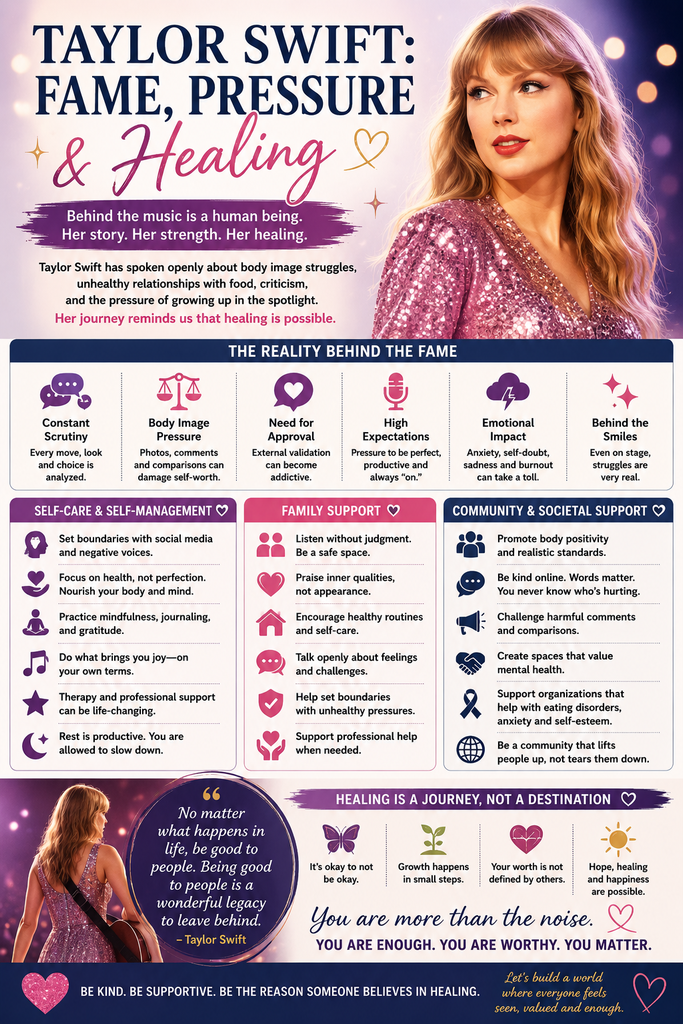
Taylor Swift is one of the world’s most recognizable musicians, but extraordinary success has not protected her from emotional struggles. Throughout her career, Swift has spoken about the psychological effects of intense public scrutiny, criticism, expectations, body-image pressure, and an unhealthy relationship with food. Her experiences demonstrate an important lesson: someone can appear confident, productive, and successful while privately struggling with self-worth and emotional well-being.
Swift’s story should not be used to diagnose her from a distance. Instead, her own disclosures provide an opportunity to discuss body image, disordered eating, perfectionism, external validation, public criticism, and the importance of healthier coping strategies.
Growing Up Under Constant Scrutiny
Swift entered the music industry as a teenager. As her career grew, so did public attention to virtually every aspect of her life.
Her music, appearance, weight, relationships, friendships, clothing, political opinions, and personality have all been discussed publicly.
Constant evaluation can create tremendous psychological pressure.
For someone repeatedly exposed to criticism, possible emotional consequences may include:
- Anxiety and excessive worry
- Fear of making mistakes
- Perfectionistic thinking
- Low self-esteem
- Constant comparison with others
- Body dissatisfaction
- Sensitivity to criticism
- People-pleasing behaviors
- Difficulty separating personal worth from achievement
- Emotional exhaustion
Public figures experience these pressures on an enormous scale, but similar patterns can occur in workplaces, schools, families, relationships, and social media environments.
Taylor Swift’s Body-Image Struggles
One of Swift’s most significant mental-health disclosures involved her relationship with food and her body.
She has discussed how photographs and comments about her appearance could trigger negative thoughts about her body. She described periods of restricting food and exercising excessively while receiving positive reinforcement for being thin.
This demonstrates how external validation can unintentionally reinforce unhealthy behavior.
If someone repeatedly receives praise after losing weight, she may begin connecting thinness with approval, success, attractiveness, or personal worth.
Over time, the thought pattern can become:
Being thinner = approval
Gaining weight = failure
That relationship can become psychologically and physically dangerous.
The Impossible Standard of Perfection
Women frequently receive contradictory messages about appearance.
Be thin—but not too thin.
Be confident—but not arrogant.
Be attractive—but don’t appear to be trying too hard.
Be successful—but remain universally likable.
Swift has discussed experiencing conflicting beauty expectations and learning that satisfying every standard was essentially impossible.
This realization is important because perfectionism can create a goal that can never actually be achieved.
The healthier goal is to accept that no person can satisfy everyone’s expectations.
External Validation and Self-Worth
Swift has also discussed how strongly she once depended on approval.
This psychological pattern is not unique to celebrities.
Someone who depends heavily on external validation may feel wonderful when praised but experience intense distress when criticized.
Social media can intensify this cycle.
Likes, comments, followers, views, rankings, reviews, and other measurements can turn personal approval into something that appears measurable.
The problem arises when the mind begins believing:
“If people approve of me, I have value.”
A healthier belief is:
“Other people’s opinions may affect me, but they do not determine my worth.”
Fame and the Pressure to Be Perfect
Success can create its own psychological challenges.
The more someone achieves, the more she may fear losing what she has accomplished.
This can produce pressure to:
- Work constantly
- Avoid mistakes
- Maintain a certain appearance
- Keep everyone satisfied
- Remain productive despite exhaustion
- Monitor public opinion
- Compare current success with previous achievements
- Hide vulnerability
- Prove herself repeatedly
Eventually, achievement can stop feeling rewarding because every accomplishment immediately creates another expectation.
Mental health requires making room for a person’s identity outside performance and productivity.
Self-Management Strategies
People experiencing body-image difficulties, perfectionism, overwhelming criticism, or excessive dependence on external approval can practice healthier coping strategies.
Helpful approaches include:
- Identify emotional triggers. Notice whether certain photographs, comments, social media accounts, people, or situations increase negative self-talk.
- Reduce body checking. Constantly weighing, measuring, photographing, or inspecting the body can reinforce preoccupation.
- Challenge perfectionism. Replace “I must do this perfectly” with “I can do this well without being perfect.”
- Limit harmful social media exposure. Unfollow accounts that consistently create feelings of inadequacy or unhealthy comparison.
- Separate worth from appearance. Personal value includes character, relationships, abilities, creativity, compassion, and much more than physical appearance.
- Protect nutrition and physical health. Restrictive eating and excessive exercise can have serious medical consequences.
- Develop coping strategies unrelated to appearance. Music, hobbies, mindfulness, journaling, exercise for health rather than punishment, and supportive relationships can help.
- Practice self-compassion. Speak to yourself as respectfully as you would speak to someone you care about.
- Recognize when professional help is needed. Persistent food restriction, bingeing, purging, compulsive exercise, intense fear surrounding food, or severe body dissatisfaction deserves professional attention.
- Allow yourself to rest. Productivity should not determine personal worth.
Family Support Strategies
Families can significantly influence how someone learns to think about appearance, achievement, and emotional health.
Helpful family strategies include:
- Avoid criticizing someone’s weight or body shape.
- Avoid labeling foods as morally “good” or “bad.”
- Praise qualities beyond physical appearance.
- Encourage balanced eating and healthy movement rather than extreme dieting.
- Listen without immediately trying to solve the problem.
- Take changes in eating behavior seriously.
- Avoid comparing siblings or family members.
- Encourage breaks from overwhelming social media.
- Support professional treatment when needed.
- Avoid telling someone to “just eat” or “stop worrying about your weight.”
- Learn about eating disorders and body-image concerns.
- Create an environment where emotional struggles can be discussed openly.
Families should remember that eating-related problems are not simply about food. Emotional, psychological, biological, and social factors can all be involved.
Community Support Strategies
Mental-health recovery should not depend entirely on individual willpower.
Community resources may include:
- Primary care clinicians
- Mental-health counselors
- Psychologists and psychiatrists
- Registered dietitians experienced in eating disorders
- Eating-disorder treatment programs
- Peer-support organizations
- School and university counseling programs
- Employee assistance programs
- Community mental-health centers
- Body-image education programs
- Crisis mental-health services
Schools, workplaces, entertainment industries, and social media communities can also help by reducing appearance-based criticism and promoting healthier conversations about bodies.
Social Media and Body Image
Social media creates unprecedented opportunities for comparison.
People may compare their ordinary lives with carefully selected photographs, professionally styled celebrities, filtered images, or edited videos.
This can create unrealistic expectations.
A healthier digital environment may involve:
- Following diverse body types
- Unfollowing accounts that consistently trigger insecurity
- Taking regular social media breaks
- Remembering that photographs represent moments rather than complete lives
- Avoiding commenting on people’s weight
- Focusing on health rather than appearance
- Recognizing advertising and image manipulation
Digital boundaries are increasingly becoming part of emotional self-care.
Recovery Is More Than Changing Your Appearance
Body-image recovery does not necessarily mean loving every part of your appearance every day.
A more realistic goal may be reaching a point where appearance no longer controls eating, relationships, happiness, or self-worth.
Someone can learn:
My body does not have to be perfect to deserve nourishment.
My appearance does not determine whether I deserve respect.
I can take care of my body without punishing it.
My value does not rise or fall with someone else’s opinion.
These beliefs can take time to develop.
What Taylor Swift’s Story Can Teach Us
Swift’s public disclosures demonstrate how praise and criticism can influence behavior in unexpected ways.
Complimenting extreme thinness may unintentionally reinforce unhealthy restriction.
Constantly discussing someone’s body can create psychological pressure even when comments are intended as compliments.
Social approval can become addictive when personal worth depends on receiving it.
And external success does not guarantee internal confidence.
These lessons apply far beyond celebrity culture.
When Professional Help Is Important
Body-image concerns warrant professional evaluation when they begin to affect eating, exercise, relationships, physical health, concentration, or everyday functioning.
Warning signs may include significant food restriction, compulsive exercise, binge eating, purging behaviors, intense fear of weight gain, rapid changes in weight, dizziness, fainting, social withdrawal, or obsessive thoughts about food and appearance.
Eating disorders can have serious medical consequences. Early professional assessment is important.
Conclusion
Taylor Swift’s publicly described struggles with body image, restrictive eating, external validation, criticism, and overwhelming public pressure reveal a side of success that audiences do not always see.
Her experiences remind us that mental health cannot be judged by someone’s achievements, appearance, wealth, or popularity.
Healing may involve challenging perfectionism, reducing unhealthy comparison, nourishing the body appropriately, establishing boundaries around criticism, developing an identity beyond appearance, and seeking professional support when necessary.
Perhaps one of the most important lessons is that a person cannot build lasting self-worth entirely from applause.
Applause eventually stops.
Comments change.
Bodies change.
Careers change.
But learning to treat yourself with respect provides a foundation that does not have to disappear when other people’s opinions do.
You do not have to become perfect to become healthier. You can learn to value yourself while you are still growing.
Frequently Asked Questions
Here are some common questions:
1. Has Taylor Swift publicly discussed struggles with mental health and body image?
Yes. Taylor Swift has publicly discussed body-image struggles, disordered eating, intense criticism, the desire for approval, and the emotional pressures associated with fame. In Miss Americana, she described how comments and photographs about her appearance could trigger restrictive eating behaviors.
2. How did fame affect Taylor Swift emotionally?
Swift has described living under enormous scrutiny, with her music, appearance, relationships, decisions, and public statements repeatedly evaluated. She has said that periods of widespread criticism became overwhelming enough that she felt she needed to restructure her life to protect her mental health.
3. Did Taylor Swift struggle with disordered eating?
Yes. Swift has publicly described restricting her diet and exercising excessively earlier in her career. She explained that praise for being thin could reinforce unhealthy behavior and that she later recognized the importance of eating adequately to maintain her health and energy.
4. What contributed to her body-image struggles?
Swift has described being affected by photographs, comments about her appearance, beauty standards, and praise for fitting into smaller clothing sizes. She eventually recognized that constantly trying to meet changing appearance standards was unrealistic and unhealthy.
5. Did Taylor Swift depend on other people’s approval?
Swift has acknowledged that approval was once extremely important to her. In Miss Americana, she discussed how praise became connected with feeling that she was doing something right, including in relation to her body.
6. Can constant criticism affect mental health?
Yes. Persistent criticism and public scrutiny can contribute to stress, self-doubt, anxiety, body dissatisfaction, and unhealthy coping behaviors. Swift’s experiences provide a high-profile example of how external judgments can influence someone’s internal sense of self.
7. Does success protect someone from mental-health struggles?
No. Achievement, wealth, popularity, and professional success do not guarantee emotional well-being. Someone may be highly successful while privately experiencing anxiety, insecurity, disordered eating, grief, burnout, or other psychological difficulties.
8. What does Taylor Swift’s experience teach about perfectionism?
Her story illustrates the danger of allowing self-worth to depend entirely on achievement or approval. Constantly trying to satisfy changing expectations can create a standard that is impossible to maintain.
A healthier goal is progress and well-being rather than perfection.
9. What self-management strategies can help with similar pressures?
Helpful strategies may include:
- Limiting exposure to triggering social-media content
- Challenging negative self-talk
- Avoiding excessive body checking
- Eating consistently and adequately
- Exercising for health rather than punishment
- Developing interests beyond appearance and achievement
- Establishing boundaries around criticism
- Practicing mindfulness or journaling
- Maintaining supportive relationships
- Seeking professional help when eating or emotional difficulties become persistent
10. How can families support someone struggling with body image?
Families can avoid criticizing weight or appearance, discourage extreme dieting, praise qualities unrelated to physical appearance, encourage balanced nutrition, listen without judgment, and take significant changes in eating or exercise seriously.
11. What should families avoid saying?
Comments such as “You look so skinny,” “Have you gained weight?” or “Just eat normally” may unintentionally increase distress.
Instead, families can focus on health, emotions, behavior, and overall well-being rather than appearance.
12. How can social media affect body image?
Social media can expose people to edited photographs, appearance-focused commentary, unrealistic comparisons, and constant feedback. Even well-intentioned discussion about another person’s body can contribute to body dissatisfaction, which is why experts increasingly recommend reducing appearance-focused commentary.
13. What community resources can help?
Support may come from:
- Primary care clinicians
- Mental-health counselors
- Psychologists and psychiatrists
- Registered dietitians experienced with eating disorders
- Eating-disorder treatment programs
- School or university counseling services
- Peer-support organizations
- Community mental-health centers
- Crisis services
14. When should someone seek professional help for eating concerns?
Professional evaluation is important when someone frequently restricts food, binges, purges, exercises compulsively, experiences intense fear surrounding weight or food, becomes dizzy or weak, or finds that body-image concerns interfere with everyday life.
Eating disorders can have serious physical and psychological consequences.
15. Is body acceptance the same as loving your appearance every day?
No. Body acceptance can mean treating the body with respect even when someone does not feel completely confident about their appearance.
The goal can become:
“I don’t have to love everything about my appearance today to nourish and care for my body.”
16. Can talking openly about body-image struggles help others?
Potentially. A 2024 study examining thousands of online comments found that Swift’s disclosures about body image and disordered eating were associated with healthier attitudes among many fans discussing their own relationships with food and their bodies, although appearance-focused commentary about Swift continued.
17. Should Taylor Swift be given a mental-health diagnosis based on public information?
No. It is better to distinguish between struggles she has publicly described and psychiatric diagnoses. A person’s interviews, documentaries, music, and public behavior are not substitutes for a confidential clinical assessment.
18. What is the biggest lesson from Taylor Swift’s journey?
Her experiences illustrate that fame and achievement cannot eliminate emotional vulnerability. Constant criticism, unrealistic beauty expectations, perfectionism, and dependence on external approval can affect even extremely successful people.
Healing may involve changing the relationship with food and the body, setting boundaries, accepting imperfection, building self-worth beyond appearance, and seeking support when necessary.
Video: Taylor Swift’s Body Image Struggles