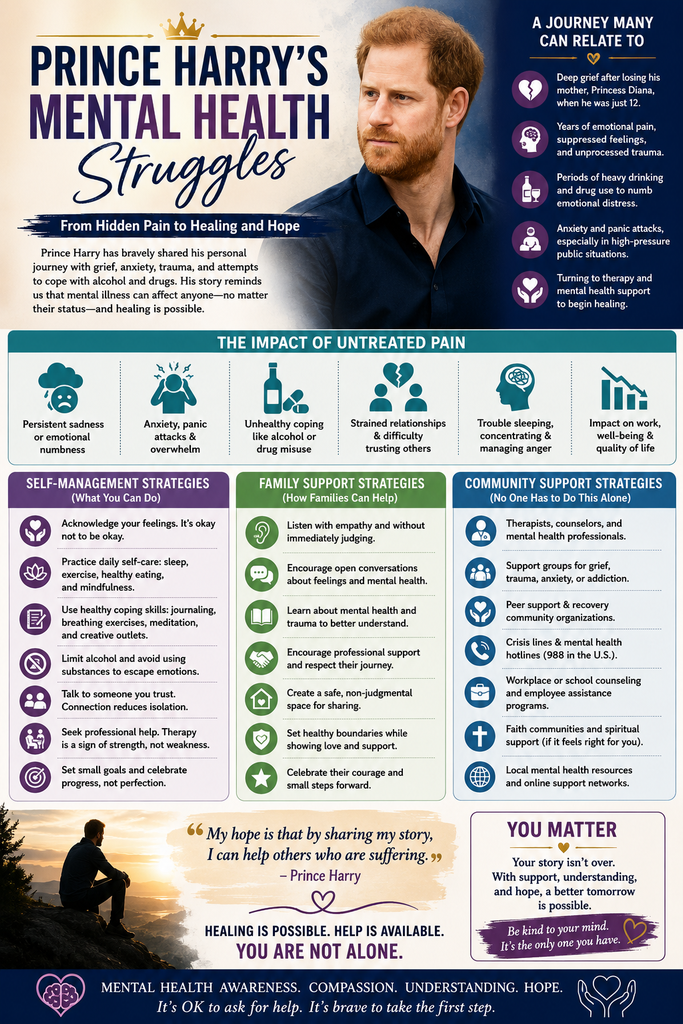
Prince Harry, Duke of Sussex, has spoken publicly about experiencing significant emotional struggles following the death of his mother, Princess Diana. He was only 12 years old when she died in a car crash in 1997, an experience he has repeatedly described as profoundly affecting his life. In later interviews, documentaries, and his memoir Spare, Harry discussed grief, anxiety, panic attacks, emotional numbness, anger, and attempts to escape painful feelings.
His experiences demonstrate an important mental-health lesson: wealth, status, fame, and privilege do not provide immunity from grief or psychological distress. His story also illustrates how unresolved emotional pain can remain hidden for years before a person recognizes the need for help.
Losing His Mother at a Young Age
The death of a parent can be especially difficult for a child. Harry experienced this loss while simultaneously living under extraordinary public attention.
Images of 12-year-old Harry walking behind his mother’s coffin during her funeral became internationally recognized. Behind that public moment was a child attempting to understand an enormous personal loss.
Harry has described suppressing his feelings and having difficulty processing his mother’s death.
Unresolved grief can sometimes contribute to:
- Persistent sadness or emotional numbness
- Anger and irritability
- Anxiety
- Difficulty trusting others
- Avoidance of painful memories
- Sleep disturbances
- Relationship difficulties
- Risk-taking behaviors
- Alcohol or drug misuse
- Difficulty discussing emotions
Grief itself is not a mental illness. However, persistent or severe symptoms can sometimes contribute to significant psychological distress and deserve professional attention.
Anxiety and Panic Attacks
Harry has publicly described experiencing anxiety and panic attacks, particularly around public appearances and royal responsibilities.
A panic attack can involve an intense surge of fear or discomfort accompanied by physical symptoms.
Someone experiencing a panic attack may notice:
- Rapid heartbeat
- Sweating
- Shaking
- Shortness of breath
- Chest discomfort
- Dizziness
- Nausea
- Feelings of losing control
- An overwhelming urge to escape
Repeated panic symptoms can become especially difficult when someone fears experiencing another episode in public.
For Harry, being constantly photographed and scrutinized added another dimension to these experiences.
Trauma and the Constant Presence of the Media
Harry has frequently connected his emotional struggles with both his mother’s death and his experiences with intense media attention.
Traumatic experiences can affect how someone responds to perceived threats. Certain sounds, locations, photographs, news coverage, anniversaries, or situations may trigger strong emotional reactions because they become associated with earlier painful experiences.
Trauma responses can involve:
- Hypervigilance
- Avoidance
- Emotional numbness
- Irritability
- Difficulty concentrating
- Intrusive memories
- Sleep problems
- Anxiety
- Strong reactions to reminders of previous experiences
Not everyone exposed to trauma develops a trauma-related disorder. Diagnosis requires an appropriate clinical assessment.
Emotional Avoidance and Unhealthy Coping
Harry has also publicly discussed periods of heavy drinking and drug use while trying to manage difficult emotions.
This illustrates an important connection between mental health and substance use.
Someone experiencing unresolved grief, anxiety, or trauma may discover that alcohol or drugs temporarily reduce emotional discomfort. Unfortunately, substances do not resolve the underlying problem and can introduce additional health, relationship, and behavioral consequences.
A cycle can develop:
Emotional pain → avoidance → substance use or risky behavior → temporary relief → consequences → additional distress
Breaking this cycle often requires addressing both the behavior and the emotional experiences underneath it.
Seeking Therapy
Harry has described eventually seeking professional therapy after years of avoiding his grief.
Therapy can provide a structured environment for understanding emotional experiences, recognizing triggers, developing coping strategies, and processing difficult memories.
Seeking therapy does not mean someone has failed to cope independently.
Sometimes recognizing “I cannot keep handling this the same way” is an important turning point.
Self-Management Strategies
People experiencing grief, anxiety, trauma-related symptoms, or emotional distress can develop strategies that support recovery and emotional stability.
Helpful approaches include:
- Recognize emotional triggers. Identify situations, memories, anniversaries, relationships, or environments that increase distress.
- Allow grief to be expressed. Suppressing painful emotions indefinitely may interfere with healthy processing.
- Practice grounding techniques. Slow breathing and attention to the immediate environment may help during periods of intense anxiety.
- Maintain consistent routines. Regular sleep, meals, exercise, and daily structure can support emotional regulation.
- Reduce unhealthy coping behaviors. Alcohol and drugs may provide temporary relief while worsening emotional difficulties over time.
- Limit overwhelming media exposure. Constant exposure to distressing information can increase anxiety for some individuals.
- Journal thoughts and emotions. Writing can help identify patterns and triggers.
- Stay connected. Isolation can make emotional distress more difficult to manage.
- Practice self-compassion. Emotional recovery does not happen according to a perfect schedule.
- Seek professional help when symptoms interfere with everyday functioning.
Family Support Strategies
Families can play an important role in mental-health recovery. Support does not require understanding exactly what another person is experiencing.
Family members can:
- Listen without immediately giving advice.
- Avoid minimizing grief or anxiety.
- Allow someone to discuss painful memories when they are ready.
- Encourage counseling or professional treatment.
- Learn about anxiety, grief, trauma, and substance use.
- Watch for significant changes in behavior.
- Encourage healthy routines.
- Maintain appropriate boundaries.
- Avoid enabling harmful coping behaviors.
- Ask directly about safety when someone expresses hopelessness or suicidal thoughts.
- Consider family counseling when relationships have been significantly affected.
- Seek support for themselves when caregiving becomes overwhelming.
Sometimes the most valuable family message is simply:
“You do not have to manage this alone.”
Community Support Strategies
Mental-health recovery extends beyond the individual and family. Community resources can provide professional expertise, peer connection, crisis intervention, and ongoing support.
Resources may include:
- Primary care professionals
- Licensed mental-health counselors
- Psychologists and psychiatrists
- Trauma-informed therapists
- Grief counselors
- Substance use treatment professionals
- Peer-support programs
- Community mental-health centers
- Bereavement support groups
- Veterans’ mental-health services when applicable
- Employee assistance programs
- Faith communities when consistent with personal preferences
- Crisis and emergency mental-health services
Support groups can be especially valuable because they remind individuals that difficult emotional experiences are not something they must face in isolation.
Breaking Generational Patterns
Harry has also spoken publicly about wanting to approach emotional health differently within his own family.
Families sometimes pass coping patterns from one generation to another—not necessarily intentionally.
These patterns might include:
- Avoiding difficult conversations
- Suppressing grief
- Discouraging emotional vulnerability
- Using substances to cope
- Refusing counseling because of stigma
- Expecting people to remain strong regardless of emotional pain
Recognizing an unhealthy pattern creates an opportunity to change it.
Breaking generational patterns does not require blaming previous generations. It involves deciding which behaviors should continue and which should end.
Mental Health Does Not Discriminate
Prince Harry’s experiences reinforce a broader reality: psychological distress can affect anyone.
A person can be wealthy and experience anxiety.
A person can be famous and experience profound grief.
A person can have a supportive partner and still need professional treatment.
A person can appear successful while privately struggling.
Mental health should therefore be evaluated according to someone’s experiences and symptoms rather than assumptions based on social status.
When Professional Help Is Important
Occasional sadness, anxiety, or stress is part of normal human experience. Professional evaluation becomes particularly important when symptoms are persistent, worsening, interfering with relationships or responsibilities, contributing to substance misuse, or creating concerns about personal safety.
Thoughts of suicide or self-harm require immediate attention. In the United States, people experiencing a suicidal or mental-health crisis can call or text 988 for crisis support. Immediate danger requires emergency services.
Conclusion
Prince Harry’s publicly described mental-health journey illustrates the long-term impact that grief, trauma, emotional suppression, anxiety, and extraordinary public pressure can have on someone’s well-being. His eventual decision to discuss therapy and mental health also demonstrates that emotional struggles do not need to remain hidden indefinitely.
His experience should not be used to diagnose him from a distance. Instead, it provides an opportunity to understand a broader lesson about mental health.
Pain that remains unspoken can influence behavior for years. Healing often begins with acknowledging what happened, understanding how it continues to affect the present, and becoming willing to accept support.
Through self-management, supportive families, professional treatment, and community resources, people can develop healthier relationships with difficult experiences.
The goal is not to erase the past. It is to reach a point where the past no longer controls the future.
Frequently Asked Questions
Here are some common questions:
1. Has Prince Harry publicly discussed his mental health?
Yes. Prince Harry has spoken publicly about grief, anxiety, panic attacks, emotional distress, and the effects of losing his mother, Princess Diana, when he was 12. He has also discussed seeking therapy and becoming more willing to address his emotions.
2. What contributed to Prince Harry’s mental health struggles?
Harry has connected much of his emotional distress to the death of his mother, the pressure of growing up in the public eye, intense media scrutiny, and years of suppressing difficult emotions. Mental health is complex, however, and it would be inappropriate to attribute someone’s psychological condition to one cause without a clinical assessment.
3. How did Princess Diana’s death affect Prince Harry?
Harry has described his mother’s death as profoundly affecting him. He has spoken about suppressing his grief for years and struggling to fully process the loss. Childhood bereavement can influence emotional well-being differently for every person.
4. Did Prince Harry experience anxiety and panic attacks?
Harry has publicly described experiencing severe anxiety and panic attacks, including distress associated with public appearances. Panic attacks can involve rapid heartbeat, sweating, shaking, shortness of breath, dizziness, chest discomfort, and an intense feeling of losing control.
5. Has Prince Harry said he experienced trauma?
Yes. Harry has frequently discussed trauma in connection with his mother’s death, media attention, and other life experiences. However, discussing traumatic experiences is not necessarily the same as having a particular trauma-related psychiatric diagnosis.
6. Did Prince Harry use alcohol or drugs to cope?
Harry has publicly discussed periods of heavy drinking and drug use and has connected some of this behavior with attempts to escape or numb difficult emotions. His experience illustrates why substance use and mental health should sometimes be evaluated together.
7. Does this mean Prince Harry has a substance use disorder?
Not necessarily. Public reports of drinking or drug use are not sufficient to diagnose a substance use disorder. Diagnosis requires assessment of factors such as loss of control, impairment, consequences, tolerance, withdrawal, and patterns of continued use.
8. Did Prince Harry receive therapy?
Yes. Harry has spoken extensively about participating in therapy and has described it as an important part of understanding his grief, emotions, and past experiences.
9. How can therapy help someone experiencing unresolved grief or trauma?
Depending on the person’s needs, therapy can help someone:
- Process painful experiences
- Recognize emotional triggers
- Develop healthier coping strategies
- Challenge unhelpful thinking patterns
- Improve emotional regulation
- Address anxiety or panic symptoms
- Reduce reliance on unhealthy coping behaviors
- Strengthen relationships and communication
Treatment should be individualized rather than based solely on another person’s experience.
10. Why might someone avoid getting mental health treatment?
Fear of judgment, stigma, family expectations, cultural beliefs, concerns about appearing weak, lack of resources, or difficulty acknowledging emotional pain can delay treatment. Someone who appears successful externally may still be struggling privately.
11. What self-management strategies can help with emotional distress?
Healthy strategies can include regular exercise, adequate sleep, mindfulness, journaling, structured routines, limiting alcohol and other substances, identifying emotional triggers, maintaining supportive relationships, and seeking professional care when symptoms become persistent or disruptive.
12. How can families support someone experiencing mental health difficulties?
Families can listen without judgment, encourage honest conversations, avoid minimizing someone’s experiences, learn about mental health, encourage professional treatment, maintain appropriate boundaries, and take statements about suicide or self-harm seriously.
13. Can family relationships influence mental health?
Yes. Family relationships can provide important emotional protection, but conflict, communication difficulties, unresolved grief, and unhealthy patterns can also contribute to distress. Family counseling may sometimes help people understand these dynamics without requiring that one individual receive all the blame.
14. What does Prince Harry’s story teach about grief?
One important lesson is that grief does not necessarily disappear simply because many years have passed. Avoiding grief may provide temporary emotional protection, while acknowledging and processing loss can be an important part of healing for some people.
15. Does wealth or fame protect someone from mental illness?
No. Mental health problems can affect people across socioeconomic and professional backgrounds. Financial resources may improve access to some forms of care, but they do not eliminate grief, trauma, anxiety, depression, or other psychological difficulties.
16. Why is it important not to diagnose celebrities from a distance?
Mental health diagnoses require careful professional evaluation. Interviews, memoirs, social media posts, and news reports provide only part of someone’s story. It is more responsible to discuss the symptoms and experiences a public figure has disclosed rather than assigning additional diagnoses.
17. What community resources can help people experiencing similar struggles?
Helpful resources may include:
- Primary care clinicians
- Psychologists and psychiatrists
- Licensed mental health counselors
- Grief and bereavement counselors
- Trauma-informed therapists
- Substance use treatment professionals
- Peer-support programs
- Community mental health centers
- Family support organizations
- Crisis and emergency mental health services
18. What is the main lesson from Prince Harry’s mental health journey?
His publicly described experiences demonstrate that emotional pain can exist behind privilege, achievement, and public appearances. Grief and trauma do not have to be handled in isolation, and seeking professional support can be an important part of understanding difficult emotions and developing healthier coping strategies.
Video: