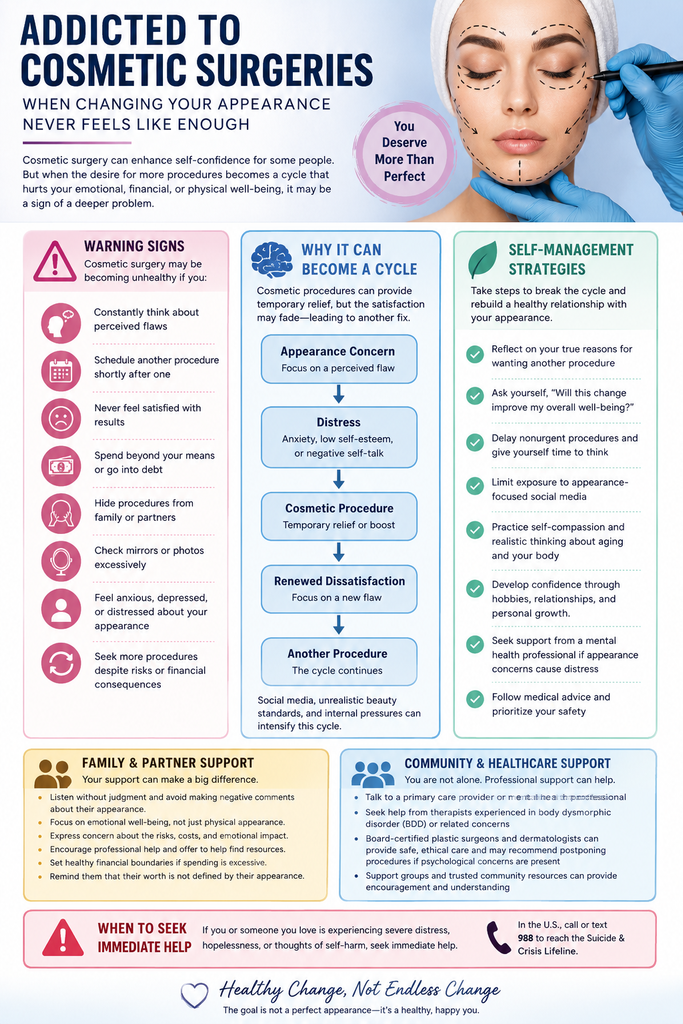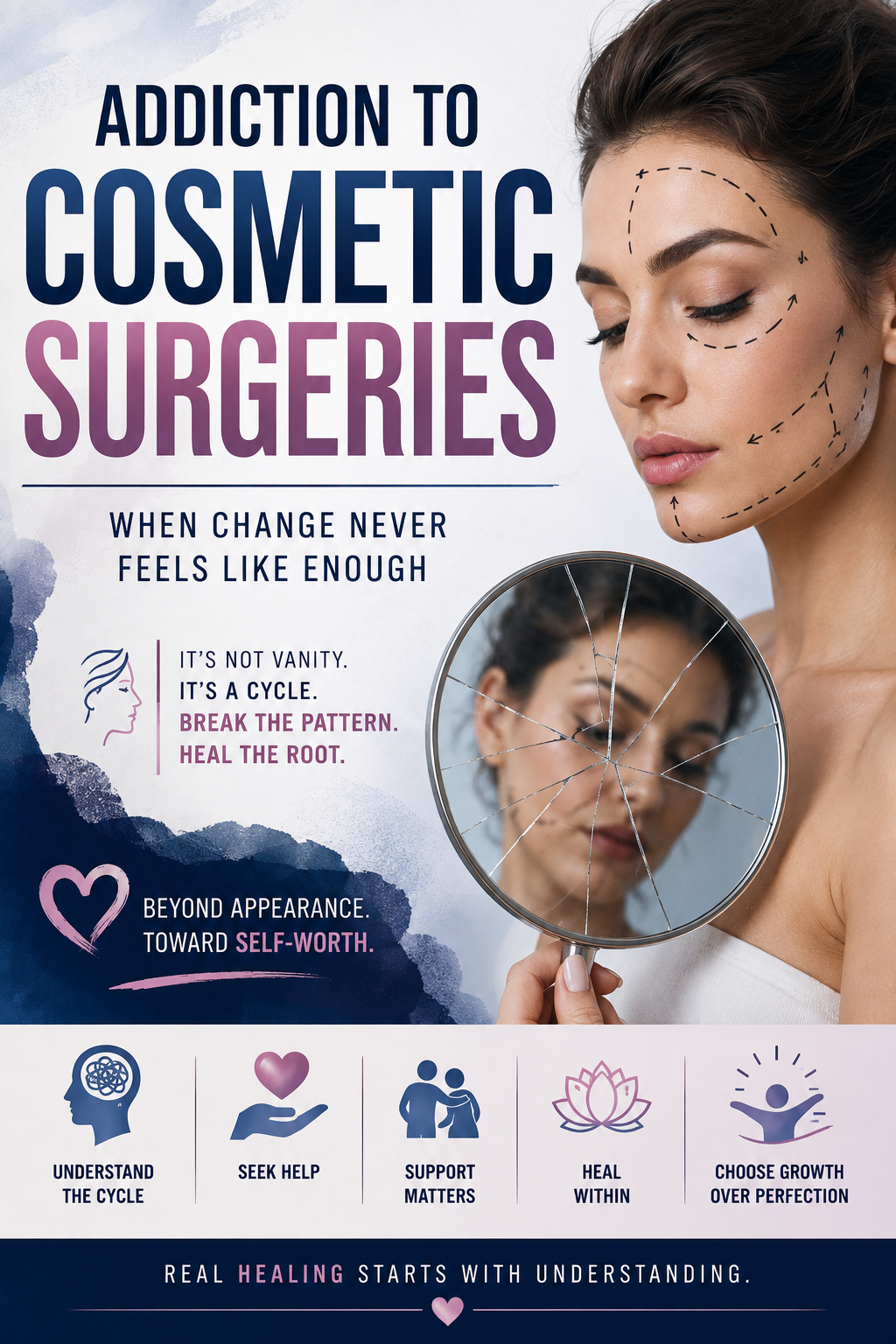
Cosmetic surgery can help some people feel more comfortable with their appearance, and choosing an elective procedure does not mean someone has an addiction or mental health disorder. Concern may arise, however, when a person repeatedly seeks procedures, remains dissatisfied despite successful results, spends beyond their means, takes increasing medical risks, or believes the next operation will finally make them feel acceptable.
The phrase “cosmetic surgery addiction” is commonly used to describe this pattern, although it is not a formal standalone diagnosis in the DSM-5-TR. Repeated procedures may sometimes be associated with body dysmorphic disorder (BDD), anxiety, depression, low self-esteem, perfectionism, social pressures, or compulsive behaviors. Understanding what is driving the desire for continued physical change is therefore just as important as discussing the procedures themselves.
Why Can Cosmetic Procedures Become Compulsive?
Cosmetic procedures can produce powerful emotional rewards. A person may receive compliments, feel temporarily more confident, or experience excitement about a new appearance. Unfortunately, that satisfaction may fade.
The individual may then notice another perceived flaw and begin thinking about another procedure. A cycle can develop:
Appearance concern → distress → cosmetic procedure → temporary relief → renewed dissatisfaction → another procedure
Social media can intensify this process. Filters, edited photographs, celebrity images, and constant comparison can create unrealistic expectations about what normal faces and bodies should look like.
Possible contributing factors include:
- Low self-esteem
- Perfectionism
- Fear of aging
- Body-image dissatisfaction
- Social comparison
- Bullying or previous criticism about appearance
- Relationship insecurity
- Anxiety or depression
- Body dysmorphic disorder
- Desire for validation or approval
- Pressure from social media or beauty standards
Having one or more of these factors does not mean someone will develop problematic behavior.
Warning Signs That Cosmetic Surgery May Be Becoming Unhealthy
The number of procedures alone does not determine whether someone has a problem. Motivation, distress, functioning, medical risk, and ability to control the behavior matter.
Potential warning signs include:
- Constantly thinking about perceived physical flaws
- Scheduling another procedure shortly after completing one
- Never feeling satisfied with results
- Frequently changing surgeons after being advised against additional procedures
- Hiding procedures from family or partners
- Borrowing money or accumulating debt for cosmetic treatments
- Ignoring medical advice about recovery or surgical risks
- Spending excessive amounts of time checking mirrors or photographs
- Avoiding work or social situations because of appearance concerns
- Expecting surgery to solve relationship, career, or emotional problems
- Experiencing severe distress when unable to obtain a desired procedure
These behaviors deserve attention rather than ridicule.
The Connection With Body Dysmorphic Disorder
Body dysmorphic disorder involves an intense preoccupation with perceived defects or flaws in appearance that are minor or not observable to other people. Individuals may repeatedly check mirrors, compare themselves with others, seek reassurance, conceal perceived flaws, or pursue cosmetic procedures.
BDD is different from simply wishing you looked younger or wanting to change a particular feature. It can cause substantial emotional distress and interfere with relationships, employment, education, and everyday functioning.
Cosmetic procedures generally do not treat the underlying psychological symptoms of BDD. A person may initially feel relieved but later become concerned about the same feature or shift attention to another perceived problem.
This is why psychological assessment can be particularly important when appearance concerns are severe or persistent.
Self-Management Strategies
Recognizing the pattern can be the first step toward changing it. The goal does not have to be rejecting every cosmetic treatment. Instead, individuals can learn to distinguish an informed preference for appearance from an emotional need that surgery cannot satisfy.
Helpful strategies include:
- Write down the reason you want another procedure.
- Ask, “What do I expect my life to be like after this change?”
- Consider whether previous procedures provided lasting satisfaction.
- Delay nonurgent procedures while examining your motivation.
- Reduce exposure to appearance-focused social media accounts.
- Avoid repeatedly checking mirrors, selfies, or perceived imperfections.
- Track how much time and money are being spent on appearance concerns.
- Develop sources of confidence unrelated to physical appearance.
- Practice realistic rather than perfectionistic thinking about aging and the body.
- Discuss persistent appearance distress with a mental health professional.
- Follow medical advice about healing and appropriate intervals between procedures.
If the urge to pursue another procedure becomes overwhelming, creating a waiting period before scheduling it can provide time to examine whether the decision is based on a stable preference or temporary emotional distress.
Family and Partner Support Strategies
Watching someone repeatedly undergo cosmetic procedures can be frustrating and frightening. Family members may be tempted to say, “You look fine,” “You’re obsessed,” or “Just stop.” Although understandable, confrontation about appearance may increase shame or defensiveness.
Supportive approaches can include:
- Listen to the person’s concerns without mocking their appearance.
- Focus conversations on emotional distress rather than arguing about whether a flaw exists.
- Avoid repeatedly providing reassurance about perceived imperfections.
- Express concern about medical, emotional, or financial consequences.
- Encourage evaluation by an appropriate mental health professional.
- Offer to attend appointments when the person wants support.
- Establish financial boundaries when cosmetic spending affects shared resources.
- Avoid financing procedures you believe are unsafe or compulsive.
- Encourage hobbies, relationships, and achievements unrelated to appearance.
- Learn about BDD and other body-image concerns.
A helpful message may be: “I can see how much distress your appearance is causing you. I want to help you find support that addresses how you’re feeling, not only how you look.”
Community and Healthcare Support Strategies
Problematic cosmetic surgery behavior may require cooperation among medical, mental health, and social support systems.
Helpful resources can include:
- Primary care professionals
- Psychiatrists
- Psychologists and licensed therapists
- Professionals experienced in body dysmorphic disorder
- Board-certified plastic surgeons and dermatologists
- Cognitive behavioral therapy programs
- Peer or body-image support resources
- Evidence-based mental health organizations
Ethical cosmetic professionals also play an important role. When expectations are unrealistic, medical risks are excessive, or significant BDD symptoms are suspected, postponing a procedure and recommending psychological evaluation may be more appropriate than continuing treatment.
Treatment for the Underlying Problem
When BDD is present, evidence-based mental health treatment can help. Cognitive behavioral therapy is commonly used to address distorted beliefs about appearance, repetitive behaviors, avoidance, and compulsive checking. Certain medications, particularly selective serotonin reuptake inhibitors (SSRIs), may also be considered by qualified healthcare professionals.
Treatment focuses on reducing distress and helping the person function more freely—not convincing someone that appearance should never matter.
Recovery may involve learning to tolerate imperfections, reducing comparison, managing anxiety, developing healthier sources of self-worth, and recognizing that changing the body cannot resolve every emotional problem.
When to Seek Immediate Help
Appearance-related distress can occasionally become severe. Someone expressing hopelessness, suicidal thoughts, or an intention to harm themselves requires immediate mental health support.
In the United States, a person experiencing a suicidal or mental health crisis can call or text 988 to reach the Suicide & Crisis Lifeline. Life-threatening emergencies require emergency medical assistance.
Conclusion
Wanting cosmetic surgery does not automatically indicate addiction, vanity, or mental illness. The concern begins when changing appearance becomes an escalating cycle in which no procedure feels sufficient and emotional, financial, social, or physical consequences continue to grow.
The question may eventually need to shift from “What should I change next?” to “Why does changing my appearance never feel like enough?”
Self-management can help individuals recognize triggers and unrealistic expectations. Families can provide compassionate support while maintaining healthy boundaries, and healthcare professionals can evaluate whether body dysmorphic disorder or another psychological concern is contributing to repeated procedures.
Sometimes the most meaningful transformation does not come from another surgery. It comes from addressing the distress that keeps telling a person they must continually change before they can finally feel comfortable with themselves.
Frequently Asked Questions
Here are some common questions:
1. Can someone actually become addicted to cosmetic surgery?
“Cosmetic surgery addiction” is not a formal standalone psychiatric diagnosis. However, some people can develop a compulsive pattern of repeatedly seeking cosmetic procedures despite medical, emotional, relationship, or financial consequences. The behavior may sometimes be associated with body dysmorphic disorder (BDD), anxiety, depression, perfectionism, or significant body-image concerns.
2. What are the warning signs of problematic cosmetic surgery?
Warning signs can include:
- Constantly thinking about perceived physical flaws
- Never feeling satisfied after procedures
- Quickly planning another procedure
- Seeking multiple surgeons after being refused treatment
- Hiding procedures from family or partners
- Spending beyond one’s means
- Ignoring medical risks or recovery recommendations
- Excessively checking mirrors, photographs, or social media
- Believing another procedure will finally create happiness or acceptance
3. Why can cosmetic procedures become compulsive?
A procedure may temporarily reduce appearance-related anxiety or increase confidence. When that relief fades, the person may focus on another perceived imperfection and seek another treatment. This can create a cycle of appearance concern → distress → procedure → temporary relief → renewed dissatisfaction → another procedure.
4. Is cosmetic surgery addiction the same as body dysmorphic disorder?
No. They are not interchangeable. BDD is a recognized mental health disorder characterized by persistent preoccupation with perceived appearance flaws that are minor or not observable to others, along with repetitive behaviors or significant distress. Some people who repeatedly seek cosmetic procedures may have BDD, while others do not.
5. Does having several cosmetic procedures mean someone has a problem?
Not necessarily. The number of procedures alone does not determine whether behavior is unhealthy. Healthcare professionals consider the person’s motivations, expectations, distress, functioning, financial consequences, medical risks, and ability to control the behavior.
6. Can social media contribute to the problem?
It can. Filters, edited photographs, influencers, celebrity images, and constant comparison may create unrealistic expectations about what normal faces and bodies look like. For someone already struggling with body image, repeated exposure may intensify dissatisfaction.
7. Why doesn’t another surgery always make the person feel better?
Surgery can change physical features but cannot necessarily resolve underlying anxiety, low self-esteem, trauma, perfectionism, relationship problems, or BDD. A person may initially feel satisfied but later become preoccupied with the same feature or another perceived flaw.
8. Can cosmetic surgery affect finances and relationships?
Yes. Repeated procedures can become expensive and may lead to debt, secrecy, disagreements about money, missed work, or relationship conflict. Family members may also become worried about repeated anesthesia, surgical complications, or inadequate recovery time.
9. How can someone manage the urge to have another procedure?
Helpful strategies may include delaying nonurgent procedures, writing down expectations, reducing appearance-focused social media, limiting excessive mirror checking, tracking cosmetic spending, developing interests unrelated to appearance, and discussing persistent concerns with a mental health professional.
10. How can families support someone struggling with repeated cosmetic procedures?
Families can listen without ridicule, focus on the person’s emotional distress rather than debating their appearance, encourage professional evaluation, and establish reasonable financial boundaries. Avoiding comments such as “You’re just being vain” can make productive conversations easier.
11. Should family members constantly reassure the person that they look fine?
Repeated reassurance may provide only temporary relief when severe appearance anxiety or BDD is present. Instead, family members can acknowledge the distress and encourage the person to discuss persistent concerns with a qualified professional.
12. Can a cosmetic surgeon refuse to perform another procedure?
Yes. A responsible clinician may determine that another procedure is medically inappropriate, carries excessive risk, involves unrealistic expectations, or is unlikely to provide the desired benefit. When significant psychological concerns are suspected, mental health evaluation may be recommended.
13. How is body dysmorphic disorder treated?
Treatment may include cognitive behavioral therapy (CBT) specifically addressing BDD. Certain medications, particularly selective serotonin reuptake inhibitors (SSRIs), may also be prescribed when clinically appropriate. Treatment should be individualized by qualified healthcare professionals.
14. Can someone recover from compulsive cosmetic surgery behavior?
Yes. When the underlying psychological and behavioral factors are identified, treatment can help a person reduce compulsive behaviors, challenge unrealistic beliefs about appearance, manage anxiety, and develop sources of self-worth beyond physical appearance.
15. When should professional help be considered?
Professional evaluation is particularly important when appearance concerns consume significant amounts of time, cause severe distress, interfere with relationships or work, lead to dangerous procedures or debt, or continue despite repeated reassurance and cosmetic treatment.
16. What if appearance concerns lead to thoughts of suicide or self-harm?
Severe body-image distress can become a mental health crisis. In the United States, someone experiencing suicidal thoughts or an immediate emotional crisis can call or text 988 for the Suicide & Crisis Lifeline. If there is immediate danger or a life-threatening emergency, call 911 or seek emergency medical care.
17. What is the most important message about cosmetic surgery and self-worth?
Choosing cosmetic surgery does not automatically indicate a psychological problem. The concern is when changing appearance becomes an endless attempt to resolve distress that physical procedures cannot fix. Healthy recovery focuses not only on changing the mirror, but also on understanding what makes the reflection feel unacceptable in the first place.
Video: Addicted to Cosmetic Surgery