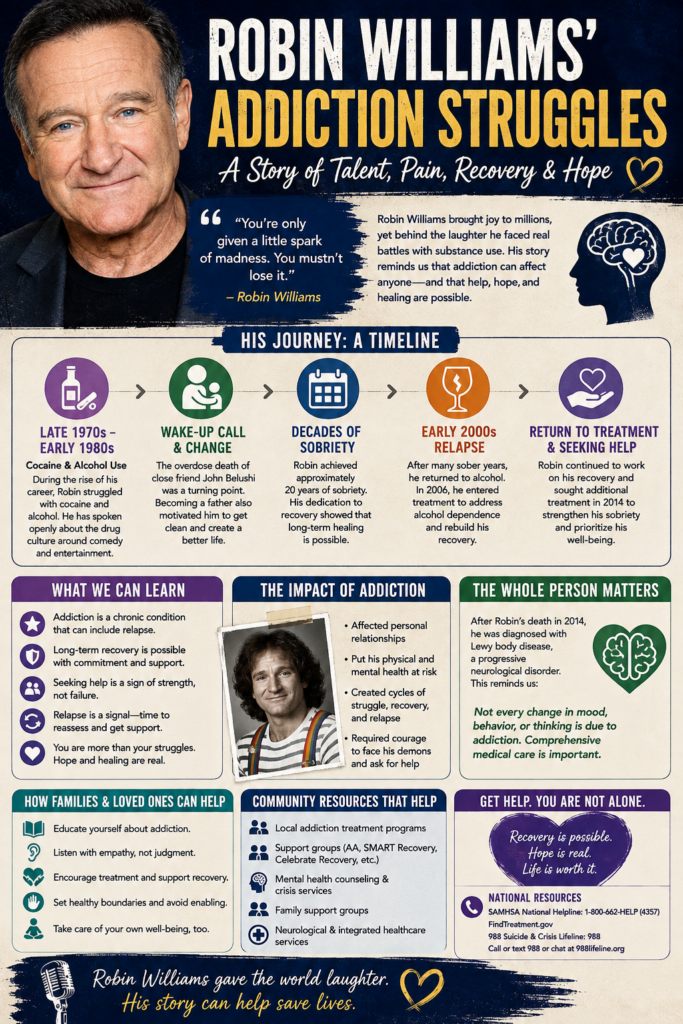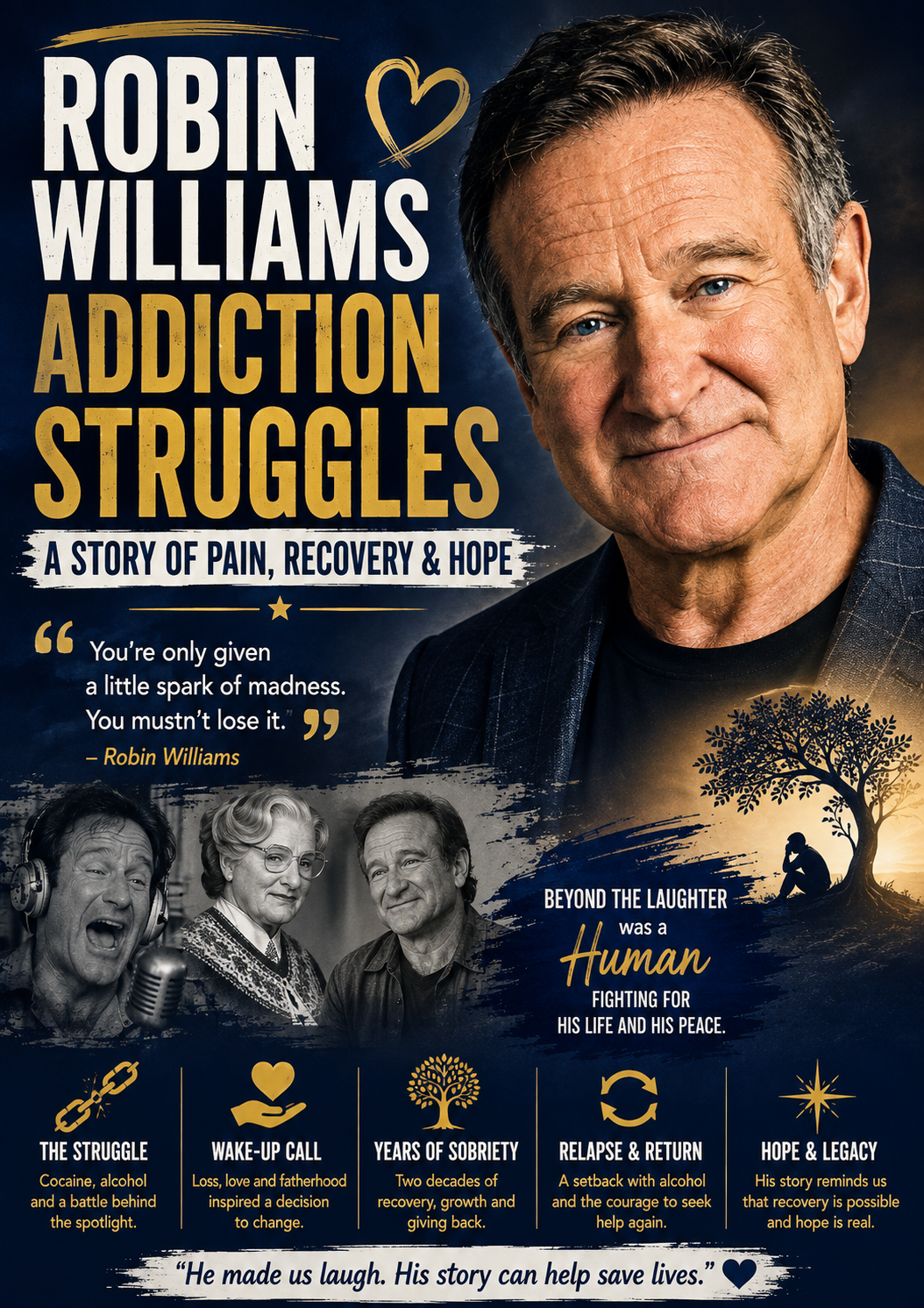
Robin Williams was an internationally celebrated actor and comedian whose extraordinary creativity and humor were matched by personal struggles with substance use. During the late 1970s and early 1980s, Williams experienced problems with cocaine and alcohol before achieving approximately two decades of sobriety. He later returned to alcohol use and sought professional treatment, demonstrating that substance use disorder can remain a long-term vulnerability even after many years of successful recovery. His experience illustrates that addiction can affect anyone, regardless of talent, intelligence, wealth, or professional achievement. Williams’ story also highlights the importance of recognizing triggers, maintaining recovery support, seeking treatment when difficulties return, and understanding relapse as a reason to reassess care rather than erase previous progress.
Robin Williams’ Struggles: Addiction, Recovery, and Relapse
Robin Williams was one of the world’s most celebrated comedians and actors, but behind his extraordinary career, he publicly experienced struggles with cocaine and alcohol use, followed by recovery, relapse, and renewed treatment. His experience provides an important opportunity to understand that addiction can affect people regardless of intelligence, creativity, success, or social status.
Cocaine and Alcohol Use
During the late 1970s and early 1980s, Williams used cocaine and drank heavily while his career was rapidly expanding. He later spoke openly about cocaine use during this period and described the drug culture surrounding comedy and entertainment at the time.
Williams eventually stopped using cocaine. He discussed the death of his friend John Belushi from a drug overdose as an important wake-up call. Becoming a father around the same period also contributed to his decision to change his lifestyle.
Years of Recovery
Williams subsequently maintained sobriety for approximately two decades. This long period is important because it demonstrates that sustained recovery after significant substance use is possible.
Recovery, however, does not necessarily eliminate future vulnerability. Substance use disorder can have a chronic or recurring course for some individuals, meaning that maintaining recovery may require continued awareness of triggers and changes in circumstances.
Alcohol Relapse
After many years without alcohol or drugs, Williams returned to drinking in the early 2000s. He later described how alcohol gradually re-entered his life rather than presenting as an immediate catastrophic event.
In 2006, he entered treatment for alcohol-related problems. His experience demonstrates an important principle of addiction medicine: relapse can occur even after many years of recovery.
A long period of sobriety is not erased by a recurrence of substance use. Instead, relapse can indicate that recovery strategies and treatment need to be reassessed.
Returning to Treatment
Williams sought professional help after his alcohol relapse. In 2014, he also entered a treatment facility to reinforce his sobriety. Contemporary reports described this as a proactive step to maintain recovery rather than evidence that he had necessarily returned to active substance use at that particular time.
This distinction matters. Treatment facilities are not used exclusively during crises. Some people seek structured support to strengthen an existing recovery program.
Addiction and Mental Health
Williams’ story is sometimes simplified into a narrative in which addiction or depression alone explains everything that happened later in his life. His medical history was considerably more complicated.
After his death in August 2014, an autopsy and subsequent medical information showed that he had Lewy body disease, a progressive neurodegenerative disorder. His widow, Susan Schneider Williams, later described severe neurological and psychiatric symptoms that emerged before his death.
Therefore, it would be inaccurate to attribute his death solely to addiction. His substance-use history, mental health, and later neurological illness should be understood as distinct but potentially interacting aspects of his health history.
What Can We Learn From His Experience?
Williams’ experience provides several important lessons in addiction education. Addiction can occur alongside tremendous professional success. Long-term sobriety is achievable, but relapse remains possible. Returning to treatment is an appropriate response when recovery becomes vulnerable. Support from family, healthcare professionals, and recovery communities can remain valuable even after many years without substance use.
His story also demonstrates why healthcare professionals should avoid assuming that every behavioral or emotional change in someone with a history of addiction represents relapse. New anxiety, depression, cognitive changes, sleep disturbances, paranoia, or behavioral changes may require a broader medical and neurological evaluation.
A Legacy Beyond Addiction
Robin Williams should not be defined by addiction or by the circumstances surrounding his death. His substance-use experiences represent only one part of a much larger life and career.
From an addiction-education perspective, his experience carries an important message: recovery can last for decades, relapse does not erase previous progress, and returning to treatment remains worthwhile whenever additional support is needed. At the same time, his later illness reminds us to look at the whole person rather than reducing complex medical and psychological problems to a history of addiction.
Self-Management Strategies for Understanding Robin Williams’ Addiction Struggles
Robin Williams’ publicly discussed history of cocaine and alcohol use, long-term sobriety, later alcohol relapse, and return to treatment provides several useful lessons for understanding the long-term management of substance use disorder. His later neurological illness should be considered separately rather than assuming that every difficulty he experienced was caused by addiction.
- Recognize addiction as a long-term health concern. A person may remain in recovery for many years and still benefit from maintaining awareness of substance-related vulnerabilities. Long-term sobriety does not make earlier recovery work unnecessary.
- Identify personal triggers. Stress, loneliness, major life transitions, social environments, physical illness, relationship difficulties, and emotional distress can increase vulnerability to substance use. Keeping a journal or recovery plan can help identify individual patterns.
- Do not become overconfident after years of recovery. Williams reportedly maintained sobriety for approximately two decades before returning to alcohol. Long-term recovery is a major achievement, but maintaining protective habits and support remains valuable.
- Recognize early warning signs. Increased thoughts about drinking or drugs, isolation, secrecy, changes in routines, reconnecting with high-risk environments, or abandoning recovery activities may indicate that additional support is needed.
- Develop healthier ways to manage stress. Exercise, mindfulness, creative activities, structured routines, adequate sleep, relaxation techniques, hobbies, and supportive social relationships can provide alternatives to using substances to regulate difficult emotions.
- Maintain meaningful social connections. Addiction often becomes more difficult to manage in isolation. Trusted friends, family members, recovery peers, counselors, and healthcare professionals can provide encouragement and recognize changes that an individual may overlook.
- Seek help early rather than waiting for a crisis. Returning to counseling, treatment, or structured recovery support when warning signs appear can prevent problems from worsening. Treatment does not need to be reserved for “rock bottom.”
- Respond constructively to relapse. A return to substance use should prompt questions such as: What changed? What were the triggers? Which recovery supports disappeared? What treatment needs to be adjusted? Relapse does not erase the progress achieved during previous years of recovery.
- Continue recovery maintenance. Recovery may involve counseling, peer-support meetings, medical care, healthy routines, relapse-prevention planning, or other individualized strategies. What works may also change as a person’s life circumstances change.
- Protect physical health. Exercise, nutrition, sleep, preventive healthcare, and management of chronic medical conditions can support overall recovery and emotional resilience.
- Do not assume every symptom is addiction-related. This is an especially important lesson from Williams’ later life. Significant changes in cognition, sleep, mood, anxiety, perception, or behavior deserve appropriate medical assessment. His later symptoms occurred in the context of Lewy body disease, demonstrating why clinicians should consider neurological and other medical explanations rather than automatically attributing symptoms to addiction.
- Develop an identity beyond addiction. Recovery is not simply about avoiding substances. Creativity, meaningful relationships, work, volunteering, spirituality, recreation, and personal goals can provide purpose and strengthen a life in recovery.
Key Self-Management Lesson
Robin Williams’ experience demonstrates that long-term recovery is possible, but it may still require ongoing attention. Effective self-management involves recognizing triggers, maintaining supportive relationships, responding early to warning signs, using healthy coping strategies, and returning to professional care when necessary.
His story also provides another important lesson: a history of addiction should never prevent someone from receiving a thorough evaluation for new physical, psychiatric, or neurological symptoms. Understanding the whole person—not simply the addiction—is essential to effective long-term care.
Family Support Strategies for Understanding Robin Williams’ Addiction Struggles
Robin Williams’ experiences with cocaine and alcohol use, approximately two decades of sobriety, later alcohol relapse, and renewed treatment offer important lessons for families supporting someone with substance use disorder. His later diagnosis of Lewy body disease also demonstrates why families should avoid assuming that every behavioral or emotional change is caused by addiction.
- Learn about addiction as a health condition. Families can educate themselves about substance use disorder, cravings, triggers, relapse, treatment, and recovery. Understanding addiction reduces blame and helps families respond more constructively.
- Recognize that long-term recovery is possible. Williams maintained sobriety for many years. Families should recognize and encourage progress in recovery while understanding that continued support may still be valuable.
- Understand that relapse can occur after years of sobriety. A long period without substance use does not guarantee that vulnerability has disappeared. Families can watch for changes without constantly treating their loved one as though relapse is inevitable.
- Communicate without shame or judgment. Statements such as “You threw everything away” can increase shame after a relapse. Instead, families can focus on what happened, what support is needed, and how to strengthen the recovery plan.
- Recognize early warning signs. Increased isolation, secrecy, mood changes, abandoning recovery routines, romanticizing previous substance use, or returning to high-risk environments may indicate that additional support is needed.
- Encourage treatment before a crisis develops. Williams’ return to structured treatment illustrates that professional help does not have to be reserved for the worst stage of addiction. Families can encourage counseling or treatment when warning signs first appear.
- Support recovery without becoming controlling. Families can encourage appointments, healthy activities, peer support, and treatment while allowing the individual to take responsibility for recovery. Constant surveillance can damage trust and create additional conflict.
- Set healthy boundaries. Supporting someone does not mean tolerating intoxication, verbal abuse, financial exploitation, unsafe driving, or other harmful behavior. Clear and consistent boundaries protect both the individual and the family.
- Avoid enabling substance use. Giving money that may support substance use, repeatedly covering up consequences, making excuses, or assuming responsibilities the person can manage themselves may unintentionally prolong harmful patterns.
- Encourage healthy routines and relationships. Exercise, adequate sleep, hobbies, creative activities, nutritious meals, social connection, and meaningful daily structure can strengthen overall well-being and complement professional treatment.
- Take new symptoms seriously. Williams’ later experience provides an especially important lesson. New problems involving memory, movement, sleep, anxiety, confusion, perception, personality, or behavior should receive appropriate medical evaluation rather than automatically being attributed to substance use or a psychiatric disorder. Williams was found after his death to have Lewy body disease.
- Support the family’s own well-being. Addiction affects the entire family system. Counseling, family therapy, caregiver education, and peer-support programs can help relatives manage stress and establish healthier communication and boundaries.
- Develop a family relapse-response plan. Families can decide in advance whom to contact, which treatment providers are available, what boundaries will apply, and how they will respond if substance use returns. Planning during a stable period can make responding to a crisis easier.
- Separate the person from the addiction. Someone with substance use disorder remains a parent, spouse, sibling, friend, professional, artist, or community member. Avoid allowing addiction to become the person’s entire identity.
Key Family Lesson
Robin Williams’ story demonstrates that families can provide compassion, encouragement, boundaries, and connection to professional care, but they cannot personally control another person’s recovery. Long-term sobriety should be celebrated, while relapse should prompt renewed assessment and support rather than shame.
His later neurological illness provides an equally important lesson: a history of addiction should never become the automatic explanation for every new symptom. Families can advocate for comprehensive medical, psychiatric, and neurological evaluation when significant changes occur, helping ensure that the whole person—not simply their addiction history—is considered.
Community Resource Strategies for Understanding Robin Williams’ Addiction Struggles
Robin Williams’ experiences with cocaine and alcohol use, long-term sobriety, alcohol relapse, and return to treatment provide valuable lessons about the importance of community-based addiction services. His later Lewy body disease also demonstrates why communities need integrated medical, mental health, neurological, and addiction resources.
- Expand access to evidence-based addiction treatment. Communities should provide multiple levels of care, including outpatient treatment, intensive outpatient programs, residential services, medically supervised withdrawal when indicated, and continuing recovery support.
- Provide accessible mental health services. Substance use may coexist with depression, anxiety, trauma, or other psychiatric concerns. Community mental health centers can provide screening, counseling, psychiatric evaluation, and referrals to specialized services.
- Support peer-recovery programs. Recovery community organizations and mutual-support groups can reduce isolation and provide encouragement, accountability, mentorship, and connection with people who understand the challenges of maintaining recovery.
- Develop long-term recovery services. Williams’ years of sobriety followed by later alcohol relapse demonstrate why recovery resources should remain available beyond the initial treatment period. Recovery check-ins, counseling, peer support, and relapse-prevention programs can provide ongoing protection.
- Create relapse-response pathways. Communities should make it easy for people to return to treatment when substance use reappears. A relapse should lead to reassessment and renewed care rather than shame, exclusion, or unnecessary barriers to services.
- Increase family education. Community organizations can teach families about addiction, triggers, relapse warning signs, communication, healthy boundaries, enabling behaviors, and ways to encourage treatment without attempting to control another person’s recovery.
- Integrate addiction and primary healthcare. Primary care clinicians can screen for unhealthy substance use, monitor physical health, discuss medications, and refer patients to behavioral health and addiction specialists when appropriate.
- Improve access to neurological assessment. Williams’ later history is particularly important because significant neurological symptoms eventually occurred in the context of Lewy body disease. Communities need referral pathways that allow cognitive, behavioral, sleep, movement, or perceptual changes to receive appropriate medical and neurological evaluation rather than automatically attributing them to addiction.
- Provide integrated behavioral healthcare. Collaboration among addiction professionals, primary care clinicians, psychiatrists, psychologists, social workers, and neurologists can be especially valuable when symptoms have multiple possible explanations.
- Promote healthy community connections. Recreation programs, arts organizations, volunteering, exercise groups, educational programs, and other community activities can provide purpose and social connection outside environments associated with substance use.
- Address stigma through public education. Celebrity stories can be used carefully to demonstrate that substance use disorder can affect people regardless of intelligence, creativity, income, or professional success. Public education should emphasize that addiction is treatable and seeking help is appropriate.
- Provide support for families and caregivers. Family counseling, caregiver education, and peer-support organizations can help relatives manage stress, establish boundaries, and understand that they also deserve support.
- Educate community professionals about co-occurring conditions. Healthcare professionals, social workers, first responders, and other community providers should recognize that behavioral changes can have psychiatric, substance-related, medication-related, or neurological causes. Comprehensive assessment reduces the risk of prematurely attributing every symptom to a person’s addiction history.
- Strengthen transitions between treatment and the community. After residential or intensive treatment, individuals may benefit from coordinated follow-up involving outpatient care, peer recovery, primary healthcare, housing, employment assistance, and supportive social activities.
Key Community Lesson
Robin Williams’ experience illustrates why communities need a continuum of care that extends beyond detoxification or rehabilitation. Effective community support combines addiction treatment, mental healthcare, peer recovery, family education, primary care, and long-term relapse-prevention services.
His later experience also provides a particularly important healthcare lesson: a history of addiction should not overshadow new medical or neurological symptoms. Community systems work best when they treat the whole person and make it possible to move between addiction, psychiatric, medical, and neurological services as needs change over time.
Frequently Asked Questions
Here are some common questions:
1. What substances did Robin Williams struggle with?
Williams publicly discussed problems with cocaine and alcohol, particularly during the late 1970s and early 1980s. He later achieved long-term sobriety before experiencing problems with alcohol again.
2. When did his substance use become a problem?
His cocaine and alcohol use occurred during a period when his entertainment career was rapidly growing. Williams later spoke openly about the drug culture surrounding comedy and entertainment at that time.
3. What influenced Robin Williams to stop using cocaine?
Williams described the 1982 overdose death of his friend John Belushi as an important wake-up call. Becoming a father around this period was also associated with major changes in his lifestyle.
4. How long was Robin Williams sober?
Williams reportedly maintained sobriety for approximately 20 years before experiencing problems with alcohol again. His experience demonstrates that sustained, long-term recovery is possible.
5. Did Robin Williams relapse?
Yes. After many years of sobriety, Williams returned to alcohol use in the early 2000s. He subsequently sought professional treatment.
6. Did he go to rehabilitation?
Yes. Williams entered treatment for alcohol-related problems in 2006. In 2014, he also spent time at a treatment facility to reinforce his ongoing recovery and sobriety.
7. Does relapse after many years mean recovery failed?
No. A recurrence of substance use does not erase years of recovery. Clinically, it is more useful to determine what changed, identify new or recurring risk factors, and adjust treatment and recovery strategies accordingly.
8. What can his experience teach us about long-term recovery?
It demonstrates that recovery can remain successful for many years while still requiring attention. Maintaining supportive relationships, recognizing triggers, using healthy coping strategies, and seeking help early can remain important throughout recovery.
9. Was Robin Williams using drugs or alcohol when he died?
Toxicology findings reported after his death did not indicate alcohol or illicit drug intoxication as the explanation for his death. This distinction is important when discussing his addiction history.
10. Did addiction cause Robin Williams’ death?
It would be inaccurate to describe his death simply as the result of addiction. Williams died by suicide in 2014, and subsequent examination revealed that he had Lewy body disease, a serious neurodegenerative disorder. His widow, Susan Schneider Williams, later described significant neurological and psychiatric symptoms that occurred during his final months.
11. Why is Lewy body disease important to understanding his story?
Lewy body disease can produce complex cognitive, behavioral, movement, sleep, and psychiatric symptoms. Williams’ experience demonstrates why new symptoms in someone with a history of addiction should not automatically be attributed to substance use or relapse.
12. Did Robin Williams struggle with mental health as well as addiction?
Public accounts describe emotional and psychiatric symptoms during different periods of his life, but retrospective explanations should be approached carefully. His later neurological disease significantly complicates attempts to attribute particular symptoms to one cause.
13. What can families learn from his addiction experience?
Families can learn the importance of compassionate communication, recognizing relapse warning signs, encouraging professional treatment, maintaining healthy boundaries, and supporting long-term recovery without attempting to control it.
14. What should someone do if substance use returns after years of sobriety?
They should consider contacting an addiction medicine professional, therapist, primary-care clinician, recovery program, or other trusted treatment resource. Returning to treatment should be viewed as an appropriate healthcare response rather than something shameful.
15. What is the most important addiction lesson from Robin Williams’ story?
His experience demonstrates that long-term recovery is possible and that relapse does not erase previous progress. It also teaches an equally important medical lesson: clinicians and families should consider the whole person. A history of addiction should never prevent appropriate investigation of new psychiatric, cognitive, physical, or neurological symptoms.
Conclusion
Robin Williams’ addiction struggles provide an important example of both the challenges and possibilities of long-term recovery. His years of sobriety demonstrate that sustained recovery is achievable, while his later return to alcohol and decision to seek additional support illustrate why recovery may require continued attention throughout life. His story also reminds us not to attribute every emotional, behavioral, or cognitive problem in someone with an addiction history to substance use. Williams experienced severe symptoms later in life in the context of Lewy body disease, a complex neurodegenerative disorder discovered after his death. Ultimately, his experiences encourage a compassionate, whole-person approach to addiction—one that recognizes relapse risk, supports renewed treatment, addresses co-occurring medical and mental health concerns, and remembers that a person’s life and identity are far greater than their history of substance use.
Video: What Robin Williams’ Story Teaches Us About Addiction 📚 #inspiration