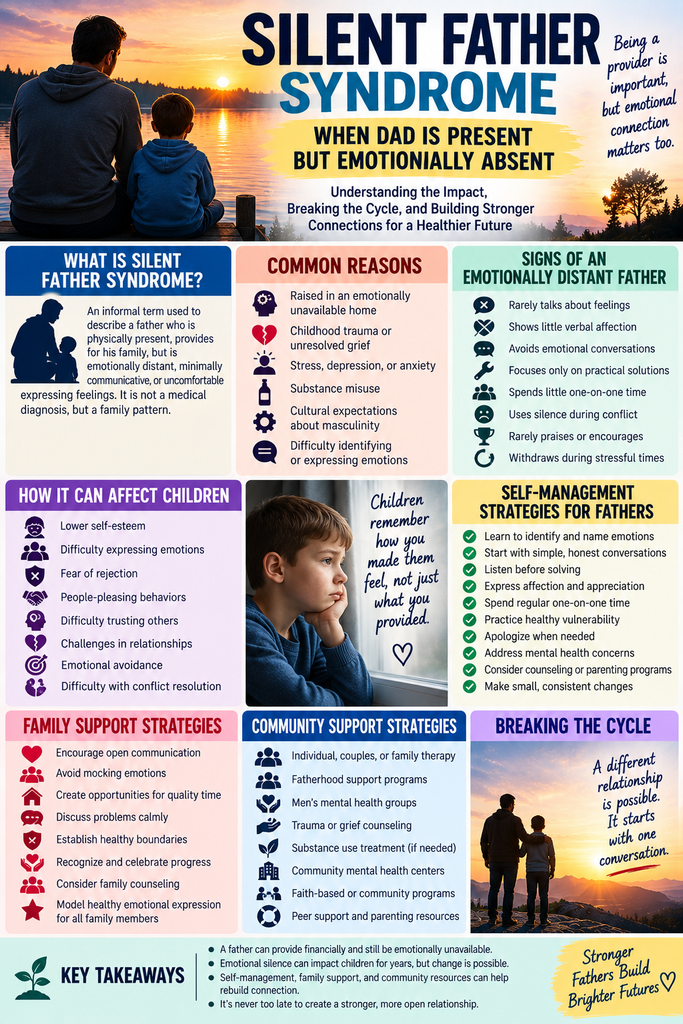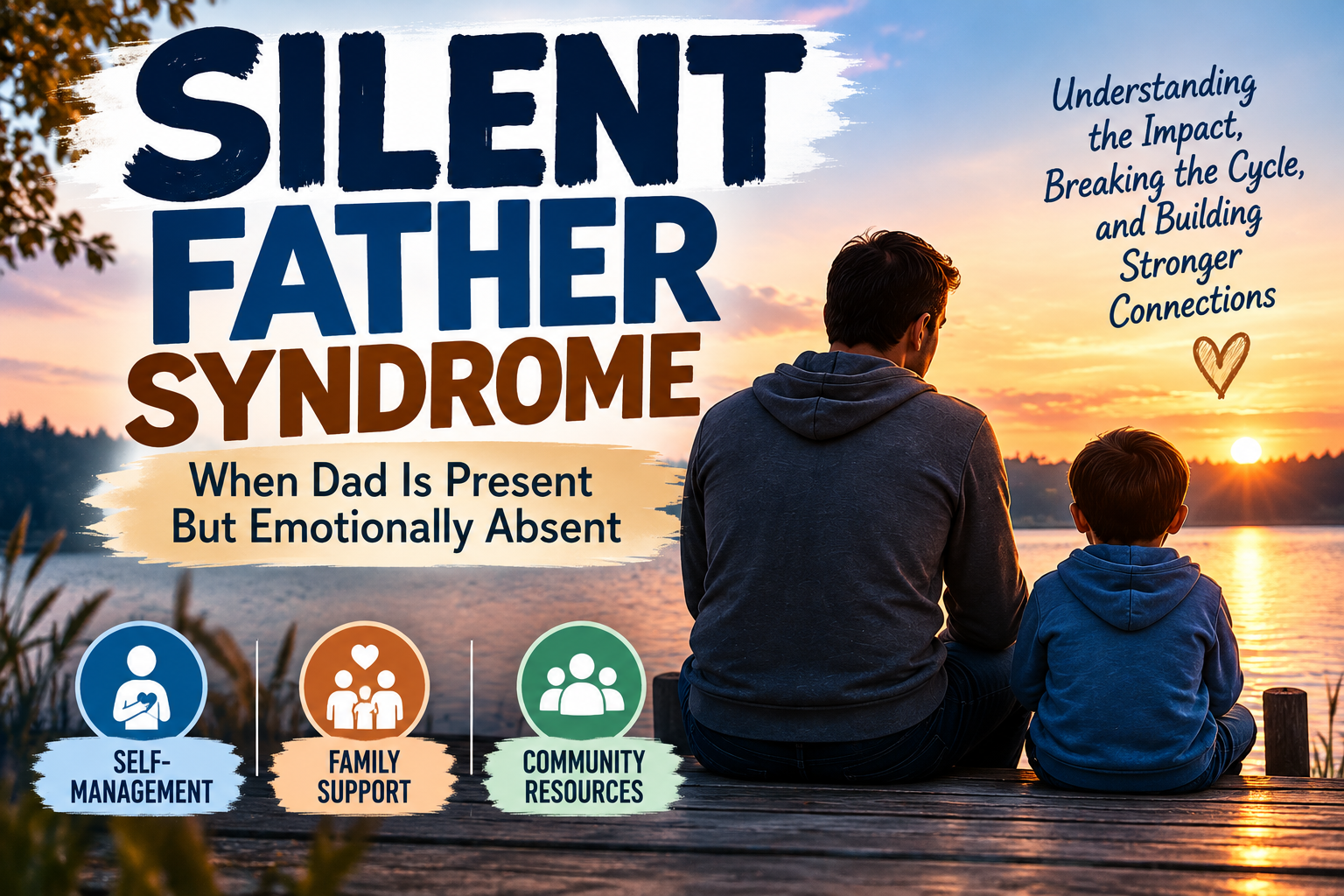
A father may live in the same home, provide financially, attend important events, and fulfill many responsibilities while rarely expressing affection, discussing emotions, or engaging in meaningful conversations with his children. This pattern is sometimes described informally as “Silent Father Syndrome.”
Silent Father Syndrome is not an official mental health diagnosis. Instead, the phrase describes a family pattern in which a father is consistently emotionally withdrawn, minimally communicative, or uncomfortable expressing vulnerability and affection.
For children, the experience can be confusing. They may know their father loves them while rarely hearing the words “I love you,” “I’m proud of you,” or “Tell me what’s bothering you.” Over time, emotional silence can influence how children understand relationships, self-worth, vulnerability, and communication.
Why Some Fathers Become Emotionally Silent
Emotional withdrawal does not necessarily mean a father does not love his family.
Some men were raised in environments where emotional expression was discouraged. They may have learned messages such as:
“Men don’t cry.”
“Handle your problems yourself.”
“Providing for your family is how you show love.”
“Talking about feelings makes you weak.”
A father may therefore genuinely believe that working hard, paying bills, repairing the house, or protecting his family communicates love more effectively than words.
Other possible contributors include:
- Childhood emotional neglect.
- Trauma or unresolved grief.
- Depression or anxiety.
- Chronic stress.
- Relationship difficulties.
- Fear of vulnerability.
- Difficulty identifying emotions.
- Substance misuse.
- Cultural expectations surrounding masculinity.
- Growing up with an emotionally distant father himself.
Understanding these influences can create compassion without dismissing the effects emotional distance may have on children.
When Presence Is Not the Same as Connection
Physical presence and emotional availability are different.
A father can sit at the dinner table every evening while knowing very little about what his child is experiencing emotionally.
Children need more than physical safety and material support. They also benefit from emotional connection—being listened to, comforted, encouraged, praised, and reassured.
When those interactions are consistently missing, children may begin developing their own explanations.
A child might think:
“Dad doesn’t talk to me because I’m not important.”
“Maybe he’s disappointed in me.”
“I shouldn’t bother people with my feelings.”
“If I show emotion, people will reject me.”
These beliefs can sometimes follow children into adulthood.
Possible Signs of an Emotionally Distant Father
Not every quiet father is emotionally unavailable. Some people simply communicate differently or have naturally reserved personalities.
The concern is a persistent pattern in which emotional connection is repeatedly unavailable.
Possible signs include:
- Rarely discussing feelings.
- Avoiding emotionally difficult conversations.
- Showing little verbal affection.
- Difficulty praising or encouraging children.
- Changing the subject when emotions arise.
- Responding to emotional problems only with practical solutions.
- Becoming uncomfortable when children cry.
- Spending little meaningful one-on-one time with children.
- Using silence during family conflict.
- Rarely apologizing or acknowledging mistakes.
- Showing love primarily through financial support or practical tasks.
- Withdrawing during stressful situations.
Consider these behaviors in the broader context of the relationship rather than using them to label someone.
How Emotional Silence Can Affect Children
Children learn about emotions partly through their caregivers.
When feelings are acknowledged, children learn:
“My emotions are understandable.”
When emotions are consistently ignored, they may learn:
“My feelings should remain hidden.”
Some children of emotionally distant fathers may struggle with:
- Expressing emotions.
- Asking for help.
- Trusting others.
- Fear of rejection.
- Low self-esteem.
- People-pleasing.
- Difficulty establishing boundaries.
- Emotional avoidance.
- Conflict resolution.
- Forming emotionally intimate relationships.
Not every child will experience these outcomes. Temperament, relationships with other caregivers, friendships, therapy, and supportive adults can all influence development.
The Cycle Can Continue Into Adulthood
One of the most important aspects of emotional silence is that it can become intergenerational.
A boy who rarely sees his father discuss emotions may grow into an adult who does not know how to communicate emotionally with his own children.
He may love them deeply.
He may simply lack the language.
Without realizing it, he may repeat what he learned:
His father remained silent.
He learned to remain silent.
His children learn the same lesson.
Breaking the cycle requires learning skills that may never have been modeled.
Self-Management Strategies for Fathers
Emotional connection is a skill you can develop.
A father does not have to transform overnight into someone who discusses every feeling. Small, consistent changes can make an enormous difference.
Helpful strategies include:
- Name emotions. Practice identifying feelings such as sadness, frustration, embarrassment, fear, loneliness, and pride.
- Start with simple statements. Saying “I had a difficult day” can be an important first step.
- Ask open-ended questions. Instead of “School okay?” try “What was the best and hardest part of your day?”
- Listen before solving. Sometimes children need understanding before advice.
- Express affection directly. Say “I love you,” “I’m proud of you,” and “I’m glad you’re here.”
- Practice healthy vulnerability. Children benefit from seeing adults acknowledge emotions appropriately.
- Apologize when necessary. An apology teaches children that strength and accountability can coexist.
- Create regular one-on-one time. Connection often develops through ordinary activities rather than formal conversations.
- Address mental health concerns. Depression, trauma, anxiety, or substance misuse may contribute to emotional withdrawal.
- Consider counseling. Therapy can help develop emotional awareness and communication skills.
The goal is not perfection.
The goal is greater emotional availability.
Strategies for Adult Children of Silent Fathers
Adults who grew up with emotionally unavailable fathers may carry unanswered questions for years.
Some continue seeking approval long after childhood.
Healing can begin by separating the father’s emotional limitations from one’s own value.
Helpful strategies include:
- Recognize that emotional neglect can affect adulthood.
- Identify beliefs learned during childhood.
- Practice expressing emotions safely.
- Develop healthy boundaries.
- Build relationships with emotionally available people.
- Stop measuring self-worth exclusively through parental approval.
- Journal about unmet childhood needs.
- Consider individual psychotherapy.
- Practice self-compassion.
- Learn communication skills that were not modeled at home.
An adult child can understand why a father behaved a certain way without pretending the behavior caused no pain.
Understanding is not the same as excusing.
Family Support Strategies
Families can encourage emotional connection without turning every conversation into confrontation.
Helpful approaches include:
- Create opportunities for conversation without forcing disclosure.
- Avoid mocking emotional vulnerability.
- Encourage fathers and children to spend individual time together.
- Discuss family problems calmly rather than using prolonged silence.
- Recognize practical expressions of love while encouraging verbal affection.
- Avoid placing children in the middle of parental conflict.
- Encourage family counseling when communication repeatedly breaks down.
- Celebrate small improvements in emotional communication.
- Teach all family members healthy ways to express anger, sadness, fear, and affection.
- Establish boundaries around emotionally harmful behavior.
Family change often happens gradually.
A father who has spent 40 years avoiding emotional conversations may not suddenly become comfortable discussing vulnerability after one family meeting.
Progress may begin with a single honest conversation.
When Silence Becomes the Silent Treatment
Emotional quietness should be distinguished from intentionally using silence to punish or control someone.
Someone may naturally need time to calm down during conflict. A healthy approach sounds like:
“I’m upset and need an hour to calm down. Then we can talk.”
That is different from refusing communication indefinitely to frighten, punish, manipulate, or control another family member.
Healthy boundaries allow temporary space.
Emotionally harmful silence uses withdrawal as a weapon.
Recognizing the difference is important.
Community Support Strategies
Families do not have to change longstanding emotional patterns alone.
Helpful community resources may include:
- Individual psychotherapy.
- Couples counseling.
- Family therapy.
- Parenting programs.
- Men’s mental health groups.
- Fatherhood support programs.
- Trauma-informed counseling.
- Grief-support programs.
- Substance-use treatment when necessary.
- Community mental health centers.
- Faith communities when appropriate for the family.
- Peer-support groups.
Community programs can be especially valuable for fathers who were never taught emotional communication.
Sometimes hearing another man say “I struggle with this too” makes emotional growth feel safer.
Masculinity and Emotional Strength
One cultural message worth challenging is the belief that emotional silence equals strength.
Strength can also mean:
Admitting fear.
Apologizing to your child.
Asking for help.
Saying “I love you.”
Listening without defending yourself.
Going to therapy.
Changing a family pattern that has existed for generations.
Emotional openness does not require abandoning masculinity. It expands the definition of strength.
Reconnecting With an Adult Child
Sometimes fathers recognize emotional distance only after their children become adults.
It is not necessarily too late.
A meaningful conversation might begin:
“I realize I didn’t talk about emotions very much when you were growing up. I thought providing for the family was enough. I understand now that you may have needed more from me. I want to listen if you’re willing to tell me about it.”
The important part is listening to the answer.
The father may hear painful things.
Reconnection requires resisting the temptation to immediately respond:
“That’s not what happened.”
or
“I gave you everything.”
Both statements may reflect the father’s perspective, but they can shut down the conversation.
Sometimes healing begins when a parent can say:
“I remember it differently, but I believe that was your experience.”
Breaking the Generational Cycle
A father who grew up without emotional affection can decide that his children will experience something different.
An adult child of an emotionally distant father can make the same decision.
Breaking the cycle does not require blaming previous generations.
It requires recognizing the pattern and choosing not to repeat it.
That might mean telling your children you love them every day.
It might mean listening when they are afraid.
It might mean allowing your son to cry without telling him to toughen up.
It might mean apologizing after losing your temper.
Small interactions repeated over many years create emotional security.
Conclusion
“Silent Father Syndrome” is not a medical diagnosis, but the phrase can describe a very real family experience: a father who is physically present yet emotionally difficult to reach.
The reasons behind emotional silence can be complicated. Childhood experiences, cultural expectations, trauma, grief, depression, stress, substance use, and learned ideas about masculinity may all contribute.
But understanding the origin of emotional distance does not mean families must continue living with it unchanged.
Self-management helps fathers develop emotional awareness, communication skills, and healthier coping strategies. Family support creates opportunities for honest conversation while establishing appropriate boundaries. Community support provides counseling, parenting resources, peer groups, and mental health services that can help families change patterns that may have existed for generations.
A father does not need perfect words to begin repairing emotional distance.
Sometimes healing starts with three simple sentences:
“I love you.”
“I’m listening.”
“Tell me what I missed.”
Frequently Asked Questions
Here are some common questions:
1. What is Silent Father Syndrome?
“Silent Father Syndrome” is an informal term describing a family pattern in which a father may be physically present and responsible but emotionally distant, minimally communicative, or uncomfortable expressing affection and feelings. It is not an official medical or psychiatric diagnosis.
2. Does a silent father necessarily mean an uncaring father?
No. Some emotionally distant fathers deeply love their children but struggle to communicate that love. They may show they care by working, providing financially, solving practical problems, or protecting their families rather than through emotional conversations or verbal affection.
3. Why do some fathers become emotionally distant?
There is no single cause. Possible contributing factors include childhood emotional neglect, trauma, unresolved grief, depression, anxiety, chronic stress, substance misuse, relationship difficulties, cultural expectations about masculinity, or simply never having learned healthy emotional communication.
4. What are common signs of an emotionally unavailable father?
Possible signs include:
- Rarely discussing emotions.
- Showing little verbal affection.
- Avoiding difficult conversations.
- Becoming uncomfortable when family members cry.
- Offering solutions without acknowledging feelings.
- Rarely giving praise or encouragement.
- Withdrawing during conflict.
- Spending little meaningful one-on-one time with family members.
- Finding it difficult to apologize.
- Showing love mainly through financial or practical support.
A quiet personality alone does not mean someone is emotionally unavailable.
5. How can having an emotionally distant father affect a child?
Some children may struggle to express emotions, have low self-esteem, fear rejection, people-please, struggle to trust others, avoid emotions, or have difficulty developing close relationships. However, children respond differently, and having an emotionally reserved father does not automatically cause these outcomes.
6. Can Silent Father Syndrome affect adult relationships?
Potentially. Someone who learned that emotions should remain hidden may find vulnerability uncomfortable as an adult. They may struggle to ask for help, discuss relationship problems, accept affection, or trust that others will remain emotionally available.
7. Can emotional distance become a generational pattern?
Yes. Children often learn communication styles from caregivers. A boy raised by a father who never discussed feelings may unintentionally reproduce that communication style with his own children.
The pattern can look like:
Emotional silence → learned emotional avoidance → difficulty with intimacy → emotional silence in the next generation.
Recognizing the pattern creates an opportunity to change it.
8. Is Silent Father Syndrome the same as emotional neglect?
Not necessarily. Emotional neglect generally refers to a persistent failure to adequately respond to a child’s emotional needs. A reserved father may still provide meaningful emotional support in other ways. The overall quality and consistency of the relationship matter more than whether someone is naturally quiet.
9. Is Silent Father Syndrome a mental illness?
No. It is not a recognized psychiatric disorder. Emotional withdrawal can sometimes occur alongside conditions such as depression, anxiety, trauma-related difficulties, grief, or substance use disorders, but professional assessment is necessary before attributing someone’s behavior to a mental health condition.
10. What is the difference between emotional silence and the silent treatment?
Emotional silence may result from discomfort, learned behavior, stress, or difficulty communicating. The silent treatment involves deliberately withdrawing communication, sometimes to punish or control.
Healthy temporary space sounds like:
“I’m upset and need some time to calm down. Let’s talk tonight.”
That is very different from refusing to communicate indefinitely in order to punish another person.
11. Can a father learn to become more emotionally available?
Yes. Emotional communication is a skill that can be developed. Small behaviors—asking meaningful questions, listening without immediately trying to solve the problem, expressing appreciation, apologizing, and spending intentional time together—can gradually strengthen relationships.
12. What self-management strategies can help fathers become more emotionally connected?
Helpful strategies include:
- Learn to identify and name emotions.
- Practice discussing everyday feelings.
- Listen before offering advice.
- Express affection and appreciation directly.
- Schedule regular one-on-one time with family members.
- Practice appropriate vulnerability.
- Apologize when necessary.
- Address unresolved trauma or grief.
- Seek treatment for depression, anxiety, or substance problems when appropriate.
- Consider individual or family counseling.
The goal is consistent improvement, not perfect communication.
13. How can families encourage an emotionally distant father to communicate?
Families can create opportunities for conversation without demanding immediate emotional disclosure. Avoid ridicule when vulnerability occurs, recognize small attempts at communication, and consider family counseling when longstanding patterns are difficult to change.
14. Should family members confront an emotionally distant father?
A calm conversation is usually more productive than an accusation. Instead of saying, “You never cared about us,” someone might say, “I know you provided for us, but I also needed more emotional connection from you.”
This focuses on the person’s experience rather than assuming the father’s intentions.
15. What can adult children of emotionally distant fathers do to heal?
Adult children can identify childhood beliefs that continue affecting relationships, practice emotional communication, establish boundaries, develop relationships with emotionally available people, and consider therapy when unresolved experiences continue causing distress.
Understanding a father’s history may create compassion, but it doesn’t require denying your own pain.
16. Should an adult child keep trying to get emotional validation from a distant father?
That depends on the relationship. Repeatedly seeking something a parent is unwilling or unable to provide can become emotionally exhausting. Some adults benefit from accepting the parent’s limitations, building supportive relationships elsewhere, and setting boundaries around harmful interactions.
17. Can fathers repair relationships with adult children?
Sometimes, yes. Repair may begin with acknowledging the past rather than defending it.
A father might say:
“I realize I wasn’t emotionally available when you were growing up. I thought providing for the family was enough. I want to understand what you needed from me.”
Listening to the response without immediately becoming defensive can be an important step.
18. How can community support help families?
Community resources may include individual psychotherapy, couples counseling, family therapy, parenting programs, fatherhood groups, men’s mental health programs, trauma or grief counseling, substance-use treatment, and community mental health services.
19. Does emotional strength mean hiding feelings?
No. Emotional strength can include recognizing feelings, communicating respectfully, asking for help, apologizing, setting boundaries, and tolerating difficult conversations.
Saying “I’m struggling” can require considerable strength.
20. What is the most important lesson about Silent Father Syndrome?
Emotional distance does not have to become a permanent family legacy. A father may have learned silence from his own childhood, but learned behaviors can change.
Video: