Casinos are designed around excitement. Bright lights, celebrations, near-wins, jackpots, rewards programs, and the possibility of walking away with more money than you brought can make gambling feel like harmless entertainment. What receives far less attention is what happens when gambling stops being recreational and becomes difficult to control.
For someone experiencing gambling disorder, the consequences can extend far beyond money. Gambling can affect relationships, employment, sleep, emotional health, and financial security. Recovery can also be more complicated than simply deciding never to enter a casino again.
Understanding gambling disorder—and the self-management, family, and community strategies that support recovery—can help replace shame with informed action.
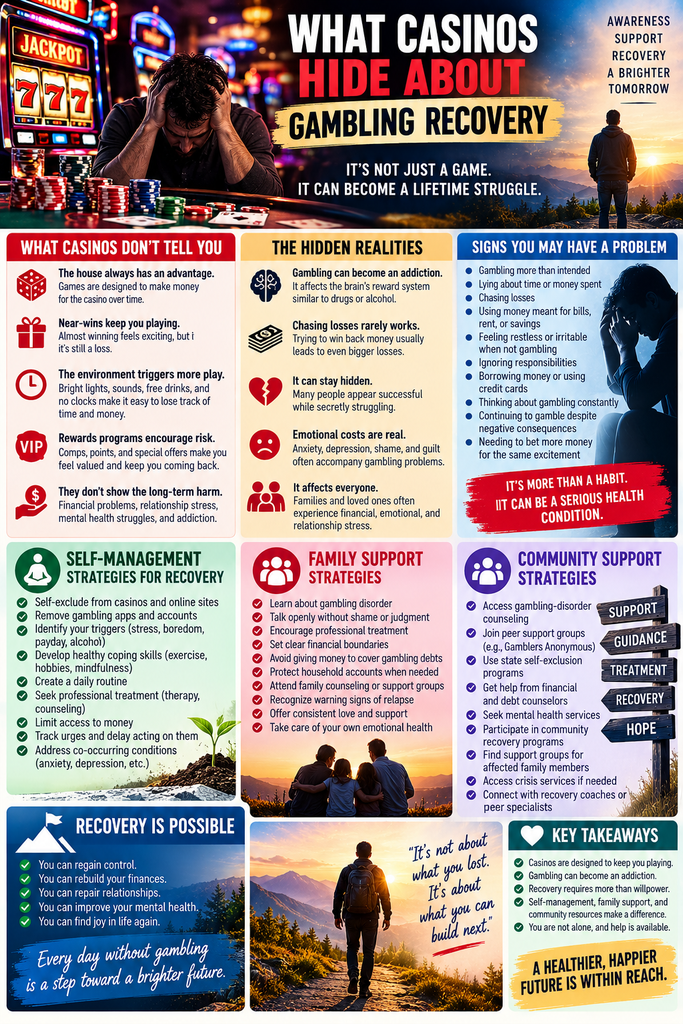
Gambling Can Become an Addiction
Gambling disorder is recognized as a behavioral addiction. A person does not have to consume a substance to develop patterns of craving, impaired control, continued behavior despite consequences, and repeated unsuccessful attempts to stop.
The excitement and uncertainty surrounding gambling can reinforce continued play. Winning can strengthen the desire to gamble again, while losing can create another dangerous motivation: trying to win the money back.
This is known as chasing losses.
Someone may think:
“If I can win one more time, I can fix everything.”
Instead, additional gambling may create even greater losses.
The House Has an Advantage
One reality that can disappear beneath the excitement of gambling is mathematical: casino games are structured so the operator has an advantage over time.
Individual players can certainly win during particular sessions. However, repeated gambling exposes the player to the house advantage again and again.
This matters in recovery because people experiencing gambling problems may remember their largest wins more vividly than their many smaller losses.
A jackpot can become evidence in the person’s mind that another big win is possible.
Recovery requires recognizing that gambling is not a reliable strategy for repairing financial damage caused by gambling.
Near-Wins Can Keep People Playing
Imagine a slot machine showing two jackpot symbols and narrowly missing the third.
Nothing was actually won, yet the experience may feel dramatically different from an obvious loss.
Features such as near-misses, sounds, animations, rewards, and rapid repeated betting can maintain excitement and encourage continued play.
For someone vulnerable to gambling problems, these experiences can make walking away particularly difficult.
Understanding these psychological mechanisms can help people recognize an important distinction:
Feeling close to winning does not mean a win is becoming more likely.
Gambling Addiction Can Remain Hidden
Unlike many substance use disorders, gambling disorder may have few obvious physical signs.
A person can go to work, maintain relationships, dress normally, and appear financially stable while privately experiencing enormous gambling losses.
Warning signs can include:
- Increasing secrecy about money or gambling.
- Borrowing money repeatedly.
- Unexplained debt or missing funds.
- Gambling for longer than intended.
- Trying unsuccessfully to stop.
- Becoming restless or irritable when attempting to reduce gambling.
- Chasing previous losses.
- Lying about the amount of money or time spent gambling.
- Neglecting responsibilities.
- Gambling when distressed.
- Using credit cards, loans, or retirement savings to continue gambling.
- Asking relatives for financial rescue after repeated losses.
The secrecy surrounding gambling can allow serious problems to develop before families recognize what is happening.
The Emotional Cost Goes Beyond Money
Financial losses may be the most visible consequence, but gambling disorder can create significant emotional distress.
People may experience anxiety, depression, shame, guilt, irritability, hopelessness, and relationship conflict.
Financial crises can intensify those emotions.
The person may gamble again to escape those feelings, creating another destructive cycle:
Stress → gambling → temporary excitement or escape → losses → shame and financial problems → more stress → more gambling.
Recovery requires interrupting this cycle rather than simply finding another source of money.
Winning Money Back Is Not Recovery
One of the most dangerous ideas in problematic gambling is:
“I just need one big win.”
This turns gambling into the proposed solution for damage caused by gambling.
Even when a person occasionally wins, the experience may reinforce the desire to continue rather than encourage them to stop.
Recovery requires a different objective.
Instead of asking:
“How can I win my money back?”
the healthier question becomes:
“How can I rebuild my life without gambling?”
That shift is fundamental.
Self-Management Strategies for Gambling Recovery
Recovery begins with reducing access to gambling while developing healthier ways to manage urges, stress, boredom, and financial problems.
Helpful strategies include:
- Self-exclude from gambling venues and platforms. Formal self-exclusion programs can create an additional barrier during moments of temptation.
- Limit access to money. Consider reducing cash availability, lowering withdrawal limits, or temporarily involving a trusted person in financial management.
- Remove gambling apps and accounts. Reducing immediate access can create valuable time between an urge and an action.
- Identify triggers. Stress, loneliness, boredom, payday, alcohol use, sports events, advertising, or relationship conflict may increase gambling urges.
- Track urges. Recording when cravings occur can reveal patterns.
- Delay acting on cravings. Urges often rise and fall. Creating distance between the urge and access to gambling can help.
- Develop replacement activities. Exercise, hobbies, social activities, volunteering, and creative interests can replace time previously devoted to gambling.
- Seek professional treatment. Cognitive behavioral therapy and other evidence-based approaches may help change gambling-related thoughts and behaviors.
- Address co-occurring conditions. Depression, anxiety, substance misuse, ADHD, trauma, or other mental health concerns may complicate recovery.
- Create a financial recovery plan. Debt counseling and structured repayment strategies can replace unrealistic attempts to gamble out of debt.
Recovery becomes easier when the environment supports the decision rather than constantly testing it.
Family Support Strategies
Families frequently experience the consequences of gambling disorder through debt, secrecy, broken trust, and emotional instability.
Supporting recovery does not mean repeatedly paying gambling debts.
Families can:
- Learn about gambling disorder as a behavioral addiction.
- Discuss gambling without humiliation or name-calling.
- Encourage professional treatment.
- Establish clear financial boundaries.
- Protect household accounts when necessary.
- Avoid repeatedly providing money to cover gambling losses.
- Attend family counseling.
- Develop transparency around major financial decisions.
- Recognize signs of recurrence early.
- Encourage participation in peer-support programs.
- Create a crisis plan if financial or emotional distress becomes severe.
- Protect children and other dependents from financial instability.
Trust may take time to rebuild.
A person in recovery may need to demonstrate consistency through actions rather than expecting family members to immediately believe that gambling has stopped.
Support Without Financial Rescue
One difficult question for families is:
“Should I pay their gambling debts?”
There is no universal answer because financial circumstances differ. However, repeatedly rescuing someone from gambling-related consequences without treatment or safeguards may unintentionally allow the cycle to continue.
Families can support recovery while still saying:
“I will help you find treatment and financial counseling, but I will not provide money for gambling.”
Boundaries are not the opposite of compassion.
Healthy boundaries can become part of recovery.
Community Support Strategies
Gambling recovery should not have to happen in isolation.
Community resources may include:
- Gambling-disorder counselors.
- Cognitive behavioral therapy.
- Gamblers Anonymous and other peer-support programs.
- Financial and debt counseling.
- Family therapy.
- Community mental health services.
- State problem-gambling programs.
- Self-exclusion programs.
- Recovery coaches or peer specialists.
- Support groups for affected family members.
- Crisis and suicide-prevention services.
These resources address different pieces of the problem.
A therapist may help change gambling-related thinking. A financial counselor may help organize debt. A peer-support group can reduce isolation. Family therapy can begin rebuilding trust.
Recovery often works best when these supports operate together.
Relapse Does Not Have to End Recovery
Someone may stop gambling for weeks, months, or years and later experience a recurrence.
That does not erase previous progress.
Instead, it should prompt questions:
What triggered the gambling?
Which safeguards failed?
Was access to money too easy?
Did stress, depression, alcohol, loneliness, or another problem increase vulnerability?
Does the treatment plan need to change?
A recurrence can become information that strengthens the next recovery plan.
Financial Recovery Takes Time
Stopping gambling does not automatically eliminate gambling debt.
This can be one of recovery’s hardest realities.
A person may stop gambling today while continuing to face credit-card balances, loans, damaged credit, overdue bills, or strained relationships for months or years.
Financial recovery may require budgeting, debt counseling, repayment plans, lifestyle changes, and considerable patience.
Trying to repair years of losses with one jackpot often returns people to the same cycle.
Slow financial progress may feel frustrating, but predictable progress is safer than gambling on another rescue.
Advertising Can Be a Recovery Trigger
People in gambling recovery may encounter casino advertisements, sportsbook promotions, gambling apps, emails, loyalty rewards, and bonus offers.
For someone without gambling problems, these may simply look like advertisements.
For someone in recovery, they can become triggers.
Practical strategies may include unsubscribing from promotional messages, deleting gambling apps, blocking gambling websites, avoiding gambling-oriented social media accounts, and asking supportive people not to discuss betting opportunities.
Recovery sometimes requires changing the digital environment as much as the physical one.
Recovery Is About More Than Not Gambling
Long-term recovery involves rebuilding the areas of life that gambling may have damaged.
That can mean restoring relationships, rebuilding finances, improving mental health, returning to hobbies, repairing employment problems, and learning how to experience excitement without gambling.
Eventually, the goal becomes larger than:
“I haven’t gambled today.”
It becomes:
“I am building a life where gambling no longer controls my decisions.”
When Gambling Creates a Mental Health Crisis
Gambling-related financial losses and shame can sometimes create severe emotional distress. Statements such as “Everyone would be better without me,” “There’s no way out,” or “I’ve ruined everything” should be taken seriously.
A gambling crisis is not merely a financial problem when hopelessness or suicidal thinking is present.
Family members should prioritize immediate safety and professional crisis support rather than arguing about money or demanding explanations.
The financial problems can be addressed later.
A life cannot be replaced.
Conclusion
What casinos may not emphasize is that gambling can become much more than entertainment for vulnerable individuals. The consequences can involve addiction, secrecy, debt, damaged relationships, emotional distress, and years of rebuilding.
But gambling disorder is treatable.
Self-management can reduce access to gambling, identify triggers, protect finances, and develop healthier coping strategies. Family support can combine compassion with financial boundaries and accountability. Community support can provide specialized counseling, peer recovery, financial guidance, self-exclusion programs, and crisis services.
Recovery does not begin with winning back everything that was lost.
It begins when the person stops asking gambling to solve the problems gambling created.
Rebuilding the money may take time. Trust may take time to repair. Emotional healing may take even longer.
But every day spent moving away from gambling and toward treatment, connection, stability, and purpose is an investment with far better odds.
Frequently Asked Questions
Here are some common questions:
1. Can gambling really become an addiction?
Yes. Gambling disorder is a recognized behavioral addiction. A person may experience intense urges, difficulty controlling gambling, repeated unsuccessful attempts to stop, and continued gambling despite serious financial, emotional, or relationship consequences.
2. Why is it so difficult for some people to stop gambling?
Gambling combines excitement, uncertainty, anticipation, and occasional rewards. These experiences can reinforce the desire to continue playing. For someone with gambling disorder, urges may persist even after gambling has caused significant harm.
3. Does the casino always have an advantage?
Casino games generally include a mathematical house edge, meaning the casino has an advantage over players over time. A person can win during an individual session, but gambling repeatedly is not a reliable way to make money.
4. What does “chasing losses” mean?
Chasing losses occurs when someone keeps gambling because they believe another bet will recover money they’ve already lost. Unfortunately, this can create even greater losses and is an important warning sign of problematic gambling.
5. Why can near-wins make people want to keep gambling?
A near-win—such as almost hitting a slot-machine jackpot—can feel exciting even though it is still a loss. That feeling may encourage continued gambling. Importantly, almost winning does not make a future win more likely.
6. What are common signs of gambling disorder?
Warning signs can include:
- Gambling longer or spending more than intended.
- Constantly thinking about gambling.
- Increasing bets to experience excitement.
- Chasing losses.
- Borrowing money to gamble.
- Using money intended for bills or necessities.
- Hiding gambling from family members.
- Becoming restless or irritable when trying to stop.
- Neglecting work, school, or family responsibilities.
- Continuing despite serious consequences.
- Repeatedly trying unsuccessfully to quit.
7. Can someone have a gambling problem without going to a casino?
Absolutely. Gambling can occur through sports betting, online casinos, mobile gambling apps, poker, lotteries, and other forms of wagering. Because smartphones provide immediate access, some people can gamble privately almost anytime.
8. Why can gambling addiction remain hidden for so long?
Gambling disorder may not produce obvious physical signs. Someone can appear successful while privately accumulating debt, borrowing money, hiding accounts, or experiencing severe emotional distress.
9. Is gambling addiction only about losing money?
No. Financial losses are only one consequence. Gambling disorder can contribute to anxiety, depression, shame, relationship conflict, occupational problems, sleep difficulties, isolation, and severe emotional distress.
10. Can someone win enough money to solve their gambling debt?
Relying on gambling to repair gambling-related debt is extremely risky. Even a large win can reinforce continued gambling. Recovery generally requires stopping or controlling access to gambling and developing a realistic financial plan rather than pursuing another jackpot.
11. What are good self-management strategies for gambling recovery?
Helpful approaches include:
- Self-excluding from casinos and gambling platforms.
- Removing gambling apps and accounts.
- Blocking gambling websites.
- Limiting access to cash and credit.
- Identifying emotional and environmental triggers.
- Tracking and delaying gambling urges.
- Developing alternative activities.
- Creating a structured daily routine.
- Seeking professional counseling.
- Addressing depression, anxiety, substance use, or other co-occurring conditions.
- Developing a realistic debt-repayment plan.
12. What is gambling self-exclusion?
Self-exclusion programs allow individuals to voluntarily restrict themselves from participating in gambling at specified casinos, sportsbooks, online platforms, or other regulated gambling services. Programs vary by jurisdiction.
13. Should family members pay off someone’s gambling debts?
Repeatedly paying gambling debts without addressing the underlying behavior may unintentionally allow the cycle to continue. Families may benefit from professional financial and addiction guidance before deciding how to handle debts.
14. How can families support gambling recovery without enabling it?
Families can encourage treatment, establish financial boundaries, protect household accounts, avoid providing gambling money, participate in counseling, and support healthy recovery activities.
A useful message is:
“I will help you get treatment and rebuild your finances, but I will not finance gambling.”
15. Should a recovering gambler temporarily give someone else control of their money?
For some people, voluntarily involving a trusted person in financial management can create an important barrier against impulsive gambling. The arrangement should respect the person’s dignity and ideally be part of a broader recovery and financial plan.
16. What treatments can help gambling disorder?
Psychotherapy—particularly approaches such as cognitive behavioral therapy—can help people identify gambling triggers, challenge distorted beliefs about winning, develop coping skills, and prevent recurrence. Peer support and financial counseling can complement professional treatment.
17. Can support groups help?
Yes. Programs such as Gamblers Anonymous and other peer-support communities can provide accountability, shared experience, encouragement, and connection. Family members may also benefit from groups specifically designed for people affected by another person’s gambling.
18. What should someone do after returning to gambling during recovery?
A recurrence does not mean that all progress has been lost. Instead, examine what happened: What triggered the gambling? How was money accessed? Were safeguards removed? Was the person experiencing stress, depression, loneliness, alcohol use, or another problem? The recovery plan can then be strengthened.
19. How long does financial recovery take?
It varies considerably. Stopping gambling does not immediately eliminate debt. Recovery may require budgeting, repayment plans, financial counseling, lifestyle changes, and months or years of gradual rebuilding.
20. Can casino or sports-betting advertising trigger someone in recovery?
Yes. Advertisements, bonuses, loyalty offers, gambling emails, sports-betting promotions, and gambling-related social media may trigger urges in some people. Unsubscribing, blocking advertisements where possible, deleting apps, and avoiding gambling-focused content can help reduce exposure.
21. Can gambling problems occur together with substance use or mental health disorders?
Yes. Gambling disorder may coexist with depression, anxiety, substance use disorders, ADHD, or other mental health concerns. Comprehensive treatment should consider these conditions rather than addressing gambling in isolation.
22. Can people fully recover from gambling addiction?
Yes. People can stop gambling and rebuild their finances, relationships, emotional health, and daily lives. Recovery often becomes stronger when professional treatment, financial safeguards, family involvement, and peer or community support work together.
23. What should families do if gambling losses cause suicidal thoughts?
Take statements such as “There is no way out,” “I’ve ruined everything,” or “Everyone would be better without me” seriously. When there is immediate danger or suicidal intent, emergency or crisis assistance should be obtained promptly. Financial problems can be addressed later; immediate safety comes first.
24. What is the biggest misconception about gambling recovery?
One misconception is that recovery means simply developing more willpower. Gambling disorder can involve powerful learned behaviors, cravings, distorted thinking, emotional triggers, and easy access to gambling. Effective recovery often requires changing both the person’s coping strategies and their environment.
25. What is the most important lesson about gambling recovery?
Recovery begins when gambling stops being viewed as the solution to problems created by gambling. Self-management helps control triggers and access to money, family support provides healthy boundaries and accountability, and community support provides treatment, peer connection, and financial guidance.
Video: