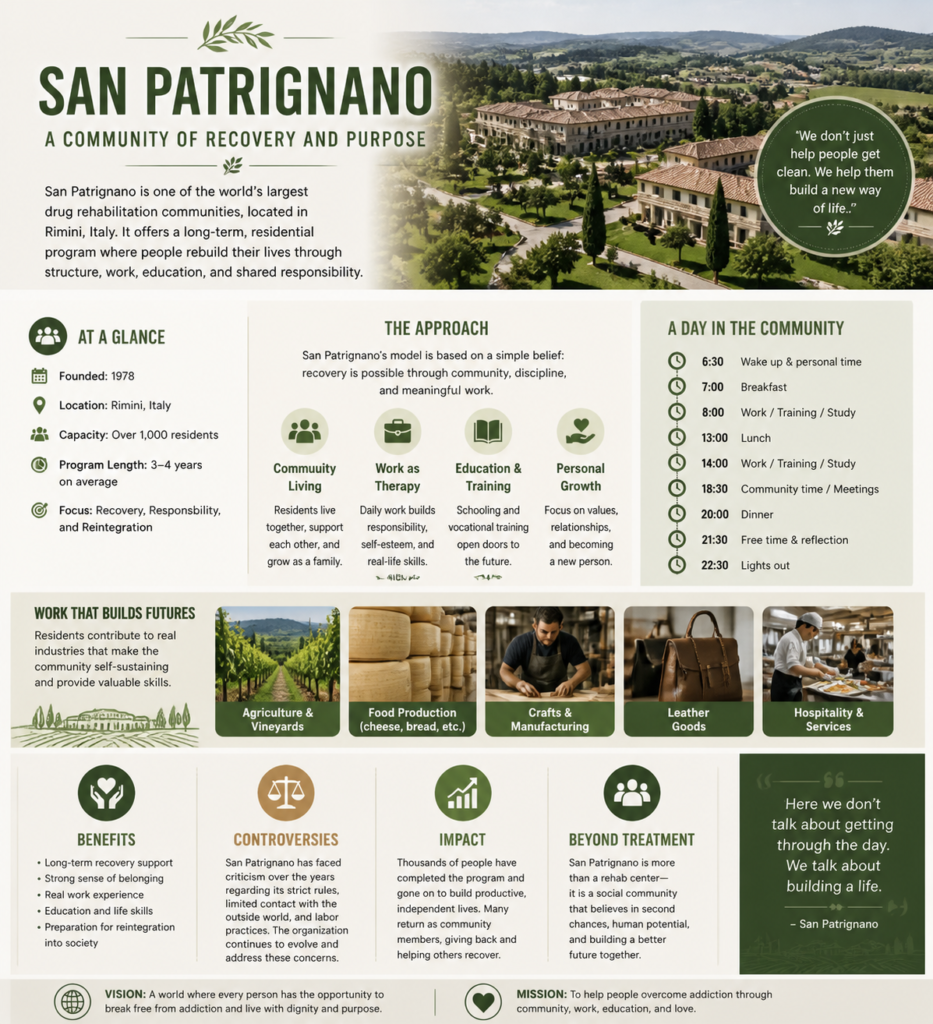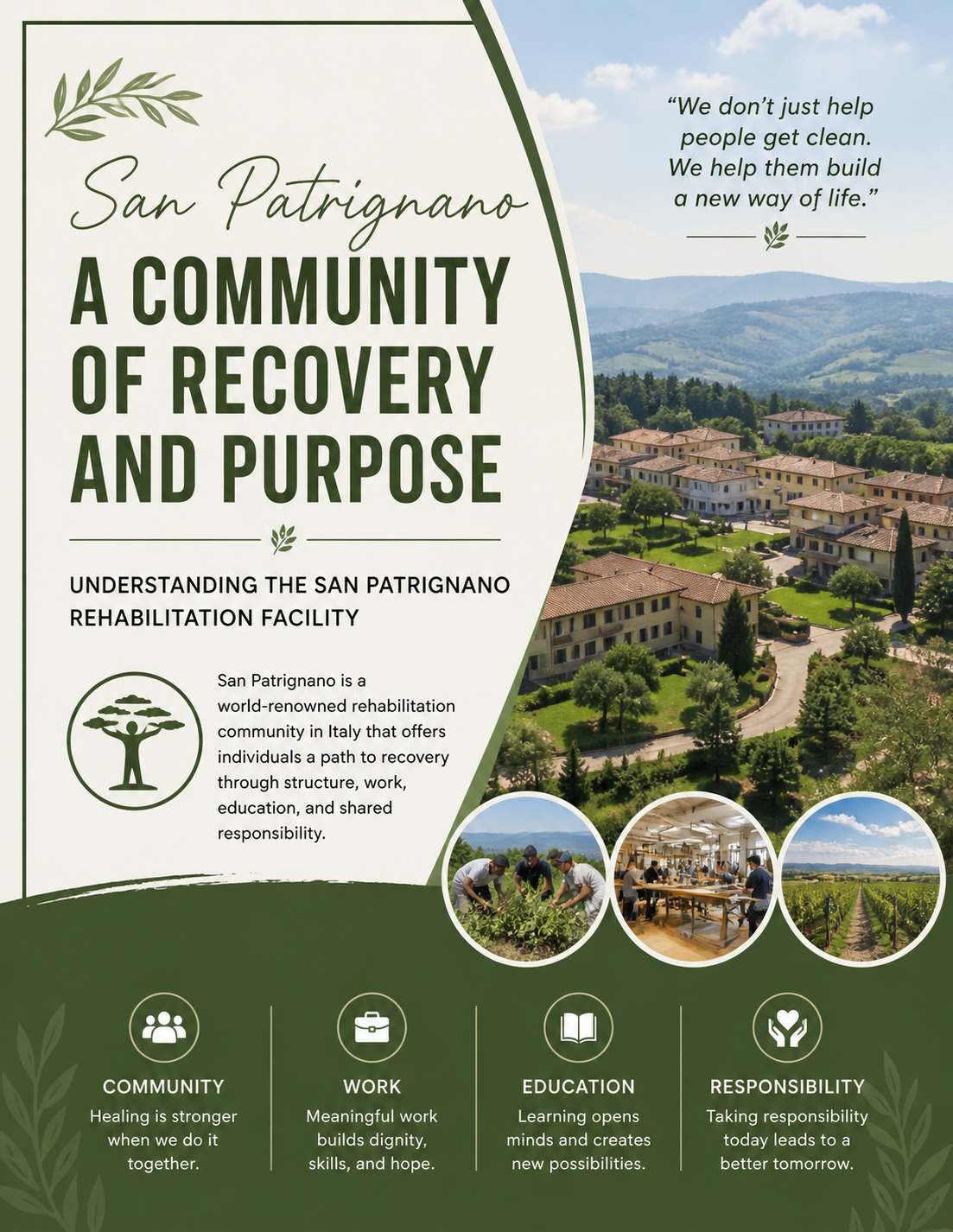
Located in the Italian countryside, San Patrignano is one of the largest and most distinctive drug rehabilitation communities in the world. Founded in 1978 during a period of rising heroin addiction, it was designed as an alternative to traditional treatment models. Rather than focusing on short-term clinical care, San Patrignano emphasizes long-term residential living, structured routines, and community participation. Residents commit to rebuilding their lives through work, discipline, and shared responsibility, making the program as much a social environment as a treatment facility. This unique approach offers a different perspective on how addiction can be addressed—one that prioritizes transformation of lifestyle and identity alongside recovery.
San Patrignano: A Radical Community Approach to Addiction Recovery
Tucked into the hills of Italy, San Patrignano stands apart from conventional drug rehabilitation centers. It is not just a clinic or a short-term treatment program—it is a self-sustaining community where recovery is built through structure, responsibility, and shared purpose.
Founded in 1978, San Patrignano emerged during a time when Italy faced a growing heroin crisis. Rather than relying solely on medical detox or outpatient counseling, the program developed a long-term, residential model centered on lifestyle transformation. Residents—many battling severe substance use disorders—commit to staying for several years, immersing themselves in a community that prioritizes discipline, work, and social reintegration.
A Different Model of Recovery
Unlike many rehab facilities that emphasize therapy sessions and medication-assisted treatment, San Patrignano focuses on community living and vocational training. Residents participate in activities such as farming, winemaking, carpentry, and artisan crafts. These are not symbolic tasks—they are integral to the functioning of the community.
This model reflects a key idea: addiction recovery is not just about stopping substance use, but about rebuilding identity, skills, and purpose. By contributing to a working community, individuals begin to see themselves as capable and needed, which can be a powerful counterforce to the isolation often associated with addiction.
Structure, Discipline, and Controversy
San Patrignano’s strict structure has drawn both praise and criticism. The program historically enforced rigid rules, including limited contact with the outside world during early stages of recovery. Supporters argue that this level of control helps individuals break deeply ingrained patterns and avoid relapse triggers.
Critics, however, have raised ethical concerns—particularly in earlier decades—about autonomy and the balance between care and control. These debates highlight a broader tension in addiction treatment: how to support recovery while respecting individual freedom.
Success and Social Reintegration
Despite controversy, San Patrignano reports higher rates of long-term recovery than many traditional programs. A major reason may be its emphasis on reintegration into society. Residents leave not only sober, but with job skills, work experience, and a sense of belonging.
The community also funds itself largely through the sale of goods produced on-site, reducing reliance on external funding and reinforcing the idea that recovery can be both personally and economically productive.
What San Patrignano Teaches Us
San Patrignano challenges the idea that there is a single path to recovery. Its model suggests that for some individuals—especially those with severe or long-term addiction—intensive, community-based approaches may offer benefits that short-term or purely clinical treatments cannot.
At the same time, its history raises important ethical questions that continue to shape modern addiction care.
In the end, San Patrignano is more than a rehab facility. It is an experiment in how society responds to addiction—one that blends compassion, structure, controversy, and hope into a uniquely human story.
San Patrignano: Community, Controversy, and the Business of Recovery
Located in the Italian countryside, San Patrignano is one of the largest and most distinctive drug rehabilitation communities in the world. Unlike traditional rehab centers that focus on short-term treatment, San Patrignano operates as a long-term residential program where individuals rebuild their lives through structure, work, and community.
Founded in 1978 during a surge in heroin addiction across Italy, the facility was created as an alternative to conventional treatment models. Rather than emphasizing medication or brief therapy, it promotes a lifestyle transformation—one that can take several years and involves complete immersion in a supportive but highly structured environment.
A Community-Based Approach to Recovery
At the core of San Patrignano’s philosophy is the belief that recovery goes beyond sobriety. Residents live and work together, developing routines that emphasize responsibility, accountability, and cooperation.
Key elements of this approach include:
- Long-term residency: Participants often stay for 3–4 years
- Peer support: Recovery is reinforced through shared experience
- Structured daily life: Strict schedules reduce chaos and uncertainty
- Skill-building: Residents gain practical and vocational abilities
This model shifts the focus from simply quitting drugs to reconstructing identity and purpose.
Work as Therapy
A defining feature of San Patrignano is its emphasis on labor as a form of rehabilitation. Residents contribute to a variety of industries within the community, making it largely self-sufficient.
Common work areas include:
- Agriculture and vineyards (wine production is a major output)
- Animal husbandry and farming
- Artisan crafts such as leatherwork and woodworking
- Food production, including cheese and baked goods
These activities are not just occupational—they serve as a means of restoring discipline, confidence, and a sense of value.
The Business of Rehabilitation
San Patrignano also operates as an economic entity. The goods produced by residents are sold, helping to fund the program and reduce reliance on external support.
This creates a unique intersection between care and commerce:
- The community is largely self-funded through production
- Residents gain real-world job experience
- The program demonstrates how recovery can be economically sustainable
However, this model raises questions about labor, compensation, and the ethics of using work as therapy—especially in a controlled environment.
Controversy and Criticism
Despite its success stories, San Patrignano has faced criticism, particularly regarding its strict rules and past practices.
Concerns have included:
- Limited personal freedom during early stages of recovery
- Isolation from family and outside influences
- Historical allegations of harsh disciplinary methods
Supporters argue that such structure is necessary for individuals with severe addiction, while critics question whether it crosses ethical boundaries.
Outcomes and Impact
San Patrignano reports relatively high long-term recovery rates compared to many traditional programs. While outcomes vary, its model highlights several important factors:
- The value of community and belonging in recovery
- The importance of long-term commitment
- The role of purpose and productivity in sustaining sobriety
Final Thoughts
San Patrignano is not a typical rehabilitation center—it is a social experiment in recovery. By blending community living, structured work, and economic sustainability, it offers an alternative vision for treating addiction.
At the same time, its history and methods remind us that effective treatment must always balance structure with compassion, and support with individual rights.
Understanding San Patrignano Through Self-Management Strategies
The recovery model at San Patrignano can seem intense at first glance—long-term residency, strict structure, and a strong emphasis on work and discipline. However, when viewed through the lens of self-management strategies, the program becomes easier to understand. At its core, San Patrignano teaches individuals how to regulate their behavior, rebuild habits, and develop a sustainable lifestyle free from addiction.
Self-management in addiction recovery refers to the ability to monitor thoughts, control impulses, and maintain routines that support long-term sobriety. San Patrignano embeds these skills into everyday life rather than teaching them in isolated therapy sessions.
1. Building Structure and Routine
One of the first self-management skills developed at San Patrignano is the ability to follow a consistent daily routine. Structure reduces uncertainty and helps stabilize individuals who may have lived in chaos during active addiction.
Key aspects include:
- Fixed schedules for waking, meals, and work
- Clear expectations for behavior and responsibilities
- Limited idle time, reducing exposure to triggers
Over time, this routine helps individuals internalize discipline, making it easier to manage their lives independently after leaving the program.
2. Developing Accountability
Self-management also involves taking responsibility for one’s actions. At San Patrignano, accountability is reinforced through community living.
This is encouraged by:
- Peer oversight, where residents support and correct one another
- Shared responsibilities, ensuring everyone contributes
- Consequences for rule-breaking, reinforcing boundaries
This environment teaches individuals to recognize how their behavior affects others, a critical step in long-term recovery.
3. Emotional Regulation and Coping
Addiction is often tied to difficulty managing emotions. Instead of relying heavily on clinical interventions, San Patrignano integrates emotional regulation into daily life.
Residents learn to:
- Handle stress through work and productivity
- Develop patience and frustration tolerance
- Replace impulsive reactions with thoughtful responses
While less formal than therapy-based models, these experiences can strengthen real-world coping skills.
4. Skill-Building and Purpose
A major component of self-management is developing a sense of purpose. At San Patrignano, this is achieved through vocational training and meaningful work.
Examples include:
- Learning trades like carpentry, agriculture, or craftsmanship
- Contributing to real economic output, such as food or wine production
- Setting long-term goals tied to personal growth and independence
These experiences help shift identity—from someone defined by addiction to someone capable and productive.
5. Gradual Reintegration and Independence
Self-management ultimately means being able to function independently. San Patrignano prepares residents for this transition by gradually increasing their responsibilities.
This process involves:
- Earning trust within the community
- Taking on leadership roles over time
- Preparing for employment and social reintegration
The goal is not just sobriety, but sustained self-regulation outside a controlled environment.
Final Thoughts
Understanding San Patrignano through self-management strategies reveals that its strict structure is not just about control—it is about training individuals to manage themselves. By embedding discipline, accountability, and purpose into everyday life, the program aims to create lasting behavioral change.
At the same time, this approach raises important questions about balance—how much structure is helpful, and when might it limit personal autonomy? These are essential considerations when evaluating any recovery model.
Ultimately, San Patrignano offers a powerful example of how self-management can be taught not just through instruction, but through lived experience.
Learning Control Through Community: Self-Management Strategies at San Patrignano
Understanding how San Patrignano operates becomes clearer when you view it through the lens of self-management. Rather than focusing only on detox or short-term therapy, the program is built around teaching individuals how to regulate their own behavior, emotions, and decision-making over time.
Self-management in addiction recovery means developing the ability to create structure, control impulses, and sustain healthy habits without constant supervision. At San Patrignano, these skills are not taught in isolation—they are embedded into everyday life within the community.
Structure as a Foundation for Stability
One of the most visible aspects of San Patrignano is its strict daily routine. For individuals coming from unstable or chaotic environments, structure becomes a tool for regaining control.
Core elements include:
- Consistent daily schedules (wake times, meals, work periods)
- Clear rules and expectations that reduce ambiguity
- Minimized downtime, limiting opportunities for relapse triggers
Over time, this external structure helps individuals internalize discipline—an essential self-management skill.
Accountability Through Community Living
Self-management is not just personal—it is social. Living in a large, interdependent community forces individuals to recognize their impact on others.
This is reinforced by:
- Peer accountability, where residents observe and support one another
- Shared responsibilities that require reliability
- Immediate feedback when expectations are not met
These dynamics help individuals rebuild a sense of responsibility, which is often weakened during addiction.
Emotional Regulation in Real-World Contexts
Many people struggling with addiction use substances to cope with stress or emotional discomfort. San Patrignano approaches this by integrating coping into daily responsibilities rather than relying solely on clinical sessions.
Residents practice:
- Managing stress through productive activity
- Developing patience in structured work environments
- Responding to conflict without impulsive behavior
This kind of experiential learning can strengthen emotional resilience in ways that feel more applicable to real life.
Purpose and Identity Reconstruction
A critical part of self-management is having a reason to stay committed to change. At San Patrignano, purpose is cultivated through meaningful work and skill development.
Residents engage in:
- Vocational training (e.g., agriculture, craftsmanship, food production)
- Contribution to a functioning economy, reinforcing value and competence
- Goal-setting tied to independence and future employment
This process helps shift identity—from someone defined by addiction to someone defined by capability and contribution.
Gradual Independence and Reintegration
Self-management ultimately means functioning without constant external control. San Patrignano addresses this by gradually increasing autonomy as residents progress.
This includes:
- Earning greater responsibility over time
- Mentoring newer residents
- Preparing for reintegration into society and the workforce
The transition is designed to ensure that individuals leave with both practical skills and internal self-regulation.
Final Reflection
San Patrignano’s model can seem rigid, but when viewed through the lens of self-management strategies, its purpose becomes clearer. The structure, work, and community are all tools aimed at helping individuals regain control over their lives.
At the same time, this approach raises important questions about the balance between external control and personal autonomy—a tension that exists in many forms of addiction treatment.
Ultimately, San Patrignano shows that recovery is not just about stopping substance use. It is about learning how to manage oneself consistently, responsibly, and with purpose in the long term.
Healing Together: Family Support Strategies in Understanding San Patrignano
To fully understand San Patrignano’s approach, it helps to look beyond the individual and consider the role of family support in recovery. While the program is known for its structured, community-based model, family dynamics remain a critical—though sometimes complex—part of the recovery process.
Addiction often affects not just the individual, but the entire family system. Patterns of communication, trust, and emotional response can either support recovery or unintentionally reinforce harmful behaviors. San Patrignano’s model, which initially limits outside contact, may seem counterintuitive—but it can also be understood as a way to reset relationships before rebuilding them in healthier ways.
Why Family Support Matters in Recovery
Family involvement can significantly influence long-term outcomes in addiction treatment. However, effective support requires more than good intentions—it requires awareness and strategy.
Healthy family support can:
- Encourage accountability without enabling harmful behavior
- Provide emotional stability during and after treatment
- Reinforce positive identity changes
- Help rebuild trust over time
At San Patrignano, these elements are often reintroduced gradually, allowing individuals to first develop internal stability.
Understanding Limited Early Contact
One of the most distinctive aspects of San Patrignano is the restricted communication with family during the early stages of the program. While this can be difficult, it serves a specific purpose.
This approach may help:
- Reduce external triggers or unhealthy influences
- Break cycles of codependency or enabling
- Allow individuals to focus entirely on personal change
- Create emotional distance needed for reflection
From a family perspective, understanding this phase is key to supporting the process rather than resisting it.
Rebuilding Relationships Over Time
As residents progress, family connections are gradually reintroduced. This stage is crucial for long-term reintegration and emotional healing.
Effective strategies include:
- Open and honest communication, avoiding blame or guilt
- Setting clear and healthy boundaries
- Acknowledging progress rather than focusing only on the past
- Participating in family counseling or educational programs when available
This process helps shift relationships from crisis-driven to growth-oriented.
Supporting Without Enabling
One of the most challenging aspects for families is finding the balance between support and enabling. San Patrignano’s model emphasizes responsibility, and families play a role in maintaining that standard.
Supportive behaviors include:
- Encouraging independence and accountability
- Avoiding financial or emotional rescue patterns
- Recognizing signs of manipulation or relapse risk
- Maintaining consistent expectations
These strategies align with the program’s broader goal of fostering self-sufficiency.
Preparing for Reintegration
When individuals leave San Patrignano, family support becomes even more important. The transition back into everyday life can be both exciting and challenging.
Families can help by:
- Creating a stable and low-stress environment
- Supporting employment or continued education efforts
- Respecting new routines and boundaries
- Encouraging ongoing recovery practices
This phase is where family support shifts from observation to active partnership in recovery.
Final Thoughts
Understanding San Patrignano through family support strategies highlights an important truth: recovery is not just an individual journey—it is relational. While the program emphasizes independence and internal change, long-term success often depends on the ability to rebuild healthy, supportive connections.
By learning to support without enabling, communicate effectively, and respect the structure of the recovery process, families can play a powerful role in sustaining progress at San Patrignano.
Beyond Treatment: Community Resource Strategies at San Patrignano
Understanding San Patrignano requires looking beyond traditional treatment models and focusing on how community resources are used to support long-term recovery. Rather than relying heavily on external funding or short-term clinical care, San Patrignano operates as a self-sustaining ecosystem where resources, people, and opportunities are integrated into everyday life.
Community resource strategies refer to how programs leverage local assets—skills, labor, social networks, and infrastructure—to create stability and growth. At San Patrignano, these strategies are central to both recovery and sustainability.
A Self-Sustaining Community Model
One of the most distinctive aspects of San Patrignano is its ability to function largely independently. The community produces many of its own goods and services, turning recovery into a collaborative, productive process.
Key elements include:
- On-site industries such as agriculture, winemaking, and craftsmanship
- Shared infrastructure, including housing, food production, and training facilities
- Reinvestment of profits back into the community to fund operations
This model reduces reliance on outside systems while giving residents a sense of ownership and contribution.
Leveraging Work as a Community Resource
At San Patrignano, work is more than therapy—it is a core resource that sustains the entire system. Residents actively participate in maintaining and growing the community.
This includes:
- Producing goods that are sold in external markets
- Maintaining daily operations, from cooking to construction
- Learning transferable skills that can be used after leaving the program
By aligning recovery with productivity, the program transforms labor into both a personal and communal asset.
Social Capital and Peer Networks
Another powerful resource is the community itself. Relationships formed within San Patrignano play a crucial role in recovery.
These social resources provide:
- Peer mentorship, where experienced residents guide newcomers
- Shared accountability, reinforcing positive behaviors
- A sense of belonging, which can counteract isolation
This network becomes a form of social capital that supports long-term change.
External Partnerships and Market Integration
While largely self-sufficient, San Patrignano also connects with the outside world through partnerships and commerce.
Examples include:
- Selling products such as wine, cheese, and crafts
- Collaborating with businesses and organizations
- Creating pathways to employment after program completion
These connections help bridge the gap between the community’s protected environment and real-world independence.
Sustainability and Long-Term Impact
Community resource strategies at San Patrignano are designed for durability, not just short-term success.
This approach supports:
- Financial sustainability, reducing dependence on donations
- Skill development, improving post-recovery opportunities
- Community resilience, ensuring the program can continue helping others
It demonstrates how recovery programs can function as ecosystems rather than isolated services.
Final Thoughts
San Patrignano offers a compelling example of how community resources can be mobilized to address complex social issues like addiction. Integrating work, relationships, and economic activity into the recovery process creates an environment where individuals are not just treated—they are actively engaged in rebuilding both their lives and their community.
At the same time, this model invites important questions about balance—particularly around labor, autonomy, and ethical oversight. Still, it provides valuable insight into how resource-driven, community-based strategies can shape a different path to recovery.
Frequently Asked Questions
Here are some common questions:
1. What is San Patrignano?
San Patrignano is one of the world’s largest and most renowned residential drug rehabilitation communities, located in Rimini, Italy. It provides long-term recovery programs that combine community living, work therapy, education, and shared responsibility as part of its holistic approach to addiction treatment.
2. How long does the program at San Patrignano last?
The program at San Patrignano typically lasts between 3 to 4 years. This extended period allows residents to engage deeply in the recovery process, develop new skills, and rebuild their lives through structured community living and work activities.
3. What makes San Patrignano different from other rehab centers?
Unlike many rehabilitation centers that rely on short-term treatment or medical intervention, San Patrignano uses a community-based approach to addiction recovery. Key features include:
- Community living: Residents live and work together, forming bonds of mutual support.
- Work therapy: Residents engage in meaningful work in the community, such as agriculture, winemaking, and crafts.
- Education and training: Programs are offered to help residents learn new skills that prepare them for life after rehab.
- Shared responsibility: Residents take on roles and responsibilities that help foster independence and self-esteem.
4. Is the program open to anyone?
San Patrignano typically accepts individuals struggling with severe drug addiction. However, each applicant undergoes an assessment process to determine if the program is suitable for their needs. The community focuses on helping those willing to commit to a long-term recovery journey.
5. What types of activities are included in the daily schedule?
The daily routine at San Patrignano is highly structured, with a focus on building discipline and self-responsibility. A typical day includes:
- Work therapy: Residents participate in agricultural work, crafts, food production, and other community projects.
- Study and vocational training: Opportunities for learning and personal growth are available, including courses to develop new life skills after rehab.
- Group meetings and counseling: These sessions are designed to promote self-reflection and peer support.
6. What industries does San Patrignano focus on for work therapy?
San Patrignano has developed several industries that residents engage in, both to support the community and prepare individuals for the workforce. These include:
- Agriculture and Vineyards: Growing crops, maintaining vineyards, and producing wine.
- Food production: Making products like cheese and baked goods.
- Crafts and manufacturing: Producing leather goods and furniture.
- Hospitality and services: Offering a range of services like catering and hospitality management.
7. What happens after completing the program?
Upon completing the program, residents are supported through a gradual reintegration process into society. They are helped to find employment, secure housing, and reconnect with their families. Many graduates remain part of the San Patrignano community, offering mentorship to new residents.
8. Is there family involvement in the recovery process?
Yes, family involvement is an important part of the recovery process. While early contact with family is restricted to help individuals focus on their own recovery, family support becomes a key component as the individual progresses. San Patrignano offers family counseling and programs to help mend relationships and reinforce recovery.
9. Are there any controversies associated with San Patrignano?
While San Patrignano has been praised for its effectiveness, it has faced criticism over the years, particularly regarding its strict rules and limited outside contact during the program’s early stages. Some have raised concerns about the balance between control and autonomy, as well as about labor and ethics. Despite these controversies, the program reports a high success rate for long-term recovery.
10. How does San Patrignano fund its operations?
San Patrignano is largely self-sustaining through the work of residents across various industries. Revenue from products such as wine, food, and crafts helps support the facility’s operations. Additionally, donations and grants help fund the community, but the community aims to be as independent as possible.
Conclusion
San Patrignano stands as a powerful example of how community-based rehabilitation can reshape the path to recovery. By combining structure, vocational training, and peer support, it aims to provide individuals not only with sobriety but also with purpose and stability. At the same time, its strict rules and history of controversy raise important ethical questions about autonomy and the balance between care and control. Ultimately, San Patrignano highlights that addiction recovery is complex and multifaceted, requiring approaches that address both individual behavior and broader social context. Its model continues to influence discussions about how best to support long-term recovery in meaningful and sustainable ways.
Video: They rebuild lives, not just break habits #recovery #transformation #hope