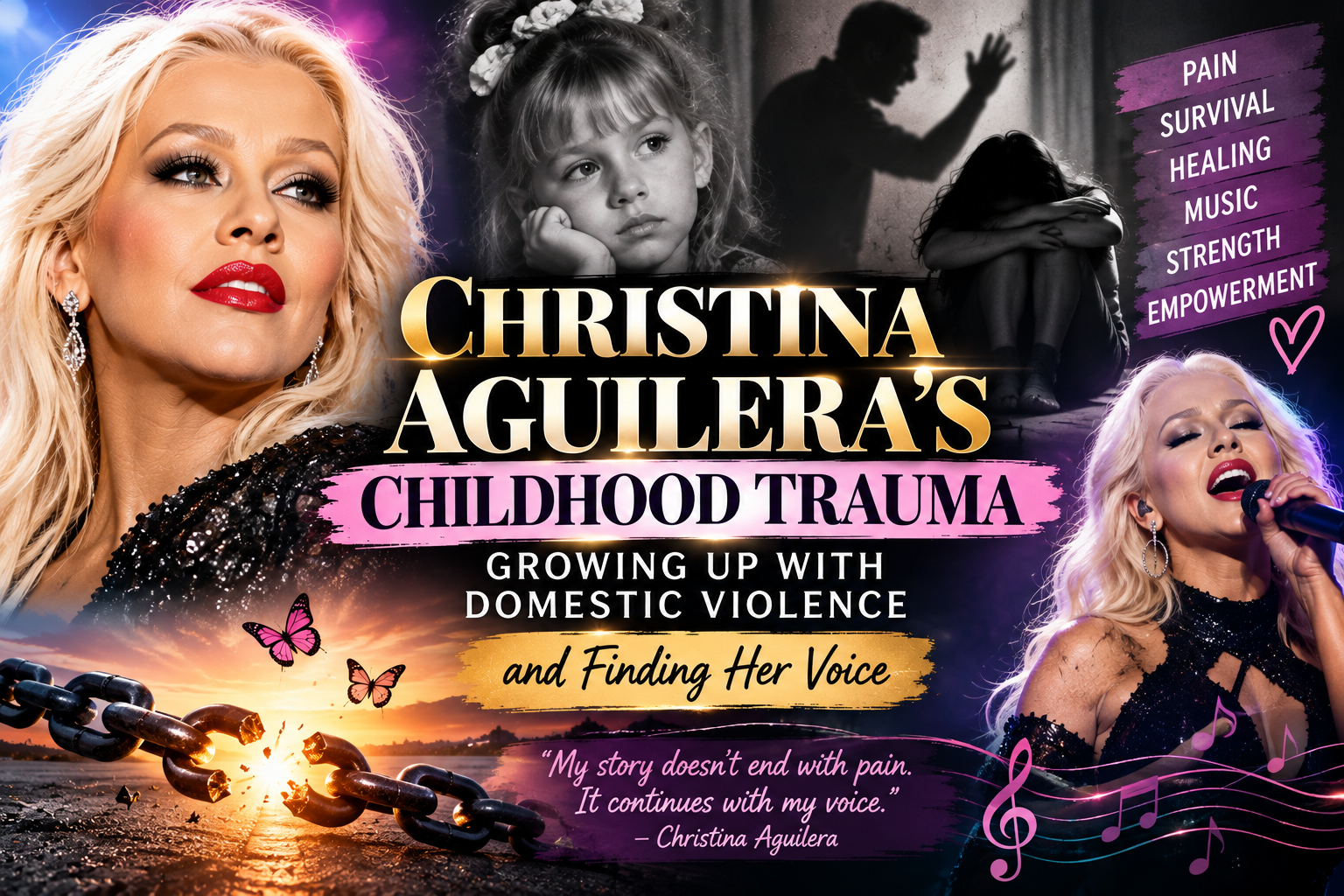
Christina Aguilera is known worldwide for her powerful voice, successful music career, and messages of strength and self-expression. Behind that success, however, is a childhood that she has described as unstable and affected by domestic violence. Aguilera has spoken publicly about witnessing physical and emotional abuse within her family and about how music became a refuge when her home did not feel safe. Her experience illustrates how childhood trauma can influence emotional development while also showing the importance of healthy coping strategies, supportive family relationships, and community resources.
Growing Up in an Unstable Home
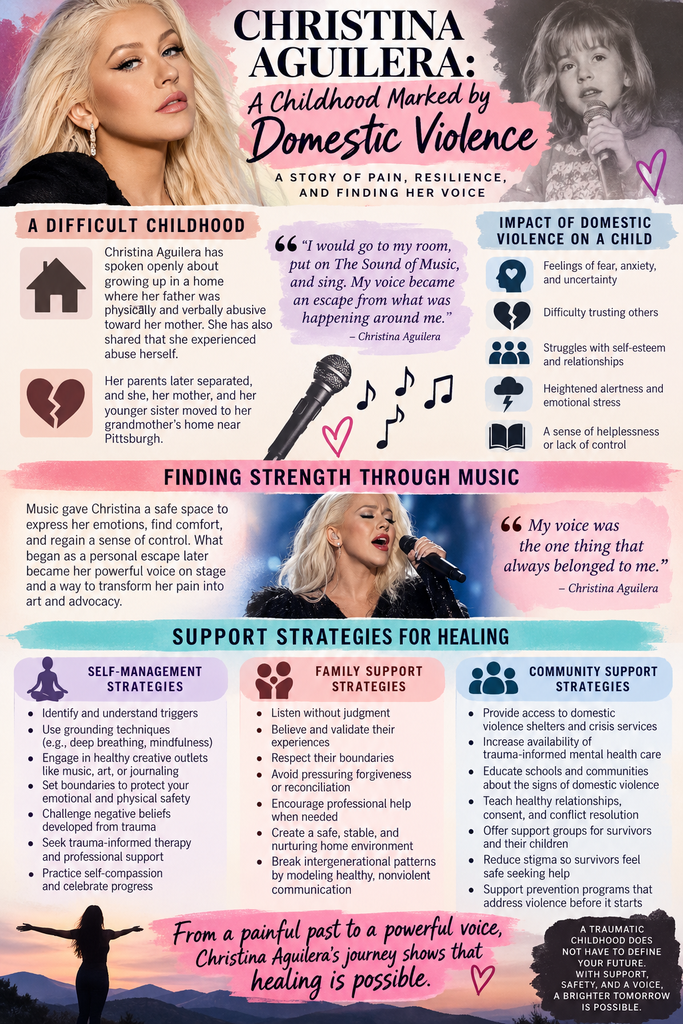
Aguilera has described growing up in a household where her father was physically and verbally abusive toward her mother. She has also discussed experiencing abuse herself. Her parents eventually separated, and Aguilera, her mother, and her younger sister moved to her grandmother’s home near Pittsburgh.
For a child, witnessing domestic violence can create an environment of unpredictability and fear. Children may become highly alert to arguments, changes in tone of voice, or other signals that conflict could begin. Some develop difficulty trusting others, while others struggle with anxiety, anger, self-esteem, relationships, or feelings of helplessness.
Aguilera has described her childhood home as chaotic and lacking stability. She has said that these experiences contributed to her determination to become independent and avoid feeling helpless in adulthood.
Her story is an important reminder that children do not have to be the direct target of violence to be deeply affected by it. Seeing or hearing violence between caregivers can itself be traumatic.
Music Became an Emotional Escape
One of Aguilera’s most important coping mechanisms was singing. She has recalled going to her bedroom during conflict, listening to The Sound of Music, and singing. She described her voice as an escape from what was happening around her.
Music may have provided several things that were missing in her environment: emotional expression, predictability, personal control, hope, and a temporary psychological distance from the violence.
Later, Aguilera transformed some of her experiences into music and advocacy. Rather than remaining silent about domestic violence, she has discussed the subject publicly and supported organizations serving people affected by abuse.
Her experience does not mean that creativity alone heals trauma. Professional treatment may be necessary for many survivors. However, healthy creative outlets can complement treatment and give people ways to express emotions that may be difficult to communicate directly.
Understanding the Long-Term Effects of Childhood Trauma
Childhood domestic violence can influence how people understand safety, love, trust, and relationships. A child who repeatedly observes aggression may learn that relationships are unpredictable or that emotional closeness can lead to pain.
Aguilera has discussed developing emotional defenses and becoming strongly committed to independence. In later interviews, she also spoke about wanting to create a more peaceful and stable environment for her own children.
Trauma does not determine a person’s future. People can learn healthier relationship patterns, develop emotional regulation skills, establish boundaries, and create environments that are very different from those in which they grew up.
Self-Management Strategies for Childhood Trauma
Self-management cannot replace professional trauma treatment, but it can help survivors strengthen emotional regulation and regain a sense of control.
- Identify triggers. Recognize situations, sounds, arguments, or behaviors that bring back feelings associated with earlier experiences.
- Use grounding techniques. Slow breathing, mindfulness, exercise, journaling, yoga, or sensory grounding can help bring attention back to the present.
- Develop healthy creative outlets. Music, writing, art, dancing, gardening, and other activities can provide constructive ways to process emotions.
- Establish boundaries. Survivors have the right to limit contact with people or situations that threaten their emotional or physical safety.
- Challenge unhealthy beliefs. Trauma can create beliefs such as “I cannot trust anyone” or “conflict always leads to violence.” Therapy can help examine and change these patterns.
- Seek trauma-informed professional care. Counseling can help individuals understand how childhood experiences continue to influence emotions, relationships, and behavior.
- Practice self-compassion. Healing does not require forgetting what happened. It involves learning to live without letting past experiences control every present decision.
Aguilera has also discussed practices such as yoga and introspection as part of finding greater emotional balance later in life.
Family Support Strategies
Family members can play an important role in recovery, particularly by creating the safety and predictability that may have been missing during childhood.
Families can support survivors by listening without judgment, believing their experiences, respecting boundaries, avoiding pressure to forgive an abusive person, and encouraging professional help when appropriate.
It is especially important to understand that reconciliation and forgiveness are personal choices. A survivor does not have to restore a relationship with an abusive family member in order to heal.
Aguilera’s mother leaving the abusive environment represented an important change in her childhood. Aguilera has spoken about appreciating her mother’s decision to leave and has incorporated that experience into her music.
Healthy families can also work intentionally to break intergenerational patterns. This may involve learning nonviolent conflict resolution, discussing emotions openly, protecting children from adult conflict, and making the home as predictable and emotionally safe as possible.
Community Support Strategies
Domestic violence should never be treated solely as a private family problem. Communities can reduce its impact by making safety, education, and treatment accessible.
Helpful community strategies include:
- Providing confidential domestic-violence shelters and crisis services.
- Increasing access to trauma-informed mental health counseling.
- Educating schools and healthcare professionals about signs of domestic violence.
- Teaching young people about healthy relationships, consent, boundaries, and conflict resolution.
- Providing legal advocacy and safety-planning resources for survivors.
- Offering support groups for adults and children affected by domestic violence.
- Reducing stigma so survivors feel safer asking for assistance.
- Supporting prevention programs that address violence before it becomes established within families.
Aguilera has used her public platform to bring attention to domestic violence and has discussed supporting a shelter near Pittsburgh. Her advocacy shows how personal experiences can grow into a broader commitment to helping others.
Breaking the Cycle
One of the most meaningful aspects of Aguilera’s story is her emphasis on creating something different from the environment she experienced as a child. She has said she wants her children to experience peace and safety rather than unnecessary conflict.
Breaking a cycle of trauma does not necessarily mean that every emotional consequence disappears. Instead, it can mean recognizing unhealthy patterns and deliberately choosing healthier responses.
For one person, that might mean entering therapy. For another, it might involve leaving an abusive relationship, establishing boundaries with relatives, learning healthier parenting skills, joining a support group, or simply acknowledging that what happened during childhood was harmful.
From Silence to Advocacy
Christina Aguilera’s experience demonstrates an important principle of trauma recovery: a painful childhood can influence a person’s life without defining the entirety of that life.
As a child, singing offered Aguilera a psychological escape from an unpredictable home. As an adult, her voice became more than that—a means of artistic expression and advocacy. She has spoken publicly about domestic violence and the importance of helping women and children find safety.
Her journey also emphasizes that resilience should never be used to minimize abuse. No child should have to become “strong” because home is unsafe. Adults and communities have a responsibility to protect children and provide survivors with meaningful pathways toward safety and healing.
Conclusion
Christina Aguilera’s childhood story shows how deeply domestic violence can affect a child, even years after the immediate danger has ended. Her accounts of using music to cope, developing fierce independence, creating a safer environment for her own family, and speaking publicly about domestic violence illustrate several dimensions of trauma and recovery.
Recovery from childhood trauma is rarely a single event. It can involve self-awareness, healthy coping skills, supportive relationships, professional treatment, strong boundaries, and community resources. Most importantly, survivors can learn that the patterns they witnessed growing up do not have to become the patterns they repeat.
A traumatic beginning does not have to determine the rest of a person’s story. With safety, support, treatment, and opportunities to reclaim one’s voice, people can build relationships and a future based on stability rather than fear.
Frequently Asked Questions and Answers
1. Does trauma really make a person more successful?
Not necessarily. Trauma does not automatically produce success, resilience, or motivation. It can cause significant emotional and physical difficulties. Some people, however, develop strengths while recovering from traumatic experiences that later contribute to personal or professional growth.
2. Why do some trauma survivors become highly successful?
Some survivors develop determination, independence, problem-solving skills, empathy, adaptability, or a strong desire to create a different future. These qualities may contribute to achievement, but they develop through adaptation and recovery—not because trauma itself is beneficial.
3. What is post-traumatic growth?
Post-traumatic growth refers to positive psychological changes that some people experience while coping with major adversity. These may include greater appreciation for life, stronger relationships, increased personal strength, new priorities, spiritual growth, or a stronger sense of purpose.
4. Does post-traumatic growth mean someone is completely healed?
No. Growth and emotional distress can exist simultaneously. Someone may discover new purpose after trauma while continuing to experience anxiety, grief, triggers, or PTSD symptoms.
5. Can trauma make someone more ambitious?
Sometimes. A person who experienced poverty, rejection, abuse, instability, or feeling powerless may become strongly motivated to achieve independence or prove themselves. However, ambition driven primarily by fear or low self-worth can eventually contribute to stress, burnout, and perfectionism.
6. Can being a high achiever actually be a trauma response?
In some cases, yes. Excessive work, perfectionism, people-pleasing, or constantly pursuing achievements can become ways of coping with insecurity or uncomfortable emotions. High achievement alone, however, does not indicate that someone has experienced trauma.
7. What are signs that achievement may be connected to unresolved trauma?
Possible signs include feeling guilty while resting, being extremely afraid of failure, constantly needing approval, never feeling satisfied after reaching goals, tying self-worth to productivity, and using work to avoid uncomfortable emotions.
8. Does trauma always make people stronger?
No. The popular statement that adversity automatically makes people stronger oversimplifies trauma. Some people develop resilience, while others experience significant and persistent psychological difficulties. Neither response represents a personal failure.
9. Why shouldn’t we romanticize trauma?
Romanticizing trauma can make suffering appear necessary for personal development. People can become resilient, compassionate, ambitious, and successful without experiencing abuse, violence, neglect, or other traumatic events.
10. What factors help someone become resilient after trauma?
Protective factors can include safe relationships, stable housing, supportive families, therapy, education, financial security, mentors, spirituality, healthy coping strategies, community resources, and opportunities to regain control over one’s life.
11. Can trauma affect someone’s definition of success?
Yes. After trauma, success may become less about money, status, or recognition and more about safety, healthy relationships, independence, peace, recovery, meaningful work, or having control over one’s decisions.
12. What self-management strategies can support trauma recovery?
Helpful approaches can include recognizing triggers, practicing grounding and mindfulness, establishing boundaries, getting adequate sleep, exercising, challenging perfectionism, maintaining supportive relationships, and seeking trauma-informed professional care when appropriate.
13. How can families support someone recovering from trauma?
Families can listen without judgment, respect boundaries, avoid minimizing the experience, encourage healthy rest, support treatment when appropriate, and remind the person that their value does not depend on productivity or accomplishments.
14. How can communities help trauma survivors succeed?
Communities can improve access to affordable mental healthcare, survivor support groups, safe housing, education, employment opportunities, addiction treatment, mentoring, crisis services, and trauma-informed schools and workplaces.
15. Does professional success prove someone has healed from trauma?
No. Someone can have a successful career while privately experiencing anxiety, depression, PTSD symptoms, relationship difficulties, substance misuse, or emotional exhaustion. External achievement and psychological recovery are different things.
16. Can someone recover from trauma without becoming exceptionally successful?
Absolutely. Recovery should not be measured by wealth, fame, career status, or extraordinary accomplishments. Feeling safe, maintaining recovery, establishing boundaries, developing healthy relationships, or simply enjoying everyday life can represent tremendous progress.
17. Can trauma lead to addiction or unhealthy coping behaviors?
Traumatic experiences can increase vulnerability to substance use and other unhealthy coping strategies in some people. Alcohol or drugs may temporarily numb distress but can create additional problems. Trauma-informed addiction treatment can address both substance use and underlying emotional experiences.
18. Can therapy help someone turn survival skills into healthier strengths?
Yes. Trauma-informed therapy can help people recognize which behaviors once helped them survive but may no longer be helpful. For example, hypervigilance can be replaced with healthier awareness, perfectionism with realistic standards, and extreme independence with the ability to accept appropriate support.
19. What is a healthier way to think about trauma and success?
Instead of saying, “Trauma made me successful,” it may be more accurate to say, “I developed strengths while surviving and healing from experiences that should never have happened.” This recognizes resilience without suggesting that trauma itself was beneficial.
20. What is the most important message about trauma and success?
Trauma is not a requirement for greatness. Some people experience meaningful growth after adversity, while others need significant support simply to regain stability—and both experiences are valid.
Video: