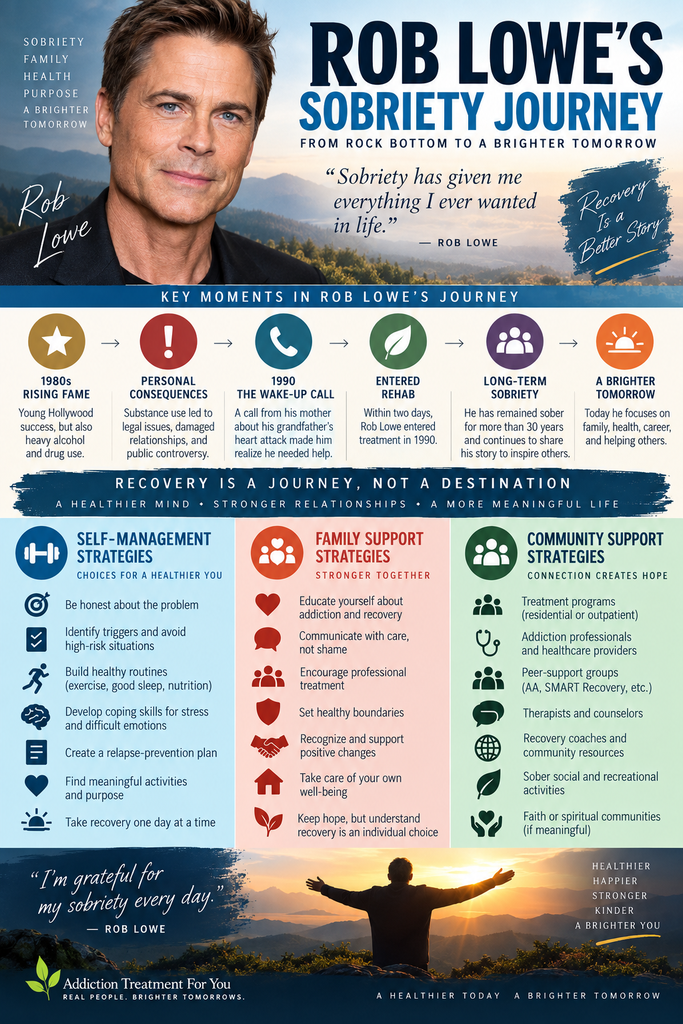
Rob Lowe became famous at a young age, experiencing the excitement and pressures of Hollywood while still developing his adult identity. Behind the successful acting career, however, Lowe has spoken openly about a period of heavy alcohol and drug use. His eventual decision to enter treatment in 1990 became a major turning point in his life. More than three decades later, his story offers valuable lessons about recognizing addiction, becoming willing to change, accepting help, and building a meaningful life in recovery.
Fame, Alcohol, and the Road Toward Addiction
Lowe rose to fame as a young actor in the 1980s and became associated with Hollywood’s hard-partying culture. He has acknowledged abusing alcohol and drugs during this period. Over time, personal consequences and public controversy forced him to examine the direction his life was taking.
For Lowe, becoming sober was not the result of one realization. He has described it as an “incremental decision,” with several experiences gradually showing him that his lifestyle was no longer sustainable.
This is important for understanding addiction. People do not always experience one dramatic “rock bottom.” Sometimes awareness develops gradually as consequences accumulate.
Rob Lowe’s Final Wake-Up Call
One of Lowe’s most significant turning points occurred in 1990. His mother called to tell him that his grandfather had suffered a heart attack. Lowe later recalled being unable to respond appropriately because of the condition he was in and turning to alcohol instead.
He described this experience as his final wake-up call. Within approximately two days, he entered rehabilitation.
Lowe has remained sober since 1990.
His experience illustrates an important recovery principle: recognizing the problem matters, but recognition must eventually be followed by action.
Treatment and Learning About Addiction
Lowe has spoken positively about his rehabilitation experience. He has explained that learning about the science of addiction helped him understand what substances were doing to his body and behavior. He has also said that, for him, rehabilitation provided something he did not believe he could have achieved through a 12-step program alone.
This highlights an important point: there is no single recovery pathway that works for everyone.
Some people benefit from residential rehabilitation. Others may use outpatient treatment, psychotherapy, medications, peer-support programs, recovery coaching, or combinations of these resources.
The appropriate approach depends on the individual.
Self-Management Strategies
One of the strongest themes in Lowe’s recovery story is personal readiness. He has emphasized that although other people can provide motivation and encouragement, sustainable recovery ultimately requires the individual to participate in the decision to change.
Helpful self-management strategies may include:
- Practice honest self-reflection. Examine how alcohol or drugs are affecting health, relationships, responsibilities, and personal values.
- Identify triggers. Stress, loneliness, celebrations, certain relationships, and environments can increase vulnerability.
- Develop a relapse-prevention plan. Decide beforehand what to do and whom to contact when cravings or high-risk situations occur.
- Build healthy routines. Regular sleep, nutrition, exercise, work, recreation, and meaningful activities can provide stability.
- Accept professional help. Addiction treatment is healthcare, not a personal failure.
- Stay connected to recovery. Long-term recovery requires continued attention even after the immediate crisis has passed.
- Develop healthy coping skills. Learn alternatives to using substances to manage difficult emotions.
- Practice accountability. Recovery becomes stronger when people can honestly recognize problems rather than hide them.
- Build a meaningful sober life. Sobriety becomes more sustainable when life contains relationships, interests, purpose, and enjoyment.
Lowe has described rigorous honesty and authenticity as important parts of his ongoing recovery.
Family Support Strategies
Family has played an important role in Lowe’s life after addiction.
He has credited his relationship with Sheryl Berkoff, whom he married in 1991, as an important motivation for changing his life. However, Lowe has also emphasized that ultimately a person cannot maintain sobriety solely for a spouse, job, children, or other external reason.
Families supporting someone with addiction can:
- Learn about substance use disorders and recovery.
- Communicate concern without humiliation or shaming.
- Encourage professional treatment.
- Set clear and consistent boundaries.
- Avoid covering up consequences caused by substance use.
- Recognize positive changes without expecting perfection.
- Encourage healthy routines and sober activities.
- Learn the warning signs of relapse.
- Seek counseling or family recovery programs for themselves.
- Remember that they can support recovery without controlling another person’s choices.
Family support can be powerful, but family members cannot do the recovery work for someone else.
When Addiction Affects the Next Generation
Lowe’s family story has another unusual dimension. His son John Owen Lowe has also publicly discussed his own recovery.
Rob has described the gratitude he felt when his son presented him with a sobriety chip marking 34 years of recovery in 2024. Their shared experience with sobriety has become a source of connection between father and son.
Their experience illustrates why families affected by addiction may benefit from open conversations rather than secrecy and shame.
Parents can provide resources, treatment options, love, and boundaries. However, they may also need to recognize that even personal experience with addiction does not give them complete control over another person’s recovery.
Community Support Strategies
Recovery becomes difficult when someone attempts to manage addiction entirely alone. Professional and community resources can provide treatment, accountability, education, and connection.
Helpful community resources may include:
- Residential or outpatient addiction treatment
- Addiction medicine specialists
- Primary care providers
- Psychologists, therapists, and counselors
- Alcoholics Anonymous and other 12-step programs
- SMART Recovery and other peer-support approaches
- Recovery coaches and peer recovery specialists
- Sober social and recreational groups
- Family programs and support groups
- Community mental health services
Lowe has emphasized the value of learning about addiction and developing recovery tools through treatment.
The lesson is not that everyone needs Lowe’s exact treatment experience. Instead, people should find evidence-based treatment and recovery supports that fit their individual needs.
Building a Life Worth Protecting
Long-term sobriety is not simply about avoiding alcohol or drugs. Recovery can involve creating a life that a person no longer wants substances to destroy.
After becoming sober, Lowe increasingly invested in his marriage, family, spirituality, recovery, personal development, health, and career. He has described being grateful for the life that developed after his decision to change.
Healthy recovery goals might include:
- Strengthening relationships
- Developing hobbies
- Exercising regularly
- Pursuing education or career goals
- Improving emotional health
- Reconnecting with family
- Volunteering
- Developing spiritual practices
- Finding sober friendships
- Helping others in recovery
The question gradually changes from “How do I stop using?” to “What kind of life do I want to create?”
What Families Can Learn From Rob Lowe
Lowe’s experience offers several lessons for families affected by addiction.
Love and encouragement matter, but they cannot guarantee another person’s sobriety. Families can provide treatment options, establish boundaries, communicate their concerns, and remain available when someone is ready for help.
Lowe has spoken sympathetically about the difficult position families face when they know someone needs treatment but cannot force that person to genuinely embrace recovery.
Families therefore need support themselves.
Living around addiction can create anxiety, anger, guilt, resentment, and exhaustion. Counseling and family support groups can help relatives learn how to support recovery without sacrificing their own well-being.
Recovery Is More Than Abstinence
Rob Lowe’s sobriety journey demonstrates that recovery can become much larger than simply giving up alcohol or drugs.
It can mean learning about addiction, becoming more honest with yourself, repairing relationships, accepting accountability, developing healthier coping strategies, finding purpose, and creating a life that supports continued sobriety.
Lowe entered rehabilitation in 1990 after years of substance use and a series of personal wake-up calls. He has remained publicly committed to sobriety for decades.
His story also provides an important reminder for anyone struggling with addiction: you do not have to wait for every part of your life to collapse before asking for help.
Treatment can begin when someone recognizes that the way they are living is no longer the way they want to live.
Frequently Asked Questions
Here are some common questions:
1. Did Rob Lowe struggle with alcohol and drugs?
Yes. Rob Lowe has publicly discussed abusing alcohol and drugs during his early years of fame. He has described the hard-partying lifestyle surrounding his rapid rise in Hollywood and the consequences that eventually pushed him to reconsider how he was living.
2. When did Rob Lowe become sober?
Lowe entered rehabilitation in 1990 at age 26 and has said he has remained sober since. By 2025, he was celebrating approximately 35 years of sobriety.
3. What was Rob Lowe’s wake-up call?
Lowe has described several experiences that have gradually moved him toward recovery, rather than a single isolated event. His final wake-up call came when his mother contacted him because his grandfather had suffered a heart attack. Lowe realized that because of his substance use, he was unable to respond to his family in the way he wanted. He entered treatment shortly afterward.
4. Did Rob Lowe go to rehabilitation?
Yes. Lowe entered a treatment program in 1990. He has spoken positively about rehabilitation, explaining that learning about addiction and understanding its effects on the body were particularly important to him.
5. Did Rob Lowe participate in a 12-step recovery program?
Yes. Lowe has discussed the importance of both rehabilitation and 12-step recovery. He has said that he personally needed the education and structured work provided by rehab in addition to appreciating the value of 12-step programs.
6. What does Rob Lowe say about being ready for recovery?
One of Lowe’s recurring messages is that lasting change requires personal readiness. He has described becoming sober as an “incremental decision”—a series of realizations that eventually reached the point where he was ready to change.
7. What self-management lessons can be learned from his experience?
Lowe’s story emphasizes self-honesty, accepting help, understanding addiction, and remaining connected to recovery. General self-management strategies can include identifying triggers, developing healthy coping skills, creating structured routines, avoiding high-risk situations, maintaining a relapse-prevention plan, and asking for help when warning signs appear.
8. What role has family played in Rob Lowe’s recovery?
Family became an important part of the life Lowe built after becoming sober. He married Sheryl Berkoff in 1991 and has spoken about investing more of himself in his spirituality, recovery, marriage, and family after age 26.
9. Can family members make someone become sober?
Lowe has emphasized that loved ones can encourage and support recovery but cannot make another person genuinely want sobriety. Families can provide treatment options, communicate their concerns, establish boundaries, and be ready to help when the individual is willing to accept treatment.
10. Has addiction affected Rob Lowe’s family in another generation?
His son John Owen Lowe has also publicly discussed his own recovery. Rob has spoken about their ability to share experiences surrounding sobriety, while their family’s experience also demonstrates how difficult it can be for parents to help an adult child who is struggling.
11. What community resources can help someone seeking sobriety?
Depending on individual needs, resources can include residential or outpatient treatment, addiction medicine professionals, therapists, primary care providers, AA or other peer-support groups, recovery coaches, and sober community activities. Lowe’s own experience demonstrates how treatment and a recovery community can complement personal commitment.
12. Does everyone need to follow Rob Lowe’s recovery approach?
No. His experience is personal and should not be treated as a universal treatment plan. Some people benefit from residential rehabilitation and 12-step programs, while others may use outpatient treatment, psychotherapy, medications for substance use disorders, secular peer-support programs, or combinations of approaches.
13. What does long-term sobriety mean to Rob Lowe?
Lowe has described recovery as becoming deeply integrated into his everyday life. In discussing decades of sobriety, he has emphasized gratitude, honesty, authenticity, family, and continuing to make choices that protect his recovery.
14. Can life still be enjoyable without alcohol or drugs?
Absolutely. Lowe has specifically discussed discovering that he could enjoy celebrations, relationships, marriage, parenthood, and life without substances. He has described himself as happier in sobriety and rejected the idea that becoming sober means giving up enjoyment.
15. What is the biggest lesson from Rob Lowe’s sobriety journey?
Perhaps the strongest lesson is that recognizing a problem must eventually be followed by action. Lowe experienced warning signs before he was fully ready to change. Once he reached that point, he sought professional treatment and committed himself to recovery. His decades of sobriety illustrate how treatment, personal responsibility, family connection, community support, and continued recovery work can help someone build a very different life.
Video: How Rob Lowe Saved His Life At The Peak Of Fame #sobrietyjourney #mindset #shorts