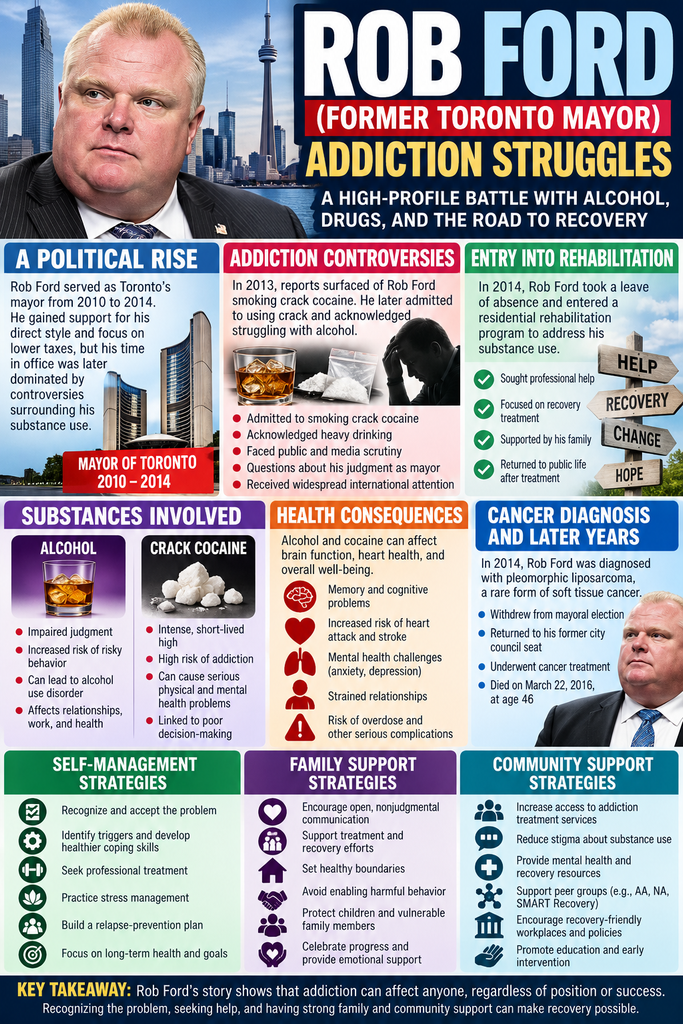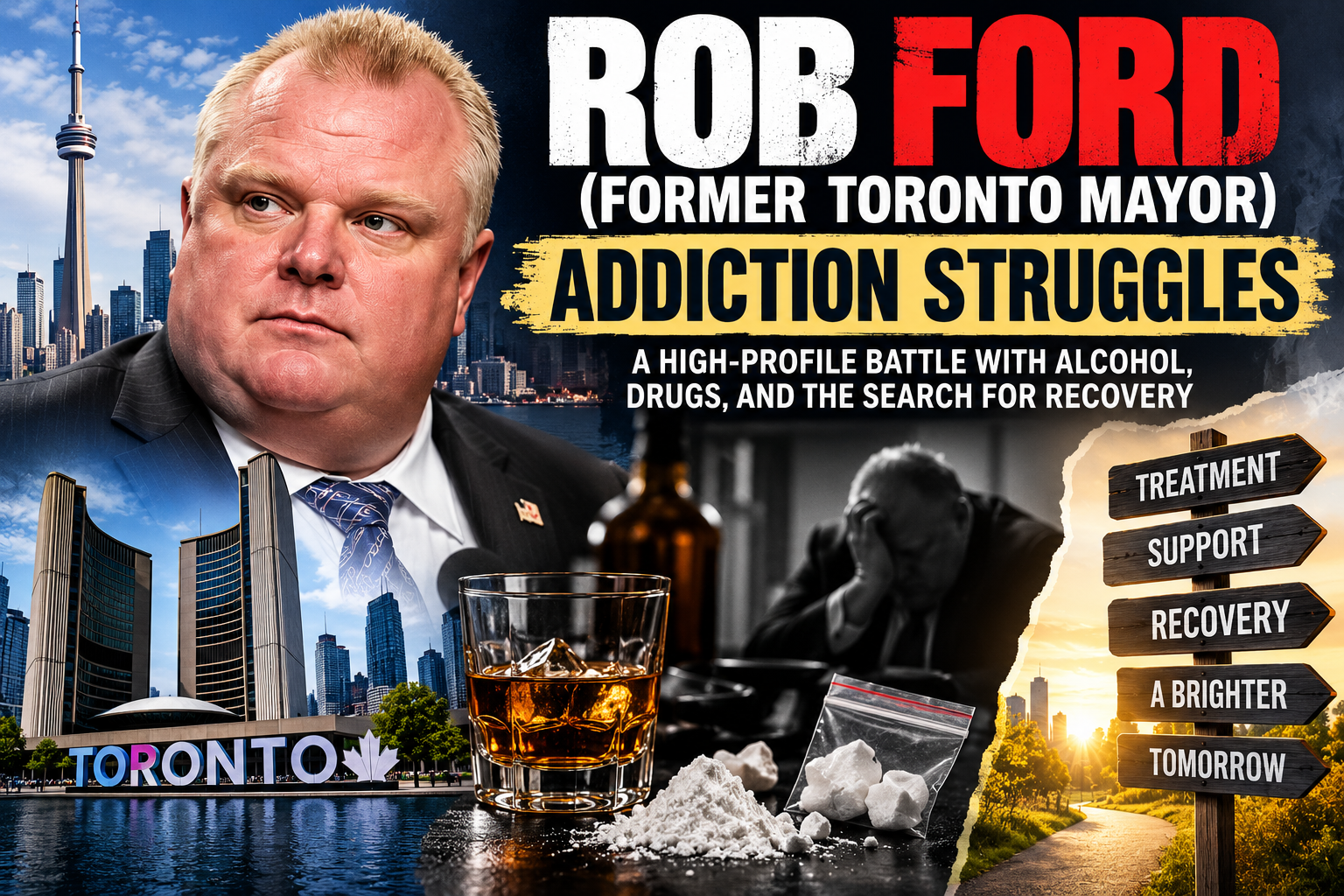
Rob Ford, the former mayor of Toronto, Canada, became internationally known not only for his outspoken political personality but also for his highly publicized struggles with alcohol and drug use. His personal challenges unfolded under intense media scrutiny, raising important questions about addiction, mental health, accountability, family support, and the difficulties of seeking recovery while holding public office.
Ford served as Toronto’s mayor from 2010 to 2014. During his administration, reports of excessive drinking, drug use, and controversial public behavior attracted widespread attention. In 2013, he acknowledged smoking crack cocaine during a period he described as a drunken stupor. In 2014, he entered a residential rehabilitation program to address his substance use.
His experience illustrates how addiction-related problems can affect individuals regardless of their professional position, financial resources, or public recognition.
Although Ford’s public statements and treatment history are documented, his complete medical and psychological history remains private. Therefore, his story should be examined without assuming diagnoses or motivations that have not been established.
By exploring his experiences through self-management, family involvement, and community support, we can better understand the challenges of substance use, the importance of treatment, and the need to balance compassion with personal accountability.
Rob Ford’s Rise to Political Prominence
Rob Ford was born on May 28, 1969, in Etobicoke, Ontario. Before becoming mayor, he served as a Toronto city councilor and built a political reputation around fiscal restraint, constituent services, and opposition to government spending.
His direct communication style attracted devoted supporters and strong critics.
In 2010, Ford won Toronto’s mayoral election, becoming one of Canada’s most recognizable municipal political figures.
However, his administration became increasingly dominated by controversies surrounding his personal behavior and substance use.
Factors that made his circumstances particularly challenging
- Public visibility: His behavior received extensive local and international media coverage.
- Professional responsibilities: As mayor, he faced demanding leadership and decision-making obligations.
- Public accountability: His substance use raised questions about judgment, credibility, and professional conduct.
- Family pressures: Public controversies could also affect his spouse, children, and relatives.
- Stigma surrounding addiction: Substance use problems often carry shame that may discourage individuals from seeking assistance.
- Political polarization: Supporters and critics frequently interpreted his behavior through competing political perspectives.
These circumstances demonstrate why addiction-related challenges involving public officials can become both personal health matters and public accountability issues.
Rob Ford’s Alcohol and Drug Use Controversies
Ford’s substance use became a major public controversy in 2013 when reports emerged of a video showing him smoking what appeared to be crack cocaine.
After initially denying the allegations, Ford publicly acknowledged smoking crack cocaine in November 2013. He also admitted that he had been drinking heavily around the time of the incident.
His statements attracted international attention and intensified concerns about his ability to fulfill his responsibilities as mayor.
Documented concerns surrounding his substance use
- Public acknowledgment of crack cocaine use.
- Episodes involving excessive alcohol consumption.
- Reports of impaired or erratic behavior.
- Controversies surrounding his public statements and conduct.
- Growing pressure to seek professional treatment.
- Questions about his ability to maintain professional responsibilities.
It is important to distinguish between documented substance use and a formal clinical diagnosis. Although Ford acknowledged serious problems involving alcohol and drugs and later entered rehabilitation, publicly available information does not establish every clinical detail of his condition.
His experience nevertheless illustrates how substance use can become associated with impaired judgment, damaged relationships, and professional consequences.
Understanding Alcohol and Crack Cocaine Use
Alcohol and crack cocaine affect the brain and body in different ways, but both can contribute to harmful patterns of substance use.
Alcohol and impaired judgment
Alcohol is a central nervous system depressant that affects brain regions involved in coordination, impulse control, emotional regulation, and decision-making.
Excessive alcohol consumption can increase the likelihood of risky behavior and interfere with personal and professional responsibilities.
Potential consequences include:
- Impaired judgment and reduced inhibition.
- Memory problems and blackouts.
- Increased risk of accidents and injuries.
- Relationship conflicts.
- Liver and cardiovascular complications.
- Development of alcohol use disorder.
Crack cocaine and addiction risk
Crack cocaine is a smokable form of cocaine that produces rapid and intense stimulant effects.
It increases dopamine activity in the brain and can strongly reinforce repeated use.
Potential consequences include:
- Intense cravings and compulsive use.
- Anxiety, agitation, and sleep disturbances.
- Cardiovascular complications, including heart attack and stroke.
- Impaired decision-making.
- Psychological distress.
- Increased risk of developing cocaine use disorder.
Using alcohol and cocaine together introduces additional medical risks because the body can produce cocaethylene, a metabolite associated with increased cardiovascular toxicity.
Ford’s public disclosures provide an opportunity to understand these risks without assuming the precise frequency or severity of his individual substance use.
Rob Ford’s Decision to Enter Rehabilitation
In April 2014, Ford announced that he would take a leave of absence from his mayoral responsibilities to seek professional help for substance use problems.
He subsequently attended a residential rehabilitation program and returned to public life after treatment.
Entering rehabilitation represented a significant development in his publicly documented efforts to address his alcohol and drug use.
However, attending treatment does not automatically establish permanent recovery, and Ford’s long-term substance use outcomes cannot be fully determined from public reports.
Why professional rehabilitation can be important
- Provides a structured environment away from familiar substance use triggers.
- Offers clinical assessment of substance use and mental health concerns.
- Introduces behavioral therapies and relapse-prevention techniques.
- Encourages healthier coping mechanisms.
- Creates opportunities to address relationships and personal responsibilities.
- Helps individuals establish ongoing recovery support.
Ford’s decision to seek treatment illustrates an important principle: acknowledging substance-related problems and obtaining professional assistance can be meaningful steps toward change.
Self-Management Strategies: Taking Responsibility for Addiction Recovery
Self-management is an essential part of addiction recovery. It involves recognizing substance use patterns, identifying triggers, developing healthier coping skills, and accepting responsibility for personal decisions.
Ford’s experience shows why self-awareness and a willingness to seek treatment matter.
In 2014, he acknowledged that he had tried to address his alcohol problems on his own before recognizing that he needed professional assistance.
Recognize and acknowledge the problem
One of the first steps toward recovery is recognizing when substance use is interfering with daily life.
Individuals can begin by asking themselves:
- Am I using alcohol or drugs to cope with uncomfortable emotions?
- Have I continued using substances despite negative consequences?
- Have family members expressed concerns about my behavior?
- Have I attempted unsuccessfully to reduce my substance use?
- Has substance use affected my relationships, employment, or health?
Acknowledging a problem does not mean accepting shame. It means recognizing an opportunity for change.
Identify personal triggers
Triggers are internal or external experiences that increase the desire to use substances.
Common triggers include:
- Emotional distress and frustration.
- Social gatherings involving alcohol or drugs.
- Conflict with family members or coworkers.
- Exposure to familiar substance use environments.
- Feelings of isolation or boredom.
- High-pressure situations.
Ford later explained that his drinking and drug use began before he became mayor, challenging the assumption that political stress alone caused his substance use problems.
Develop healthier coping mechanisms
People recovering from addiction benefit from replacing substance use with healthier responses to stress.
Practical strategies include:
- Practicing mindfulness and relaxation techniques.
- Participating in regular physical activity.
- Maintaining a consistent sleep schedule.
- Attending individual or group counseling.
- Developing hobbies and meaningful interests.
- Building relationships that support sobriety.
- Seeking treatment for co-occurring mental health conditions when present.
Establishing a relapse-prevention plan
Recovery often involves ongoing attention to cravings, emotional challenges, and high-risk situations.
A relapse-prevention plan may include recognizing early warning signs, avoiding high-risk environments, maintaining treatment appointments, and identifying trusted people to contact during difficult moments.
For alcohol use disorder, medications such as naltrexone or acamprosate may be appropriate. For cocaine use disorder, contingency management and other behavioral treatments are important evidence-based options.
Alcohol withdrawal can be medically dangerous in people with significant physical dependence, so stopping heavy drinking may require supervised withdrawal management.
Family Support Strategies: Balancing Compassion and Accountability
Family relationships can significantly influence addiction recovery.
Rob Ford’s family played a visible role during his substance use controversies. His brother, Doug Ford, frequently defended him publicly, while other family members expressed concern for his well-being.
Ford later described how his family encouraged him to seek rehabilitation. He also reported that his wife, Renata, and their two children visited him during residential treatment.
His experience illustrates the complicated balance between protecting a loved one and acknowledging harmful behavior.
Encourage honest communication
Families can create opportunities for open conversations about substance use without humiliation or personal attacks.
Helpful approaches include:
- Expressing concern about specific behaviors.
- Listening to the person’s experiences.
- Avoiding accusations and name-calling.
- Encouraging professional evaluation.
- Recognizing progress toward recovery.
Avoid unintentionally enabling harmful behavior
Family members sometimes attempt to protect loved ones from embarrassment or consequences.
However, repeatedly denying serious problems or covering up dangerous behavior may delay treatment.
Healthier responses include:
- Refusing to provide excuses for harmful conduct.
- Establishing clear boundaries.
- Avoiding financial support that directly facilitates substance use.
- Encouraging accountability for personal decisions.
- Supporting treatment without taking control of the person’s recovery.
Support participation in treatment
Families can help with transportation, scheduling appointments, planning treatment, and handling practical responsibilities.
Family counseling may also help address communication difficulties and rebuild trust.
Protect children and other vulnerable family members
When addiction affects a household, children may experience uncertainty, emotional distress, or disrupted routines.
Families should prioritize:
- Predictable household routines.
- Age-appropriate explanations.
- Protection from intoxicated or unsafe behavior.
- Emotional reassurance.
- Access to counseling when necessary.
Supporting someone with addiction should never require family members to tolerate abuse, intimidation, or dangerous behavior.
Community Support Strategies: Making Recovery Accessible
Rob Ford’s struggles became a public conversation about addiction, stigma, leadership, and treatment access.
His situation demonstrated that substance use disorders can affect individuals across social and economic backgrounds.
However, many people lack the financial resources or professional connections available to prominent public figures.
Community-based addiction services help reduce these disparities.
Expand access to professional treatment
Communities can support recovery by providing:
- Affordable outpatient counseling.
- Residential treatment when clinically appropriate.
- Medically supervised withdrawal services.
- Integrated addiction and mental health care.
- Peer recovery programs.
- Long-term follow-up and continuing care.
Encourage peer support and recovery networks
Mutual-help groups can reduce isolation and provide encouragement.
Programs such as Alcoholics Anonymous, Narcotics Anonymous, and SMART Recovery offer different approaches to peer support.
Participation should reflect individual preferences and treatment needs.
Reduce addiction-related stigma
Public discussion of Ford’s substance use frequently included ridicule and sensationalized coverage.
While public officials must remain accountable for their conduct, addiction treatment should not be discouraged through humiliation.
Communities can reduce stigma by:
- Using respectful language.
- Educating the public about substance use disorders.
- Encouraging early treatment.
- Protecting patient confidentiality.
- Supporting recovery-friendly workplaces.
- Recognizing that treatment and accountability can coexist.
Providing accessible recovery resources
In Canada, people seeking addiction support can contact provincial healthcare services, community mental health organizations, or local addiction treatment programs.
Useful resources include:
- Center for Addiction and Mental Health (CAMH)
- ConnexOntario — Mental Health and Addiction Services
- Health Canada — Substance Use and Addiction
These organizations provide educational information and pathways to treatment.
Addiction, Public Leadership, and Personal Accountability
Ford’s experience raised difficult questions about the relationship between addiction and professional responsibility.
Public officials are expected to exercise sound judgment, follow laws, and maintain public trust.
Substance use problems may affect these responsibilities, particularly when intoxication interferes with decision-making or workplace behavior.
In November 2013, Toronto City Council voted to remove most of Ford’s mayoral powers following escalating controversies. He remained mayor but served with substantially reduced authority.
Lessons about professional accountability
- Addiction treatment does not eliminate responsibility for harmful behavior.
- Professional responsibilities may require temporary leave during treatment.
- Organizations should establish clear impairment and safety policies.
- Confidential access to healthcare can encourage earlier intervention.
- Evaluate recovery progress through sustained behavior rather than public promises alone.
- Individuals deserve rehabilitation opportunities while remaining accountable for their actions.
Ford’s story shows that compassion and accountability complement, rather than oppose, one another.
Rob Ford’s Cancer Diagnosis and Later Years
In September 2014, several months after returning from rehabilitation, Ford was diagnosed with pleomorphic liposarcoma, a rare form of soft tissue cancer.
The diagnosis forced him to withdraw from the 2014 Toronto mayoral election.
He subsequently ran for and won his former city council seat.
Ford underwent cancer treatment, but his illness progressed. He died on March 22, 2016, at age 46.
It is important to distinguish his cancer diagnosis from his substance use history.
There is no established evidence that Ford’s alcohol or cocaine use caused his liposarcoma. His cancer and addiction struggles were separate health challenges, and a causal relationship should not be assumed.
His final years demonstrate how individuals and families may face multiple serious health concerns while also navigating recovery, public responsibilities, and emotional stress.
Important Lessons From Rob Ford’s Addiction Journey
Ford’s experience offers several lessons for individuals, families, healthcare professionals, and communities.
Addiction can affect people in positions of authority
Professional achievement does not protect individuals from developing substance use disorders.
Denial may delay treatment
Ford initially rejected allegations of addiction before publicly acknowledging his need for professional help.
Recognizing a problem can create opportunities for meaningful intervention.
Treatment requires personal participation
Ford later emphasized that entering rehabilitation was ultimately his own decision, even though people around him had encouraged treatment.
Family support must include boundaries
Compassion matters, but shielding someone from every consequence can undermine accountability and recovery.
Recovery extends beyond rehabilitation
Residential treatment may provide an important foundation, but ongoing counseling, coping skills, social support, and relapse prevention often remain necessary.
Public stigma can create barriers
Ridicule and shame may discourage people from acknowledging substance use problems or seeking professional assistance.
Accountability remains essential
Understanding addiction as a health condition does not excuse unsafe behavior, dishonesty, or harm to others.
How Rob Ford’s Story Can Help Others Seek Recovery
Ford’s public acknowledgment of his substance use and decision to enter rehabilitation can encourage conversations about the importance of recognizing addiction and seeking treatment.
His experience also shows that professional pressures, family relationships, public expectations, and personal beliefs can complicate recovery.
For individuals experiencing similar challenges, several actions can provide a starting point:
- Speak with a qualified healthcare professional about alcohol or drug use.
- Request an assessment for substance use disorder.
- Explore appropriate outpatient or residential treatment.
- Develop a personalized recovery plan.
- Involve trusted family members or friends when safe and helpful.
- Establish clear boundaries around substance use.
- Continue care after formal treatment.
- Seek additional help when cravings or setbacks occur.
No single recovery approach works for everyone. Treatment should reflect the individual’s health, circumstances, preferences, and support needs.
Conclusion: Understanding Rob Ford Beyond the Headlines
Rob Ford’s years as Toronto’s mayor were marked by political controversy, public scrutiny, and widely documented struggles with alcohol and drug use.
His eventual decision to enter rehabilitation highlighted the importance of recognizing when professional treatment is necessary.
His story also illustrates the complex relationships between addiction, family dynamics, public accountability, and community attitudes toward substance use disorders.
While his long-term recovery cannot be fully assessed from public information, his experience provides valuable lessons about acknowledging harmful behaviors, accepting assistance, and developing healthier coping strategies.
Through self-management, family support, accessible treatment, and compassionate community involvement, individuals struggling with addiction can pursue meaningful and sustainable recovery.
Rob Ford’s story reminds us that addiction does not erase personal responsibility, and personal responsibility does not eliminate the need for compassion, treatment, and support.
Frequently Asked Questions and Answers
Rob Ford’s Addiction History
1. Who was Rob Ford, and why did his addiction struggles attract international attention?
Rob Ford served as Toronto’s mayor from 2010 to 2014. His substance use became international news after reports surfaced in 2013 of a video showing him smoking crack cocaine. His subsequent admission, public behavior, and decision to seek rehabilitation generated widespread discussion about addiction and the responsibilities of public officials.
2. What substances did Rob Ford struggle with?
Ford publicly acknowledged excessive alcohol consumption and using crack cocaine. His statements and reported behavior raised concerns about harmful substance use and its effects on his personal life, professional responsibilities, and public reputation.
3. Did Rob Ford admit to smoking crack cocaine?
Yes. In November 2013, Ford publicly acknowledged smoking crack cocaine after previously denying allegations about his drug use. He stated that the incident occurred while he was intoxicated.
4. Was Rob Ford diagnosed with alcohol use disorder?
Ford acknowledged serious problems with alcohol and entered rehabilitation for substance use in 2014. However, his complete medical records are not publicly available, so we should not assume precise clinical diagnoses or the severity of his conditions.
5. Did Rob Ford use alcohol and crack cocaine together?
Ford acknowledged using crack cocaine during a period of heavy drinking. Using alcohol and cocaine together can be particularly dangerous because the body produces cocaethylene, a substance associated with increased cardiovascular toxicity and other health risks.
6. Why did Rob Ford initially deny allegations about his drug use?
Ford initially disputed reports concerning his substance use before later acknowledging smoking crack cocaine. His private motivations for those denials cannot be established with certainty. More generally, fear of consequences, stigma, shame, and difficulty recognizing a problem can contribute to denial in people experiencing substance-related difficulties.
7. Did political stress cause Rob Ford’s substance use problems?
There is no reliable evidence establishing political stress as the cause of Ford’s substance use. Ford publicly indicated that his drinking and drug use began before he became mayor. Stress can contribute to harmful substance use patterns, but addiction usually involves multiple biological, psychological, and environmental factors.
Rehabilitation and Recovery
8. When did Rob Ford enter rehabilitation?
Ford announced in April 2014 that he would take a leave of absence from his mayoral responsibilities to seek treatment. He attended a residential rehabilitation program and returned to public life after completing treatment.
9. Why did Rob Ford decide to seek professional treatment?
Ford publicly acknowledged that he needed assistance addressing his alcohol and drug use. His decision followed increasing public controversy and concern about his behavior. He also said he recognized that his previous attempts to manage his problems were insufficient.
10. What type of addiction treatment did Rob Ford receive?
Ford attended a residential rehabilitation facility. Although he discussed aspects of his treatment publicly, his complete clinical treatment plan is not available. Residential programs commonly provide counseling, behavioral therapy, structured routines, and relapse-prevention education.
11. Did Rob Ford successfully overcome his addiction?
Ford completed a period of residential treatment and publicly discussed efforts to change his behavior. However, his long-term substance use outcomes cannot be conclusively determined from available public information. Completing rehabilitation is an important step, but sustained recovery generally requires continuing care and ongoing support.
12. Can residential rehabilitation help people struggling with alcohol and cocaine use?
Yes. Residential treatment can provide a structured environment, clinical assessment, behavioral therapies, and protection from certain substance use triggers. However, residential care is not necessary for everyone. The appropriate level of treatment depends on medical needs, substance use severity, safety, and available support.
13. What happens after someone completes addiction rehabilitation?
Continuing care may involve outpatient counseling, peer support meetings, relapse-prevention planning, medication when appropriate, and ongoing mental health treatment. Recovery often requires adjusting routines, rebuilding relationships, and developing healthier coping strategies.
14. Can someone relapse after completing rehabilitation?
Yes. A return to substance use can occur after treatment. It does not mean that recovery is impossible. A setback may mean reassessing triggers, increasing treatment intensity, or modifying the recovery plan. Overdose prevention and medical evaluation are especially important when tolerance has changed.
Self-Management Strategies
15. What self-management strategies can help someone struggling with addiction?
Effective self-management strategies include:
- Recognizing harmful substance use patterns.
- Identifying emotional and environmental triggers.
- Developing healthier stress-management techniques.
- Establishing consistent sleep and exercise routines.
- Participating in counseling or behavioral therapy.
- Creating a relapse-prevention plan.
- Maintaining regular contact with recovery support systems.
These strategies work best when combined with professional treatment when clinically indicated.
16. How can someone recognize that alcohol or drug use has become a serious problem?
Warning signs include unsuccessful attempts to reduce use, strong cravings, neglecting responsibilities, relationship conflicts, risky behavior while intoxicated, and continued use despite harmful consequences. A healthcare professional can assess whether these symptoms meet criteria for a substance use disorder.
17. What are common triggers for alcohol and cocaine use?
Common triggers include stress, social pressure, conflict, loneliness, boredom, exposure to substances, and familiar environments associated with previous use. Identifying these triggers helps individuals develop healthier responses and avoid high-risk situations.
18. How can someone manage stress without alcohol or drugs?
Helpful strategies include physical activity, mindfulness, breathing exercises, structured daily routines, supportive conversations, counseling, and recreational activities. People experiencing persistent anxiety or depression may benefit from professional mental health assessment.
19. Are medications available to treat alcohol and cocaine addiction?
Medications such as naltrexone, acamprosate, and disulfiram may be used for alcohol use disorder when appropriate. There are currently no FDA-approved medications specifically for cocaine use disorder in the United States. Behavioral approaches, particularly contingency management, have demonstrated effectiveness for stimulant use disorders.
20. Can someone safely stop drinking alcohol without medical supervision?
Not always. Individuals with significant physical alcohol dependence may experience dangerous withdrawal symptoms, including seizures and delirium tremens. Anyone who drinks heavily or has experienced withdrawal symptoms should consult a healthcare professional before abruptly stopping alcohol use.
Family Support Strategies
21. How did Rob Ford’s family respond to his addiction struggles?
Ford’s family remained publicly involved during his controversies and treatment. His brother, Doug Ford, often spoke in his defense, and family members encouraged him to seek help. Rob Ford also discussed receiving family support during rehabilitation.
22. How can families encourage someone to seek addiction treatment?
Families can express concern about specific behaviors, listen without judgment, explain available treatment options, and offer practical assistance. Encouragement is generally more constructive when it focuses on health and safety rather than shame or punishment.
23. What is the difference between supporting someone and enabling addiction?
Support involves encouraging treatment, maintaining healthy boundaries, and helping someone take responsibility for recovery. Enabling may involve repeatedly concealing harmful behavior, providing resources that directly facilitate substance use, or preventing someone from experiencing reasonable consequences.
24. Should families establish boundaries with a loved one experiencing addiction?
Yes. Healthy boundaries protect family members while supporting recovery. Examples include refusing to tolerate threatening behavior, maintaining substance-free household rules, and avoiding financial arrangements that facilitate drug or alcohol use.
25. How can addiction affect children and spouses?
Addiction may contribute to emotional distress, financial instability, conflict, inconsistent caregiving, and uncertainty about family routines. Children may experience anxiety or confusion. Family counseling, predictable routines, and age-appropriate communication can help reduce these effects.
26. Can family therapy improve addiction recovery outcomes?
Yes. Family-based interventions can improve communication, strengthen treatment engagement, address relationship conflicts, and help relatives develop healthier responses to substance use. The best approach depends on family circumstances and safety concerns.
Community Support and Public Accountability
27. How did Rob Ford’s addiction struggles affect his political career?
Ford’s substance use controversies damaged his public standing and raised concerns about his ability to perform mayoral responsibilities. In November 2013, Toronto City Council voted to strip him of many mayoral powers. He remained mayor until the end of his term in 2014.
28. Should addiction be treated as a medical condition or a personal responsibility?
Both medical treatment and personal accountability are important. Substance use disorders involve changes in brain function, behavior, and health, making evidence-based treatment essential. At the same time, individuals remain responsible for addressing harmful conduct and protecting others from unsafe behavior.
29. How can communities reduce the stigma surrounding addiction?
Communities can provide accurate education, use respectful language, improve access to confidential treatment, support recovery-friendly workplaces, and avoid portraying people with substance use disorders as morally inferior. Reducing stigma can make it easier for individuals to seek help.
30. What community recovery programs can help people struggling with alcohol and drug use?
Available programs may include:
- Alcoholics Anonymous (AA).
- Narcotics Anonymous (NA).
- SMART Recovery.
- Outpatient addiction counseling.
- Residential treatment services.
- Community mental health clinics.
- Peer recovery support groups.
- Continuing care and recovery housing programs.
These services offer different approaches, allowing individuals to select support that fits their needs.
31. Where can people in Toronto find addiction treatment resources?
People in Toronto and throughout Ontario can access information and referrals through the Center for Addiction and Mental Health (CAMH) and ConnexOntario. These organizations help individuals and families locate mental health and addiction services.
Rob Ford’s Later Years and Legacy
32. Did Rob Ford develop cancer after attending rehabilitation?
Yes. In September 2014, Ford was diagnosed with pleomorphic liposarcoma, a rare form of soft tissue cancer. His diagnosis occurred several months after his residential rehabilitation treatment.
33. Was Rob Ford’s cancer caused by alcohol or cocaine use?
There is no established evidence that Ford’s alcohol or cocaine use caused his pleomorphic liposarcoma. His cancer diagnosis should not be presented as a direct consequence of his substance use. Although substance use can contribute to various medical problems, specific cancer causes require scientific evidence.
34. When did Rob Ford die, and what caused his death?
Rob Ford died on March 22, 2016, at age 46, following complications from pleomorphic liposarcoma. His death was associated with cancer rather than a documented drug overdose.
35. What is the most important lesson from Rob Ford’s addiction struggles?
Ford’s experience illustrates that substance use problems can affect people regardless of professional achievement, social status, or public recognition. His decision to enter rehabilitation demonstrates the importance of seeking professional assistance, while the controversies surrounding his behavior highlight the need for accountability.
His story also emphasizes that addiction recovery is strengthened by self-management, family encouragement, evidence-based treatment, and accessible community resources.
Video: