Have you ever felt responsible for a friend’s happiness, constantly rescued them from difficult situations, or felt guilty for prioritizing your own needs?
Friendships are an important source of emotional support, companionship, and encouragement during addiction recovery. However, some friendships can become unhealthy when emotional dependence, excessive caretaking, controlling behavior, and poor boundaries replace mutual respect and personal independence.
Codependent friendships may develop when one or both individuals rely excessively on the relationship for emotional security, validation, or self-worth. These patterns can create emotional exhaustion, interfere with personal growth, and potentially increase vulnerability to substance use or relapse.
Although codependency is not a formal psychiatric diagnosis, the concept can help individuals recognize unhealthy relationship patterns.
Learning how to spot codependent friends does not mean abandoning everyone who needs support. Instead, it involves recognizing the difference between genuine friendship and unhealthy emotional dependence.
A healthy friendship should support your recovery, not require you to sacrifice it.
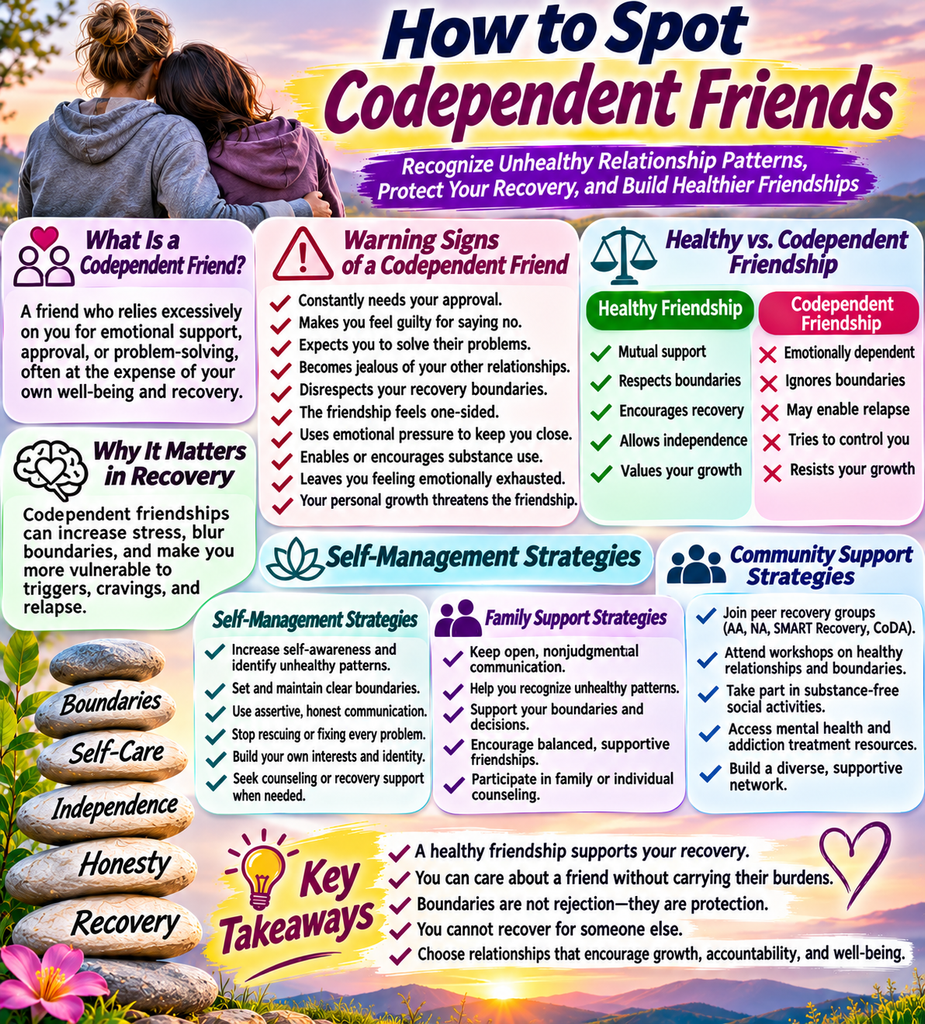
What Is a Codependent Friendship?
A codependent friendship is a relationship characterized by excessive emotional reliance, difficulty maintaining boundaries, and an imbalance between giving and receiving support.
One person may assume the role of caretaker or rescuer, while the other becomes increasingly dependent on that person’s attention, approval, or assistance. These roles can also shift between individuals.
Over time, both individuals may develop unhealthy patterns that interfere with emotional independence.
Common Characteristics of Codependent Friendships
- Excessive reliance on another person for emotional stability.
- Difficulty making independent decisions.
- Constantly seeking reassurance and approval.
- Feeling responsible for another person’s happiness.
- Fear of rejection or abandonment.
- Difficulty saying no.
- Neglecting personal needs to maintain the friendship.
- Rescuing someone from the consequences of harmful behavior.
- Feeling guilty when establishing boundaries.
- Becoming emotionally exhausted by the relationship.
Healthy friendships involve mutual support, but codependent relationships may gradually undermine independence and personal well-being.
Ten Warning Signs of Codependent Friends
Recognizing unhealthy relationship patterns can help individuals protect their emotional health and recovery.
1. They Constantly Need Your Approval
A friend may repeatedly seek reassurance about their decisions, relationships, appearance, or personal worth.
Although occasional reassurance is normal, excessive dependence on external validation can create emotional pressure.
You may begin feeling responsible for maintaining their confidence and emotional stability.
2. They Make You Feel Guilty for Saying No
A codependent friendship may involve guilt-based pressure whenever you establish boundaries.
Examples include:
- Accusing you of being selfish.
- Suggesting that you no longer care about them.
- Becoming upset when you prioritize treatment appointments.
- Making you feel responsible for their loneliness.
Healthy friends respect your right to decline requests without requiring constant explanations.
3. They Expect You to Solve Their Problems
Some friends repeatedly expect others to resolve their financial, emotional, or relationship difficulties.
You may find yourself constantly:
- Lending money.
- Resolving personal conflicts.
- Making excuses for their behavior.
- Managing their emotional crises.
- Protecting them from consequences.
Supporting a friend is different from assuming responsibility for their life.
4. They Become Jealous of Your Other Relationships
A friend may feel threatened when you develop new friendships, attend recovery meetings, or spend time with family members.
They may attempt to discourage relationships that support your independence.
Healthy friendships allow individuals to maintain multiple sources of emotional support.
5. They Disrespect Your Recovery Boundaries
A particularly concerning warning sign occurs when a friend repeatedly disregards boundaries related to addiction recovery.
Examples include:
- Encouraging you to drink or use drugs.
- Bringing substances into your home despite your objections.
- Pressuring you to attend high-risk social events.
- Criticizing your participation in recovery programs.
- Making fun of your sobriety goals.
- Discouraging prescribed addiction treatment.
These behaviors can undermine recovery regardless of whether the friendship is codependent.
6. The Friendship Feels One-Sided
You may consistently provide emotional, financial, or practical support without receiving similar consideration.
Conversations may focus almost entirely on your friend’s problems, leaving little opportunity to discuss your own needs.
Although friendships naturally fluctuate, persistent imbalance can lead to resentment and emotional exhaustion.
7. They Use Emotional Pressure to Maintain the Friendship
Some unhealthy friendships involve behaviors such as:
- Guilt-tripping.
- Withholding affection or communication as punishment.
- Threatening to end the friendship.
- Exaggerating crises to demand attention.
- Making you responsible for their emotional reactions.
These behaviors may occur intentionally or unintentionally. Regardless of intent, repeated emotional pressure deserves attention.
8. They Enable Your Substance Use
A friend may believe they are helping when their actions actually make continued substance use easier.
Enabling behaviors may include:
- Providing money for substances.
- Covering up substance-related problems.
- Making excuses for missed responsibilities.
- Minimizing the seriousness of addiction.
- Discouraging professional treatment.
- Providing substances to maintain the friendship.
True support encourages safety, accountability, and access to treatment.
9. You Feel Emotionally Exhausted After Spending Time Together
A friendship may become unhealthy when interactions consistently leave you feeling anxious, guilty, overwhelmed, or emotionally drained.
You may start avoiding conversations while still feeling obligated to stay available.
Persistent emotional exhaustion may indicate that you need to reassess your boundaries.
10. Your Personal Growth Threatens the Friendship
As you develop healthier habits, independence, and confidence, some friends may struggle to adjust.
They may resist changes that reduce their dependence on you or disrupt established relationship patterns.
A healthy friend may need time to adjust, but should ultimately respect your efforts to improve your life.
Healthy Friendships Versus Codependent Friendships
Understanding the differences between healthy support and unhealthy dependence can help individuals evaluate their relationships.
| Healthy friendship | Codependent friendship patterns |
|---|---|
| Respects personal boundaries | Repeatedly challenges boundaries |
| Encourages independence | Promotes excessive dependence |
| Provides mutual support | Creates persistent imbalance |
| Respects recovery goals | May undermine recovery goals |
| Allows honest communication | Relies on guilt or emotional pressure |
| Encourages personal responsibility | Repeatedly rescues others |
| Supports other relationships | May become possessive or jealous |
| Allows time for self-care | Demands constant availability |
| Accepts individual differences | Attempts to control decisions |
| Promotes personal growth | Resists changes toward independence |
A single behavior does not establish codependency. Look for persistent patterns, their impact on well-being, and whether both individuals are willing to make constructive changes.
Why Codependent Friendships Develop
Codependent relationship patterns may develop through a combination of childhood experiences, emotional difficulties, learned behaviors, and environmental influences.
Childhood Experiences and Family Dynamics
Individuals who grew up in households affected by addiction, neglect, emotional instability, or unpredictable caregiving may learn to prioritize other people’s needs as a way of maintaining safety or acceptance.
These patterns can continue into adulthood.
Potential contributing factors include:
- Parental substance use disorders.
- Childhood emotional neglect.
- Fear of abandonment.
- Inconsistent caregiving.
- Excessive responsibilities during childhood.
- Exposure to unhealthy relationship patterns.
- Limited opportunities to develop independence.
These experiences may increase vulnerability but do not inevitably lead to codependent relationships.
Low Self-Esteem and Fear of Rejection
Some individuals develop a sense of personal worth primarily through helping others.
They may believe that being needed is necessary to maintain relationships.
This can lead to excessive caretaking, people-pleasing, and difficulty establishing boundaries.
Shared Substance Use Experiences
Friendships formed around alcohol or drug use may become difficult to maintain when one individual begins recovery.
A friend who continues using substances may feel uncomfortable with changes in the relationship.
Similarly, two individuals in recovery may become excessively dependent on each other if they lack broader support systems.
Developing multiple sources of support can reduce unhealthy emotional dependence.
How Codependent Friendships Can Affect Addiction Recovery
Recovery requires emotional stability, personal responsibility, healthy coping skills, and supportive relationships.
Codependent friendships may interfere with these goals by increasing stress and reducing opportunities for independent growth.
The Cycle of Codependency and Relapse Risk
Unhealthy emotional dependence
Excessive caretaking and poor boundaries
Emotional exhaustion and resentment
Increased stress and substance cravings
Greater vulnerability to unhealthy coping
Renewed dependence on the relationship
Without intervention, these patterns may reinforce one another.
Potential Effects on Recovery
- Increased anxiety and emotional distress.
- Reduced time for treatment and self-care.
- Exposure to substance-related triggers.
- Difficulty maintaining sobriety boundaries.
- Increased feelings of guilt and resentment.
- Reduced confidence in independent decision-making.
- Social isolation from healthier relationships.
- Increased vulnerability to relapse.
Codependency does not directly cause addiction, but relationship-related stress may contribute to substance use when other risk factors are present.
Self-Management Strategies: Breaking Codependent Friendship Patterns
Self-management involves recognizing unhealthy behaviors, developing emotional independence, and making decisions that support recovery.
Develop Self-Awareness
Recognizing your own role in a friendship is an important first step.
Consider asking yourself:
- Do I feel responsible for my friend’s happiness?
- Am I afraid to say no?
- Do I neglect recovery activities to solve their problems?
- Do I feel guilty when spending time with other people?
- Am I constantly rescuing my friend from consequences?
- Does this friendship support or undermine my recovery?
Journaling can help identify recurring patterns and emotional triggers.
Establish Healthy Boundaries
Boundaries communicate what behaviors you will accept and how you will protect your well-being.
Examples include:
- Limiting the amount of time spent managing another person’s problems.
- Refusing to lend money that may support substance use.
- Protecting scheduled treatment appointments.
- Avoiding environments associated with previous substance use.
- Maintaining independent friendships.
- Refusing to participate in disrespectful conversations.
- Setting limits on late-night calls and messages.
Boundaries are most effective when they are clear, realistic, and consistently maintained.
Practice Assertive Communication
Assertive communication allows individuals to express their needs without aggression or excessive guilt.
| Situation | Healthy response |
|---|---|
| A friend pressures you to drink | “I am committed to my recovery, and I will not be drinking.” |
| A friend constantly requests money | “I care about you, but I cannot provide financial assistance.” |
| A friend demands your attention | “I need time for myself today. We can talk another time.” |
| A friend criticizes your boundaries | “My boundaries are important to my well-being.” |
| A friend expects you to solve every problem | “I can listen, but I cannot make this decision for you.” |
Assertiveness can help reduce resentment and strengthen emotional independence.
Stop Assuming Responsibility for Other People’s Choices
Supporting someone does not mean controlling their behavior or preventing every negative consequence.
Individuals can offer encouragement, recommend treatment, and provide appropriate assistance without becoming responsible for another person’s recovery.
Learning to tolerate the discomfort of saying no is an important part of developing healthier relationships.
Strengthen Your Personal Identity
Recovery involves developing a sense of identity beyond caregiving, substance use, and relationship approval.
Helpful practices include:
- Pursuing educational or professional goals.
- Developing independent hobbies.
- Participating in physical activity.
- Practicing mindfulness and meditation.
- Maintaining a recovery journal.
- Spending time with supportive family members.
- Building new friendships.
- Recognizing personal strengths and accomplishments.
Personal worth should not depend entirely on being needed by another person.
Seek Professional Counseling
Persistent codependent relationship patterns may benefit from professional mental health treatment.
Potential approaches include:
- Cognitive behavioral therapy (CBT): Helps identify unhealthy beliefs about responsibility and self-worth.
- Dialectical behavior therapy (DBT): Develops interpersonal effectiveness, emotional regulation, and distress tolerance.
- Trauma-informed therapy: Addresses the effects of previous traumatic experiences.
- Interpersonal therapy: Examines relationship difficulties and social functioning.
- Addiction counseling: Addresses substance use triggers and relapse prevention.
Treatment should be individualized according to the person’s clinical needs.
Family Support Strategies: Encouraging Healthy Friendships
Families can help individuals recognize unhealthy relationships and develop stronger recovery support systems.
However, criticizing friends or attempting to control relationships may create defensiveness and conflict.
Encourage Open Communication
Family members can create opportunities for honest conversations about friendships.
Helpful strategies include:
- Listening without immediately criticizing.
- Asking how the friendship affects emotional well-being.
- Discussing specific behaviors rather than labeling the friend.
- Encouraging independent decision-making.
- Recognizing positive changes in recovery.
- Supporting healthy boundaries.
For example, a family member might say:
“I’ve noticed that you seem exhausted after helping your friend. How is this relationship affecting your recovery and your own needs?”
This approach encourages reflection rather than confrontation.
Help Identify Unhealthy Relationship Patterns
Families may recognize changes that the individual has difficulty seeing.
Potential warning signs include:
- Frequently canceling treatment appointments to help a friend.
- Providing excessive financial assistance.
- Becoming increasingly isolated from family.
- Experiencing emotional distress after interactions.
- Returning to environments associated with substance use.
- Neglecting personal responsibilities.
Family members should discuss these observations respectfully without assuming they understand every aspect of the relationship.
Model Healthy Boundaries
Families can demonstrate healthy relationships through their own behavior.
Examples include:
- Respecting privacy and independence.
- Sharing responsibilities fairly.
- Communicating expectations clearly.
- Avoiding guilt-based manipulation.
- Encouraging personal accountability.
- Respecting decisions that support recovery.
Healthy family relationships can model mutual respect and emotional independence.
Encourage Broader Social Connections
Families can support opportunities to develop friendships outside unhealthy relationship patterns.
These may include:
- Recovery meetings.
- Community activities.
- Volunteer opportunities.
- Educational programs.
- Exercise groups.
- Faith-based activities.
- Substance-free social events.
A diverse support network reduces pressure on any single friendship.
Participate in Family Counseling
Family counseling may help address relationship patterns that contribute to excessive caretaking, poor boundaries, or emotional dependence.
It can also help family members distinguish between supporting recovery and enabling harmful behavior.
When relationships involve coercion, threats, or abuse, individual safety planning and specialized support may be more appropriate.
Community Support Strategies: Building Healthier Social Networks
Communities play an important role in helping individuals develop supportive relationships during addiction recovery.
Social isolation can increase emotional distress, while meaningful community connections can strengthen resilience and engagement in recovery.
Promote Peer Recovery Support
Peer recovery groups provide opportunities to connect with individuals who understand addiction-related challenges.
Helpful organizations include:
- Alcoholics Anonymous (AA): Peer support for alcohol recovery.
- Narcotics Anonymous (NA): Peer support for drug addiction recovery.
- SMART Recovery: Skills-based approaches to managing addictive behaviors.
- Co-Dependents Anonymous (CoDA): Peer support focused on developing healthier relationships.
- Al-Anon: Support for people affected by another person’s alcohol use.
- Nar-Anon: Support for families and friends affected by another person’s drug use.
- Recovery Dharma: Mindfulness-oriented recovery support.
Peer support can complement professional addiction and mental health treatment.
Expand Relationship Education Programs
Community organizations can provide workshops addressing:
- Healthy boundaries.
- Assertive communication.
- Emotional independence.
- Recognizing manipulation.
- Conflict resolution.
- Addiction and enabling behaviors.
- Relapse prevention.
- Building healthy friendships.
Education can help individuals recognize unhealthy relationship patterns before they become deeply established.
Create Substance-Free Social Opportunities
Individuals in recovery may struggle to develop new friendships when previous social activities centered on alcohol or drugs.
Communities can provide alternatives through:
- Sober social clubs.
- Community fitness programs.
- Art and music workshops.
- Recovery cafés.
- Gardening groups.
- Volunteer organizations.
- Outdoor recreational activities.
- Recovery-oriented community events.
These activities provide opportunities to develop relationships based on shared interests rather than substance use or emotional dependence.
Improve Access to Mental Health and Addiction Treatment
Community services should address both substance use and the emotional difficulties that may contribute to unhealthy relationships.
Important resources include:
- Affordable mental health counseling.
- Integrated addiction treatment.
- Trauma-informed services.
- Peer recovery coaching.
- Recovery housing.
- Domestic violence advocacy.
- Crisis intervention services.
- Telehealth counseling.
Accessible treatment can help individuals strengthen emotional independence and develop healthier coping skills.
How to Distance Yourself From a Codependent Friend
Not every unhealthy friendship needs to end. Some relationships can improve when both individuals recognize problematic behaviors and respect new boundaries.
However, distancing yourself may become necessary when the relationship repeatedly threatens your safety, emotional health, or recovery.
Practical Steps for Creating Healthy Distance
- Recognize the pattern. Identify recurring behaviors that interfere with your emotional well-being.
- Communicate your needs. Explain your boundaries clearly and respectfully.
- Reduce excessive availability. Stop feeling obligated to respond immediately to every request.
- Avoid repeated rescuing. Encourage your friend to seek appropriate resources and professional assistance.
- Strengthen other relationships. Develop a broader network of supportive friends and recovery peers.
- Prepare for emotional discomfort. Feelings of guilt do not necessarily mean your boundaries are inappropriate.
- Evaluate behavioral changes. Observe whether your friend respects your boundaries over time.
- Prioritize safety and recovery. Consider ending contact if harmful behaviors persist or your safety is threatened.
If a friend threatens self-harm when you establish boundaries, take the threat seriously and contact appropriate crisis services. You should not be expected to manage a mental health emergency alone.
Self-Assessment: Is Your Friendship Affecting Your Recovery?
Use the following reflection checklist to examine your relationship patterns.
Friendship reflection checklist
I feel responsible for my friend’s happiness.
I feel guilty whenever I say no.
I frequently neglect my needs to help my friend.
My friend repeatedly disregards my boundaries.
I feel emotionally exhausted after our interactions.
I worry that becoming more independent will end the friendship.
I repeatedly rescue my friend from consequences.
My friendship interferes with treatment or recovery activities.
I feel pressured to participate in unhealthy behaviors
I struggle to imagine my life without this friendship.
This checklist is an educational self-reflection tool, not a validated clinical screening instrument. There is no diagnostic cutoff for codependency.
Understanding the Difference Between Supporting and Rescuing
One of the most important lessons in addiction recovery is recognizing that compassion does not require assuming responsibility for another person’s life.
| Supporting a friend | Rescuing a friend |
|---|---|
| Encouraging professional treatment | Attempting to become their therapist |
| Listening to concerns | Assuming responsibility for their emotions |
| Offering reasonable assistance | Repeatedly sacrificing personal needs |
| Encouraging accountability | Protecting them from every consequence |
| Respecting independent decisions | Attempting to control their choices |
| Maintaining healthy boundaries | Feeling guilty for having boundaries |
| Encouraging broader support | Becoming their only source of support |
Healthy support encourages personal growth. Repeated rescuing may unintentionally reinforce unhealthy dependence.
Important Lessons About Codependent Friendships and Recovery
Understanding codependent friendship patterns can help individuals develop healthier relationships and protect their recovery.
Friendship should involve mutual respect. Both individuals deserve opportunities to express their needs and pursue personal goals.
Being needed is not the same as being loved. Personal worth should not depend on constantly rescuing others.
Boundaries are not rejection. Healthy boundaries protect relationships and emotional well-being.
You cannot recover for someone else. Encouragement and practical assistance are valuable, but another person’s choices remain their responsibility.
Recovery deserves protection. Friendships that repeatedly undermine treatment, safety, or sobriety require careful reassessment.
Healthy independence does not mean isolation. Individuals can maintain meaningful relationships while developing emotional autonomy.
Professional support can help. Counseling and addiction treatment can address underlying emotional and relationship difficulties.
Conclusion: Choose Friendships That Support Your Recovery
Learning how to spot codependent friends is an important part of developing healthier relationships during addiction recovery.
Although friendships can provide comfort, encouragement, and emotional connection, unhealthy dependence may lead to excessive caretaking, guilt, emotional exhaustion, and increased vulnerability to substance use.
Through self-awareness, assertive communication, healthy boundaries, and professional counseling, individuals can begin breaking these patterns.
Families can support recovery by modeling healthy relationships, encouraging independence, and providing compassionate guidance.
Communities can strengthen recovery through peer support programs, relationship education, accessible treatment, and substance-free social opportunities.
The goal is not to eliminate compassion or stop helping others. It is to develop relationships where both individuals can grow without sacrificing their emotional health or personal independence.
You can care about someone without carrying their burdens. You can support a friend without sacrificing your recovery. Healthy friendship encourages growth, independence, accountability, and mutual respect.
Addiction and Relationship Support Resources
| Organization | Available support |
|---|---|
| Co-Dependents Anonymous | Peer support for developing healthy relationships |
| SMART Recovery | Addiction recovery and self-management skills |
| Al-Anon | Support for families and friends affected by alcohol use |
| Nar-Anon | Support for families and friends affected by drug use |
| NAMI | Mental health education and support |
| FindTreatment.gov | Addiction and mental health treatment locator |
| SAMHSA National Helpline | 1-800-662-HELP (4357) |
| 988 Suicide & Crisis Lifeline | Call or text 988 for crisis support |
Frequently Asked Questions and Answers
Understanding Codependent Friendships
1. What is a codependent friendship?
A codependent friendship is a relationship characterized by excessive emotional dependence, poor personal boundaries, and an imbalance of responsibilities. One or both individuals may rely heavily on the other for emotional stability, validation, decision-making, or a sense of identity.
Unlike healthy friendships, codependent relationships may interfere with emotional independence, personal growth, and addiction recovery.
2. What are the warning signs of a codependent friend?
Common warning signs include:
- Constantly seeking reassurance and approval.
- Making you feel guilty for saying no.
- Expecting you to solve their problems.
- Becoming jealous of your other friendships.
- Disrespecting personal boundaries.
- Demanding constant emotional availability.
- Using emotional pressure to maintain the relationship.
- Enabling unhealthy or addictive behaviors.
- Resisting your personal growth and independence.
- Leaving you emotionally exhausted.
Repeated patterns are more meaningful than isolated incidents.
3. What causes codependent friendships?
Codependent friendship patterns may develop from childhood adversity, emotional neglect, low self-esteem, fear of abandonment, or exposure to unhealthy family relationships.
Individuals who grew up in households affected by addiction may have learned to prioritize other people’s needs while neglecting their own. These behaviors can continue into adulthood and influence friendships.
4. Is codependency a mental health disorder?
No. Codependency is not a formally recognized psychiatric diagnosis in the Diagnostic and Statistical Manual of Mental Disorders (DSM-5-TR).
However, codependent behaviors may coexist with anxiety, depression, trauma-related symptoms, attachment difficulties, and substance use disorders.
Professional counseling can help address these underlying concerns.
5. What is the difference between a supportive friend and a codependent friend?
A supportive friend encourages independence, respects boundaries, and provides mutual emotional support. Codependent friendship patterns may involve excessive reliance, guilt, controlling behaviors, and repeated self-sacrifice.
| Supportive friendship | Codependent friendship |
|---|---|
| Mutual emotional support | Excessive emotional dependence |
| Respect for boundaries | Repeated boundary violations |
| Encourages independence | Fears independence |
| Promotes accountability | May enable harmful behaviors |
| Honest communication | Guilt-based communication |
| Encourages personal growth | Resists personal growth |
| Respects other friendships | May become possessive |
| Supports addiction recovery | May interfere with recovery |
6. Can both friends be codependent?
Yes. Both individuals may develop unhealthy emotional reliance on each other.
One person may seek constant reassurance while the other gains a sense of self-worth from being needed. These behaviors can reinforce each other, creating a cycle of emotional dependence.
The roles of caretaker and dependent individual may also change over time.
7. Are codependent friends intentionally manipulative?
Not necessarily. Some individuals develop unhealthy relationship behaviors without recognizing their impact on others.
Fear of rejection, insecurity, unresolved trauma, and learned coping mechanisms may contribute to controlling or guilt-inducing behaviors.
However, understanding someone’s motivations does not require accepting harmful behavior. Individuals remain responsible for respecting other people’s boundaries.
8. Can a close friendship be mistaken for codependency?
Yes. Close friendships often involve emotional intimacy, frequent communication, and mutual assistance.
The difference is whether the relationship allows both individuals to maintain independence, respect boundaries, and pursue personal goals.
Healthy emotional connection should not be confused with unhealthy dependence.
Codependent Friendships and Addiction Recovery
9. How can codependent friendships affect addiction recovery?
Codependent friendships may increase emotional stress, interfere with treatment participation, and expose individuals to substance-related triggers.
Potential consequences include:
- Increased anxiety and emotional exhaustion.
- Neglecting recovery appointments.
- Difficulty maintaining sobriety boundaries.
- Increased exposure to drugs or alcohol.
- Reduced self-confidence.
- Feelings of guilt and resentment.
- Increased vulnerability to cravings and relapse.
A healthy recovery environment encourages emotional stability and personal accountability.
10. Can codependent friends increase the risk of relapse?
Yes. Unhealthy friendship dynamics may contribute to relapse vulnerability, particularly when they increase emotional distress or encourage substance use.
A friend who repeatedly pressures someone to drink, discourages treatment, or creates ongoing emotional conflict may undermine recovery efforts.
However, relapse is influenced by multiple biological, psychological, and environmental factors. Codependency alone does not cause relapse.
11. What is the difference between codependency and enabling?
Codependency describes broader patterns of unhealthy emotional reliance and relationship imbalance.
Enabling refers to behaviors that unintentionally or intentionally facilitate continued harmful behavior.
Examples of enabling include:
- Providing money used to purchase substances.
- Covering up substance-related problems.
- Making excuses for missed responsibilities.
- Minimizing the seriousness of addiction.
- Discouraging professional treatment.
- Repeatedly protecting someone from avoidable consequences.
Enabling can occur within codependent friendships, but the two concepts are not identical.
12. Why do some friends resist another person’s sobriety?
Some friends may struggle to adjust when recovery changes established relationship patterns.
They may fear losing companionship, feel uncomfortable examining their own substance use, or worry that the recovering individual will become more independent.
Although these reactions may reflect insecurity, they do not justify undermining another person’s recovery.
13. Can two people in addiction recovery develop a codependent friendship?
Yes. Shared recovery experiences can create meaningful connections, but problems may arise when two individuals become excessively reliant on each other for emotional stability.
Maintaining separate recovery goals, professional treatment, personal boundaries, and diverse support networks can help prevent unhealthy dependence.
14. How can I recognize whether a friendship is threatening my sobriety?
Consider whether the friendship repeatedly interferes with treatment, emotional stability, or recovery goals.
Warning signs include feeling pressured to use substances, missing counseling appointments to manage a friend’s problems, hiding interactions from your support network, or experiencing increased cravings after spending time together.
Discussing these concerns with an addiction counselor or recovery coach can help clarify appropriate next steps.
Self-Management Strategies
15. How can I stop being codependent with a friend?
Breaking codependent patterns requires self-awareness, consistent boundaries, and emotional independence.
Helpful strategies include:
- Identifying unhealthy relationship patterns.
- Practicing assertive communication.
- Learning to say no without excessive explanations.
- Reducing unnecessary rescuing behaviors.
- Developing independent hobbies and interests.
- Strengthening self-esteem.
- Expanding your support network.
- Seeking professional counseling.
Changing established relationship patterns takes time and consistent practice.
16. How do I establish healthy boundaries with a codependent friend?
Healthy boundaries communicate what behaviors you will accept and how you will protect your well-being.
Examples include limiting excessive phone calls, refusing financial requests that support harmful behavior, protecting treatment appointments, and avoiding environments associated with substance use.
Boundaries should focus on your own decisions and actions rather than attempting to control another person.
17. How can I say no without feeling guilty?
Learning to tolerate guilt while maintaining healthy boundaries is an important part of emotional growth.
Helpful responses include:
- “I care about you, but I cannot solve this problem for you.”
- “I need to prioritize my recovery today.”
- “I am not comfortable participating in that activity.”
- “I cannot lend you money.”
- “I need some time for myself.”
- “I can listen, but I cannot make this decision for you.”
Experiencing guilt does not necessarily mean you have done something wrong.
18. How can I stop feeling responsible for my friend’s happiness?
Recognize that every individual has responsibility for managing their emotions, decisions, and personal well-being.
You can offer compassion, encouragement, and reasonable assistance without becoming someone’s only source of emotional stability.
Practicing self-compassion, challenging unrealistic beliefs about responsibility, and participating in counseling may help reduce excessive caretaking.
19. What types of therapy can help with codependent behaviors?
Several therapeutic approaches may help address underlying relationship difficulties:
- Cognitive behavioral therapy (CBT): Challenges unhealthy beliefs about responsibility, guilt, and self-worth.
- Dialectical behavior therapy (DBT): Develops emotional regulation, distress tolerance, and interpersonal effectiveness.
- Trauma-informed therapy: Addresses the effects of adverse childhood experiences and trauma.
- Interpersonal therapy: Explores relationship difficulties and social functioning.
- Schema therapy: Examines deeply established patterns of thinking and behavior.
- Addiction counseling: Addresses substance use triggers and relapse prevention.
There is no single standardized treatment for codependency. Therapy should be selected according to individual clinical needs.
20. Should I end a codependent friendship?
Not necessarily. Some friendships can improve when both individuals recognize unhealthy patterns and commit to respecting boundaries.
However, reducing or ending contact may be appropriate when a friendship repeatedly involves manipulation, threats, abuse, substance use pressure, or disregard for recovery goals.
Personal safety and emotional well-being should remain priorities.
21. How can I rebuild my identity outside a codependent friendship?
Developing an independent identity involves discovering personal values, interests, strengths, and goals.
Helpful activities include:
- Pursuing educational or career opportunities.
- Developing new hobbies.
- Participating in regular exercise.
- Practicing mindfulness and journaling.
- Building additional friendships.
- Volunteering in the community.
- Setting independent recovery goals.
- Celebrating personal accomplishments.
Your self-worth should not depend entirely on being needed by another person.
Family Support Strategies
22. How can family members help someone recognize codependent friendships?
Family members can provide compassionate observations without immediately criticizing or labeling the friend.
They can discuss specific behaviors, encourage self-reflection, support independent decision-making, and recommend professional counseling.
For example, a family member might ask, “Do you feel that this friendship gives you the same support that you provide?”
Respectful communication can reduce defensiveness and encourage greater self-awareness.
23. How can families support healthy boundaries?
Families can model healthy relationship behaviors by:
- Respecting privacy and independence.
- Avoiding guilt-based communication.
- Encouraging personal responsibility.
- Supporting treatment and recovery appointments.
- Recognizing individual accomplishments.
- Respecting the person’s right to say no.
- Encouraging balanced friendships.
Family members should avoid replacing one controlling relationship with another.
24. Can childhood family dynamics contribute to codependent friendships?
Yes. Individuals who grew up with unpredictable caregiving, parental addiction, emotional neglect, or excessive childhood responsibilities may develop patterns of people-pleasing and caretaking.
Some children assume adult emotional or practical responsibilities, a process known as parentification.
These experiences may influence adult friendships, although they do not inevitably result in codependency.
25. How can families avoid enabling codependent behaviors?
Families can encourage independence rather than repeatedly solving problems for their loved ones.
Helpful approaches include maintaining consistent boundaries, encouraging professional assistance, avoiding excessive financial rescue, and allowing individuals to make age-appropriate decisions.
Providing emergency assistance, overdose prevention, food, or access to medical care should not automatically be considered enabling.
Community Support Strategies
26. What support groups can help individuals overcome codependency?
Several peer support organizations may help individuals develop healthier relationships and strengthen recovery:
- Co-Dependents Anonymous (CoDA): Focuses on healthy and fulfilling relationships.
- Al-Anon: Supports people affected by another person’s alcohol use.
- Nar-Anon: Supports families and friends affected by another person’s drug use.
- SMART Recovery Family & Friends: Provides practical communication and coping strategies.
- Adult Children of Alcoholics and Dysfunctional Families (ACA): Addresses the lasting effects of dysfunctional childhood environments.
- Alcoholics Anonymous and Narcotics Anonymous: Provide peer support for individuals recovering from substance use.
Peer support can complement professional mental health and addiction treatment.
27. How can communities help people develop healthier friendships?
Community organizations can provide opportunities for meaningful social connections that do not revolve around substance use or unhealthy emotional dependence.
Helpful community initiatives include:
- Substance-free recreational activities.
- Peer recovery coaching.
- Healthy relationship workshops.
- Communication and boundary-setting classes.
- Community fitness programs.
- Volunteer opportunities.
- Recovery cafés.
- Affordable mental health counseling.
- Trauma-informed addiction treatment.
A diverse social support network can reduce excessive reliance on a single friendship.
28. How can I make healthier friends during addiction recovery?
Building healthier friendships begins with participating in environments that align with your personal values and recovery goals.
Consider attending recovery meetings, joining hobby groups, volunteering, participating in educational programs, or attending substance-free community events.
Look for individuals who demonstrate honesty, mutual respect, accountability, emotional maturity, and acceptance of your recovery decisions.
Emotional Healing and Long-Term Recovery
29. What should I do if a friend threatens self-harm when I establish boundaries?
Take any threat of self-harm seriously, regardless of whether it occurs during a relationship conflict.
Encourage immediate professional assistance and contact crisis services when appropriate. In the United States, call or text 988 for crisis support. Call 911 if there is an immediate danger to life.
You can care about your friend’s safety without becoming solely responsible for preventing a mental health crisis.
30. What is the most important lesson about codependent friendships?
The most important lesson is that caring for another person does not require sacrificing your identity, emotional health, personal safety, or addiction recovery.
Healthy friendships involve mutual respect, compassion, independence, honest communication, and personal accountability.
You can support someone without rescuing them, love someone without losing yourself, and establish boundaries without abandoning compassion.
Quick Self-Reflection Checklist
Is your friendship becoming unhealthy?
Select the statements that reflect your experiences.
I feel responsible for my friend’s happiness.
I feel guilty when I say no.
I frequently sacrifice my needs to help my friend.
My friend repeatedly ignores my boundaries.
I feel emotionally exhausted after our interactions.
I worry that becoming independent will end our friendship.
I repeatedly rescue my friend from avoidable consequences.
My friendship interferes with my recovery activities.
I feel pressured to participate in unhealthy behaviors. I depend on my friend’s approval for my self-worth.
Consider whether your friendships allow you to maintain independence, personal boundaries, and recovery goals.
This checklist is an educational reflection exercise, not a validated diagnostic assessment. No specific number of responses establishes codependency.
Community and Professional Support Resources
| Organization | Available support |
|---|---|
| Co-Dependents Anonymous | Healthy relationships and codependency support |
| Al-Anon | Support for families and friends affected by alcohol use |
| Nar-Anon | Support for families and friends affected by drug use |
| SMART Recovery | Self-management and family support |
| Adult Children of Alcoholics | Recovery from dysfunctional family experiences |
| NAMI | Mental health education and support |
| FindTreatment.gov | Addiction and mental health treatment locator |
| SAMHSA National Helpline | 1-800-662-HELP (4357) |
| 988 Suicide & Crisis Lifeline | Call or text 988 for crisis assistance |
Video: