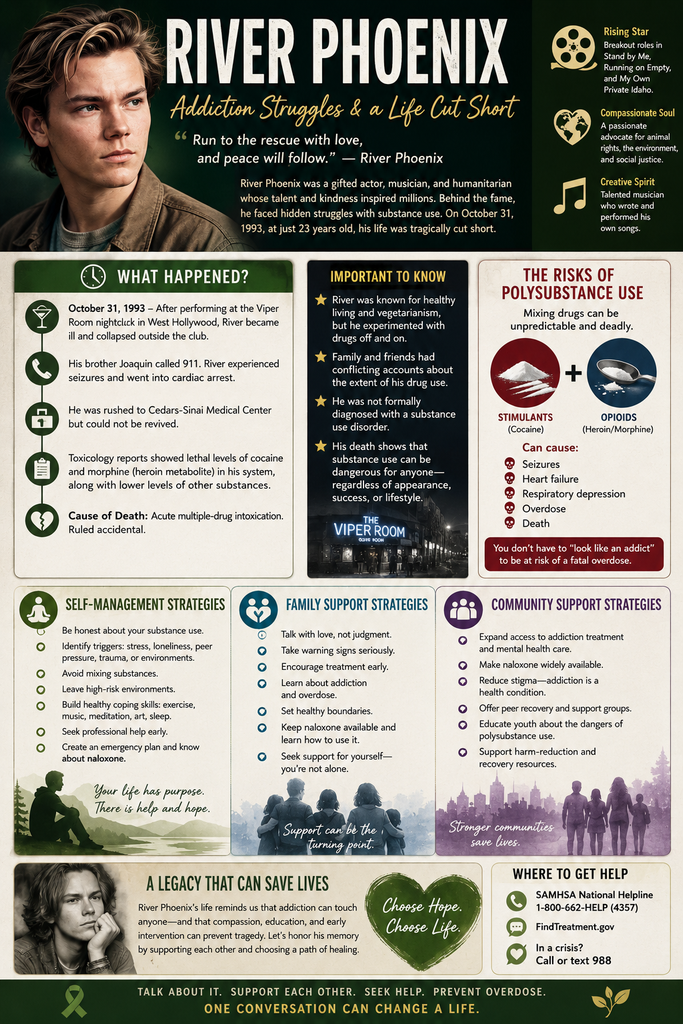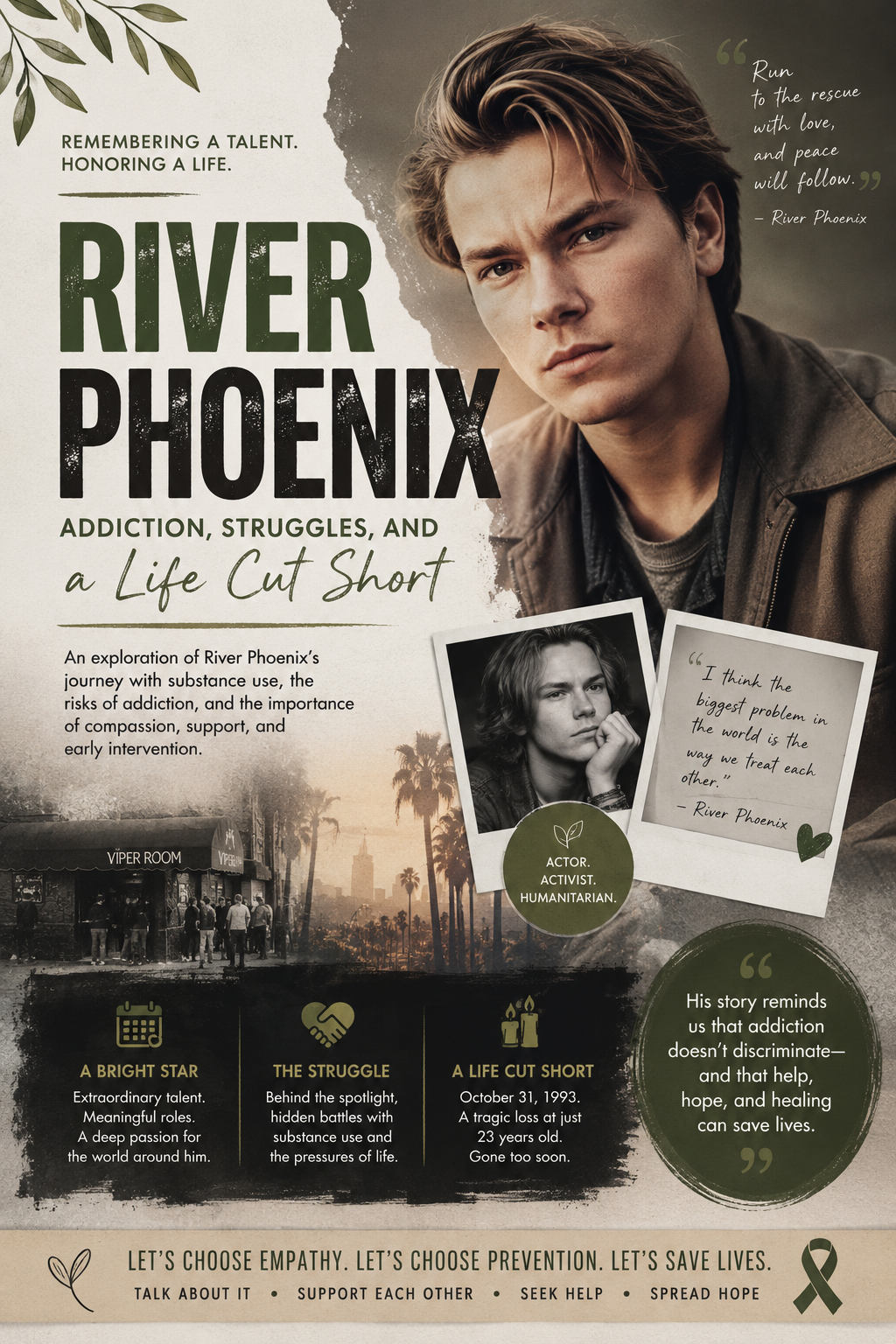
River Phoenix was one of the most celebrated young actors of his generation, earning recognition for memorable performances in Stand by Me, Running on Empty, and My Own Private Idaho. Beyond acting, he was known for supporting animal rights and environmental causes. Tragically, his life ended at just 23 years old after he collapsed outside the Viper Room in West Hollywood on October 31, 1993. Toxicology findings determined that Phoenix died from acute multiple-drug intoxication involving lethal levels of cocaine and morphine, and his death was ruled accidental. His sudden death remains a powerful reminder of the potentially fatal risks associated with polysubstance use.
River Phoenix’s Struggles and Sudden Death
Phoenix’s death shocked the public partly because he had been widely associated with healthy living. Friends and colleagues described him as a committed vegetarian who cared about his health and environmental issues. After his death, however, conflicting accounts emerged about the extent of his drug use. His mother wrote that family members and friends did not consider him a regular drug user, while other acquaintances reported concerns or rumors about drug use before his death. Because of these conflicting accounts, it is more accurate to discuss his fatal drug use and possible substance-related struggles rather than claim that he had a formally diagnosed substance use disorder.
On the night of his death, Phoenix became severely ill at the Viper Room. He experienced seizures, collapsed outside the club, and went into cardiac arrest. His brother Joaquin called 911 to request emergency assistance. Phoenix was transported to Cedars-Sinai Medical Center but could not be revived.
Toxicology testing subsequently found cocaine and morphine at lethal levels, along with lower levels of other substances. Authorities believed the morphine detected was consistent with heroin having been metabolized by his body. No alcohol was detected, and the coroner ruled the death accidental.
His death demonstrates an important lesson about substance use: a person does not have to fit the stereotype of addiction to experience a fatal overdose. Someone can appear successful, health-conscious, talented, and functional while still engaging in extremely dangerous substance use.
Understanding the Risks of Polysubstance Use
Using multiple drugs can create unpredictable and potentially fatal effects. Stimulants such as cocaine and opioids such as heroin affect the body differently, but combining substances does not make either drug safer. Instead, polysubstance use can place enormous stress on the cardiovascular, respiratory, and nervous systems.
River Phoenix’s death reminds us that recreational or occasional drug use can still carry serious consequences. Addiction risk should not be measured solely by how successful someone appears or how frequently others believe the person uses substances.
Important warning signs may include:
- Increasing secrecy about drug use or whereabouts
- Changes in mood, sleep, relationships, or behavior
- Using several substances during the same period
- Spending more time around environments where drugs are readily available
- Continuing to use despite negative consequences
- Increasing tolerance or needing larger amounts
- Withdrawal from supportive friends or family
- Episodes of intoxication, blackouts, seizures, or medical emergencies
Self-Management Strategies
For someone struggling with substance use, recognizing risk early can prevent experimentation or intermittent use from becoming increasingly dangerous. A person does not need to wait until addiction becomes severe before seeking help.
Helpful self-management strategies include:
- Be honest about substance use. Keep track of which substances are used, how often, and the consequences.
- Identify triggers. Stress, loneliness, social pressure, nightlife, trauma, exhaustion, and emotional distress may increase vulnerability to substance use.
- Avoid mixing substances. Combining drugs significantly increases unpredictability and overdose risk.
- Leave high-risk environments. Parties, clubs, social groups, or situations centered around substance use may undermine attempts to stop.
- Build healthier coping strategies. Exercise, music, meditation, creative activities, adequate sleep, and supportive relationships can provide alternatives for managing stress.
- Seek professional assessment. Addiction medicine professionals can determine whether counseling, medications, outpatient treatment, residential care, or other services are appropriate.
- Create an emergency plan. People who use opioids or may encounter an unpredictable illicit drug supply should understand overdose response and the role of naloxone.
Family Support Strategies
River Phoenix’s story also illustrates how difficult it can be for families to recognize substance-related problems. A loved one may appear healthy and successful or may minimize, hide, or compartmentalize drug use.
Families can help by:
- Talk about changes without attacking the person. Focus on observable behaviors and genuine concerns rather than accusations.
- Take warning signs seriously. Sudden behavioral changes, unexplained intoxication, drug paraphernalia, or medical episodes deserve attention.
- Encourage treatment early. Families do not need to wait for an overdose, arrest, job loss, or other crisis before recommending professional help.
- Learn about addiction and overdose. Education can replace myths and stigma with informed responses.
- Set healthy boundaries. Supporting someone does not require providing money, covering up consequences, or accepting unsafe behavior.
- Keep naloxone accessible when opioid exposure is possible. Family members and friends should know how to recognize an opioid overdose and respond.
- Seek support for themselves. Addiction affects entire families. Counseling and family support programs can help relatives manage fear, grief, anger, and uncertainty.
Community Support Strategies
Communities can reduce overdose deaths by treating substance use disorders as health conditions that deserve early intervention, evidence-based treatment, and compassionate support.
Community strategies include:
- Expanding access to addiction medicine and behavioral healthcare
- Making naloxone widely available and teaching people how to use it
- Providing evidence-based treatment for opioid and other substance use disorders
- Offering peer recovery and recovery-support programs
- Educating young adults about the dangers of polysubstance use
- Reducing stigma surrounding treatment and recovery
- Training workplaces, schools, families, and community organizations to recognize substance-related problems
- Supporting harm-reduction services that connect people who use drugs with healthcare and treatment
What River Phoenix’s Death Can Teach Us
One of the most important lessons from River Phoenix’s death is that appearance does not reliably indicate substance-use risk. Fame, talent, money, healthy eating, career success, and supportive relationships cannot guarantee protection from a fatal drug-related event.
His story also demonstrates why we should be careful about diagnosing someone retrospectively. The medical evidence clearly establishes that Phoenix died from acute multiple-drug intoxication, but publicly available accounts conflict about whether he regularly used drugs or met the clinical criteria for addiction.
For families, the lesson is not to search for someone who “looks like an addict.” Instead, pay attention to behaviors, changing patterns, risky substance combinations, and opportunities for early intervention.
Conclusion
River Phoenix’s death ended an extraordinary career before its full potential could be realized. At just 23, he died from an accidental combination of powerful substances, demonstrating how quickly drug use can become a medical emergency. His story should be remembered not simply as a celebrity tragedy but as an opportunity to discuss overdose prevention, polysubstance use, early intervention, and compassionate addiction care.
Recovery and prevention begin with honest conversations. Individuals can recognize their risks and seek help early. Families can respond with concern, boundaries, education, and support. Communities can make treatment, naloxone, harm-reduction services, and recovery resources easier to access. River Phoenix’s story reminds us that substance-related harm can happen behind almost any public image—and that intervention should never have to wait until a person’s life is in immediate danger.
Frequently Asked Questions
Here are some common questions:
1. Who was River Phoenix?
River Phoenix was an American actor and musician who became one of the most acclaimed young performers of his generation. He was known for films including Stand by Me, Running on Empty, and My Own Private Idaho. He was also known publicly for vegetarianism, environmental concerns, and animal-rights advocacy.
2. How old was River Phoenix when he died?
River Phoenix was only 23 years old when he died on October 31, 1993. He collapsed outside the Viper Room nightclub in West Hollywood and was transported to Cedars-Sinai Medical Center, where he was pronounced dead.
3. What caused River Phoenix’s death?
The Los Angeles County coroner determined that Phoenix died from acute multiple-drug intoxication. Toxicology testing found lethal levels of cocaine and morphine; officials indicated that the morphine was believed to have resulted from heroin being metabolized in his body. His death was ruled accidental.
4. Did River Phoenix die from heroin and cocaine?
Cocaine and morphine were found at lethal levels. The coroner’s office reported that the morphine was believed to have originated from heroin. Lower levels of other substances, including Valium, marijuana, and ephedrine, were also reported.
5. Did River Phoenix have an addiction?
It is important not to diagnose River Phoenix retrospectively. His fatal toxicology results clearly document multiple-drug use, but publicly available evidence does not establish that he had been formally diagnosed with a substance use disorder. His mother later wrote that his family, friends, and coworkers did not consider him a regular drug user.
6. Why is River Phoenix’s death associated with polysubstance use?
Polysubstance use means using more than one substance, either together or within a similar period. River Phoenix’s toxicology results showed multiple substances in his body, making his death an important example of how combining substances can create unpredictable and potentially fatal effects.
7. Can someone die from drugs even without having a long history of addiction?
Yes. A fatal overdose does not require years of substance use or a diagnosed addiction. Potency, dose, contamination, tolerance, individual health factors, and combining substances can all affect overdose risk.
8. Why can combining stimulants and opioids be particularly dangerous?
Stimulants such as cocaine and opioids such as heroin affect the body differently, but one does not safely “cancel out” the other. Combining substances can place severe stress on the heart, brain, and respiratory system and make intoxication more difficult to recognize and predict.
9. What warning signs may indicate a drug overdose?
Warning signs can include inability to wake, abnormal or stopped breathing, blue or gray lips or fingertips, severe confusion, vomiting, loss of consciousness, or seizures. A suspected overdose should always be treated as a medical emergency.
10. What should someone do if an opioid overdose is suspected?
Call emergency services immediately. Administer naloxone when available and an opioid overdose is suspected, and follow emergency-dispatch instructions. Naloxone can temporarily reverse the effects of opioids, but the person still needs emergency medical evaluation.
11. How can families help someone struggling with substance use?
Families can approach the person with concern rather than shame, learn the warning signs of addiction and overdose, encourage professional treatment, establish healthy boundaries, and keep naloxone available when opioid exposure is possible. Family members may also benefit from counseling or peer-support programs.
12. What can individuals do to reduce substance-related risks?
Helpful strategies include recognizing personal triggers, avoiding high-risk environments, not mixing substances, developing healthy coping skills, seeking professional help early, and creating an emergency plan. People struggling to control their substance use should consider an evaluation from an addiction-treatment professional.
13. How can communities prevent deaths like River Phoenix’s?
Communities can expand evidence-based addiction treatment, increase overdose education and naloxone access, provide mental-health services, support harm-reduction programs, strengthen peer-recovery resources, and reduce the stigma that prevents people from seeking help.
14. What can we learn from River Phoenix’s death?
His death demonstrates that talent, success, youth, or a healthy public image does not eliminate the risks associated with substance use. It also reminds us that a person’s appearance alone cannot tell us whether they are experiencing substance-related risks.
15. Should River Phoenix’s story be described simply as an “addiction story”?
A more accurate approach is to describe it as a story involving fatal polysubstance use and possible substance-related struggles rather than confidently labeling him as having an addiction. The toxicology findings are documented, but accounts about the extent and frequency of his drug use differed.
16. What is the most important message from River Phoenix’s story?
River Phoenix’s death at only 23 illustrates how quickly substance use can become life-threatening. His story can be remembered without judgment or sensationalism—as an opportunity to promote prevention, early intervention, overdose awareness, compassionate treatment, and greater support for individuals and families affected by substance use.
Video: Why The World Was Shocked By River Phoenix’s Death #riverphoenix #hollywood #cautionarytale