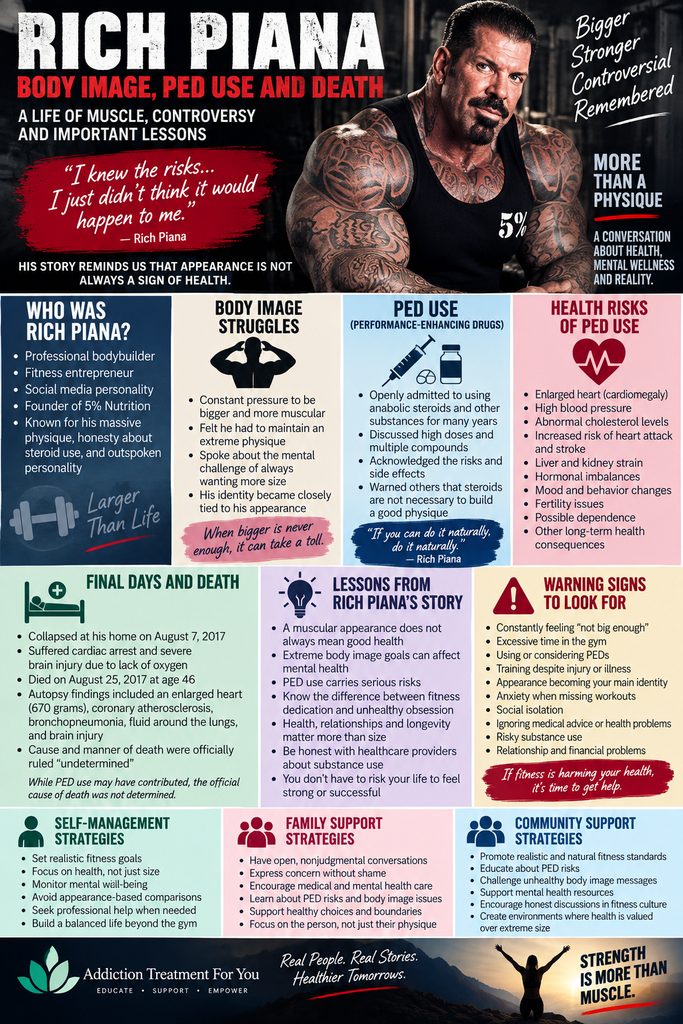
Rich Piana became one of bodybuilding’s most recognizable personalities because of his enormous physique, outspoken personality, and unusual willingness to discuss performance-enhancing drugs (PEDs). Unlike many fitness personalities who avoided talking about steroid use, Piana openly acknowledged using anabolic steroids and discussed the physical consequences and risks associated with his choices.
His story also raises a larger question: What happens when becoming bigger, stronger, and more muscular becomes central to someone’s identity?
Piana died on August 25, 2017, at only 46 years old after collapsing earlier that month. His autopsy documented significant medical abnormalities, including a markedly enlarged heart and coronary atherosclerosis. However, the medical examiner officially classified both his cause and manner of death as undetermined. Therefore, it would be inaccurate to say that steroids were proven to have caused his death.
His life nevertheless provides an opportunity to discuss extreme bodybuilding, body image, PED use, health monitoring, and the pressures that can develop when appearance becomes inseparable from personal identity.
Who Was Rich Piana?
Piana was a competitive bodybuilder, fitness entrepreneur, social-media personality, and founder of the supplement company 5% Nutrition.
He developed an online following partly because he was unusually candid about enhanced bodybuilding. His own company’s archived material describes him discussing his first steroid cycle and saying that he became intensely drawn to the rapid physical changes he experienced.
At the same time, Piana repeatedly told people who had the choice to remain natural to do so. This created an important contradiction in his public persona: he pursued an extremely enhanced physique while simultaneously acknowledging that the lifestyle carried significant consequences.
Body Image and the Pressure to Stay Huge
Body-image difficulties are often stereotyped as a problem involving a desire to become thinner. Men can experience another form of appearance pressure—the feeling that they are never muscular, lean, or large enough.
Piana publicly discussed the pressure of maintaining his enormous physique. In comments analyzed in academic research on bodybuilding culture, he described feeling that being in the public spotlight created an expectation that he maintain a “monster” appearance, even though he did not necessarily want to remain as large as he had become.
That distinction is important.
Someone can receive admiration for their physique while privately feeling trapped by the expectations that come with maintaining it.
Extreme muscularity can become connected to:
- Self-esteem
- Masculinity
- Social-media attention
- Competition
- Sponsorship opportunities
- Business success
- Personal identity
- Approval from other lifters
- Fear of becoming smaller
- Fear of losing status or recognition
For some people, the goalpost continually moves. Being muscular is no longer enough. They need to become bigger, leaner, or stronger than before.
Muscle Dysmorphia and the “Never Big Enough” Mentality
Extreme concern about muscularity can be associated with muscle dysmorphia, a form of body dysmorphic disorder in which someone becomes preoccupied with the belief that their body is insufficiently muscular.
It would be inappropriate to retrospectively diagnose Piana with muscle dysmorphia without clinical evidence. His story can, however, help illustrate behaviors that should prompt someone to evaluate their relationship with bodybuilding.
Potential warning signs can include:
- Constantly believing you are too small despite being highly muscular
- Feeling severe anxiety when missing workouts
- Exercising despite significant injury or illness
- Allowing appearance goals to dominate relationships and responsibilities
- Extreme dieting specifically to manipulate appearance
- Constantly checking muscles in mirrors
- Comparing your physique obsessively with other people
- Using increasingly risky substances to change appearance
- Feeling that losing muscle would mean losing your identity
- Continuing harmful practices despite medical consequences
Dedication to bodybuilding is not automatically a mental health disorder. The concern arises when the pursuit begins to damage someone’s physical or emotional health, relationships, or ability to function.
Rich Piana and Performance-Enhancing Drugs
Piana was remarkably open about anabolic steroid use.
He acknowledged using steroids for many years and discussed both perceived benefits and consequences. Archived material associated with his company continues to document his openness about “gear” while also noting his repeated message that people did not need PEDs simply to build muscle.
He reportedly experienced adverse effects and publicly acknowledged that his choices could damage his body.
His story demonstrates an important distinction:
Knowing that something is dangerous does not necessarily make stopping it easy.
The enormous rewards associated with a particular behavior—appearance, status, competitive success, attention, or identity—can outweigh distant health consequences in someone’s everyday decision-making.
PED Use and Health Risks
Nonmedical anabolic-androgenic steroid use can affect multiple body systems. Risks vary according to substances, doses, combinations, duration of exposure, underlying health conditions, and other factors.
Potential complications can involve:
- Cardiovascular disease
- Abnormal cholesterol levels
- Elevated blood pressure
- Changes in heart structure
- Liver injury with certain agents
- Hormonal disruption
- Fertility problems
- Sexual dysfunction
- Acne and hair loss
- Mood and behavioral changes
- Dependence in some users
- Withdrawal-related symptoms after discontinuation
Using multiple performance-enhancing substances can further complicate risk.
This is why someone’s muscular appearance should never automatically be interpreted as evidence of excellent health.
The Collapse That Preceded His Death
On August 7, 2017, Piana collapsed at his Florida home. His heartbeat was eventually restored, but he experienced severe brain injury related to oxygen deprivation and remained hospitalized.
He died on August 25, 2017, at age 46.
The medical examiner documented:
- Cardiomegaly, with a heart weighing 670 grams
- Mild coronary atherosclerosis
- Bronchopneumonia
- Fluid around both lungs
- Ascites
- Brain edema, ischemia, and necrosis
The autopsy also noted that no hospital-admission specimen was available for toxicology testing.
Did Steroids Cause Rich Piana’s Death?
This question requires an important qualification.
The official autopsy did not determine that steroids caused Rich Piana’s death.
The medical examiner listed both the cause and manner of death as undetermined. Because appropriate admission specimens were unavailable for toxicological testing, drug involvement could not be adequately evaluated. Significant heart disease was also documented.
Therefore, statements such as “Rich Piana died from steroids” go beyond what the medical evidence established.
A more accurate statement is:
Piana had a documented history of PED use and significant cardiovascular abnormalities were found at autopsy, but the medical examiner could not establish a definitive cause of death.
That distinction matters when using his story for health education.
Self-Management Strategies
Piana’s experience can encourage athletes and recreational lifters to examine whether fitness remains something they do or has become the primary measure of who they are.
1. Separate Identity From Physique
Ask yourself:
“If my body became smaller tomorrow, would I still feel valuable?”
A healthy identity can include many areas:
- Relationships
- Career
- Education
- Creativity
- Character
- Spirituality
- Parenting
- Friendship
- Hobbies
- Community involvement
Muscle can be something you build without becoming the foundation of your self-worth.
2. Monitor the Psychological Warning Signs
Pay attention when exercise produces more anxiety than enjoyment.
Consider professional support when you repeatedly sacrifice health, relationships, finances, or responsibilities to maintain a particular appearance.
3. Prioritize Health Over Appearance
Visible muscle does not reveal what is happening internally.
Routine healthcare should focus on cardiovascular health, blood pressure, metabolic health, mental health, and other clinically appropriate assessments—not simply on body fat percentage or gym performance.
4. Be Honest About PED Use With Healthcare Professionals
People using PEDs may hide their use because they fear judgment.
Concealing relevant substance use can make appropriate medical assessment more difficult. Healthcare professionals need accurate information about substances, medications, supplements, and symptoms to appropriately evaluate health risks.
5. Seek Medical Help for Concerning Symptoms
Chest pain, fainting, severe shortness of breath, neurological symptoms, or other acute warning signs should not be dismissed as normal consequences of intense training.
Family Support Strategies
Families sometimes struggle to recognize problematic bodybuilding behaviors because exercise and muscularity are generally praised.
Loved ones can help by:
- Asking about emotional well-being rather than criticizing appearance
- Listening without humiliation or ridicule
- Encouraging medical evaluation
- Learning about muscle dysmorphia and PED risks
- Watching for dramatic behavioral changes
- Encouraging interests outside bodybuilding
- Avoiding compliments that reinforce increasingly extreme size
- Supporting professional mental-health care
- Establishing boundaries when substance use affects the household
Instead of saying:
“You’re getting way too big. You need to stop.”
A family member might begin with:
“I’ve noticed how much pressure you seem to feel about maintaining your size. I’m more concerned about your health and how you’re feeling than how you look.”
That approach can make conversation easier without endorsing dangerous behavior.
Community Support Strategies
The bodybuilding and fitness community also has an important responsibility.
Social media can create unrealistic expectations when enhanced physiques are presented as easily achievable through ordinary training, supplements, or dieting.
Communities can respond by:
- Promoting realistic expectations about natural muscular development
- Providing accurate education about PED risks
- Discouraging the glamorization of dangerous drug practices
- Increasing awareness of muscle dysmorphia
- Encouraging confidential conversations with healthcare professionals
- Training coaches to recognize problematic exercise behaviors
- Supporting mental-health resources for athletes
- Challenging the idea that “bigger is always better”
- Celebrating strength, mobility, longevity, and health—not appearance alone
Social Media’s Role
Piana became famous during the rapid expansion of fitness content online. Today’s environment can be even more challenging.
Users may encounter enormous physiques every few seconds without knowing what combination of genetics, years of training, lighting, editing, dehydration, PEDs, posing, or other factors contributed to the image.
Research and contemporary reporting continue to raise concerns about social-media fitness culture and unrealistic expectations surrounding enhanced physiques.
Young lifters especially need to understand:
You should not compare your natural body with someone’s potentially enhanced, edited, professionally photographed, or genetically exceptional body.
When Fitness Stops Being Healthy
Exercise usually provides substantial physical and psychological benefits. But more is not automatically better.
Fitness deserves reevaluation when someone is:
- Training through serious injuries
- Experiencing extreme anxiety about missing workouts
- Using dangerous substances primarily to alter appearance
- Becoming socially isolated
- Spending unsustainable amounts of money on physique enhancement
- Ignoring concerning medical results
- Feeling worthless when body composition changes
- Sacrificing relationships to maintain a physique
- Constantly believing that they are not muscular enough
At that point, the goal should not simply be another training program.
The person may need medical and psychological support.
What We Can Learn From Rich Piana
Piana’s story presents complicated lessons rather than a simple morality tale.
He was unusually transparent about PED use and sometimes explicitly discouraged others from following the same path. At the same time, his extraordinary physique helped make him famous and contributed to a fitness culture fascinated by extreme muscularity.
His experience can encourage athletes to ask:
How big is big enough?
What am I willing to sacrifice for my appearance?
Would I listen if my body started warning me to slow down?
Who would I be without my physique?
Those questions may matter more than another inch of muscle.
Final Thoughts
Rich Piana built a career around becoming larger-than-life. His openness about PED use made him unusual within bodybuilding culture, and his willingness to acknowledge risks offers an opportunity for education.
His death at 46 is often linked online directly to steroids, but responsible health education requires greater precision. His autopsy documented cardiomegaly and coronary atherosclerosis, while the official cause and manner of death remained undetermined because multiple factors were present and adequate toxicological evidence was unavailable.
The broader lesson does not require speculation about exactly what killed him.
Self-management means recognizing when the pursuit of a physique begins competing with health. Family support means expressing concern without shame while encouraging appropriate medical and psychological care. Community support means creating a fitness culture where people do not have to risk their health to feel respected, successful, or strong.
A powerful physique can attract attention. Protecting the person living inside that physique matters more.
Frequently Asked Questions
Here are some common questions:
1. Who was Rich Piana?
Rich Piana was an American bodybuilder, fitness entrepreneur, social-media personality, and founder of 5% Nutrition. He became particularly well known for his extremely muscular physique and unusually open discussions about performance-enhancing drugs (PEDs).
2. Did Rich Piana openly admit to using anabolic steroids?
Yes. Piana publicly discussed using anabolic steroids for many years. Material from his company even describes him recalling his first steroid cycle and how quickly he became attracted to the resulting muscle growth.
3. Did Rich Piana encourage other people to use steroids?
Despite his own PED use, Piana publicly advised people who had the option to remain natural to do so. His position was complicated: he acknowledged choosing PEDs in pursuit of competitive bodybuilding while also warning followers about their risks.
4. Did Rich Piana struggle with body image?
Piana publicly described significant pressure to maintain an extraordinarily large physique. In one documented statement, he said that being in the spotlight required him to maintain a “monster” appearance, even though he did not necessarily want to remain that large.
However, it would be inappropriate to diagnose Piana retrospectively with a body-image disorder based solely on his physique or statements.
5. What is muscle dysmorphia?
Muscle dysmorphia is a form of body dysmorphic disorder involving an excessive preoccupation with believing one’s body is insufficiently muscular or lean. It can contribute to compulsive exercise, restrictive eating, excessive body checking, and potentially dangerous attempts to increase muscularity.
6. Did Rich Piana have muscle dysmorphia?
There is not enough reliable clinical evidence to state that Piana was formally diagnosed with muscle dysmorphia. His experience can be used to discuss the condition, but it should not be presented as his confirmed diagnosis.
7. What are warning signs that bodybuilding may be becoming unhealthy?
- Constantly feeling “not big enough”
- Extreme distress after missing workouts
- Exercising despite serious injuries
- Obsessively comparing one’s physique with others
- Allowing appearance to determine self-worth
- Increasingly risky PED use
- Ignoring medical problems to maintain muscle
- Sacrificing relationships or responsibilities for training
- Feeling unable to tolerate losing muscle mass
Having a strong interest in bodybuilding does not automatically mean someone has a psychological disorder.
8. What are the health risks associated with anabolic steroid misuse?
Nonmedical anabolic-androgenic steroid use can be associated with cardiovascular problems, abnormal cholesterol levels, hypertension, hormonal disturbances, reproductive problems, liver complications with some agents, psychiatric effects, and dependence in some users. Risk varies considerably according to the drugs, doses, duration, combinations, and an individual’s underlying health.
9. Did Rich Piana recognize that maintaining extreme size could affect his health?
Yes. Piana publicly acknowledged health concerns surrounding his size. A published academic analysis quotes him as saying he weighed around 285 pounds and recognized that he could not reasonably maintain that weight indefinitely as he aged.
10. When did Rich Piana collapse?
Piana collapsed at his Florida home on August 7, 2017. He was hospitalized and survived for 18 days before dying on August 25, 2017, at age 46.
11. What did Rich Piana’s autopsy find?
The medical examiner documented several significant findings, including a 670-gram enlarged heart (cardiomegaly), mild coronary atherosclerosis, bronchopneumonia, fluid around the lungs, ascites, and brain edema, ischemia, and necrosis.
12. Did steroids cause Rich Piana’s death?
This is one of the most important misconceptions surrounding his story. The medical examiner did not establish that anabolic steroids caused Piana’s death.
His official cause of death was undetermined, and his manner of death was also undetermined. The medical examiner cited his prolonged hospitalization, significant heart disease, reported drug-use history, and lack of an admission specimen for toxicology as reasons a definitive determination could not be made.
13. Why wasn’t toxicology able to provide an answer?
According to the official autopsy report, no hospital-admission specimen was available for toxicology testing. Consequently, the medical examiner could not adequately determine whether drugs contributed to the original medical emergency.
14. Did Rich Piana have heart disease?
Yes. The autopsy documented cardiomegaly and mild coronary atherosclerosis, and the medical examiner specifically referred to “significant heart disease” when explaining why the cause of death could not be determined with certainty.
15. Does having an extremely muscular body mean someone is healthy?
No. Physical appearance alone cannot reveal cardiovascular health, blood pressure, cholesterol, liver function, hormonal health, mental health, or other internal conditions. Piana’s case provides a powerful example of why muscularity and health should not be treated as synonymous.
Self-Management and Prevention
16. How can bodybuilders protect their physical and mental health?
- Establish goals based on health and performance rather than size alone.
- Avoid constantly comparing yourself to fitness influencers.
- Recognize anxiety surrounding muscle loss or missed workouts.
- Maintain an identity and relationships outside the gym.
- Be truthful with healthcare professionals about substances being used.
- Take concerning symptoms seriously.
- Seek mental-health support when appearance becomes an obsession.
- Remember that greater muscularity does not automatically mean greater health.
17. Why is honesty with healthcare professionals about PED use important?
Healthcare professionals need accurate information about medications, supplements, hormones, and other substances to appropriately assess health risks. Fear of judgment should not prevent someone from discussing relevant substance use with their clinician.
Family Support
18. How can families help someone who seems obsessed with becoming bigger?
Families can approach the person with concern rather than ridicule. Instead of criticizing their physique, discuss changes in behavior, emotional health, substance use, relationships, or physical symptoms.
Families can also:
- Learn about PEDs and muscle dysmorphia.
- Encourage appropriate medical evaluation.
- Support interests outside bodybuilding.
- Avoid reinforcing increasingly extreme muscularity.
- Encourage mental-health treatment when appropriate.
- Maintain healthy boundaries around substance use.
19. What should families avoid doing?
Shaming, mocking, or repeatedly arguing about someone’s appearance may increase defensiveness. Statements such as “You look disgusting” are unlikely to promote productive discussion. Focusing on health and behavior is generally more constructive.
Community Support
20. What can the fitness community learn from Rich Piana’s story?
Fitness communities can promote realistic expectations, provide accurate education on PED risks, discuss muscle dysmorphia, encourage seeking medical care, and stop presenting extreme physiques as the universal definition of fitness.
Social media deserves particular attention because enhanced physiques may be presented without explaining the pharmaceutical, genetic, dietary, photographic, or lifestyle factors involved. Contemporary reporting continues to document concerns about concealed PED use and unrealistic expectations within influencer culture.
21. What should coaches and gyms do?
Coaches and fitness professionals can promote strength, cardiovascular fitness, mobility, mental well-being, and longevity rather than emphasizing appearance alone. They should also recognize concerning patterns and encourage appropriate professional evaluation rather than attempting to diagnose or medically manage PED-related problems themselves.
22. What is the biggest lesson from Rich Piana’s story?
Piana’s story demonstrates how bodybuilding, identity, social pressure, extreme muscularity, and PED use can become intertwined. His willingness to discuss PED use also opened conversations that many people in bodybuilding had previously avoided.
Video: Why bodybuilders are TERRIFIED of this 💉 #gym #health