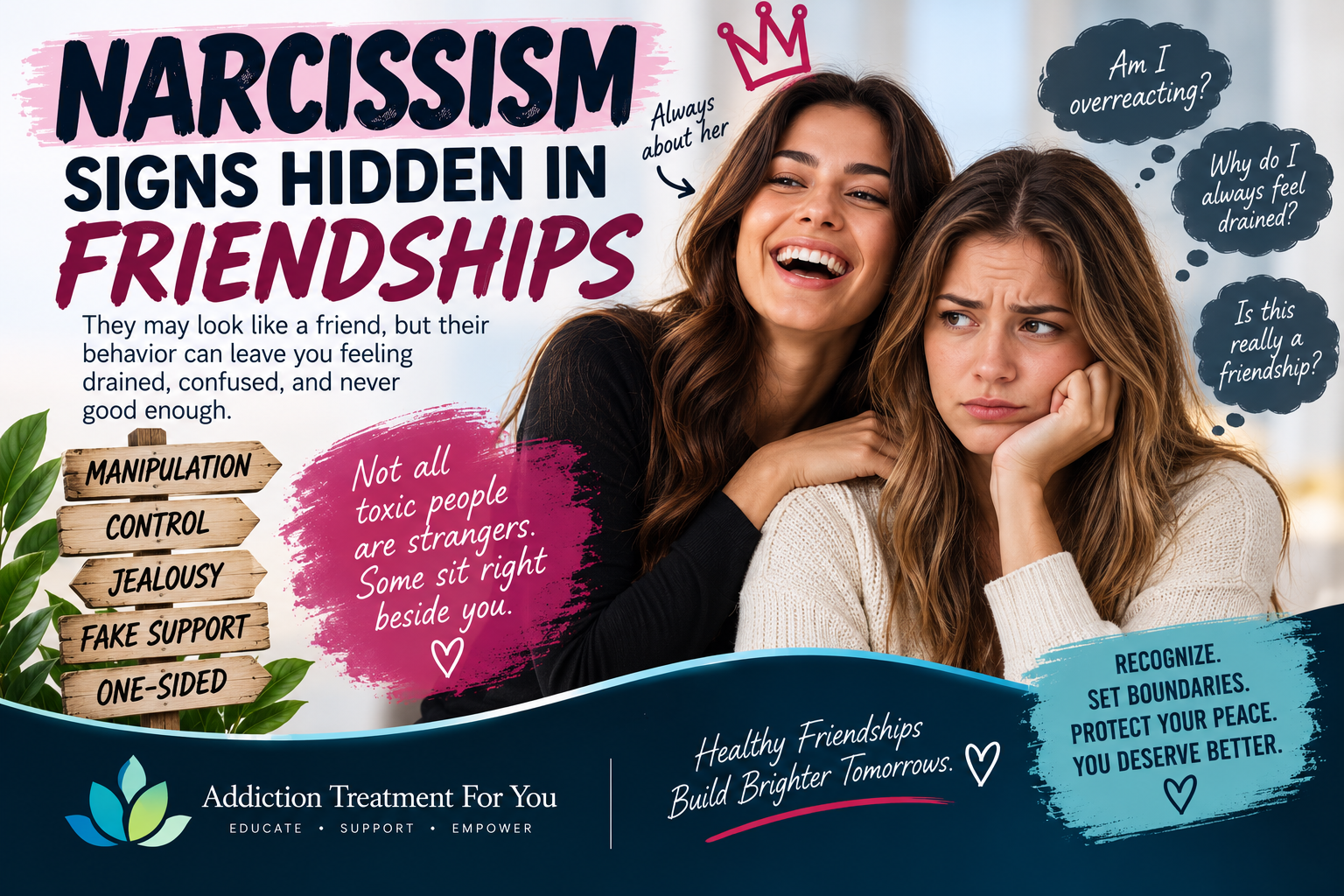
Friendships are supposed to provide connection, trust, encouragement, and mutual respect. Yet some friendships gradually become exhausting. One person may constantly need attention, minimize the other’s accomplishments, ignore boundaries, manipulate conversations, or disappear whenever support needs to flow in the opposite direction.
These patterns are sometimes described online as signs of a “narcissistic friend.”
However, an important distinction should be made: narcissistic traits are not the same thing as narcissistic personality disorder (NPD). Only a qualified mental-health professional can diagnose NPD after an appropriate evaluation. A selfish, competitive, emotionally immature, or difficult friend does not automatically have a personality disorder.
Instead of trying to diagnose someone, it can be more useful to ask:
“Is this friendship consistently healthy for me?”
That question shifts attention away from labels and toward behavior.
Why Narcissistic Traits Can Be Hard to Recognize in Friendships
Unhealthy romantic relationships receive considerable attention, but unhealthy friendships can be more difficult to identify.
Friendship problems may be dismissed with statements such as:
“That’s just how she is.”
“We’ve been friends forever.”
“He’s only joking.”
“She doesn’t mean anything by it.”
Because friendships usually do not involve the same formal commitments as marriages or partnerships, unhealthy patterns can continue for years without being seriously examined.
A friend may also be supportive in some situations and hurtful in others, making the relationship confusing.
What Are Narcissistic Traits?
Narcissistic traits exist on a spectrum. Many people occasionally seek attention, become defensive, act selfishly, or want recognition.
The concern is when patterns become persistent and repeatedly damage relationships.
Possible narcissistic-style behaviors can include:
- Excessive need for admiration
- Strong sense of entitlement
- Difficulty showing empathy
- Exploiting relationships for personal benefit
- Constantly redirecting attention toward oneself
- Extreme sensitivity to criticism
- Envy or intense competitiveness
- Belittling other people’s achievements
- Expecting special treatment
- Difficulty accepting responsibility
Again, these behaviors alone do not establish NPD.
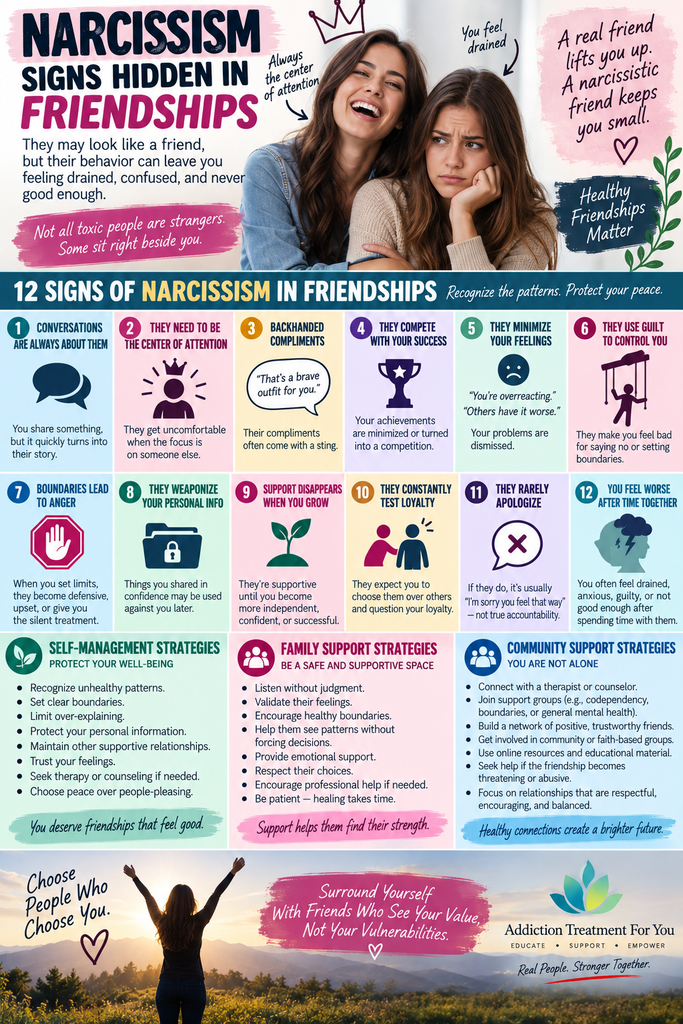
Sign #1: Every Conversation Eventually Becomes About Them
You begin telling your friend about a difficult day.
Within minutes, you’re discussing their problems.
You announce something exciting.
They immediately tell you about something better that happened to them.
You explain that you’re struggling.
They respond:
“You think that’s bad? Listen to what happened to me.”
Healthy friendships naturally shift attention between people. The concern arises when one person’s experiences consistently dominate.
Sign #2: They Need to Be the Center of Attention
Some friends become uncomfortable when attention moves toward someone else.
A birthday, promotion, engagement, graduation, new relationship, pregnancy, or personal achievement may unexpectedly trigger criticism or competition.
Instead of saying:
“I’m proud of you.”
The friend might minimize the accomplishment:
“It’s really not that big of a deal.”
Or immediately introduce their own achievement.
Occasional jealousy is human. A repeated inability to celebrate someone else’s success deserves attention.
Sign #3: Compliments Come With a Hidden Sting
Backhanded compliments can slowly damage confidence.
Examples include:
“You actually look really good today.”
“I’m surprised you got that job.”
“That outfit is brave for someone with your body type.”
“You’ve finally found someone who can tolerate you.”
Humor should not become a permanent excuse for humiliation.
Sign #4: They Compete With Your Success
Healthy friends can experience jealousy while still supporting one another.
An unhealthy friendship may turn everything into a competition:
- Who earns more money
- Who receives more attention
- Who has the better relationship
- Who looks better
- Who has more followers
- Who has the better career
- Who has experienced greater hardship
If every accomplishment becomes a competition, friendship can start to feel more like a scoreboard.
Sign #5: Your Problems Are Minimized
You may spend hours listening to your friend’s problems but receive little attention when you need support.
Your concerns may be dismissed with:
“You’re too sensitive.”
“You’re overreacting.”
“Other people have it worse.”
Healthy friends do not have to agree with every interpretation of events. But repeated emotional invalidation can make someone question whether their feelings deserve attention.
Sign #6: They Use Guilt to Control You
Manipulation in friendships can be subtle.
A friend may say:
“I guess I know who your real friends are now.”
“After everything I’ve done for you…”
“You’ve changed since you started dating them.”
“If you cared about me, you’d come.”
The goal may be to make saying no feel like betrayal.
Healthy friendship allows people to have separate lives.
Sign #7: Boundaries Become Personal Attacks
Suppose you say:
“I can’t talk tonight. I’m exhausted.”
A healthy friend may feel disappointed but respect the boundary.
An unhealthy response might be:
“Wow. I guess I’m not important anymore.”
People with poor boundaries may interpret independence as rejection.
Watch what happens when you say no.
A person’s response to a reasonable boundary can reveal more about the relationship than their response when you always say yes.
Sign #8: They Collect Personal Information and Later Weaponize It
Trust requires vulnerability.
A concerning pattern occurs when information shared privately during vulnerable moments later appears during arguments.
You may hear:
“No wonder your relationship failed.”
or
“Even your family can’t stand you.”
Using someone’s vulnerabilities as ammunition can make emotional safety impossible.
Sign #9: They Are Supportive Until You Stop Needing Them
Some friendships are built around one person being the helper and the other being dependent.
When the dependent friend becomes healthier, more confident, sober, financially stable, or socially connected, the relationship unexpectedly deteriorates.
Why?
Because the friendship may have depended partly on an unequal power dynamic.
Your growth can change that balance.
Sign #10: They Constantly Test Loyalty
A friend may expect you to prove loyalty by:
- Choosing them over other friends
- Ending relationships they dislike
- Sharing private information
- Taking their side regardless of circumstances
- Responding immediately to messages
- Defending inappropriate behavior
- Keeping secrets that make you uncomfortable
Healthy friendship does not require unconditional obedience.
Sign #11: They Rarely Give Genuine Apologies
Everyone hurts people occasionally.
A meaningful apology includes recognizing the behavior and taking responsibility.
An unhealthy apology may sound like:
“I’m sorry you feel that way.”
“I’m sorry, but you started it.”
“Fine, I’m apparently a terrible person.”
These responses redirect attention away from the behavior and toward the other person’s reaction.
Sign #12: You Feel Worse After Spending Time Together
Sometimes your body recognizes an unhealthy relationship before you consciously identify the pattern.
After spending time with the person, you may repeatedly feel:
- Drained
- Anxious
- Guilty
- Inferior
- Confused
- Angry
- Ashamed
- Responsible for their emotions
- Afraid of saying the wrong thing
One uncomfortable interaction does not define a friendship. Repeated emotional exhaustion is worth examining.
Self-Management Strategies
You cannot control another person’s personality, but you can control how you participate in the relationship.
1. Focus on Behavior Rather Than Labels
Instead of thinking:
“My friend is definitely a narcissist.”
try:
“My friend repeatedly ignores my boundaries and insults me when I disagree.”
Specific behaviors are easier to evaluate and address than diagnostic labels.
2. Establish Clear Boundaries
Boundaries might include:
- “I’m not discussing my relationship with you anymore.”
- “I won’t lend money.”
- “If you insult me, I’m ending the conversation.”
- “I can’t respond to messages while I’m working.”
- “I’m not keeping secrets that could harm someone.”
Boundaries describe what you will do, rather than attempting to control another person.
3. Stop Overexplaining
People-pleasing can turn a simple “no” into a lengthy defense.
Sometimes:
“I can’t make it tonight.”
is enough.
You do not always need to provide evidence proving that your boundary is reasonable.
4. Protect Sensitive Information
If someone repeatedly weaponizes private information, reconsider how much access they receive to your vulnerabilities.
Trust should be earned through consistent behavior.
5. Maintain Other Relationships
Controlling friendships can become more powerful when someone becomes socially isolated.
Maintain connections with:
- Family
- Other friends
- Coworkers
- Mentors
- Recovery peers
- Community groups
One friendship should not have to meet every emotional need.
6. Document Patterns When Necessary
If a relationship leaves you repeatedly confused, writing down interactions can help identify patterns.
Ask yourself:
What happened?
What did I say?
How did they respond?
How did I feel afterward?
The purpose is not to build a legal case against your friend. It is to gain clarity.
Family Support Strategies
Families can help when someone is struggling with a manipulative or emotionally draining friendship.
Helpful approaches include:
- Listen without immediately criticizing the friend.
- Validate the person’s emotional experience.
- Encourage healthy boundaries.
- Avoid saying, “I told you so.”
- Help the person maintain other relationships.
- Encourage counseling when appropriate.
- Watch for increasing isolation.
- Reinforce that friendship should include mutual respect.
- Provide practical support if the friendship becomes threatening.
Family members should avoid demanding:
“You need to stop talking to that person immediately.”
Unless there is an urgent safety concern, controlling someone’s relationships can unintentionally reproduce the same dynamic they are struggling to escape.
Community Support Strategies
Community relationships can provide perspective when a friendship becomes unhealthy.
Helpful resources may include:
- Individual counseling
- Support groups
- Peer recovery programs
- Community mental-health centers
- Healthy relationship education
- Faith communities
- Trusted mentors
- Social clubs and hobby groups
- Domestic-abuse resources when coercion, stalking, threats, or violence are involved
A broader support network can make it easier to recognize when one friendship has become disproportionately controlling.
Narcissistic Friendships and Addiction Recovery
Friendship dynamics can become particularly important during recovery.
A person becoming sober may discover that some friendships were built primarily around:
- Drinking
- Drug use
- Parties
- Chaos
- Rescuing
- Codependency
- Shared crises
When one person enters recovery, the friendship may change.
A friend might say:
“You’re boring now.”
“One drink isn’t going to hurt you.”
“You think you’re better than us because you’re sober.”
These statements can undermine recovery.
A supportive friend does not have to fully understand addiction treatment, but they should respect someone’s recovery plan.
When Friendship Becomes Manipulation
Manipulation often works because it creates uncertainty.
You begin asking:
“Am I selfish?”
“Am I overreacting?”
“Maybe I’m the problem.”
Self-reflection is healthy. Constantly doubting your perception because someone repeatedly dismisses your experience is different.
A counselor or trusted neutral person can sometimes help separate normal conflict from a persistent unhealthy pattern.
Should You End the Friendship?
Not every difficult friendship needs to end.
Some relationships improve when concerns are discussed clearly, and both people are willing to change.
You might say:
“I value our friendship, but when you make jokes about my appearance after I’ve asked you to stop, I feel disrespected. If it continues, I’m going to spend less time in situations where that happens.”
Then observe the response.
A friend willing to repair the relationship may listen, apologize, and change their behavior over time.
Someone committed to maintaining control may ridicule the boundary, blame you, escalate the conflict, or repeatedly violate it.
When Distance May Be Necessary
Consider creating more distance when:
- Boundaries are repeatedly ignored.
- Private information is weaponized.
- Your recovery is deliberately undermined.
- Manipulation becomes constant.
- You are becoming socially isolated.
- The friendship significantly damages your mental health.
- Threats, stalking, intimidation, or violence occur.
Safety should take priority over preserving a friendship.
What Healthy Friendship Looks Like
A healthy friendship does not mean a perfect friendship.
Good friends still disagree, become jealous, say insensitive things, and make mistakes.
The difference is the ability to repair.
Healthy friendships generally include:
- Mutual respect
- Emotional reciprocity
- Trust
- Appropriate boundaries
- Honest communication
- Freedom to have other relationships
- Support during difficult periods
- Genuine celebration of success
- Accountability after mistakes
- Room for both people to grow
You should not have to become smaller so your friend can feel bigger.
Final Thoughts
Narcissistic traits can be difficult to recognize in friendships because unhealthy behavior may initially look like closeness, protectiveness, confidence, humor, or intense loyalty.
Over time, the pattern becomes more important than any individual incident.
Instead of asking only:
“Is my friend a narcissist?”
ask:
“Can I be myself in this friendship?”
“Can I say no?”
“Are my accomplishments celebrated?”
“Can I disagree without being punished?”
“Do we both give and receive support?”
“Do I generally feel respected?”
Self-management means recognizing unhealthy patterns, maintaining boundaries, and protecting your emotional well-being. Family support provides perspective without replacing one controlling relationship with another. Community support creates additional sources of connection, counseling, and healthy relationships.
You do not need a psychiatric diagnosis for your friend before deciding that a repeated behavior is hurting you.
Sometimes the most important question is not what disorder another person might have.
It is whether the friendship allows both people to matter.
Frequently Asked Questions
Here are some common questions:
1. What does narcissism look like in a friendship?
Narcissistic traits in friendships may appear as a persistent need for attention, lack of reciprocity, excessive competitiveness, manipulation, entitlement, difficulty accepting criticism, or limited concern for the other person’s feelings. The important factor is the repeated pattern rather than one selfish interaction.
2. Does having narcissistic traits mean someone has narcissistic personality disorder?
No. People can occasionally behave selfishly, defensively, or attention-seeking without having narcissistic personality disorder (NPD). NPD is a clinical diagnosis that requires assessment by a qualified mental-health professional.
3. What are some hidden warning signs of an unhealthy friendship?
Potential warning signs include:
- Conversations repeatedly becoming about the other person
- Backhanded compliments
- Constant competition
- Minimizing your feelings
- Becoming upset when you receive attention
- Guilt-tripping you for saying no
- Ignoring boundaries
- Using private information against you
- Demanding repeated demonstrations of loyalty
- Rarely accepting responsibility
- Supporting you only when you remain dependent
- Leaving you consistently feeling drained or inadequate
4. Why can narcissistic behaviors be difficult to recognize in a friend?
A friendship may initially feel exciting, supportive, or unusually close. Unhealthy patterns can emerge gradually, making individual incidents easier to excuse. Long-term friendships can be particularly confusing because shared history may make someone reluctant to question the relationship.
5. Why does everything seem to become about them?
Some people have difficulty keeping their attention on someone else. They may redirect conversations toward their experiences, achievements, problems, or opinions. Healthy friendships, by comparison, allow attention and emotional support to move in both directions.
6. Why might a friend become jealous when I succeed?
Occasional jealousy is normal. The concern arises when your success repeatedly elicits criticism, withdrawal, competition, or attempts to minimize your achievements. Healthy friends can experience their own insecurities while still celebrating you.
7. What are backhanded compliments?
A backhanded compliment contains praise mixed with an insult. Examples include, “You actually look good today,” or “I’m surprised you were able to get that job.” Repeated comments like these can gradually undermine confidence.
8. Why might an unhealthy friend react badly when I set boundaries?
If someone benefited from you having weak boundaries, your new limits may feel like a loss of access or control. They may respond with anger, guilt, criticism, or withdrawal.
9. What is an example of guilt manipulation in friendship?
Statements such as “If you were really my friend, you’d do this,” or “After everything I’ve done for you, you can’t do this one thing?” can turn normal boundaries into supposed evidence of disloyalty.
10. Can a narcissistic friend use the silent treatment?
Some people withdraw communication to express anger or attempt to influence another person’s behavior. However, taking time away from a conflict is not automatically manipulative. The context, intent, communication, and repeated pattern matter.
11. Why might a friend use personal information against me?
In an unhealthy relationship, information shared during vulnerable moments may later become ammunition during disagreements. When this happens repeatedly, it damages emotional safety and trust.
12. Why do I feel exhausted after spending time with certain friends?
Constantly monitoring someone’s mood, avoiding disagreements, providing reassurance, defending yourself, or listening without receiving support can become emotionally exhausting. Feeling drained occasionally is normal; feeling that way after nearly every interaction deserves attention.
Self-Management Strategies
13. How can I protect myself in an unhealthy friendship?
- Identify specific behaviors that concern you.
- Establish clear boundaries.
- Stop overexplaining reasonable decisions.
- Protect sensitive personal information.
- Maintain relationships with other people.
- Pay attention to how you feel before and after interactions.
- Practice assertive communication.
- Seek counseling if the relationship significantly affects your well-being.
14. Should I tell my friend that they are a narcissist?
Usually, focusing on specific behavior is more constructive than assigning a diagnosis. Instead of saying, “You’re a narcissist,” consider saying, “When you make jokes about something I told you privately, I feel betrayed. I need that to stop.”
15. How can I tell whether my boundary is reasonable?
A healthy boundary generally describes what you will or will not participate in rather than controlling another person’s entire behavior.
For example: “If you start insulting me, I’m going to end the conversation.”
16. Why should I stop overexplaining myself?
People who struggle with boundaries sometimes feel they must prove that every “no” is justified. Excessive explanations can give another person an opportunity to debate your reasons rather than respect your decision.
Family Support Strategies
17. How can family members help someone dealing with an unhealthy friendship?
Family members can:
- Listen without judgment
- Avoid saying “I told you so”
- Encourage healthy boundaries
- Reinforce the person’s self-worth
- Help them maintain other relationships
- Encourage professional counseling when appropriate
- Take threats, stalking, or intimidation seriously
18. Should families demand that someone end the friendship?
Unless there is an immediate safety issue, demanding that someone end a friendship can unintentionally create another controlling relationship. Providing perspective and support while respecting the person’s autonomy is generally more helpful.
Community Support Strategies
19. What community resources can help?
Depending on the circumstances, support may come from:
- Mental-health counselors
- Support groups
- Peer recovery communities
- Community mental-health programs
- Trusted mentors
- Healthy relationship education
- Faith or community organizations
- Domestic-abuse services when coercion, stalking, threats, or violence are present
20. Can unhealthy friendships interfere with addiction recovery?
Yes. Someone entering recovery may discover that certain friendships were centered around drinking, drugs, partying, rescuing, or crisis. A friend who pressures someone to use substances or mocks their recovery can become a significant relapse risk.
21. What does a supportive friend do when someone enters recovery?
A supportive friend respects recovery boundaries, does not pressure the person to drink or use drugs, encourages treatment, recognizes progress, and accepts that social routines may need to change.
22. Can a narcissistic friendship become codependent?
Unhealthy friendships can develop codependent patterns in which one person becomes overly responsible for the other’s emotions, crises, or needs. Codependency and narcissism are not interchangeable diagnoses, however, and neither label should replace evaluation of the actual behaviors involved.
23. Can an unhealthy friendship improve?
Yes, particularly when both people recognize the problem and genuinely change their behavior. An apology is helpful, but consistent behavioral change over time provides stronger evidence that the relationship is improving.
24. When should I consider distancing myself from a friend?
Distance may be worth considering when boundaries are repeatedly violated, manipulation continues despite discussion, private information is weaponized, your recovery is undermined, or the relationship consistently damages your emotional well-being.
25. What if the friendship involves threats or stalking?
Threats, stalking, intimidation, or violence move the situation beyond an ordinary friendship disagreement. Prioritize safety and consider professional, legal, or domestic-violence resources appropriate to the situation.
26. What does a healthy friendship look like?
Healthy friendships usually allow:
- Mutual emotional support
- Respectful disagreement
- Independent interests and relationships
- Appropriate boundaries
- Genuine celebration of accomplishments
- Trust and confidentiality
- Accountability after mistakes
- Freedom to say no
- Growth without punishment
27. What is the biggest warning sign to remember?
Instead of focusing on whether your friend fits a particular label, examine the overall relationship.
Ask yourself:
Can I say no without being punished?
Can I succeed without being diminished?
Can I disagree without being humiliated?
Can I be vulnerable without having it used against me?
Do both of us matter in this friendship?
Video: Why You Should Walk Away From This Friend #toxicrelationships #boundaries