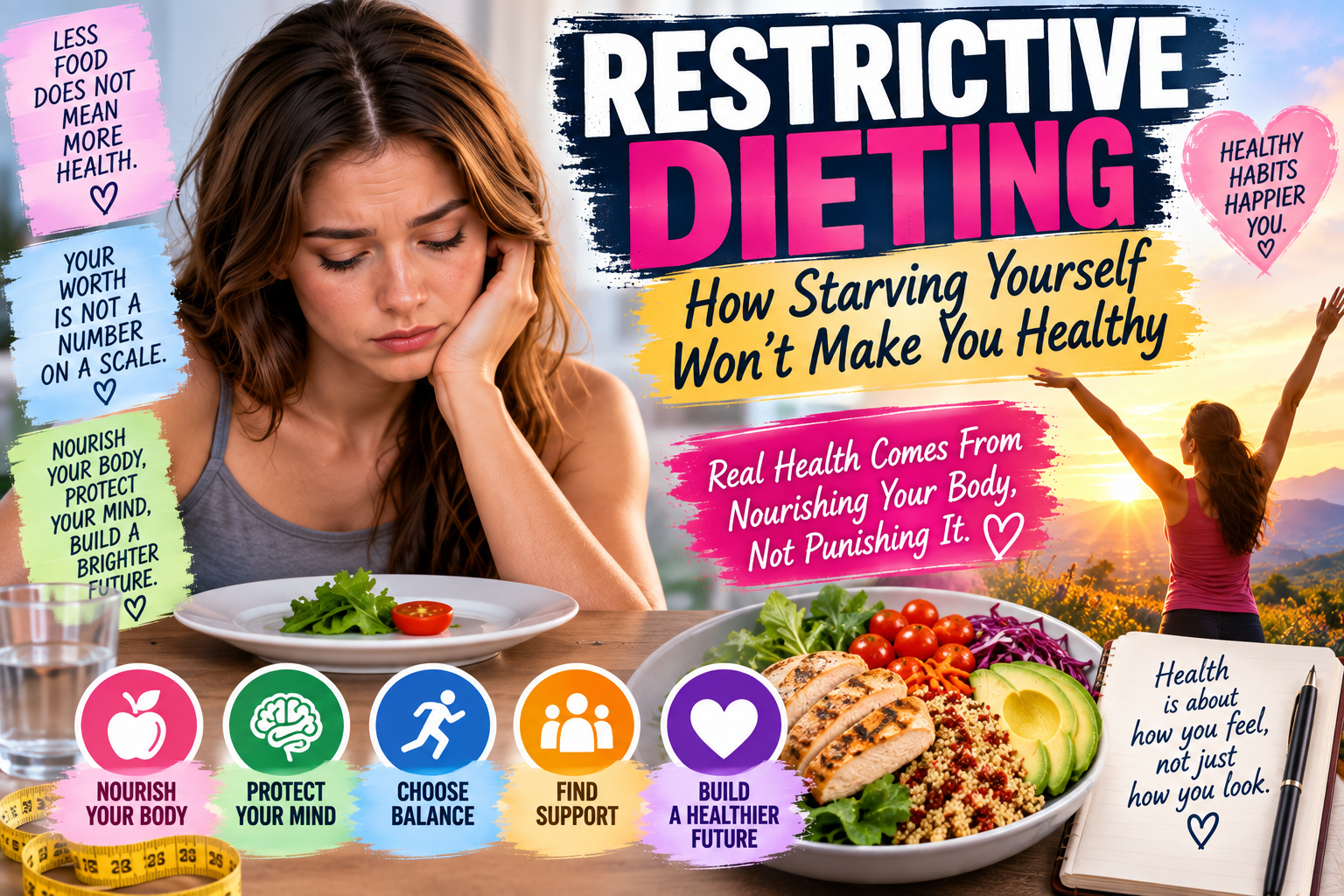
In a culture filled with weight-loss advertisements, edited social-media images, diet trends, and pressure to achieve a certain body type, some people may believe that severely restricting food is the fastest way to become thin. But starving yourself is not a safe or sustainable weight-management strategy. Severe food restriction can deprive the brain, heart, muscles, bones, and other organs of the nutrients and energy they need to function.
The number on a scale also does not tell the complete story of health. Restrictive eating can occur in people of many body sizes, and serious medical complications can develop even when someone does not appear underweight. Understanding the physical and psychological consequences of starvation is therefore important for individuals, families, healthcare professionals, and communities.
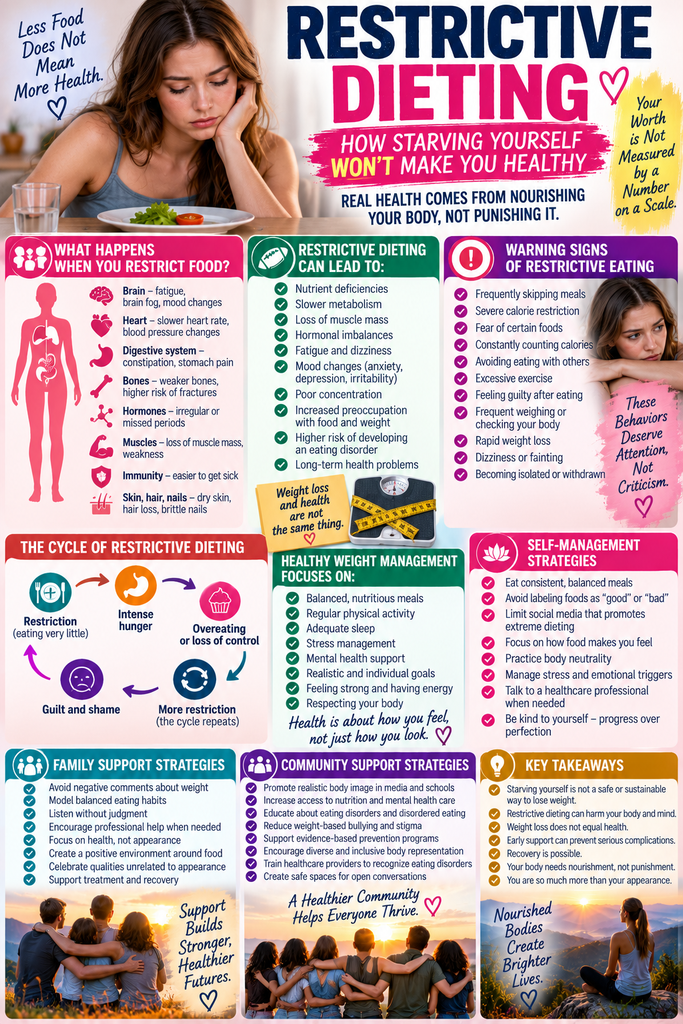
What Happens When You Starve Yourself?
When the body does not receive enough energy, it must adapt to the shortage. Initially, the body can use stored glycogen and body fat for energy. With continued inadequate intake, however, the body may also break down muscle and other tissues.
The body can respond by conserving energy and reducing functions that are not immediately essential for survival. Over time, severe restriction can affect multiple organ systems.
Possible consequences include:
- Fatigue and weakness
- Dizziness or fainting
- Difficulty concentrating
- Feeling unusually cold
- Loss of muscle mass
- Constipation and gastrointestinal problems
- Hormonal and menstrual changes
- Hair thinning or hair loss
- Dry skin
- Reduced bone health
- Changes in heart rate and blood pressure
- Electrolyte abnormalities
- Mood changes, irritability, anxiety, or depression
- Increased preoccupation with food
In severe cases, malnutrition and electrolyte disturbances can become medically dangerous.
Starvation Is Not the Same as Healthy Weight Management
Food restriction can initially cause weight loss because the body receives less energy. That does not make starvation an effective or healthy long-term strategy.
A sustainable approach to health focuses on adequate nutrition, appropriate physical activity, sleep, stress management, medical conditions, medications, mental health, and individual nutritional needs rather than simply trying to eat as little as possible.
Extreme dieting may also contribute to a cycle of restriction followed by intense hunger or episodes of overeating. The person may then feel guilty and respond by restricting again.
The cycle can become:
Restriction → intense hunger → overeating or loss of control → guilt → more restriction.
Breaking this pattern often requires moving away from punishment and toward consistent nourishment and professional support.
When Dieting Becomes Disordered Eating
Not everyone who diets has an eating disorder. However, extreme restriction, intense fear surrounding food, compulsive calorie counting, excessive exercise, and persistent concern about body weight can sometimes signal disordered eating or an eating disorder.
Warning signs may include:
- Frequently skipping meals.
- Eliminating increasingly large categories of food without a medical reason.
- Feeling intense guilt after eating.
- Avoiding meals with family or friends.
- Becoming increasingly preoccupied with calories or weight.
- Exercising despite illness, injury, or exhaustion.
- Frequently weighing or checking the body.
- Becoming fearful of normal portions of food.
- Hiding eating behaviors from other people.
- Experiencing dizziness, fainting, weakness, or difficulty concentrating.
These behaviors deserve attention, not criticism.
Restrictive Eating Can Affect Mental Health
Starvation affects more than the body.
When the brain doesn’t receive adequate energy and nutrients, concentration, decision-making, emotional regulation, and mood can suffer. A person may become increasingly anxious, irritable, withdrawn, or preoccupied with food.
This creates an unfortunate cycle. Someone may begin restricting food because of anxiety about weight or appearance, but inadequate nutrition can make psychological symptoms more difficult to manage.
Food can gradually become associated with fear rather than nourishment.
That is why recovery often requires addressing both physical nutrition and psychological well-being.
Social Media and Unrealistic Body Expectations
Modern body-image pressure does not occur only in magazines or television. Social-media feeds can expose people to carefully posed photographs, filters, editing, weight-loss transformations, and influencers promoting restrictive diets.
Repeated exposure can make unrealistic appearances seem normal.
People may begin comparing their everyday bodies with carefully selected or digitally altered images. Adolescents and young adults can be particularly vulnerable because identity and self-esteem are still developing.
A healthier question is not simply, “How can I become thinner?”
It is:
“What does my body need to function, feel strong, and remain healthy?”
Self-Management Strategies
Someone who recognizes restrictive eating patterns can begin changing their relationship with food and body image. Significant restriction, rapid weight change, fainting, purging, or other concerning symptoms should be evaluated by a healthcare professional rather than managed alone.
Helpful strategies can include:
- Eat consistently. Regular meals and snacks can reduce extreme hunger and restriction-binge cycles.
- Avoid labeling foods as morally “good” or “bad.” Food choices can vary without determining someone’s worth.
- Reduce frequent weighing. Constant scale checking can reinforce anxiety and obsessive thinking.
- Notice emotional triggers. Stress, loneliness, trauma, criticism, and social comparison can influence eating behaviors.
- Curate social media. Unfollow accounts that promote extreme dieting or make you feel ashamed of your body.
- Practice body neutrality. Instead of forcing yourself to love every aspect of your appearance, appreciate what your body allows you to do.
- Avoid compensatory behaviors. Excessive exercise or fasting after eating can perpetuate unhealthy cycles.
- Talk to someone. A physician, PA, registered dietitian, therapist, or eating-disorder specialist can help.
- Focus on health behaviors rather than punishment. Nutrition, movement, sleep, stress management, and emotional well-being all matter.
Family Support Strategies
Families can significantly influence how someone thinks about food and their body.
Comments such as “You look better now that you’ve lost weight” may unintentionally reinforce dangerous restriction. Similarly, criticizing someone’s eating or body size can increase shame and secrecy.
Families can provide healthier support by:
- Avoiding negative comments about weight or body shape.
- Avoiding praising rapid or unexplained weight loss.
- Modeling balanced attitudes toward food.
- Eating meals together when appropriate.
- Listening without judgment.
- Taking restrictive eating seriously.
- Encouraging professional evaluation.
- Learning about eating disorders and disordered eating.
- Avoiding arguments about every bite of food.
- Supporting treatment recommendations.
- Focusing compliments on qualities unrelated to appearance.
Instead of saying, “Why won’t you just eat?”, families can communicate concern: “I’ve noticed you’re struggling around food, and I’m worried about how you’re feeling. How can I support you?”
Community Support Strategies
Eating disorders and harmful dieting behaviors are not solely individual problems. Cultural expectations around thinness, appearance, fitness, and weight can shape how people see themselves.
Communities can help by:
- Teaching realistic nutrition and body-image education.
- Improving access to eating-disorder screening and treatment.
- Training healthcare professionals to recognize eating disorders across different body sizes.
- Creating school programs addressing body image and social-media literacy.
- Discouraging bullying based on body size.
- Promoting responsible fitness and nutrition messaging.
- Encouraging media representation of diverse bodies.
- Providing affordable access to registered dietitians and mental-health professionals.
- Supporting evidence-based eating-disorder prevention programs.
- Challenging the assumption that someone’s appearance determines their health.
What Healthy Weight Management Should Look Like
No single diet or body weight is appropriate for everyone.
Health goals should consider age, medical history, medications, activity level, nutritional needs, mental health, and other individual factors. Someone who wants to change their weight should ideally discuss the goal with a qualified healthcare professional, particularly if they have a history of restrictive eating or an eating disorder.
Healthy change should not require constant hunger, dizziness, fainting, fear of food, or hatred of one’s body.
A sustainable approach is more likely to emphasize adequate nutrition, gradual behavioral changes, enjoyable physical activity, sufficient sleep, realistic goals, and psychological well-being.
When Professional Help Is Needed
Restrictive eating can become medically serious before the person recognizes how ill they have become.
Professional evaluation is especially important when there is rapid weight loss, fainting, significant weakness, persistent vomiting, severe restriction, dehydration, abnormal heart symptoms, purging behaviors, or thoughts of self-harm.
Treatment may involve a primary-care clinician, registered dietitian, therapist, psychiatrist, and eating-disorder specialist depending on the person’s needs.
Recovery is possible, and earlier intervention can reduce the risk of long-term complications.
Conclusion
Starving yourself may change the number on a scale temporarily, but weight loss and health are not the same thing. Severe food restriction can affect the heart, muscles, bones, hormones, digestive system, brain, and emotional well-being. It can also create a destructive relationship with food in which eating becomes associated with fear, guilt, and punishment.
A healthier approach begins by replacing the question “How little can I eat?” with “What does my body need to stay nourished and well?”
Self-management can help people recognize unhealthy patterns and develop healthier routines. Families can reduce shame, support treatment, and create a healthier environment around food. Communities can challenge unrealistic body expectations and make evidence-based nutritional and mental-health care easier to access.
Your body needs nourishment, not punishment. Health isn’t achieved by starving yourself—it is supported by feeding your body, caring for your mental health, and building habits that can sustain you for life.
Frequently Asked Questions
Here are some common questions:
1. What is restrictive dieting?
Restrictive dieting involves significantly limiting the amount, type, or frequency of food a person eats, often to lose weight or change body shape. Restriction can include frequently skipping meals, fasting for prolonged periods, eliminating many foods without a medical reason, or consistently eating too little to meet the body’s nutritional needs.
2. Is restrictive dieting the same as healthy eating?
No. Healthy eating provides enough energy, protein, carbohydrates, fats, vitamins, minerals, and fluids to support the body’s needs. Restrictive dieting may deprive the body of essential nutrients.
Healthy nutrition emphasizes adequate nourishment and sustainable habits rather than punishment, fear, or extreme rules around food.
3. Will starving yourself make you lose weight?
Severe calorie restriction can cause weight loss, but that does not make starvation safe or healthy. Weight lost during significant restriction may include water, fat, and muscle tissue.
Extreme restriction can also produce nutritional deficiencies and other medical complications. Healthy weight management should focus on overall health rather than simply making the number on the scale as low as possible.
4. What happens to the body when someone does not eat enough?
When insufficient energy is available, the body begins using stored energy and may eventually break down muscle and other tissues.
Possible consequences include:
- Fatigue and weakness
- Dizziness or fainting
- Feeling cold
- Difficulty concentrating
- Loss of muscle mass
- Constipation or digestive problems
- Hormonal changes
- Menstrual irregularities
- Hair thinning
- Reduced bone health
- Changes in heart rate or blood pressure
- Nutritional and electrolyte abnormalities
Severe malnutrition can become medically dangerous.
5. Does restrictive dieting “slow your metabolism”?
The body can adapt to prolonged inadequate energy intake by reducing energy expenditure and altering hormonal and metabolic processes. This is sometimes called metabolic adaptation.
The response is more complicated than simply saying the metabolism “shuts down.” The body still needs energy to survive, but prolonged restriction can trigger physiological adaptations designed to conserve it.
6. Can restrictive dieting cause muscle loss?
Yes. When energy intake remains inadequate, the body may use both stored fat and protein from muscle tissue for energy.
Muscle loss can contribute to weakness, reduced physical performance, and changes in overall health.
7. Why am I constantly thinking about food when dieting?
Persistent food thoughts can be a biological response to inadequate nutrition.
When the body doesn’t receive enough energy, hunger signals and attention to food may increase. This is not necessarily a failure of willpower—it may be the body’s attempt to encourage adequate nourishment.
8. Can restrictive dieting cause overeating?
It can. Severe restriction may produce intense hunger that eventually becomes difficult to ignore.
Some people develop a repeating pattern:
Restriction → intense hunger → overeating or loss of control → guilt → additional restriction.
Regular, adequate nutrition can help break this cycle.
9. Can restrictive dieting affect mental health?
Yes. Inadequate nutrition can affect concentration, energy, mood, and emotional regulation. Restrictive eating can also become associated with anxiety, guilt, obsessive thoughts about food, social withdrawal, and body dissatisfaction.
Mental-health difficulties may also contribute to restrictive eating, creating a cycle in which each problem reinforces the other.
10. Can someone have restrictive eating problems without being underweight?
Yes. You cannot determine whether someone has an eating disorder simply by looking at their body.
People at many body sizes can experience restrictive eating, malnutrition, and eating disorders. Significant changes in eating behavior and physical or psychological symptoms deserve attention regardless of someone’s weight.
11. What are warning signs of unhealthy food restriction?
Possible warning signs include:
- Frequently skipping meals.
- Becoming increasingly afraid of certain foods.
- Constantly counting calories.
- Feeling guilty after eating.
- Avoiding meals with other people.
- Exercising excessively to compensate for eating.
- Frequently weighing or checking the body.
- Rapid or unexplained weight changes.
- Becoming socially withdrawn.
- Feeling dizzy, weak, or faint.
- Developing increasingly rigid rules around food.
One warning sign does not automatically mean someone has an eating disorder, but persistent patterns should be taken seriously.
12. Is skipping meals a healthy weight-loss strategy?
Regularly skipping meals to severely reduce food intake can contribute to inadequate nutrition, fatigue, poor concentration, and intense hunger later in the day.
Individual meal patterns vary, so no single eating schedule is appropriate for everyone. A registered dietitian or healthcare professional can help determine an appropriate nutrition plan based on a person’s medical and nutritional needs.
13. Are carbohydrates bad for weight management?
No. Carbohydrates are an important energy source and include nutrient-rich foods such as fruits, vegetables, beans, whole grains, and dairy products.
Completely eliminating an entire nutrient category without a medical reason is generally unnecessary. Nutrition should be evaluated as an overall pattern rather than labeling individual nutrients as universally “good” or “bad.”
14. How can social media contribute to restrictive dieting?
Social media can expose people to edited photographs, extreme diet challenges, “what I eat in a day” videos, weight-loss transformations, and unrealistic body standards.
Curating your feed can help. Unfollow accounts that promote extreme dieting or trigger body dissatisfaction, and follow evidence-based health professionals or body-neutral content to create a healthier online environment.
15. What are healthier self-management strategies?
Rather than focusing on eating as little as possible, consider:
- Eating adequately and consistently.
- Choosing a variety of nutrient-dense foods.
- Drinking enough fluids.
- Getting adequate sleep.
- Engaging in enjoyable physical activity.
- Recognizing emotional eating or restriction triggers.
- Limiting repeated weighing or body checking if these behaviors increase anxiety.
- Avoiding punishment through fasting or excessive exercise.
- Discussing nutrition concerns with a healthcare professional or registered dietitian.
The goal is nourishment and sustainable health—not deprivation.
16. How can families support someone who is restricting food?
Family members should approach the situation with concern rather than criticism.
Helpful strategies include listening without judgment, avoiding comments about body size, not praising rapid weight loss, learning about eating disorders, encouraging professional assessment, and focusing conversations on the person’s health and well-being rather than appearance.
Comments such as “I’m concerned because you’ve seemed tired and you’re skipping meals” are generally more supportive than criticizing someone’s weight or demanding that they “just eat.”
17. What can communities do to reduce harmful dieting behaviors?
Communities can promote realistic body-image education, address weight-based bullying, teach media literacy, improve access to registered dietitians and mental-health professionals, and provide evidence-based eating-disorder education.
Healthcare systems can also improve screening so that restrictive eating is recognized in people across the full range of body sizes.
18. When should someone seek professional help?
Professional evaluation is appropriate when restrictive eating becomes persistent, causes significant distress, interferes with everyday life, or is accompanied by concerning physical symptoms.
Urgent medical attention may be necessary for fainting, severe weakness, dehydration, confusion, chest symptoms, significant vomiting, severe restriction, or other signs of medical instability.
Treatment may involve primary-care clinicians, registered dietitians, therapists, psychiatrists, and eating-disorder specialists.
19. Can someone recover from restrictive eating?
Yes. Recovery is possible. Treatment can help restore adequate nutrition, address medical complications, challenge harmful beliefs about food and body image, and treat underlying psychological concerns.
Recovery does not have to mean developing a “perfect” relationship with food. Progress can involve becoming more flexible, nourished, physically stable, and less controlled by fear or guilt surrounding eating.
20. What is the most important message about restrictive dieting?
Your body needs nourishment, not punishment.
Eating less and weighing less do not automatically mean becoming healthier. Physical health, mental health, energy, strength, nutrition, sleep, relationships, and quality of life all matter.
Video: Why You Should Never Restrict Your Calories This Way #weightloss #healthtips