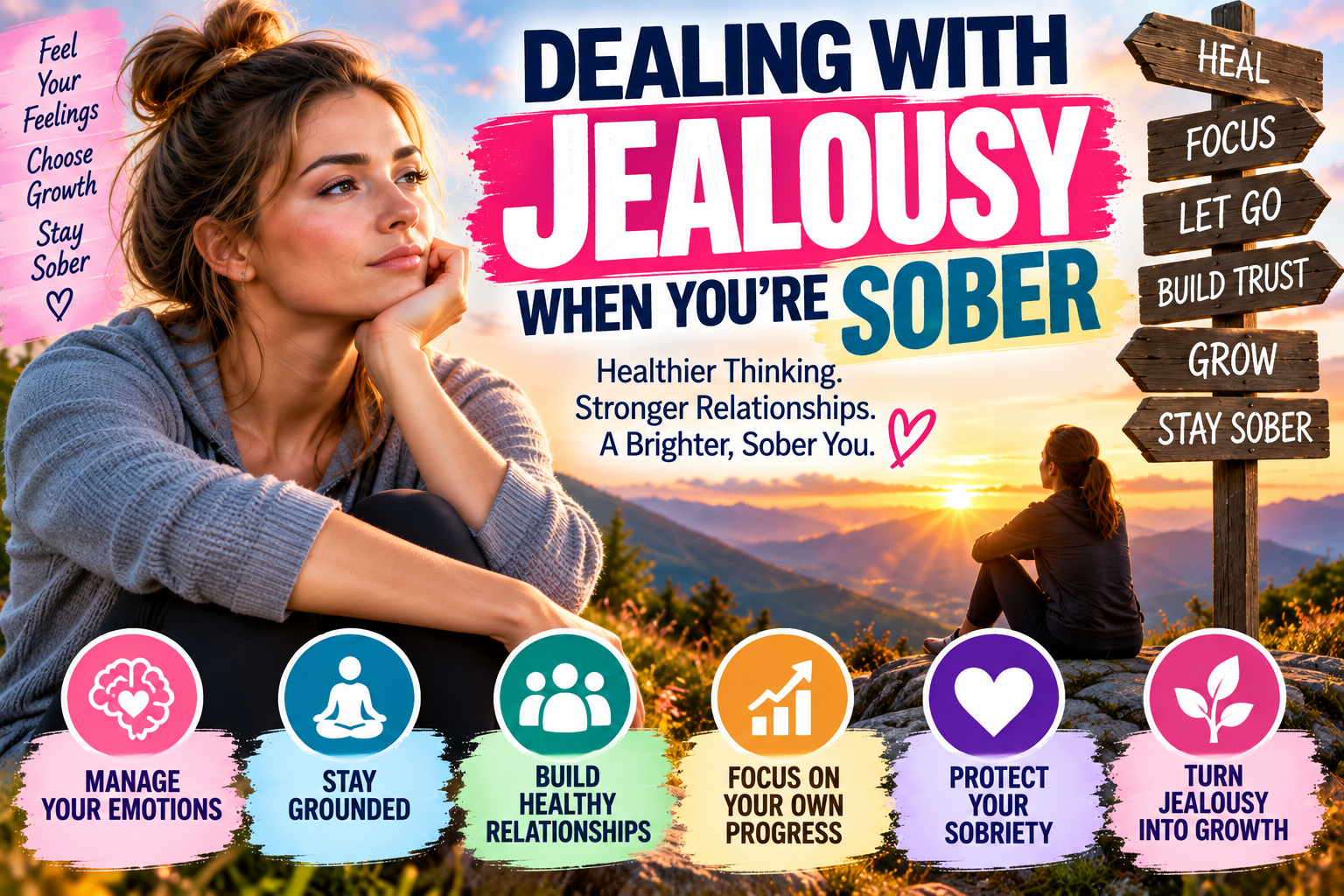
Sobriety changes much more than whether a person uses alcohol or drugs. Recovery often means learning how to experience difficult emotions without escaping, numbing, or reacting impulsively. One emotion that can become surprisingly intense during recovery is jealousy.
Jealousy may arise in romantic relationships, friendships, families, workplaces, or even within the recovery community. Someone may become jealous when a partner spends time with another person, when a friend reaches a recovery milestone first, or when someone else appears to have the career, family, financial stability, or happiness they want.
Feeling jealous does not mean recovery is failing. Jealousy is an emotion, not an action. The important question is what a person does after recognizing it.
Learning to manage jealousy can become an important recovery skill because sobriety is not only about avoiding substances—it is also about developing healthier ways to manage insecurity, fear, comparison, anger, and relationships.
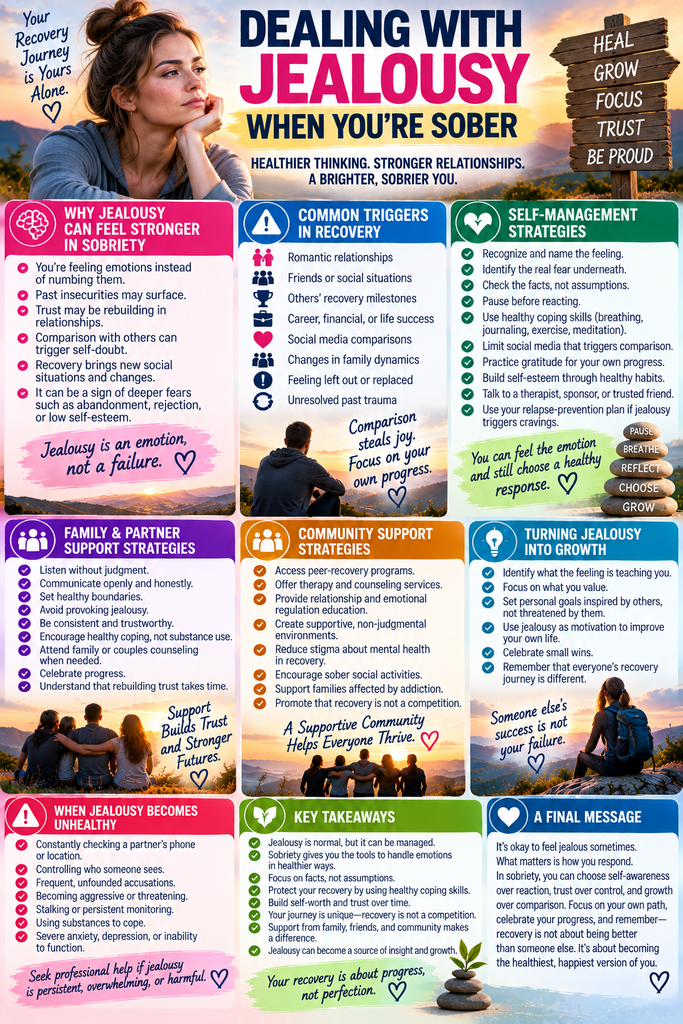
Why Jealousy Can Feel Different in Sobriety
During active addiction, substances may have been used to suppress uncomfortable emotions. Alcohol or drugs might temporarily numb loneliness, rejection, anxiety, resentment, or insecurity.
When substances are removed, those emotions can become more noticeable.
Early recovery may therefore feel emotionally intense. A person is learning to experience feelings they may have previously avoided.
Jealousy can involve several emotions at once:
- Fear of abandonment
- Insecurity
- Anger
- Sadness
- Loneliness
- Shame
- Fear of rejection
- Low self-esteem
- Resentment
- Social comparison
Instead of immediately thinking, “I’m jealous,” it can be useful to ask, “What am I afraid of right now?”
That question often reveals the deeper emotion.
Jealousy Versus Envy
Jealousy and envy are often used interchangeably, but they can describe somewhat different experiences.
Jealousy commonly involves fear that an important relationship or connection may be threatened. Someone may worry that a romantic partner prefers another person or that a close friend is becoming distant.
Envy generally involves wanting something another person possesses—perhaps their career, appearance, relationship, home, financial security, or recovery progress.
Both can occur during recovery.
A person attending a recovery meeting might think:
“They’ve been sober for two years, have their family back, and just got promoted. I’ve been sober six months, and I’m still trying to rebuild everything.”
Comparison can quickly turn another person’s success into evidence of one’s own perceived failure.
But recovery timelines are not competitions.
Social Comparison Can Become a Recovery Trap
Recovery communities naturally contain people at very different stages of rebuilding their lives.
One person may quickly repair family relationships. Another may require years. Someone may return to work rapidly, while another needs time to address medical, psychological, financial, or legal consequences.
Constant comparison can create resentment.
Social media can intensify the problem because people usually post milestones rather than ordinary struggles.
Someone may see:
“Three years sober!”
but not see the therapy appointments, cravings, arguments, financial struggles, lonely evenings, or difficult decisions that occurred during those three years.
Instead of asking, “Why aren’t I where they are?”, consider asking:
“What can their progress teach me about what may be possible?”
Romantic Jealousy During Recovery
Romantic relationships can become particularly complicated during sobriety.
Trust may have been damaged during active addiction. Partners may remember dishonesty, disappearing, financial problems, broken promises, or other painful experiences. Meanwhile, the person in recovery may fear abandonment because they know the relationship has already survived significant stress.
Jealousy can then appear as:
- Constantly asking where a partner has been.
- Checking a partner’s phone.
- Becoming angry about friendships.
- Requiring repeated reassurance.
- Interpreting ordinary behavior as rejection.
- Accusing someone without evidence.
- Trying to control who a partner sees.
- Becoming distressed by social-media interactions.
These behaviors may temporarily reduce anxiety, but controlling another person rarely creates genuine security.
Trust develops through consistent behavior over time, not surveillance.
Jealousy Can Become a Relapse Trigger
Strong emotional distress can increase vulnerability to substance use for some people in recovery.
An argument with a partner, feeling rejected, seeing an ex with someone else, or comparing oneself with another person may activate thoughts such as:
“I can’t deal with this.”
“One drink would calm me down.”
“Using would make me stop thinking about it.”
This is why emotional awareness is part of relapse prevention.
The goal is not to eliminate jealousy completely. The goal is to recognize the feeling early enough that it does not automatically determine behavior.
Self-Management Strategies
Jealousy becomes easier to manage when a person creates space between feeling an emotion and acting on it.
Helpful strategies include:
- Name the emotion. Say, “I’m feeling jealous,” rather than immediately blaming another person.
- Identify the underlying fear. Ask whether the real issue is abandonment, rejection, inadequacy, loneliness, or loss of control.
- Check the evidence. Separate facts from assumptions.
- Delay impulsive reactions. Avoid sending angry messages or making accusations while emotionally activated.
- Use grounding techniques. Slow breathing, walking, journaling, exercise, or meditation can provide time for emotional intensity to decrease.
- Talk with a trusted person. A therapist, sponsor, peer-recovery specialist, or trusted friend may provide another perspective.
- Limit unhealthy comparison. Reduce social-media exposure when it repeatedly triggers insecurity.
- Practice gratitude. Identify what is improving in your own recovery rather than focusing exclusively on someone else’s progress.
- Protect sobriety first. If jealousy produces cravings, immediately use your relapse-prevention plan and support network.
- Seek counseling when needed. Persistent jealousy connected with trauma, attachment difficulties, anxiety, or low self-esteem may benefit from professional treatment.
The Pause Before the Reaction
One of the most useful recovery skills is learning to pause.
Imagine discovering that your partner has been communicating with someone who makes you uncomfortable.
The immediate emotional reaction might be:
Fear → anger → accusation → argument → craving.
A healthier sequence could become:
Fear → pause → identify the emotion → check the facts → talk to support → communicate calmly.
The feeling has not disappeared.
The response has changed.
That difference represents emotional growth.
Building Self-Worth in Recovery
Jealousy frequently becomes stronger when self-worth is low.
Early recovery can be particularly challenging because people may be confronting consequences from active addiction while simultaneously trying to rebuild their identity.
They may think:
“Why would anyone choose me?”
“Everyone else is doing better.”
“I’ve ruined too much.”
Recovery offers an opportunity to develop self-esteem through behavior rather than comparison.
Confidence can gradually grow by:
- Keeping commitments.
- Attending treatment or recovery meetings.
- Showing up for family.
- Being honest.
- Making financial progress.
- Taking care of physical health.
- Apologizing when appropriate.
- Establishing healthy boundaries.
- Celebrating recovery milestones.
- Helping other people.
Self-worth becomes stronger when a person repeatedly behaves in ways that reflect their values.
Family and Partner Support Strategies
Families and partners can help without taking responsibility for managing every emotion the person in recovery experiences.
Helpful approaches include:
- Listen without immediately dismissing the person’s feelings.
- Communicate clearly and consistently.
- Establish reasonable relationship boundaries.
- Avoid deliberately provoking jealousy.
- Recognize that rebuilding trust takes time.
- Encourage healthy coping rather than substance use.
- Attend couples or family counseling when appropriate.
- Avoid becoming involved in constant reassurance cycles.
- Maintain personal boundaries and independence.
- Celebrate progress without pretending that previous problems never occurred.
Partners should also understand an important distinction: support does not mean accepting controlling, threatening, or abusive behavior.
Recovery never excuses abuse.
Rebuilding Trust After Addiction
Trust may take longer to repair than sobriety itself.
A person can stop using substances today, but family members may still remember years of instability.
This can be frustrating for someone in recovery:
“I’ve changed. Why don’t they trust me?”
Because trust usually depends on repeated evidence.
Showing up when you say you will, being truthful, maintaining sobriety, managing money responsibly, communicating openly, and respecting boundaries gradually provide that evidence.
Trust is less about saying “Believe me” and more about consistently becoming someone whose behavior is believable.
Community Support Strategies
Recovery is easier when people have environments where they can discuss difficult emotions without shame.
Communities can help by:
- Providing accessible peer-recovery programs.
- Offering individual, couples, and family counseling.
- Teaching emotional-regulation and communication skills.
- Including relationship education in recovery programs.
- Creating support groups for families affected by addiction.
- Providing trauma-informed mental-health services.
- Teaching relapse-prevention strategies involving emotional triggers.
- Encouraging sober recreational activities and social connections.
- Reducing stigma toward people rebuilding their lives after addiction.
Recovery communities should also avoid becoming places of competition.
Sobriety length, employment, relationships, finances, and personal achievements are not measures of one person’s worth compared with another’s.
Turning Jealousy Into Information
Jealousy does not always need to be treated as an enemy.
Sometimes it provides useful information.
Feeling jealous of someone’s strong friendships might reveal a need for deeper social connection.
Feeling envious of someone’s career might identify a personal goal.
Jealousy about another person’s recovery progress might reveal a desire for greater stability.
The question can shift from:
“Why do they have that?”
to:
“What is this feeling teaching me about what I value?”
The emotion becomes information rather than an instruction.
When Jealousy Becomes Unhealthy
Jealousy deserves professional attention when it becomes persistent, overwhelming, or leads to harmful behavior.
Warning signs can include:
- Repeatedly monitoring someone’s phone or location.
- Trying to control another person’s friendships.
- Making frequent accusations without evidence.
- Threatening oneself or another person.
- Becoming physically aggressive.
- Stalking or persistent monitoring.
- Using alcohol or drugs to cope with jealousy.
- Experiencing severe anxiety or depression.
- Having persistent thoughts of revenge.
- Being unable to function because of relationship fears.
Professional counseling can help identify whether jealousy is connected with trauma, anxiety, attachment patterns, low self-esteem, relationship problems, or another mental-health concern.
Recovery Is Not a Competition
One of the most important lessons in sobriety is that another person’s progress does not reduce your own.
Someone else’s five years of sobriety does not make your five months meaningless.
Someone rebuilding a marriage does not mean your relationship has failed.
Someone buying a house does not mean you are behind.
Someone celebrating a promotion does not diminish the work you are doing simply to remain sober today.
Recovery occurs on different timelines because people begin from different circumstances.
Conclusion
Dealing with jealousy while sober is ultimately about learning to experience uncomfortable emotions without allowing those emotions to control your actions.
Jealousy can expose fears about rejection, abandonment, inadequacy, relationships, or personal progress. Instead of escaping those feelings through substances, recovery provides an opportunity to understand them.
Self-management can help a person pause, identify triggers, challenge assumptions, build self-esteem, and protect sobriety. Family and partner support can create healthier communication and gradually rebuild trust while maintaining appropriate boundaries. Community support can provide therapy, peer connection, recovery resources, and opportunities to develop healthier relationship skills.
Sobriety does not mean you will never feel jealous, angry, insecure, or afraid again.
It means you can learn new ways to respond.
Your recovery does not have to look like anyone else’s. Someone else’s success is not your failure. Protect your sobriety, build your own life, and measure progress against where you started—not against where someone else happens to be today.
Frequently Asked Questions
Here are some common questions:
1. Is jealousy normal during addiction recovery?
Yes. Jealousy is a normal human emotion, and sobriety does not make uncomfortable emotions disappear. In fact, some emotions may initially feel stronger because alcohol or drugs are no longer being used to numb or avoid them.
The goal of recovery is not to eliminate jealousy. It is to recognize the emotion and respond to it without allowing it to threaten your relationships or sobriety.
2. Why can jealousy feel stronger after becoming sober?
Recovery can bring previously avoided emotions to the surface. Fear, insecurity, loneliness, shame, resentment, and concerns about abandonment may become easier to notice.
Instead of immediately asking, “Why am I so jealous?”, it may help to ask, “What am I afraid of losing?” The answer can reveal the deeper emotion that needs attention.
3. What is the difference between jealousy and envy?
Jealousy often involves fear of losing a valued relationship or someone’s attention. For example, you may worry that your partner is becoming interested in someone else.
Envy usually involves wanting something another person has, such as their relationship, career, financial stability, appearance, or recovery progress.
Both emotions can occur during sobriety and can be managed in healthy ways.
4. Can jealousy trigger cravings?
Yes. Strong emotions can be triggers for some people in recovery. An argument, perceived rejection, relationship insecurity, or comparing yourself with someone else may produce emotional distress and thoughts about using alcohol or drugs.
Recognizing jealousy as a potential trigger allows you to activate your relapse-prevention strategies earlier.
5. What should I do if jealousy triggers a craving?
Avoid making important decisions while emotionally overwhelmed. Create some distance from the immediate situation and use your established recovery supports.
Helpful responses can include:
- Contacting a sponsor, therapist, peer specialist, or trusted friend.
- Attending a recovery meeting.
- Using grounding or breathing techniques.
- Taking a walk or engaging in another healthy activity.
- Writing down what happened and what you are feeling.
- Removing yourself from environments where substances are available.
- Reviewing your reasons for staying sober.
Protecting sobriety should take priority over winning an argument.
6. How can I tell whether my jealousy is based on facts or assumptions?
Ask yourself:
What do I actually know?
Then ask:
What am I assuming?
For example, your partner arriving home later than expected is a fact. Automatically concluding that the delay means they are being unfaithful is an interpretation unless additional evidence supports it.
Learning to separate evidence from assumptions can prevent emotional reactions from becoming accusations.
7. Why do I compare my recovery with other people?
Recovery communities include people at very different stages. Someone may regain employment quickly, while another person may need much longer. Someone else’s family relationships may improve sooner than yours.
Comparison becomes harmful when another person’s progress becomes evidence that you are failing.
Recovery is not a competition. Different people begin from different circumstances and rebuild their lives at different speeds.
8. Can social media make jealousy worse?
It can. Social media frequently presents carefully selected moments of success—anniversaries, relationships, vacations, careers, homes, and sobriety milestones—without showing the struggles behind them.
If particular accounts repeatedly trigger resentment, insecurity, or cravings, limiting exposure may be a useful self-management strategy.
9. How can I manage jealousy without using substances?
Start by identifying and naming the emotion rather than reacting immediately.
Useful strategies include:
- Pause before responding.
- Identify the fear beneath the jealousy.
- Check the facts.
- Practice slow breathing or grounding.
- Journal about the situation.
- Exercise or take a walk.
- Discuss the feeling with someone trustworthy.
- Practice gratitude for your own progress.
- Reduce unhealthy social comparison.
- Seek counseling when jealousy becomes persistent.
Creating even a short pause between emotion and action can change the outcome.
10. How can I communicate jealousy to my partner?
Try describing your experience rather than accusing your partner.
For example:
“I’ve noticed that I’m feeling insecure about this situation, and I’d like to talk about it.”
This approach creates an opportunity for discussion without automatically assigning blame.
Healthy communication involves listening, honesty, appropriate boundaries, and allowing both people to express concerns.
11. Is checking my partner’s phone a healthy way to reduce jealousy?
Repeatedly checking someone’s phone, social-media accounts, email, or location may temporarily reduce anxiety, but it usually does not create genuine trust.
Surveillance can actually strengthen the cycle of insecurity because the person becomes dependent upon checking for reassurance.
Trust is better developed through communication, boundaries, honesty, and consistent behavior over time.
12. How can couples rebuild trust after addiction?
Trust usually takes longer to rebuild than it takes to stop using substances.
Someone in recovery may feel frustrated because they have changed but their partner remains cautious. However, family members may remember previous dishonesty, financial problems, broken promises, or instability.
Trust grows through repeated actions:
- Keeping commitments.
- Communicating honestly.
- Respecting boundaries.
- Remaining engaged in recovery.
- Taking responsibility for mistakes.
- Managing finances responsibly.
- Following through consistently.
Trust is demonstrated over time rather than demanded.
13. How can family members support someone struggling with jealousy?
Families and partners can listen without judgment, communicate clearly, maintain reasonable boundaries, encourage healthy coping strategies, and support continued recovery.
They should not feel obligated to provide endless reassurance or surrender reasonable privacy simply to prevent jealousy.
Supporting recovery does not mean accepting controlling, threatening, or abusive behavior.
14. Can low self-esteem contribute to jealousy?
Yes. Jealousy may become stronger when someone believes they are inadequate, replaceable, or undeserving of healthy relationships.
Recovery provides opportunities to rebuild self-esteem through actions such as keeping commitments, maintaining sobriety, repairing relationships, working toward goals, caring for physical health, and helping others.
Confidence develops gradually as your actions become consistent with your values.
15. Can jealousy teach me something useful?
Sometimes.
Jealousy can reveal unmet needs or personal goals.
If you envy someone’s friendships, perhaps you need more meaningful social connection. If you envy someone’s career progress, you may be identifying a professional goal. If another person’s recovery inspires jealousy, you may actually be recognizing something you want for your own future.
Try changing:
“Why do they have that?”
into:
“What does this feeling tell me that I value?”
16. What role can recovery communities play?
Recovery communities can provide social connection, accountability, peer support, and opportunities to discuss difficult emotions without immediately turning to substances.
Communities can help by providing:
- Peer-recovery programs.
- Recovery meetings.
- Individual and family counseling.
- Relationship education.
- Emotional-regulation training.
- Trauma-informed services.
- Sober recreational activities.
- Family support groups.
A strong recovery community should reinforce that recovery is personal, not competitive.
17. When does jealousy become unhealthy?
Professional assistance may be appropriate when jealousy leads to:
- Constantly checking someone’s phone or location.
- Trying to control another person’s friendships.
- Repeated accusations without reasonable evidence.
- Persistent monitoring or stalking.
- Threatening behavior.
- Physical aggression.
- Severe anxiety or depression.
- Substance cravings or relapse.
- Thoughts of harming yourself or someone else.
- Significant problems functioning at work, home, or in relationships.
These behaviors should be taken seriously.
18. Should I see a therapist about jealousy?
Therapy can be particularly helpful when jealousy is persistent or connected with trauma, abandonment experiences, attachment difficulties, anxiety, low self-esteem, or previous relationship experiences.
Treatment can help identify the underlying fear rather than simply focusing on the jealous reaction.
19. Does feeling jealous mean I am failing at recovery?
No. An emotion is not a relapse or a moral failure.
Recovery involves learning how to experience emotions without automatically escaping through substances or reacting destructively.
Recognizing jealousy and choosing a healthier response can actually demonstrate growth in recovery.
20. What is the most important message about jealousy and sobriety?
You do not need to eliminate every uncomfortable emotion to maintain recovery.
You can feel jealous without becoming controlling. You can feel insecure without using substances. You can feel afraid without making accusations. And you can see someone else’s success without treating it as evidence of your own failure.
Someone else’s progress does not diminish yours.
Protect your sobriety first, communicate rather than assume, ask for support when you need it, and measure recovery by how far you have come—not by where someone else happens to be.
Jealousy is an emotion. Your response is a choice. Recovery gives you the opportunity to choose differently.
Video: