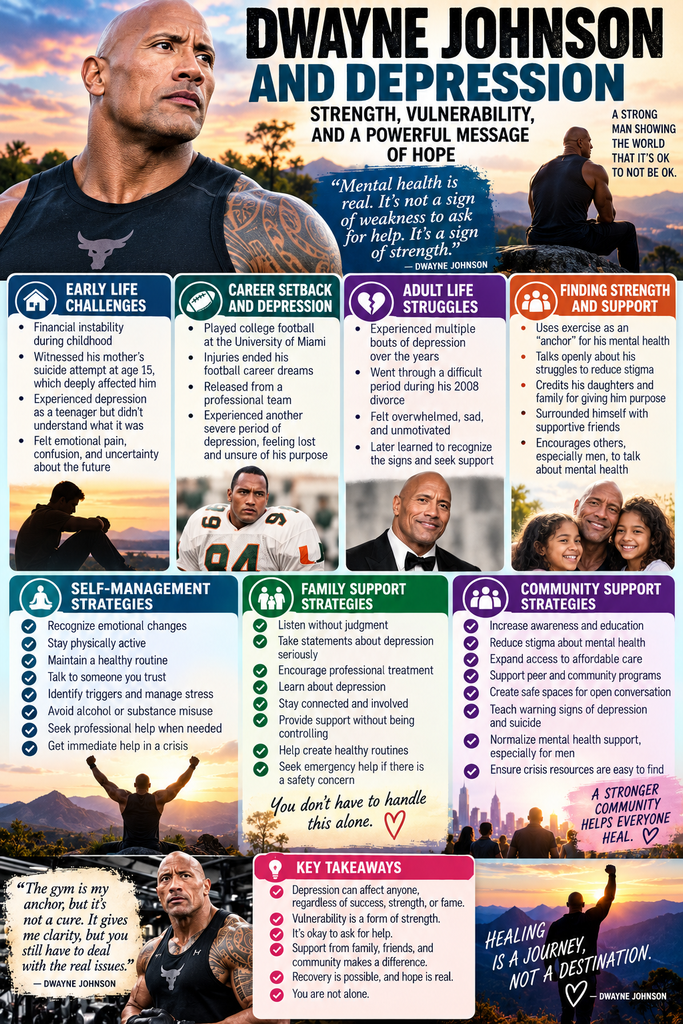
Dwayne “The Rock” Johnson is widely recognized for physical strength, professional wrestling, blockbuster movies, and an energetic public personality. Behind that image, however, Johnson has spoken openly about experiencing depression at several points in his life. His story illustrates an important mental-health lesson: outward success, confidence, and physical strength do not make someone immune to depression.
Johnson has described experiencing multiple bouts of depression and has said that, especially when he was younger, he did not understand what was happening to him. In a 2023 interview on The Pivot podcast, he explained that during an early episode he did not yet have the language to identify what he was experiencing as depression.
Early Life, Trauma, and Emotional Pain
One of the most traumatic events Johnson has publicly discussed occurred when he was 15. He has said that his mother, Ata Johnson, attempted suicide by walking into traffic on Interstate 65 in Nashville and that he pulled her to safety. Johnson later described experiencing significant emotional pain and depression during this period.
Family financial instability was also part of his childhood. Johnson has discussed his family being evicted and the emotional impact of witnessing his mother’s crisis. Years later, he described reaching a period in which he did not want to do anything or go anywhere and was frequently crying.
His story demonstrates how traumatic experiences during adolescence can leave a lasting emotional impact, even when a person later becomes highly successful.
When the Football Dream Ended
Football once represented Johnson’s hoped-for future. He played at the University of Miami, but injuries disrupted his career. He later played professionally in Canada before being released.
Johnson has described the collapse of his football aspirations as another major period of depression. During his 2023 discussion of mental health, he recalled leaving school during an earlier struggle and not understanding at the time that what he was experiencing had a mental-health dimension.
This period highlights something many people experience: loss of identity.
When people strongly connect their identity to a career, relationship, sport, or goal, losing it can create more than disappointment. It can raise painful questions such as: Who am I now? What comes next? What was all my work for?
Johnson eventually redirected his life toward professional wrestling, where “The Rock” became one of wrestling’s most recognizable personalities, and later toward acting and business.
Depression Returned During Adulthood
Success did not mean that Johnson never struggled again.
In 2023, Johnson said he had experienced roughly three bouts of depression over the years. He also discussed experiencing another difficult period around his 2008 divorce from Dany Garcia. By then, however, he said he better understood what he was experiencing and had friends he could lean on.
That difference is important.
During his earlier struggles, Johnson did not necessarily have the vocabulary or emotional tools to recognize depression. Later, he was better able to identify that something was wrong and communicate with people he trusted.
Mental-health awareness does not necessarily prevent difficult emotions. It can, however, help people recognize symptoms sooner and seek appropriate support.
Masculinity, Vulnerability, and Asking for Help
One of the most meaningful aspects of Johnson’s mental-health advocacy has been his willingness to challenge the idea that men must hide emotional pain.
Johnson has acknowledged that he once tended to keep difficult feelings inside. He has since encouraged men in particular to talk about their mental health rather than believing that vulnerability represents weakness. He has described asking for help as a form of strength.
His message challenges a common stereotype: physical toughness and emotional openness are not opposites.
A person can be strong and still:
- Experience depression.
- Cry or feel overwhelmed.
- Admit that something is wrong.
- Talk about painful experiences.
- Depend on supportive people.
- Seek counseling or professional treatment.
- Ask for help during a crisis.
Self-Management Strategies
Johnson has described exercise as an important part of managing his emotional well-being. He has called training an “anchor” and explained that the gym can provide some clarity, while also acknowledging that exercise does not solve the underlying problem.
That distinction is valuable. Healthy coping strategies can support recovery, but depression sometimes requires professional assessment and treatment.
Helpful self-management strategies may include:
- Recognizing emotional changes. Notice persistent sadness, hopelessness, irritability, withdrawal, loss of interest, sleep changes, or difficulty functioning.
- Talking instead of isolating. Share struggles with someone trustworthy.
- Maintaining physical activity. Exercise may support mood and overall health, although it should not be viewed as a replacement for needed mental-health treatment.
- Developing routines. Regular sleep, meals, activity, and responsibilities can provide structure.
- Identifying triggers. Relationship problems, grief, trauma, career setbacks, financial stress, or major transitions may worsen symptoms.
- Avoiding unhealthy coping mechanisms. Alcohol and other substances can complicate depression.
- Seeking professional support. Counseling, psychotherapy, medical evaluation, and medication when appropriate can be important components of treatment.
- Getting immediate help during a crisis. Suicidal thoughts or an inability to remain safe require urgent professional assistance.
Family Support Strategies
Johnson has also described his daughters as an important source of meaning and support, calling being a father a “saving grace” during his mental-health journey.
Family members cannot cure another person’s depression, but supportive relationships can make it easier for someone to seek and remain engaged in treatment.
Families can help by:
- Listening without immediately judging or trying to solve everything.
- Taking statements about depression or suicide seriously.
- Asking directly how the person is doing.
- Encouraging professional mental-health care.
- Learning about depression and its symptoms.
- Supporting healthy routines without becoming controlling.
- Staying connected when someone begins withdrawing.
- Helping the individual identify reasons for hope, connection, and purpose.
- Seeking emergency assistance when there is an immediate safety concern.
A useful family message is simple: “You don’t have to handle this alone.”
Community Support Strategies
Johnson’s public discussion of depression also illustrates the potential value of community conversations about mental health. When well-known people discuss their experiences responsibly, they can help challenge the misconception that depression reflects weakness or personal failure.
Communities can support people experiencing depression by:
- Expanding affordable access to mental-health professionals.
- Providing mental-health education in schools and workplaces.
- Creating peer-support and community-support programs.
- Teaching people how to recognize warning signs of depression and suicide.
- Encouraging workplaces to treat mental health as part of overall health.
- Developing programs specifically addressing barriers that discourage men from seeking help.
- Making crisis resources easy to locate.
- Reducing stigmatizing language surrounding mental illness.
Healthcare professionals can also routinely screen for depression when clinically appropriate and create opportunities for patients to discuss emotional health privately.
What Can We Learn From Dwayne Johnson’s Journey?
Perhaps the strongest lesson from Johnson’s experience is that strength can include vulnerability.
His public persona was built around extraordinary physical strength, confidence, discipline, and determination. Yet he has described periods when depression affected his motivation, emotions, relationships, and sense of direction.
Johnson has also emphasized the importance of recognizing other people’s suffering. Reflecting on what happened with his mother, he has said people should pay attention when others are in pain and remind them that they are not alone.
His experiences also show that recovery does not necessarily mean a person will never struggle again. Instead, people can gradually develop better ways to recognize symptoms, communicate their needs, build supportive relationships, and seek assistance.
Conclusion
Dwayne Johnson’s journey with depression provides a powerful contrast between outward strength and internal struggle. From witnessing his mother’s suicide attempt as a teenager to experiencing career disappointment, relationship changes, and multiple periods of depression, Johnson has described learning over time to recognize emotional distress and communicate about it more openly.
His story reinforces an important message for individuals and families: depression does not discriminate, and asking for help does not diminish strength.
Self-management strategies such as exercise, healthy routines, emotional awareness, and communication can help. Families can provide connection, listening, encouragement, and assistance obtaining treatment. Communities can reduce stigma and ensure that professional mental-health services and crisis resources are accessible.
Ultimately, Johnson’s experience reminds us that mental strength is not about pretending pain does not exist. Sometimes strength means recognizing the struggle, speaking about it, accepting support, and continuing forward one step at a time.
Frequently Asked Questions
Here are some common questions:
1. Has Dwayne Johnson experienced depression?
Yes. Dwayne “The Rock” Johnson has publicly discussed experiencing several periods of depression during his life. He has described struggles connected with adolescence, the loss of his football career, and difficulties during adulthood. His openness has helped draw attention to the fact that depression can affect people regardless of physical strength, fame, or professional success.
2. When did Dwayne Johnson first experience depression?
Johnson has described experiencing depression when he was young, although he said he did not initially understand what he was experiencing. In a 2023 interview, he explained that during an early period of depression, he did not yet have the mental-health vocabulary to recognize what was happening.
3. What traumatic experience did Johnson witness as a teenager?
Johnson has said that when he was 15, he witnessed his mother, Ata Johnson, attempt suicide by walking into traffic and that he pulled her to safety. He has spoken publicly about the emotional impact of this traumatic experience.
4. How did football affect his mental health?
Football represented an important dream for Johnson. He played at the University of Miami and later pursued professional football in Canada, but injuries and being released from his team ended that path. Johnson has described the loss of his football dream as being associated with another difficult period of depression.
5. Did becoming successful make his depression disappear?
No. Johnson has described experiencing depression again during adulthood, demonstrating that professional achievement does not necessarily protect someone from mental-health difficulties. In 2023, he discussed experiencing roughly three bouts of depression and identified his 2008 divorce as one particularly difficult period.
6. How has exercise helped Dwayne Johnson?
Johnson has described exercise and going to the gym as an important emotional “anchor.” Physical activity can support mental well-being, provide routine, and offer an outlet for stress.
However, exercise should not be considered a cure for clinical depression. Someone experiencing persistent or severe symptoms may benefit from evaluation and treatment by a qualified healthcare or mental-health professional.
7. What has Johnson said about asking for help?
A recurring theme in Johnson’s public discussions is that people should not be afraid to communicate when they are struggling. He has particularly encouraged men to move beyond the idea that emotional vulnerability represents weakness.
This is significant because stigma surrounding masculinity can sometimes discourage men from discussing depression or seeking professional assistance.
8. What symptoms of depression should people recognize?
Depression can look different from person to person. Possible symptoms include:
- Persistent sadness, emptiness, or hopelessness
- Loss of interest or pleasure in previously enjoyable activities
- Irritability or frustration
- Changes in sleep or appetite
- Fatigue or decreased energy
- Difficulty concentrating or making decisions
- Social withdrawal
- Feelings of worthlessness or excessive guilt
- Thoughts about death, self-harm, or suicide
A healthcare professional should evaluate symptoms that are persistent, severe, or interfere significantly with everyday functioning.
9. What self-management strategies can help someone experiencing depression?
Healthy self-management may include maintaining regular sleep and meal routines, staying physically active, remaining socially connected, recognizing personal triggers, limiting alcohol and other substances, and talking openly with trusted people.
Self-management should complement, not replace, professional treatment when treatment is needed.
10. How can family members support someone with depression?
Family members can listen without judgment, maintain regular contact, learn about depression, encourage professional treatment, and avoid dismissing symptoms with statements such as “just cheer up.”
Families should also take comments about suicide or self-harm seriously. If there is immediate danger, seek emergency or crisis assistance.
11. What role did family play in Johnson’s journey?
Johnson has described his daughters and family relationships as important sources of meaning and emotional support. He has referred to being a father as a “saving grace” during his mental-health journey.
12. How can communities help people experiencing depression?
Communities can improve access to affordable mental-health services, provide education about depression, support peer programs, promote mental-health resources in workplaces and schools, and challenge stigma surrounding treatment.
Community programs directed toward men can be particularly valuable when they address cultural expectations that discourage emotional expression or help-seeking.
13. Why is Johnson’s discussion of depression important for men?
Johnson’s public image is strongly associated with physical strength, athleticism, discipline, and confidence. His willingness to discuss depression provides a visible example that these characteristics can coexist with emotional vulnerability.
Mental strength does not require hiding emotional pain. Recognizing symptoms and seeking appropriate help can be part of taking responsibility for one’s health.
14. Can someone recover from depression and still experience it again?
Yes. Depression can occur as a single episode or recur over time. Experiencing another episode does not erase previous progress.
People may become better at recognizing early warning signs, identifying triggers, communicating with supportive people, and seeking professional care sooner.
15. What is the main lesson from Dwayne Johnson’s experience with depression?
Johnson’s journey illustrates that depression can affect anyone, including people who appear exceptionally strong and successful.
His experiences also emphasize the importance of communication, social connection, physical activity, family support, and seeking help when necessary. Perhaps the broader message is that vulnerability and strength do not have to be opposites.
Video: What The Rock wants you to know about depression #TheRock #MensMentalHealth #Awareness