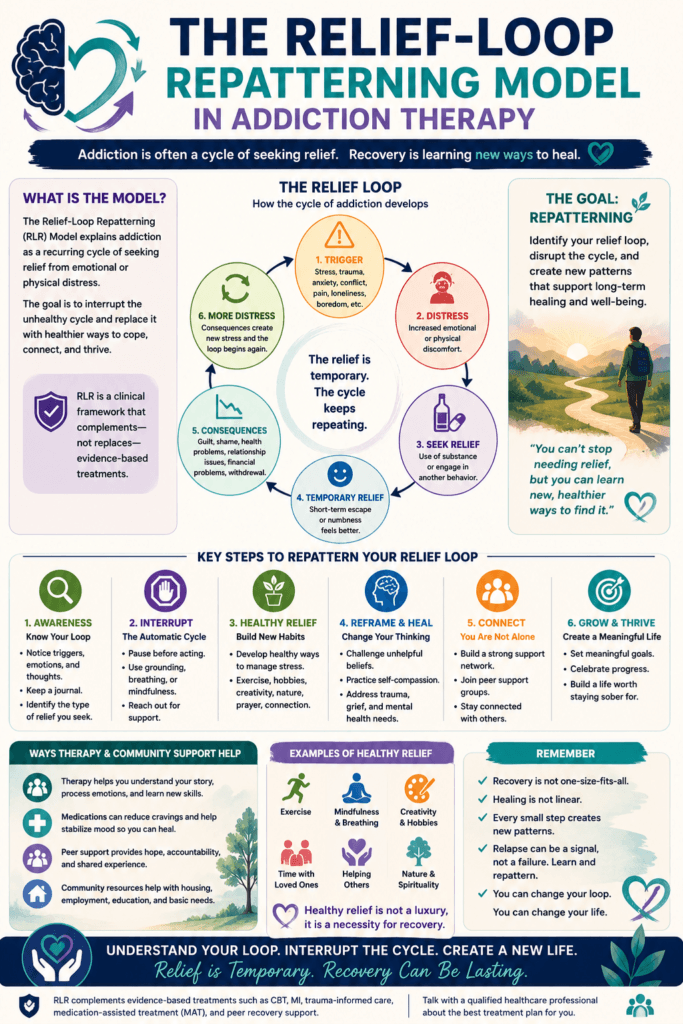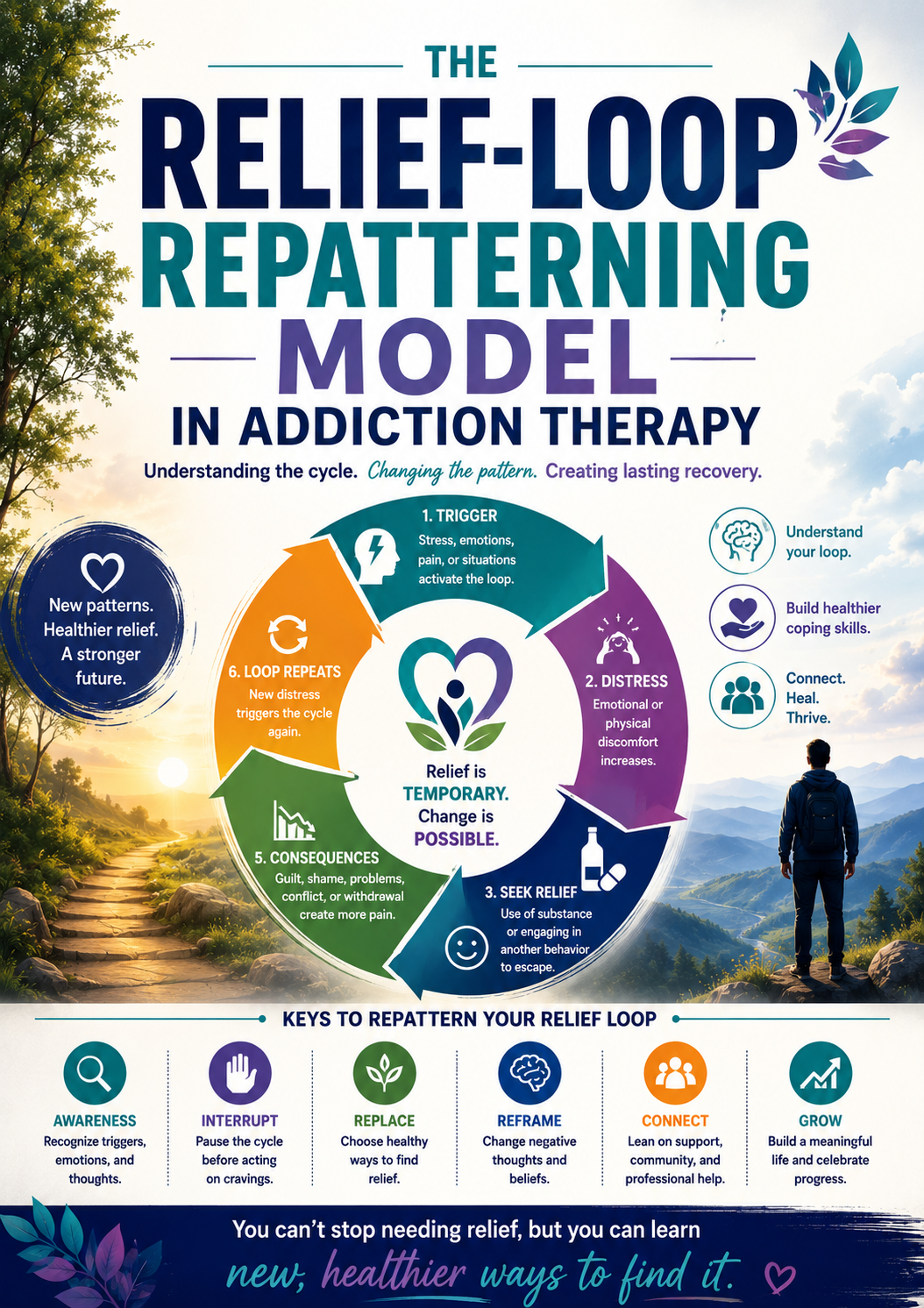
The Relief-Loop Repatterning (RLR) model is an emerging clinical framework that offers a compassionate perspective on addiction by focusing on the repeated cycle of seeking relief from emotional or physical distress. Rather than viewing substance use solely as a harmful behavior, the model encourages healthcare professionals and individuals in recovery to explore the underlying needs that drive repeated substance use, such as anxiety, trauma, loneliness, chronic pain, grief, or overwhelming stress. By identifying personal triggers and replacing unhealthy coping patterns with healthier sources of relief, the model aims to support long-term behavioral change and emotional resilience. Although Relief-Loop Repatterning is not yet considered an established evidence-based therapy on its own, many of its principles align with well-supported approaches such as cognitive behavioral therapy, motivational interviewing, trauma-informed care, mindfulness, and medication-assisted treatment. Understanding this framework may help individuals, families, and healthcare providers better recognize the complex factors that contribute to addiction and support more individualized recovery plans.
The Relief-Loop Repatterning Model in Addiction Therapy
The Relief-Loop Repatterning (RLR) model is a newer conceptual framework that views addiction through the lens of repeated cycles of seeking relief, rather than focusing only on the addictive behavior itself. Instead of asking, “Why did this person use drugs?”, the model encourages clinicians to ask, “What relief was the person trying to achieve?” According to its developers, the framework is intended to complement—not replace—established evidence-based treatments such as cognitive behavioral therapy (CBT), motivational interviewing, medications for opioid or alcohol use disorder, trauma-informed care, and peer support. It is currently presented as a research-informed clinical framework rather than an established evidence-based treatment in its own right.
Understanding the “Relief Loop”
The model proposes that many addictive behaviors follow a recurring pattern:
- A trigger occurs (stress, anxiety, trauma, loneliness, conflict, boredom, or environmental cues).
- Emotional or physical distress increases.
- The individual uses a substance or engages in another behavior that temporarily relieves discomfort.
- Short-term relief is experienced.
- Negative consequences follow, such as guilt, shame, health problems, damaged relationships, financial difficulties, or withdrawal symptoms.
- These consequences create new distress, making future substance use more likely and reinforcing the cycle.
Rather than focusing solely on stopping substance use, Relief-Loop Repatterning emphasizes identifying the underlying need for relief and helping individuals develop healthier ways to meet it.
Core Principles of the Model
1. Identify Individual Relief Loops
Every person’s addiction develops differently. Clinicians work with patients to identify:
- Emotional triggers
- Physical sensations
- Thoughts preceding substance use
- Situations that increase cravings
- The specific type of relief the substance provides
For example:
- Relief from anxiety
- Relief from emotional pain
- Relief from loneliness
- Relief from trauma memories
- Relief from insomnia
- Relief from chronic stress
Understanding these patterns allows treatment to target the causes of substance use rather than only its consequences.
2. Increase Self-Awareness
Patients learn to recognize early warning signs before cravings become overwhelming.
These may include:
- Increased irritability
- Racing thoughts
- Physical tension
- Sleep disruption
- Emotional numbness
- Social withdrawal
Recognizing these signals creates opportunities to intervene before the relief loop becomes automatic.
3. Interrupt the Automatic Cycle
Instead of immediately turning to substances, patients practice healthier responses such as:
- Deep breathing
- Mindfulness
- Calling a support person
- Physical activity
- Journaling
- Cognitive restructuring
- Relaxation techniques
- Grounding exercises
Repeated practice aims to weaken the old pattern and strengthen healthier coping behaviors.
4. Replace Unhealthy Relief With Healthy Relief
The model emphasizes that people still need relief from stress and emotional pain—they simply need safer, healthier ways to achieve it.
Examples include:
- Exercise
- Creative hobbies
- Music
- Time in nature
- Counseling
- Spiritual practices
- Peer support groups
- Healthy relationships
Over time, these activities can become the preferred response to distress.
5. Build Long-Term Recovery
Relief-Loop Repatterning emphasizes that lasting recovery involves more than stopping substance use. Long-term wellness includes:
- Emotional regulation
- Meaningful relationships
- Stable employment
- Community involvement
- Purpose
- Physical health
- Resilience
These protective factors help reduce reliance on substances for relief.
Potential Benefits
If validated through future research, the framework may offer several advantages:
- Encourages compassionate, nonjudgmental care.
- Helps patients understand why they use substances.
- Personalizes treatment based on individual triggers.
- Supports relapse prevention by identifying high-risk patterns early.
- Integrates well with existing therapies instead of replacing them.
Relationship to Evidence-Based Treatments
The concepts in Relief-Loop Repatterning overlap with several established therapies:
- CBT helps identify and change thoughts and behaviors that sustain the relief loop.
- Motivational Interviewing explores personal reasons for change and strengthens motivation.
- Dialectical Behavior Therapy (DBT) teaches emotional regulation and distress tolerance.
- Medications for opioid or alcohol use disorder reduce cravings and withdrawal, making it easier to develop healthier coping strategies.
- Trauma-informed therapy addresses underlying experiences that may drive repeated relief-seeking behaviors.
In this way, Relief-Loop Repatterning serves as an organizing framework rather than a standalone treatment.
Current Limitations
Although the framework is grounded in widely accepted ideas about stress, reward, habit formation, and coping, it is important to recognize its current status:
- It is a newly introduced conceptual model.
- It has not yet been established as an evidence-based therapy through large, independent clinical trials.
- Its developers state that it is intended to complement, not replace, proven treatments such as medication-assisted treatment, psychotherapy, and peer recovery support.
Conclusion
The Relief-Loop Repatterning model offers a compassionate way to understand addiction by focusing on the brain’s repeated search for relief from emotional or physical distress. Rather than asking only how to stop substance use, it encourages clinicians and patients to understand what need the substance was meeting and to build healthier ways of meeting that need. While the framework is promising as a method for organizing individualized care, it should currently be viewed as a research-informed clinical approach that complements established, evidence-based addiction treatments rather than replacing them. Continued independent research will be important to determine whether it improves outcomes beyond existing standards of care.
Self-Management Strategies to Understand the Relief-Loop Repatterning Model in Addiction Therapy
The Relief-Loop Repatterning (RLR) model is a clinical framework that helps individuals understand addiction as a repeated cycle of seeking temporary relief from emotional or physical distress. Instead of focusing solely on stopping substance use, the model encourages people to identify the drivers of their need for relief and develop healthier ways to respond. While RLR is not yet considered an established evidence-based therapy on its own, many of its concepts align with proven approaches such as cognitive behavioral therapy (CBT), mindfulness, relapse prevention, and trauma-informed care. Self-management strategies can help individuals apply these concepts in their daily lives and strengthen long-term recovery.
1. Learn to Recognize Your Personal Relief Loop
Begin by identifying the situations, emotions, thoughts, or physical sensations that typically lead to substance use. Ask yourself:
- What happened before I wanted to use?
- What emotions was I feeling?
- What kind of relief was I hoping to achieve?
Understanding your personal relief loop helps you recognize patterns before they become automatic.
2. Keep a Recovery Journal
Record daily experiences, including:
- Stressful events
- Emotional reactions
- Cravings
- Coping strategies used
- Recovery successes
- Situations that increased resilience
Over time, journaling can reveal patterns that help you and your healthcare provider strengthen your recovery plan.
3. Increase Emotional Awareness
Practice identifying emotions instead of automatically reacting to them. Try naming what you feel, such as:
- Anxiety
- Sadness
- Anger
- Loneliness
- Frustration
- Shame
- Boredom
Recognizing emotions early makes it easier to respond with healthy coping strategies rather than substances.
4. Identify Healthy Sources of Relief
Since everyone needs relief from stress, create a personalized list of healthy alternatives, such as:
- Walking or exercising.
- Listening to music.
- Reading.
- Deep breathing exercises.
- Meditation or mindfulness.
- Spending time outdoors.
- Talking with a trusted friend.
- Creative hobbies.
- Prayer or spiritual practices if meaningful to you.
Keep this list easily accessible during difficult moments.
5. Pause Before Acting on Cravings
When cravings occur, practice creating a brief pause before responding. During that pause:
- Take several slow breaths.
- Drink a glass of water.
- Walk for a few minutes.
- Contact a support person.
- Review your recovery goals.
Even a short delay can reduce impulsive decisions and strengthen healthier habits.
6. Build Healthy Daily Routines
Consistent routines reduce stress and increase emotional stability. Focus on:
- Regular sleep schedules.
- Nutritious meals.
- Daily physical activity.
- Scheduled recovery meetings.
- Time for relaxation.
- Balanced work and leisure.
A structured routine reduces opportunities for unhealthy relief-seeking behaviors.
7. Practice Stress Management Every Day
Do not wait until stress becomes overwhelming. Incorporate daily stress-reduction techniques such as:
- Progressive muscle relaxation.
- Mindfulness meditation.
- Yoga.
- Stretching.
- Time management.
- Gratitude journaling.
Managing stress consistently decreases the need to seek relief through substances.
8. Strengthen Your Support Network
Healthy relationships provide emotional relief without substance use. Stay connected with:
- Family members.
- Friends.
- Counselors.
- Peer recovery specialists.
- Support groups.
- Faith communities if desired.
Reaching out early during difficult times often prevents relapse.
9. Learn From Setbacks Without Self-Blame
If you experience a setback, use it as an opportunity to better understand your relief loop. Ask yourself:
- What triggered the situation?
- What need was I trying to meet?
- What healthier response could I try next time?
Viewing setbacks as learning experiences encourages growth rather than shame.
10. Work With Your Treatment Team
Discuss your relief loops with healthcare providers, therapists, or recovery coaches. Together you can identify personalized coping strategies, adjust your treatment plan if needed, and address underlying issues such as trauma, anxiety, depression, or chronic pain that may contribute to repeated relief-seeking behaviors.
11. Celebrate Healthy Choices
Recovery is strengthened by recognizing progress. Celebrate achievements such as:
- Managing a craving without using.
- Attending counseling sessions.
- Completing recovery goals.
- Using healthy coping skills during stressful situations.
- Building stronger relationships.
- Maintaining healthy routines.
These successes reinforce new patterns of behavior.
12. Focus on Long-Term Growth
Recovery is about creating a fulfilling life, not simply avoiding substances. Continue building:
- Healthy relationships.
- Meaningful work or education.
- Physical wellness.
- Emotional resilience.
- Financial stability.
- Personal purpose.
- Community involvement.
As these areas improve, the need to seek temporary relief through substances often decreases.
Conclusion
The Relief-Loop Repatterning model encourages individuals to look beyond substance use and understand the underlying need for relief that drives addictive behaviors. By recognizing personal triggers, increasing emotional awareness, developing healthy coping strategies, strengthening supportive relationships, and working closely with healthcare professionals, individuals can gradually replace unhealthy relief loops with healthier, more sustainable patterns. Although Relief-Loop Repatterning is a newer clinical framework and should complement—not replace—established evidence-based treatments, its emphasis on self-awareness and individualized recovery can help many people build resilience and support long-term healing.
Family Support Strategies to Understand the Relief-Loop Repatterning Model in Addiction Therapy
The Relief-Loop Repatterning (RLR) model views addiction as a repeated cycle of seeking temporary relief from emotional or physical distress rather than simply a pattern of substance use. This perspective helps families understand that many people use substances to cope with anxiety, trauma, loneliness, stress, depression, chronic pain, or other difficult experiences. While Relief-Loop Repatterning is a newer clinical framework and is not yet an established evidence-based therapy on its own, many of its principles align with well-supported approaches such as cognitive behavioral therapy (CBT), relapse prevention, mindfulness, trauma-informed care, and medication-assisted treatment. Families can play a powerful role in helping loved ones recognize unhealthy relief loops while encouraging healthier ways to cope.
1. Learn the Concept of the Relief Loop
Family members should understand that addiction often develops because substances provide temporary relief from emotional or physical discomfort. Although that relief is short-lived, repeated use can reinforce the cycle. Recognizing this pattern helps families respond with empathy rather than judgment.
2. Replace Judgment With Curiosity
Instead of asking, “Why did you use again?” consider asking supportive questions such as:
- “What happened before you felt like using?”
- “How were you feeling at that moment?”
- “What kind of relief were you hoping to find?”
- “How can we help you cope differently next time?”
These conversations encourage problem-solving instead of blame.
3. Learn Your Loved One’s Triggers
Families can work with their loved one to identify situations that commonly trigger the need for relief, including:
- Stress at work or school.
- Family conflict.
- Financial problems.
- Loneliness.
- Grief.
- Physical pain.
- Anxiety or depression.
- Social isolation.
Understanding these triggers allows families to provide support before a crisis develops.
4. Encourage Healthy Sources of Relief
Help your loved one discover alternatives that provide healthy stress relief, such as:
- Walking or exercising together.
- Preparing healthy meals.
- Practicing mindfulness or relaxation exercises.
- Listening to music.
- Gardening.
- Creative hobbies.
- Spending time outdoors.
- Attending recovery meetings.
- Participating in faith or spiritual activities if meaningful to them.
Healthy routines can gradually replace unhealthy coping patterns.
5. Create a Calm and Supportive Home Environment
A stable home environment can reduce emotional stress and support recovery. Families can:
- Communicate respectfully.
- Maintain predictable routines.
- Reduce unnecessary conflict.
- Encourage healthy sleep habits.
- Support balanced nutrition.
- Celebrate positive progress.
A calm environment decreases exposure to common relapse triggers.
6. Encourage Participation in Professional Treatment
Support your loved one in attending:
- Medical appointments.
- Individual counseling.
- Group therapy.
- Peer recovery meetings.
- Medication management visits when appropriate.
Relief-Loop Repatterning is intended to complement—not replace—evidence-based addiction treatment. Continued engagement with qualified healthcare professionals remains essential.
7. Practice Active Listening
Allow your loved one to discuss difficult emotions without immediately trying to solve every problem. Sometimes the greatest source of relief comes from feeling heard, understood, and accepted.
Practice:
- Listening without interrupting.
- Validating emotions.
- Avoiding criticism.
- Asking open-ended questions.
- Expressing empathy.
8. Help Develop a Crisis Plan
Families can work together to create a written plan for responding to cravings or emotional distress. The plan may include:
- Trusted people to call.
- Coping activities.
- Emergency phone numbers.
- Recovery meeting schedules.
- Contact information for healthcare providers.
- Steps to reduce immediate risk.
Having a plan in place makes it easier to respond quickly during difficult moments.
9. Celebrate Healthy Coping Skills
Recovery involves learning new ways to manage stress. Recognize and encourage healthy behaviors such as:
- Asking for help.
- Attending therapy.
- Managing stress without substances.
- Using relaxation techniques.
- Solving problems constructively.
- Building healthy relationships.
Positive reinforcement strengthens confidence and resilience.
10. Understand That Setbacks Can Be Learning Opportunities
If a relapse occurs, families can help identify what happened without assigning blame. Discuss:
- What triggered the relapse loop?
- What coping strategies were helpful?
- What additional support is needed?
- How can the recovery plan be strengthened?
Viewing setbacks as opportunities for learning promotes resilience and encourages re-engagement in treatment.
11. Take Care of Your Own Well-Being
Supporting someone with addiction can be emotionally demanding. Family members should also prioritize their own health by:
- Attending family support groups.
- Seeking counseling if needed.
- Maintaining healthy routines.
- Practicing stress management.
- Setting healthy boundaries.
- Staying connected with supportive friends and family.
Healthy caregivers are better equipped to provide consistent, compassionate support.
12. Promote Long-Term Recovery
Recovery extends beyond stopping substance use. Families can encourage long-term goals such as:
- Continuing education.
- Employment.
- Stable housing.
- Volunteer work.
- Healthy friendships.
- Physical wellness.
- Personal growth.
- Community involvement.
Helping loved ones build meaningful lives reduces reliance on unhealthy relief-seeking behaviors.
Conclusion
The Relief-Loop Repatterning model encourages families to look beyond substance use and understand the underlying emotional or physical distress that often drives addiction. By replacing judgment with empathy, recognizing triggers, encouraging healthy coping skills, supporting evidence-based treatment, and creating a stable, supportive home environment, families can help interrupt unhealthy relief loops and promote lasting recovery. Although Relief-Loop Repatterning is a newer clinical framework that requires further research, its focus on compassion, self-awareness, and healthier responses to distress aligns with many established principles of effective addiction treatment and family-centered recovery.
Community Resource Strategies to Understand the Relief-Loop Repatterning Model in Addiction Therapy
The Relief-Loop Repatterning (RLR) model is a newer clinical framework that views addiction as a repeated cycle of seeking temporary relief from emotional or physical distress. Rather than focusing solely on stopping substance use, it encourages individuals and healthcare professionals to understand the underlying reasons people seek relief and to develop healthier coping strategies. Although Relief-Loop Repatterning is not yet an established evidence-based therapy on its own, many of its principles are consistent with well-supported approaches such as cognitive behavioral therapy (CBT), motivational interviewing, trauma-informed care, mindfulness-based interventions, and medication-assisted treatment. Communities can support these concepts by expanding education, strengthening recovery resources, and promoting compassionate, evidence-based care.
1. Provide Community Education About Addiction and Relief-Seeking
Community organizations can offer educational workshops that explain addiction as a chronic medical condition rather than a moral failing. Teaching residents how stress, trauma, anxiety, chronic pain, and other forms of distress contribute to substance use helps reduce stigma and promotes a more compassionate understanding of recovery.
2. Expand Access to Evidence-Based Treatment
Communities should ensure that individuals have access to a wide range of evidence-based services, including:
- Medication for opioid and alcohol use disorders.
- Individual counseling.
- Cognitive behavioral therapy (CBT).
- Trauma-informed therapy.
- Mental health treatment.
- Intensive outpatient and residential treatment.
- Peer recovery support.
Because Relief-Loop Repatterning is intended to complement—not replace—proven treatments, strong clinical services remain essential.
3. Increase Availability of Peer Recovery Programs
Peer recovery specialists use their lived experience to help others recognize triggers, build healthier coping skills, and navigate recovery. Peer support reinforces the idea that everyone experiences relief-seeking differently and that recovery plans should be individualized.
4. Strengthen Mental Health Services
Many people seek substances to relieve anxiety, depression, trauma symptoms, grief, or chronic stress. Communities can improve recovery outcomes by increasing access to behavioral health services, crisis counseling, psychiatric care, and trauma-informed treatment that address these underlying conditions.
5. Promote Healthy Community Activities
Communities can provide opportunities for healthy stress relief through:
- Walking clubs.
- Fitness classes.
- Yoga programs.
- Art and music therapy groups.
- Community gardening.
- Volunteer opportunities.
- Recreational sports.
- Nature programs.
These activities offer positive alternatives for managing stress and building social connections.
6. Support Family Education Programs
Families benefit from learning how relief-seeking behaviors develop and how to respond with empathy rather than judgment. Community agencies can provide family education classes, support groups, counseling, and workshops that teach communication skills, relapse prevention, and healthy boundary setting.
7. Encourage Trauma-Informed Care
Many individuals with substance use disorders have experienced trauma. Communities can encourage healthcare providers, schools, social service agencies, and criminal justice systems to adopt trauma-informed practices that recognize the impact of adverse experiences on health and behavior.
8. Reduce Stigma Through Public Awareness Campaigns
Community campaigns can help people understand that addiction often develops as an attempt to manage overwhelming distress. Promoting respectful language, sharing recovery stories, and emphasizing that effective treatment is available encourages individuals to seek help earlier and supports community acceptance.
9. Improve Access to Social Support Services
Many stressors that contribute to unhealthy relief-seeking behaviors are related to social circumstances. Communities can strengthen recovery by expanding access to:
- Stable housing.
- Employment assistance.
- Job training.
- Food assistance.
- Transportation.
- Childcare.
- Legal aid.
- Educational opportunities.
Addressing these needs reduces ongoing stress and supports long-term recovery.
10. Encourage Collaboration Among Community Partners
Healthcare providers, behavioral health agencies, schools, employers, faith communities, recovery organizations, public health departments, and law enforcement can work together to create coordinated systems of care. Collaborative partnerships improve referrals, reduce service gaps, and ensure individuals receive comprehensive support throughout recovery.
11. Support Ongoing Professional Education
Communities can encourage continuing education for healthcare professionals on addiction science, emotional regulation, trauma-informed care, motivational interviewing, and relapse prevention. Clinicians who understand emerging frameworks such as Relief-Loop Repatterning can thoughtfully integrate compatible concepts into individualized, evidence-based treatment plans while recognizing the model’s current state of research.
12. Promote Research and Continuous Evaluation
As Relief-Loop Repatterning is a relatively new framework, communities can support research partnerships with universities, healthcare systems, and public health agencies to evaluate its effectiveness. Encouraging scientific study helps determine whether the model improves outcomes when used alongside established addiction treatments.
Conclusion
Communities play an essential role in helping individuals understand the emotional and physical distress that often contributes to addiction. By expanding access to evidence-based treatment, strengthening mental health services, supporting peer recovery, reducing stigma, promoting healthy coping opportunities, and addressing social determinants of health, communities create environments where healthier “relief loops” can develop. While the Relief-Loop Repatterning model is an emerging clinical framework that requires further independent research, its emphasis on understanding underlying needs, fostering resilience, and encouraging compassionate care aligns with many established principles of effective addiction treatment and recovery support.
Frequently Asked Questions
Here are some common questions:
1. What is the Relief-Loop Repatterning (RLR) model?
The Relief-Loop Repatterning (RLR) model is an emerging clinical framework that views addiction as a repeated cycle of seeking temporary relief from emotional or physical distress. It encourages individuals and healthcare providers to identify the underlying reasons for substance use and develop healthier ways to meet those needs. It is currently considered a research-informed framework, not an established evidence-based therapy in its own right.
2. How does the Relief-Loop Repatterning model explain addiction?
The model suggests that addiction often follows a recurring pattern:
- A trigger occurs.
- Emotional or physical distress increases.
- A substance or addictive behavior provides temporary relief.
- Short-term relief is experienced.
- Negative consequences develop.
- New distress emerges, restarting the cycle.
The goal is to interrupt this cycle before it becomes automatic.
3. What does the term “relief loop” mean?
A relief loop refers to the repeated pattern of using substances or engaging in addictive behaviors to temporarily reduce emotional or physical discomfort. Although relief may occur briefly, the underlying problems usually remain and often worsen over time, increasing the likelihood that the cycle will repeat.
4. Is the Relief-Loop Repatterning model an evidence-based treatment?
Not at this time. While the model incorporates concepts consistent with established therapies such as cognitive behavioral therapy (CBT), motivational interviewing, trauma-informed care, and mindfulness, Relief-Loop Repatterning itself has not yet been validated through large, independent clinical trials as a standalone evidence-based treatment.
5. Does this model replace traditional addiction treatment?
No. The model is intended to complement, not replace, evidence-based addiction treatments. Individuals should continue working with qualified healthcare professionals and follow personalized treatment plans that may include medications, counseling, behavioral therapies, peer support, and recovery services.
6. What kinds of distress can trigger a relief loop?
Common triggers include:
- Anxiety.
- Depression.
- Trauma.
- Grief.
- Chronic pain.
- Loneliness.
- Stress.
- Relationship conflicts.
- Financial difficulties.
- Boredom.
- Social isolation.
Each person’s triggers are unique.
7. How does someone identify their personal relief loop?
Individuals can increase self-awareness by paying attention to:
- Situations that occur before cravings.
- Emotional states.
- Physical sensations.
- Thoughts.
- People or environments associated with substance use.
Keeping a journal and discussing patterns with a therapist can help identify recurring relief loops.
8. What are healthy alternatives to seeking relief through substances?
Healthier coping strategies may include:
- Exercise.
- Deep breathing.
- Mindfulness meditation.
- Journaling.
- Creative hobbies.
- Spending time in nature.
- Talking with supportive friends or family.
- Peer recovery meetings.
- Counseling.
- Prayer or spiritual practices if meaningful.
The goal is to replace unhealthy coping behaviors with healthier sources of relief.
9. How does this model relate to cognitive behavioral therapy (CBT)?
Both approaches encourage individuals to recognize patterns between thoughts, emotions, and behaviors. CBT focuses on changing unhelpful thinking and behaviors, while Relief-Loop Repatterning emphasizes identifying the emotional need for relief and developing healthier responses. The two approaches can complement each other.
10. Can medications still be used with this model?
Yes. Medications for opioid use disorder and alcohol use disorder remain important evidence-based treatments for many individuals. Relief-Loop Repatterning is designed to work alongside medication and other proven therapies rather than replace them.
11. How can families support someone using this approach?
Families can:
- Learn about emotional triggers.
- Practice compassionate communication.
- Avoid blame and judgment.
- Encourage healthy coping skills.
- Support participation in professional treatment.
- Help create a stable, low-stress home environment.
- Celebrate progress and healthy choices.
Supportive relationships can strengthen recovery.
12. What role do communities play?
Communities can support recovery by expanding access to mental health services, peer recovery programs, recreational activities, housing assistance, employment services, transportation, family education, and evidence-based addiction treatment. These resources help reduce stress and provide healthier ways for individuals to meet their emotional and practical needs.
13. Can Relief-Loop Repatterning help prevent relapse?
The framework may support relapse prevention by helping individuals recognize triggers earlier, increase emotional awareness, and practice healthier coping strategies before substance use occurs. However, relapse prevention typically involves a combination of evidence-based therapies, medication when appropriate, peer support, and ongoing clinical care.
14. Is relapse considered failure in this model?
No. Like many evidence-based approaches, Relief-Loop Repatterning views relapse as an opportunity to better understand the relief loop and strengthen the recovery plan. Setbacks can provide valuable information about triggers, coping skills, and areas where additional support may be needed.
15. Who may benefit from this model?
Individuals recovering from substance use disorders, behavioral addictions, or co-occurring mental health conditions may find the framework helpful as part of a comprehensive treatment plan. Because recovery is individualized, healthcare professionals can determine whether its concepts fit a person’s specific needs and goals.
16. What are the limitations of the Relief-Loop Repatterning model?
Although the model offers a compassionate and understandable way to think about addiction, it is still relatively new. More independent research is needed to determine its effectiveness compared with, or in addition to, established treatments. It should currently be viewed as a clinical framework that complements evidence-based care rather than a replacement for proven therapies.
17. What is the main message of the Relief-Loop Repatterning model?
The central message is that addiction is often driven by a person’s attempt to find relief from emotional or physical distress. By understanding personal triggers, interrupting unhealthy cycles, and developing healthier ways to cope, individuals can build new patterns that support long-term recovery. When combined with evidence-based treatment, strong support systems, and ongoing professional care, the Relief-Loop Repatterning model encourages hope, resilience, and lasting healing.
Conclusion
The Relief-Loop Repatterning model highlights the importance of understanding why individuals seek temporary relief through substance use rather than focusing only on the addictive behavior itself. By increasing self-awareness, identifying personal triggers, strengthening emotional regulation, and developing healthier coping strategies, individuals can gradually replace destructive patterns with healthier responses to life’s challenges. Families, healthcare professionals, and communities can further strengthen recovery by providing compassionate support, reducing stigma, and encouraging participation in evidence-based treatment. While additional independent research is needed to determine the model’s effectiveness as a standalone therapeutic approach, its emphasis on addressing the underlying causes of addiction complements current best practices in addiction medicine. When combined with personalized treatment, recovery support, and ongoing clinical care, the concepts of Relief-Loop Repatterning may contribute to a more comprehensive and person-centered approach to long-term recovery.
Video: Relief Loop Approach to Recovery holisticaddictionrecovery