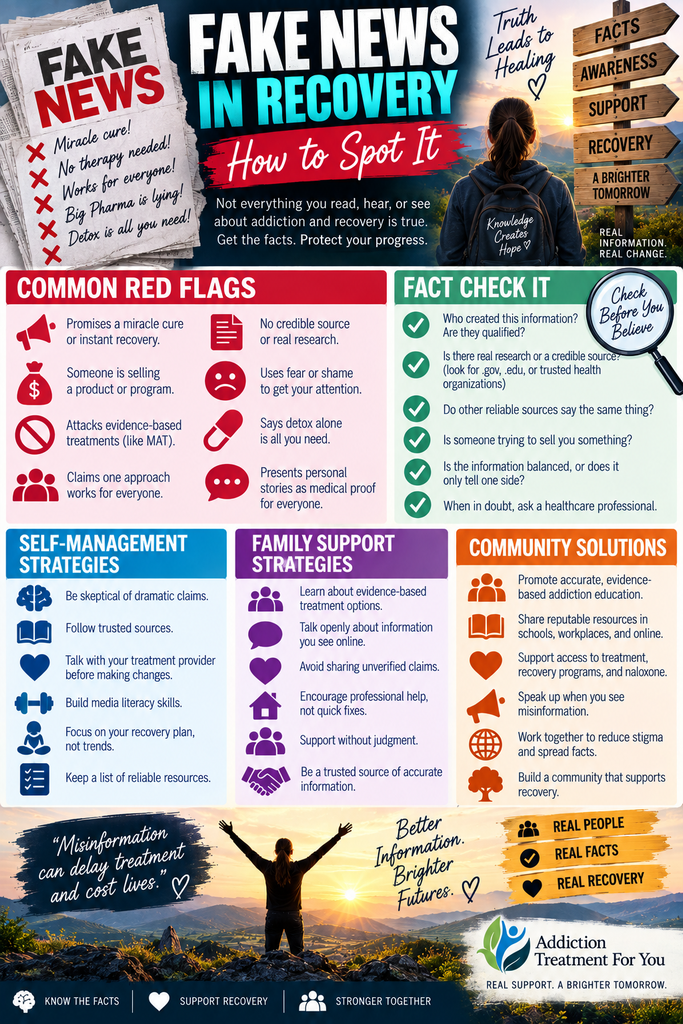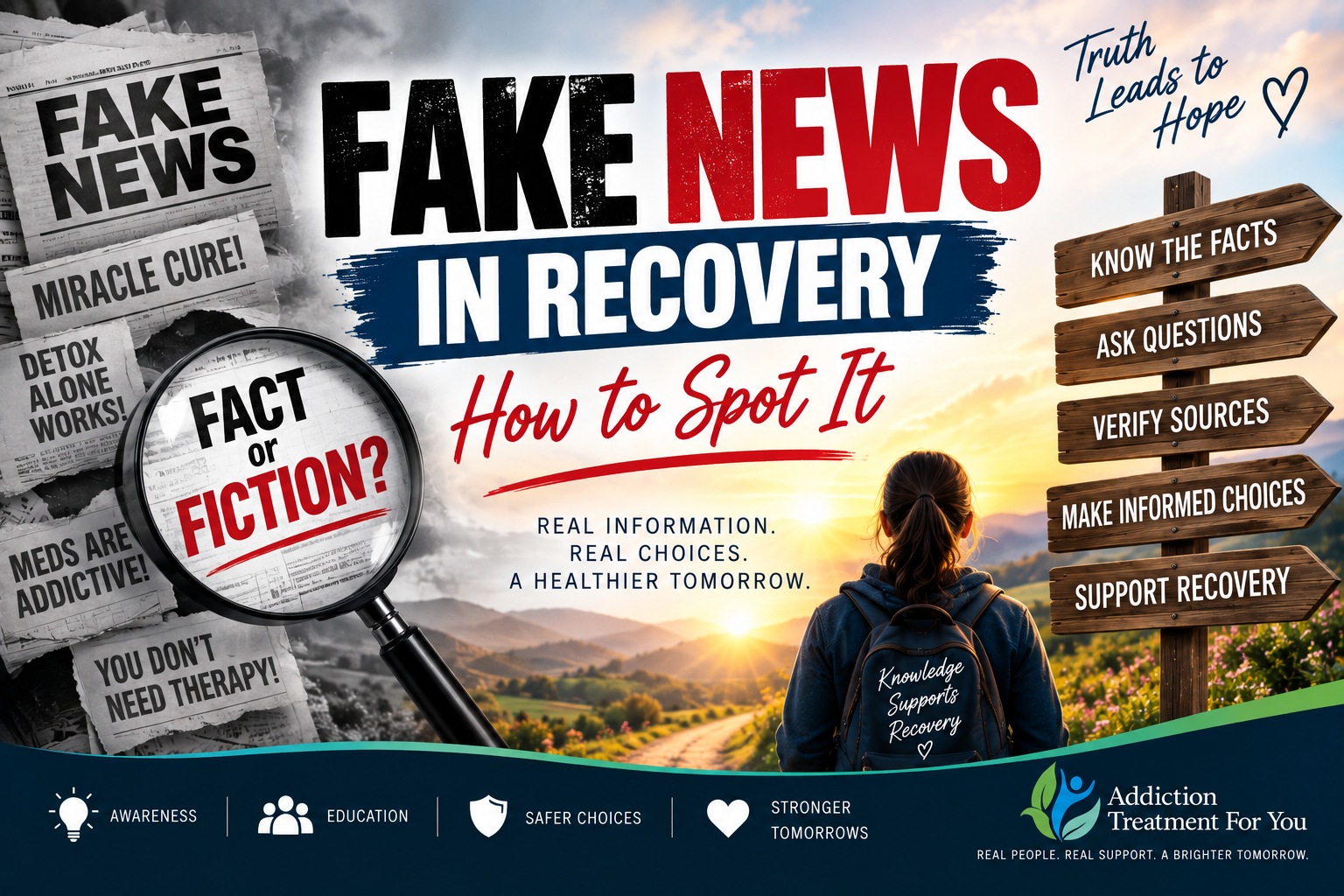
Recovery information is everywhere. Social media posts promise instant cures for addiction. Influencers promote supplements that supposedly eliminate cravings. Videos claim that one treatment works for everyone, while other posts insist medications for opioid use disorder are simply “replacing one drug with another.”
Some recovery information is helpful. Some is incomplete, exaggerated, commercially motivated, or simply false.
For someone struggling with addiction—or a frightened family searching for answers—distinguishing reliable information from misinformation can be difficult. Recovery often involves vulnerability, uncertainty, and an understandable desire for hope. Those circumstances can make dramatic promises especially attractive.
Learning to evaluate recovery information is therefore more than a media-literacy skill. Accurate information can influence decisions about treatment, medications, overdose prevention, relapse, and when to seek professional help.
What Is “Fake News” in Recovery?
The phrase “fake news” can mean many things. In recovery education, it is more useful to talk about misinformation and disinformation.
Misinformation is inaccurate or misleading information shared without necessarily intending to deceive.
Disinformation is false or misleading information deliberately created or distributed to influence people.
Recovery misinformation might include claims such as:
- “You can cure addiction in three days.”
- “Relapse proves treatment failed.”
- “Medication-assisted treatment isn’t real recovery.”
- “You have to hit rock bottom before treatment works.”
- “One supplement completely eliminates withdrawal.”
- “Detox is all someone needs to recover.”
- “People with addiction simply need more willpower.”
- “If rehabilitation worked, nobody would ever relapse.”
- “Natural means safe.”
- “One recovery program works for everyone.”
Statements like these can take complicated medical and behavioral-health issues and turn them into emotionally appealing slogans.
Why Recovery Misinformation Spreads So Easily
Recovery stories are powerful because they involve real people and real emotions.
Someone might post:
“I tried this method and haven’t wanted alcohol since.”
That experience may be completely genuine. The problem occurs when one person’s experience becomes:
“This method cures alcoholism for everyone.”
Personal testimony can provide hope, but it is not the same as scientific evidence.
Social media can make this distinction even harder because dramatic claims often receive more attention than cautious explanations.
“Scientists are continuing to study this treatment” is less exciting than:
“Doctors don’t want you to know about this miracle cure!”
The second statement may generate more clicks without providing better evidence.
Red Flag #1: The Miracle Cure
One of the clearest warning signs is a promise of guaranteed or immediate recovery.
Be cautious when someone claims:
- “100% success rate.”
- “Guaranteed sobriety.”
- “Works for everyone.”
- “No therapy needed.”
- “Eliminates cravings permanently.”
- “One treatment cures every addiction.”
- “Doctors are hiding this treatment from you.”
Substance use disorders are complex conditions influenced by biological, psychological, social, and environmental factors.
Effective treatment exists, but no legitimate treatment can guarantee identical outcomes for every person.
Red Flag #2: There Is No Reliable Source
Ask a simple question:
Where did this information come from?
A trustworthy recovery claim should ideally be supported by credible evidence from government health agencies, medical organizations, peer-reviewed research, universities, or appropriately qualified healthcare professionals.
Look beyond statements such as:
“Studies prove…”
“Scientists discovered…”
“Research shows…”
Ask which study, which researchers, and where the research was published.
If nobody can identify the evidence, the impressive wording means very little.
Red Flag #3: A Personal Story Is Presented as Medical Proof
Recovery stories deserve respect, but individual experiences cannot predict everyone’s outcome.
Someone may genuinely say:
“AA saved my life.”
Another person may genuinely say:
“Medication helped me stop using opioids.”
Both experiences can be meaningful.
The misinformation begins when the conclusion becomes:
“Therefore, everyone must recover exactly the way I did.”
Recovery pathways can include behavioral therapies, medications, mutual-help groups, residential care, outpatient treatment, peer recovery support, harm-reduction services, family involvement, and combinations of approaches.
The appropriate treatment depends on the individual.
Red Flag #4: Fear Is Used Instead of Evidence
Misinformation frequently uses fear to discourage people from seeking legitimate care.
Examples might include:
“Rehab only wants your money.”
“Doctors want to keep you addicted.”
“Psychiatric medications destroy your brain.”
“Never trust addiction treatment.”
Legitimate criticism of healthcare systems is possible and sometimes necessary. Treatment programs vary in quality, and patients should ask questions.
But sweeping claims that encourage people to reject all professional care deserve additional scrutiny.
Red Flag #5: Someone Is Selling the Solution
Financial interests do not automatically make information false.
However, they should make you ask more questions.
Be cautious when the same person who tells you that conventional treatment is useless immediately offers to sell you:
- Supplements.
- Detox products.
- Expensive coaching.
- Unproven testing.
- Exclusive recovery courses.
- Herbal treatments.
- “Secret” protocols.
- Membership programs promising guaranteed results.
Ask whether independent evidence supports the treatment—not simply testimonials on the seller’s website.
Red Flag #6: The Claim Attacks Evidence-Based Medications
One particularly harmful recovery myth is that medications for opioid use disorder are merely “replacing one addiction with another.”
Medications such as buprenorphine and methadone are established treatments for opioid use disorder. Naltrexone is another medication option for appropriate patients.
Treatment decisions belong between patients and qualified healthcare professionals.
Someone should not stop prescribed addiction or psychiatric medication because an influencer, friend, relative, or social media post claims medication means they are “not really sober.”
Red Flag #7: Detox Is Presented as a Complete Treatment
Detoxification and treatment are not the same thing.
Withdrawal management can help someone safely get through acute withdrawal, but long-term recovery may require additional treatment addressing cravings, mental health, relationships, triggers, housing, employment, physical health, and relapse prevention.
A program promising that a brief detox will permanently “cure” addiction should therefore be approached cautiously.
How to Fact-Check Recovery Information
Before sharing or acting on a recovery claim, use a simple verification process.
STOP – CHECK – COMPARE – ASK
STOP:
Do not immediately share dramatic information simply because it sounds convincing.
CHECK:
Identify who created the information. Look at the person’s qualifications, organization, evidence, publication date, and possible financial interests.
COMPARE:
See whether reputable independent sources provide similar information.
ASK:
If the information could change treatment, medication, detoxification, or overdose-prevention decisions, discuss it with an appropriately qualified healthcare professional.
A few extra minutes of verification can prevent a questionable post from becoming a dangerous healthcare decision.
Self-Management Strategies for Avoiding Recovery Misinformation
People in recovery can develop their own information-safety plan.
Helpful strategies include:
- Follow established health organizations and reputable recovery resources.
- Check the original source before sharing statistics.
- Look for publication dates because medical recommendations can change.
- Separate personal testimonials from scientific evidence.
- Be suspicious of guaranteed outcomes.
- Ask whether someone profits from the recommendation.
- Discuss major treatment changes with a healthcare professional.
- Never abruptly discontinue prescribed medication because of social media advice.
- Avoid comparing your recovery timeline with an influencer’s recovery story.
- Keep a list of trusted websites and professionals for checking questionable claims.
- Remember that emotionally powerful information is not necessarily accurate.
Family Support Strategies
Families are also vulnerable to misinformation.
Fear can make parents, spouses, and other relatives desperate for anything promising immediate change.
Families can protect themselves by:
- Researching treatment programs before paying large amounts of money.
- Asking about professional licensing and accreditation.
- Requesting evidence supporting unusual treatments.
- Avoiding programs guaranteeing permanent sobriety.
- Learning about evidence-based addiction treatment.
- Discussing medication concerns with the prescribing clinician.
- Avoiding shame-based statements about medication or relapse.
- Checking information before forwarding it to a loved one.
- Recognizing that one family’s recovery story may not apply to another.
- Participating in family education or counseling when appropriate.
Family members can become valuable partners in recovery when they help replace rumors and stigma with reliable information.
Community Support Strategies
Communities can reduce recovery misinformation by making trustworthy information easier to find.
Helpful strategies include:
- Provide evidence-based addiction education in schools and community organizations.
- Train peer recovery specialists to recognize common misinformation.
- Provide accessible information about overdose prevention and naloxone.
- Promote legitimate treatment directories.
- Encourage healthcare organizations to communicate in understandable language.
- Partner with libraries, schools, treatment programs, and community centers.
- Correct misinformation without humiliating the person who shared it.
- Provide culturally and linguistically appropriate recovery information.
- Teach digital and health literacy alongside addiction education.
- Make professional treatment and crisis resources easy to locate.
People are less likely to rely on questionable social media advice when reliable community resources are accessible.
How Artificial Intelligence Changes the Problem
Artificial intelligence has made it easier than ever to create convincing health information.
AI-generated articles, images, videos, and even fabricated quotations can appear professional while containing inaccurate information.
That means appearance is no longer a reliable measure of credibility.
A professional-looking infographic can still be wrong.
A confident answer can still be wrong.
A viral video can still be wrong.
Even AI-generated health information should be verified when the information could affect diagnosis, medication, withdrawal, overdose risk, or treatment decisions.
Don’t Shame People Who Believe Misinformation
Correcting misinformation aggressively can sometimes make people defend it more strongly.
Instead of saying:
“That’s ridiculous. How could you believe that?”
Try asking:
“Where did that information come from?”
“Can we find the original research?”
“Do other reliable medical sources agree?”
“What does your treatment provider say?”
Curiosity can create conversation where humiliation creates resistance.
Recovery Information Should Empower, Not Frighten
Good recovery education should help people understand their choices.
It should acknowledge uncertainty when uncertainty exists.
It should distinguish evidence from opinion.
It should not promise impossible outcomes.
And it should never discourage someone from seeking emergency medical attention when needed.
Recovery is complicated enough without misinformation making decisions harder.
Conclusion: Check Before You Trust, Share, or Change Treatment
Fake news and misinformation in recovery can do more than create confusion. They can reinforce stigma, promote ineffective treatments, discourage evidence-based medication, delay professional care, and influence decisions involving overdose and withdrawal.
Individuals can protect themselves by slowing down and verifying dramatic claims. Families can research treatments and avoid spreading fear-based information. Communities can improve access to accurate addiction education and qualified professional resources.
The goal is not to distrust everything online.
The goal is to develop healthy skepticism.
Ask who created the information.
Ask what evidence supports it.
Ask whether independent sources agree.
Ask whether someone is selling something.
And when the decision could affect someone’s health or safety, ask a qualified professional before making a major change.
Recovery deserves more than viral promises. It deserves accurate information, evidence-based choices, compassionate support, and the freedom to make informed decisions.
Before you believe it, share it, or change your recovery because of it—STOP, CHECK, COMPARE, and ASK.
Frequently Asked Questions
Here are some common questions:
1. What does “fake news in recovery” mean?
It refers to false, misleading, exaggerated, or unsupported information about addiction, treatment, sobriety, relapse, medications, detox, or mental health. Some misinformation is shared accidentally, while other claims may be intentionally misleading or designed to sell a product or service.
2. Why can recovery misinformation be dangerous?
Incorrect information can discourage evidence-based treatment, increase stigma, promote unsafe detox practices, or convince someone to stop prescribed medication. In serious situations, misinformation can delay lifesaving medical care.
3. What are some common addiction and recovery myths?
Common examples include:
- “Addiction is simply a lack of willpower.”
- “Someone must hit rock bottom before treatment works.”
- “Relapse means treatment failed.”
- “Detox alone cures addiction.”
- “One recovery program works for everyone.”
- “Natural treatments are always safer.”
- “Medication for opioid use disorder isn’t real recovery.”
- “A miracle supplement can permanently eliminate cravings.”
These claims oversimplify a complex health condition.
4. What is the difference between misinformation and disinformation?
Misinformation is inaccurate or misleading information that may be shared without an intention to deceive. Disinformation is false or misleading information deliberately created or spread to manipulate people.
5. How can I quickly evaluate a recovery claim?
Use four steps: STOP – CHECK – COMPARE – ASK.
STOP: Don’t immediately believe or share a dramatic claim.
CHECK: Identify the author, qualifications, evidence, date, and financial interests.
COMPARE: See whether reputable independent sources agree.
ASK: Consult an appropriately qualified healthcare professional when the information could affect treatment or safety.
6. What are warning signs of questionable recovery information?
Be cautious when you see phrases such as “100% success,” “instant cure,” “works for everyone,” “doctors don’t want you to know,” or “no professional treatment needed.” Extraordinary medical claims require strong evidence.
7. Can someone’s personal recovery story be trusted?
A person’s experience can be genuine and valuable, but it represents one person’s experience, not proof that the same treatment will work for everyone. Testimonials should not replace clinical evidence.
8. Does a large social-media following make someone a reliable recovery expert?
No. Popularity is not a professional credential. Consider the person’s education, licensing when relevant, evidence, sources, and whether reputable organizations support the information.
9. Should I trust a post because it says “research shows”?
Not automatically. Ask what research it means. Reliable information should allow you to identify the study, researchers, medical organization, or other credible source supporting the statement.
10. Is someone selling a recovery product automatically untrustworthy?
No, but a financial interest deserves additional scrutiny. Be especially cautious when someone creates fear about conventional treatment and then presents an expensive supplement, coaching program, test, or “secret protocol” as the solution.
11. Is detox the same thing as addiction treatment?
No. Withdrawal management can be an important first step, but recovery often requires continuing treatment addressing cravings, behavioral patterns, mental health, relationships, physical health, and relapse prevention.
12. Is it true that medications for opioid use disorder simply replace one addiction with another?
No. Medications such as buprenorphine and methadone are evidence-based treatments for opioid use disorder. Naltrexone is another medication option for appropriate patients. Taking medication as prescribed for a medical condition is not equivalent to uncontrolled compulsive substance use.
13. Should someone stop addiction or psychiatric medication after reading something concerning online?
Not without discussing the concern with the prescribing healthcare professional. Abruptly stopping certain medications can cause withdrawal, recurrence of symptoms, or other complications.
14. Can artificial intelligence create recovery misinformation?
Yes. AI can produce convincing articles, images, statistics, quotations, and videos that may contain errors or fabricated information. Professional appearance does not guarantee factual accuracy. Important medical claims should still be verified.
15. How can people in recovery protect themselves from misinformation?
Helpful self-management strategies include following reputable health organizations, checking original sources, separating testimonials from research, discussing treatment changes with professionals, maintaining a list of trusted resources, and avoiding impulsive decisions based on viral content.
16. How can families help prevent recovery misinformation?
Families can research treatment programs, verify credentials, learn about evidence-based treatments, avoid forwarding unverified claims, discuss medication concerns with healthcare professionals, and resist programs that promise guaranteed recovery.
17. How should I respond when a loved one believes questionable recovery information?
Avoid immediately ridiculing them. Instead, ask questions such as: “Where did this information come from?” “Can we find the original research?” or “Do independent medical organizations agree?” Collaborative fact-checking may be more productive than an argument.
18. What should communities do about recovery misinformation?
Communities can provide accessible addiction education, promote legitimate treatment resources, teach health and media literacy, distribute accurate overdose-prevention information, support naloxone education, and train peer-support workers to recognize common myths.
19. What sources are generally better starting points for addiction information?
Government health agencies, major medical organizations, universities, peer-reviewed research, licensed healthcare professionals, and established addiction-treatment organizations are generally better starting points than anonymous posts or influencers making unsupported medical claims.
20. Can reputable sources ever be wrong?
Yes. Medical knowledge evolves, studies can conflict, and recommendations can change as new evidence develops. Credibility does not mean infallibility. This is why checking publication dates and comparing multiple high-quality sources is valuable.
21. What if two reputable sources disagree?
Look at when each source was published, the populations studied, the quality of evidence, and whether newer research has changed recommendations. For decisions involving your own treatment, discuss the disagreement with your healthcare professional.
22. What is the biggest rule for spotting fake recovery news?
Be especially skeptical when a claim combines fear, certainty, urgency, and a product for sale. Reliable healthcare information generally explains benefits, limitations, risks, alternatives, and uncertainty rather than promising a guaranteed outcome.
Video: Why You Need to Fact-Check Your Recovery Info #recovery #addictionrecovery #criticalthinking