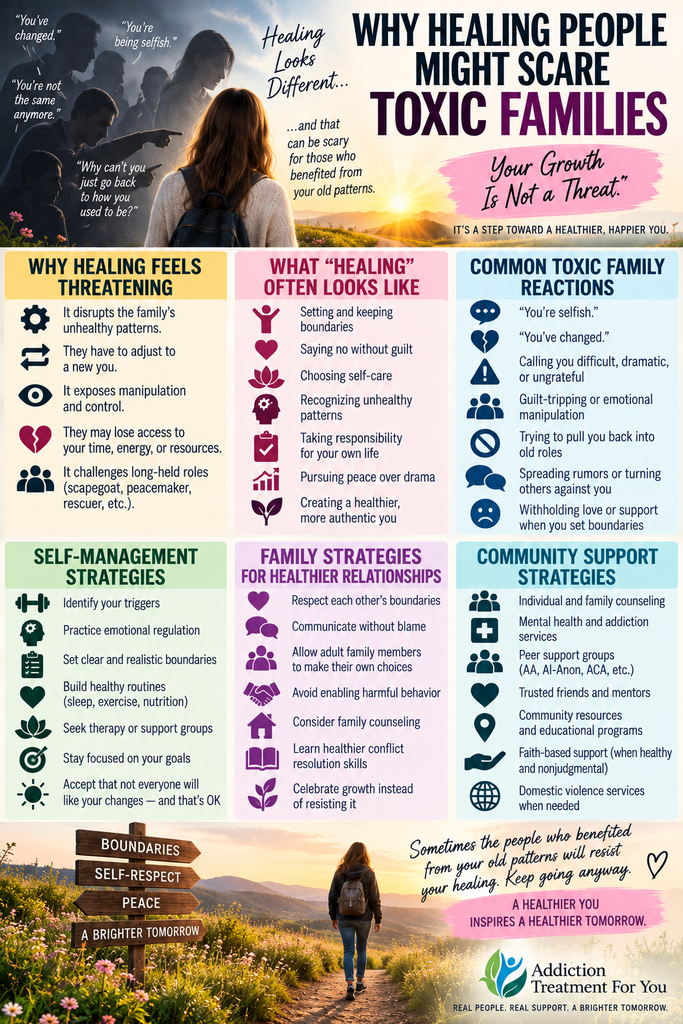
Healing is usually described as something positive. A person begins setting healthier boundaries, communicating more clearly, recognizing harmful patterns, taking responsibility for their own choices, and refusing to participate in unnecessary conflict. From the outside, these changes may look like obvious signs of progress.
Inside an unhealthy family system, however, personal growth can sometimes create tension.
When one family member changes, everyone else may have to adjust. Behaviors that once kept the family functioning—people-pleasing, secrecy, rescuing, blaming, controlling, or avoiding difficult conversations—may no longer work in the same way. The person who is healing may therefore be described as selfish, difficult, disrespectful, dramatic, or “not the person you used to be.”
The problem may not be that healing is harmful. The family may simply be uncomfortable with what the person’s growth is changing.
Why Can Healing Feel Threatening to a Family?
Families develop patterns over many years. Members often fall into informal roles: the caretaker, peacemaker, achiever, rebel, scapegoat, rescuer, or person who keeps everyone happy.
These roles are not necessarily consciously assigned.
Imagine someone who has spent years saying yes whenever relatives ask for help. They lend money, solve crises, cancel plans, tolerate insults, and avoid disagreements because saying no makes them feel guilty.
After counseling, that person begins saying:
“I can help sometimes, but I can’t take responsibility for everything.”
The statement is reasonable. Yet relatives who benefited from the previous arrangement may experience it as rejection.
Healing has changed the relationship.
Boundaries Can Feel Like Rebellion
One of the biggest changes during emotional healing is learning to establish boundaries.
Healthy boundaries might include:
- Refusing to participate in screaming or insulting conversations.
- Saying no without providing an elaborate justification.
- Protecting personal time and finances.
- Limiting conversations about private matters.
- Refusing to cover up another person’s substance use.
- Leaving situations that become emotionally or physically unsafe.
- Deciding how frequently to communicate with difficult relatives.
- Expecting other adults to accept responsibility for their own choices.
A family accustomed to having unlimited access to someone’s time, money, emotions, or attention may interpret boundaries as punishment.
But a boundary is fundamentally about what you will do, rather than controlling what another person must do.
For example, “You aren’t allowed to yell” attempts to control another person’s behavior.
“If yelling begins, I’m going to end the conversation, and we can try again later” establishes a personal boundary.
The Family Scapegoat May Begin Questioning the Story
Some families repeatedly blame one individual for problems.
That person may eventually internalize messages such as:
“Everything is always your fault.”
“You’re too sensitive.”
“You cause all the drama.”
“Why can’t you just get along with everyone?”
Healing can change that narrative.
Through therapy, education, or self-reflection, someone may begin distinguishing between genuine accountability and accepting responsibility for problems they did not create.
This can be unsettling for a family system that depends on having one person absorb the blame.
When the scapegoat stops accepting every accusation, other family members may have to examine their own behavior.
People-Pleasing Can Become Healthy Assertiveness
People-pleasing often looks like kindness from the outside.
However, genuine kindness involves choice. Chronic people-pleasing may be driven by fear of rejection, anger, conflict, abandonment, or disapproval.
Healing may involve learning to say:
- “No.”
- “That doesn’t work for me.”
- “I need time to think about it.”
- “I disagree.”
- “I’m not comfortable discussing that.”
- “I can’t solve this problem for you.”
- “I love you, but I’m not participating in this.”
To someone accustomed to automatic compliance, assertiveness may initially appear aggressive.
That does not automatically mean the boundary is wrong.
Healing Can Expose Enabling
This issue becomes particularly important in families affected by addiction.
Family members may unintentionally protect someone from the consequences of substance use by paying debts, making excuses to employers, providing money, hiding problems, repeatedly rescuing the person from crises, or pretending nothing is wrong.
A recovering family member might decide:
“I will support recovery, but I will no longer support the addiction.”
That change can disrupt the entire family system.
Other relatives might respond:
“You’re abandoning them.”
“Family is supposed to help family.”
“What if something happens?”
These concerns may come from genuine fear rather than malicious intent. Nevertheless, repeatedly removing every consequence can sometimes allow harmful patterns to continue.
Why Healthy People Become Harder to Manipulate
Healing often increases awareness of unhealthy interpersonal patterns.
A person may become better at recognizing:
- Guilt-tripping.
- Constant blame shifting.
- Emotional blackmail.
- Silent treatment used as punishment.
- Repeated boundary violations.
- Triangulation between family members.
- Manipulation through money or favors.
- Threats of abandonment.
- Denial of clearly observable behavior.
- Pressure to keep harmful family secrets.
Recognizing these patterns does not require diagnosing relatives as narcissists or labeling everyone “toxic.”
Sometimes people behave badly because they are frightened, emotionally immature, stressed, struggling with addiction, repeating learned behaviors, or lacking communication skills.
Understanding the reason, however, does not require tolerating harmful behavior.
Self-Management Strategies for Healing
Personal healing requires more than identifying what other people are doing wrong. It also requires examining our own responses and behaviors.
Helpful strategies include:
- Identify recurring patterns. Notice which interactions repeatedly leave you angry, frightened, guilty, or emotionally exhausted.
- Separate responsibility from guilt. Feeling guilty after saying no does not necessarily mean you have done something wrong.
- Practice assertive communication. Be clear without becoming unnecessarily hostile.
- Set realistic boundaries. Decide what behavior you will participate in and what you will leave.
- Stop overexplaining. A reasonable decision does not always require everyone’s approval.
- Develop emotional regulation skills. Pause before reacting to provocative messages or arguments.
- Keep supportive routines. Sleep, exercise, nutrition, hobbies, and meaningful activities can strengthen emotional resilience.
- Consider counseling. Therapy can help distinguish unhealthy family patterns from normal disagreement.
- Accept that others may dislike your boundaries. Their discomfort does not automatically prove the boundary is inappropriate.
- Review your own behavior. Healing includes being willing to apologize and change when you genuinely cause harm.
Family Strategies: Creating Healthier Relationships Together
Not every family reacts negatively to someone’s growth. Some families gradually adapt and become healthier together.
Helpful family strategies include:
- Respect reasonable boundaries even when you disagree with them.
- Discuss behavior rather than attacking someone’s personality.
- Avoid recruiting relatives to take sides during disagreements.
- Allow adult family members to make independent decisions.
- Apologize when boundaries are crossed.
- Avoid using money, affection, children, or communication as leverage.
- Encourage treatment when addiction or mental illness is present.
- Participate in family counseling when appropriate.
- Learn healthier conflict-resolution skills.
- Recognize that closeness does not require unlimited access.
- Celebrate another person’s growth rather than interpreting independence as rejection.
Healthy families can disagree.
The difference is that disagreement need not result in humiliation, intimidation, manipulation, or punishment.
Community Support Strategies
People changing long-established family patterns often need support outside the household.
Community resources can include:
- Individual psychotherapy or counseling.
- Family therapy.
- Community mental health centers.
- Peer-support groups.
- Recovery communities.
- Al-Anon and other family addiction support programs.
- Adult Children of Alcoholics/Dysfunctional Families groups.
- Domestic violence services when relationships involve abuse or threats.
- Faith communities when they provide safe and nonjudgmental support.
- Educational programs about boundaries and healthy relationships.
- Trusted friends, mentors, and recovery coaches.
Community support can provide something especially valuable: perspective.
When someone has lived within the same family patterns for decades, unhealthy behavior may feel completely normal. Outside relationships can help a person recognize healthier alternatives.
Healing Does Not Mean Cutting Everyone Off
Social media sometimes presents healing as the removal of anyone who causes discomfort.
Real relationships are more complicated.
Disagreement is not automatically toxicity. A relative making a mistake is not necessarily abusive. Someone questioning a decision is not automatically manipulating you.
Healthy healing requires discernment.
Sometimes relationships improve through communication and new boundaries. Sometimes temporary distance is appropriate. In situations involving persistent abuse, threats, stalking, violence, or severe manipulation, greater separation may become necessary.
The goal should not automatically be estrangement.
The goal is safety, emotional health, accountability, and healthier relationships whenever possible.
What If Your Family Says, “You’ve Changed”?
They may be correct.
You may have changed.
Perhaps you no longer apologize for having needs.
Perhaps you stopped rescuing adults from problems they repeatedly create.
Perhaps you stopped accepting insults disguised as jokes.
Perhaps you no longer participate in every argument.
Perhaps you learned that love does not require unlimited access to you.
Perhaps you started asking others to take responsibility for their behavior.
Change can feel uncomfortable to people who were comfortable with the previous version of you.
But discomfort is not necessarily evidence that your growth is wrong.
Healing Should Include Self-Accountability
There is another side of this conversation that deserves attention.
Learning psychological terminology can sometimes tempt people to label everyone who disagrees with them as “toxic,” “narcissistic,” or “gaslighting.”
That is not healthy either.
True healing includes asking:
- Am I communicating respectfully?
- Are my boundaries reasonable?
- Am I trying to control other people?
- Can I tolerate disagreement?
- Do I apologize when I am wrong?
- Am I interpreting every uncomfortable conversation as abuse?
- Am I willing to listen to legitimate criticism?
- Am I treating others with the respect I expect for myself?
Growth should increase self-awareness, not eliminate accountability.
Conclusion: When One Person Changes, the System Changes
Healing can disrupt unhealthy family dynamics because one person’s growth changes the rules that previously governed the relationship.
The chronic people-pleaser begins saying no.
The rescuer stops rescuing.
The scapegoat stops carrying everyone’s blame.
The person affected by addiction seeks recovery.
The family member who always remained silent begins speaking honestly.
The person who accepted disrespect establishes boundaries.
These changes may initially produce conflict because familiar family roles are being challenged.
But healthy relationships do not require someone to remain emotionally unhealthy so everyone else can remain comfortable.
Self-management helps individuals recognize patterns and regulate their responses. Family support can replace manipulation and blame with communication, boundaries, and accountability. Community resources can provide counseling, education, recovery support, and outside perspective.
Healing is not about becoming impossible to criticize or removing everyone who disagrees with you. It is about becoming healthier, more self-aware, more accountable, and less willing to participate in patterns that repeatedly cause harm.
And sometimes the clearest sign that a family system is changing is that the behaviors everyone once considered “normal” no longer feel normal at all.
Frequently Asked Questions
Here are some common questions:
1. Why might a family react negatively when one person begins healing?
Healing can change established roles and expectations. Someone who previously stayed quiet, rescued others, accepted blame, or constantly tried to keep everyone happy may begin behaving differently. Because families develop patterns that create stability—even when some patterns are unhealthy—change can initially produce resistance or anxiety.
2. Why can healthy boundaries upset some family members?
Boundaries change what other people can expect from you. A person might stop lending money, tolerating insults, answering every call, keeping harmful secrets, or solving everyone’s problems. SAMHSA describes healthy family boundaries as generally clear and flexible rather than excessively rigid or overly diffuse.
3. Why do people sometimes say, “You’ve changed,” after someone starts healing?
Because the person probably has changed. They may communicate more directly, say “no” more often, avoid unnecessary conflict, or make independent decisions. Change itself is not proof that someone has become selfish or uncaring.
4. Can saying “no” be part of emotional healing?
Yes. Learning to decline requests can be an important part of developing healthy boundaries. A respectful “no” communicates what you can and cannot reasonably provide without requiring the other person to agree with your decision.
5. Why might a chronic people-pleaser receive resistance when they become assertive?
Other people may have become accustomed to automatic agreement or assistance. When the people-pleaser begins expressing preferences and limits, relatives may experience the new behavior as rejection—even though it may actually represent healthier independence.
6. Why might the family scapegoat experience resistance during healing?
Some families develop roles that distract attention from larger problems. SAMHSA notes that family roles can help maintain the family’s usual equilibrium and gives the example of a child being perceived as the source of family problems despite significant parental substance-use problems.
7. Does healing mean blaming your family for everything?
No. Healthy recovery includes self-accountability. A person can recognize harmful family patterns while also examining their own communication, choices, reactions, and mistakes.
8. Does healing mean cutting off your family?
Not necessarily. Boundaries can range from changing how certain conversations are handled to temporarily limiting contact. Some relationships improve after healthier expectations are established. Family therapy can also help people examine communication, roles, boundaries, and problematic patterns.
9. What is the difference between a boundary and controlling behavior?
A boundary generally describes what you will do to protect your well-being. Control attempts to dictate another person’s behavior.
For example, “If you insult me, I will end the conversation” is a boundary. “You must agree with everything I say” is an attempt to control someone else.
10. Why can guilt become stronger when someone first establishes boundaries?
If someone has spent years believing they are responsible for everyone else’s happiness, independence may initially feel selfish. Feeling guilty, however, does not automatically mean a boundary is inappropriate.
11. Why might healthier behavior expose manipulation?
Greater self-awareness can make guilt-tripping, triangulation, blame shifting, intimidation, and repeated boundary violations easier to recognize. Family therapy literature specifically addresses triangulation and changes in repetitive interaction patterns within families.
12. How can healing affect families struggling with addiction?
A relative may stop providing money for substances, make excuses, cover up consequences, or participate in secrecy. The change can initially cause conflict, but families can also become an important source of support during recovery. SAMHSA recommends family counseling and support resources because substance-use and mental health conditions can affect the entire family.
13. What self-management strategies can help someone dealing with unhealthy family dynamics?
Helpful approaches include:
- Identify recurring emotional triggers.
- Practice calm, assertive communication.
- Establish clear and realistic boundaries.
- Avoid making important decisions during heated arguments.
- Develop healthy sleep, exercise, and stress-management routines.
- Stop automatically assuming responsibility for other adults’ emotions.
- Maintain relationships outside the unhealthy family dynamic.
- Consider individual counseling.
- Keep evaluating your own behavior and apologize when appropriate.
- Develop a safety plan if interactions involve threats or violence.
14. How can families respond more positively when someone begins changing?
Family members can become curious instead of defensive, respect reasonable boundaries, communicate directly rather than through other relatives, acknowledge mistakes, and allow adults to make independent decisions. Family therapy may help when established patterns are particularly difficult to change.
15. Can a family heal together?
Yes. Individual change can sometimes encourage broader family improvement. Family-based treatment can help members develop healthier communication and boundaries and reorganize problematic interaction patterns.
16. What if the family refuses counseling?
One person can still work on their own responses. Individual therapy can help someone develop communication skills, emotional regulation, boundaries, and realistic expectations even when relatives are unwilling to participate.
17. Is every difficult family relationship “toxic”?
No. Conflict, criticism, disagreements, and occasional hurt feelings are normal parts of relationships. It is more useful to examine repeated behaviors and their effects than to automatically label someone toxic.
18. Can psychological labels become harmful too?
Yes. Terms such as “toxic,” “narcissist,” and “gaslighting” can be useful when accurately describing patterns, but they can also be overused. Healing should increase someone’s ability to distinguish genuine mistreatment from ordinary disagreement.
19. When should someone seek professional help?
Consider professional support when family conflict repeatedly causes significant anxiety or distress, interferes with daily functioning or recovery, involves substance misuse, or makes establishing reasonable boundaries extremely difficult. Both family and individual counseling are options.
20. What is the most important lesson about healing within an unhealthy family?
Healing can change the entire relationship because the person no longer automatically assumes familiar roles. Resistance from relatives does not necessarily mean the person is doing something wrong—but healing also requires self-reflection rather than assuming everyone who disagrees is unhealthy.
Video: What happens when you finally set boundaries #FamilyDynamics #MentalHealth