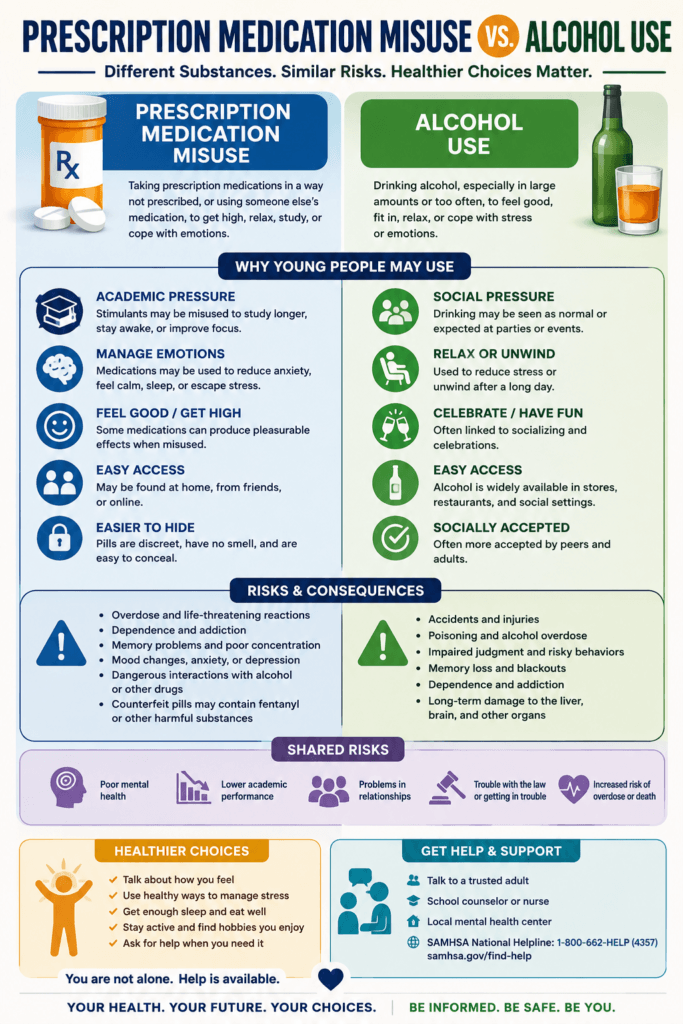
Young people may sometimes choose to misuse prescription medications rather than alcohol because pills can appear safer, more socially acceptable, easier to conceal, or more useful for managing specific needs. Some may misuse stimulants to increase energy or academic performance, while others may use opioids, sedatives, or anti-anxiety medications to relax, sleep, escape emotional distress, or experience pleasurable effects. Because these medications have legitimate medical purposes, young people may underestimate their potential for dependence, overdose, and other serious consequences. Understanding the reasons behind prescription medication misuse is essential for correcting misconceptions and addressing underlying concerns such as stress, anxiety, peer pressure, academic demands, and untreated mental health problems.
Why Young People May Choose Prescription Medications Instead of Alcohol
Young people may misuse prescription medications instead of alcohol because prescription drugs can appear safer, more legitimate, easier to obtain, and easier to hide. Because these medications are prescribed by healthcare professionals, some teens and young adults mistakenly believe that taking them without a prescription—or differently from how they were prescribed—is less dangerous than drinking alcohol or using illicit drugs.
Reasons Young People May Misuse Prescription Medications
- Perception of safety: Prescription medications may seem safer because they are manufactured and used for legitimate medical purposes.
- Easy access: Medications may be available in family medicine cabinets or obtained from friends or peers.
- Academic pressure: Some young people misuse prescription stimulants hoping to study longer, stay awake, increase energy, or improve concentration.
- Stress and anxiety: Sedatives or anti-anxiety medications may be misused to relax, sleep, or temporarily escape emotional distress.
- Seeking euphoria: Prescription opioids and some other medications may be misused for their pleasurable or calming effects.
- Self-medication: Young people experiencing anxiety, depression, trauma, loneliness, or overwhelming stress may attempt to manage their symptoms without professional treatment.
- Easier to conceal: Pills can be carried and consumed discreetly and generally do not produce the recognizable smell associated with alcohol.
- Peer influence: Friends or social media may normalize medication sharing or minimize the risks of prescription drug misuse.
Why Prescription Drug Misuse Can Be Dangerous
Prescription medications are not automatically safer than alcohol. Their safety depends on the medication, dosage, medical condition, interactions with other substances, and appropriate clinical supervision.
- Prescription opioids can cause respiratory depression, overdose, dependence, and opioid use disorder.
- Benzodiazepines and other sedatives can impair judgment, coordination, and memory and become particularly dangerous when combined with alcohol or opioids.
- Prescription stimulants can cause insomnia, anxiety, increased heart rate, elevated blood pressure, and other complications when misused.
- Mixing prescription medications with alcohol or other drugs can create unpredictable and potentially life-threatening effects.
- Pills obtained outside a licensed pharmacy may be counterfeit and contain unexpected substances, including illicitly manufactured fentanyl.
Prevention and Education
Preventing prescription medication misuse requires understanding why a young person is using the medication rather than focusing only on punishment. Parents, healthcare professionals, schools, and communities can help by:
- Keeping prescription medications securely stored.
- Properly disposing of unused medications.
- Teaching young people never to share prescriptions.
- Discussing the risks of counterfeit pills.
- Screening for substance use and mental health concerns.
- Addressing academic pressure, anxiety, trauma, and other underlying stressors.
- Encouraging healthy coping strategies and professional support when needed.
The key message for young people is simple: a medication being available by prescription does not make it safe to misuse. Prescription medications are safest when taken by the person for whom they were prescribed, at the prescribed dose, and for the intended medical purpose.
Self-Management Strategies: Prescription Medication Misuse vs. Alcohol Use
Understanding why a young person may choose prescription medications rather than alcohol is an important part of preventing substance misuse. Prescription drugs may feel safer because they have legitimate medical uses, but taking someone else’s medication, taking larger doses, or using medication to get high, relax, study, or escape emotional problems can carry serious risks.
Recognize the Reason Behind the Use
Young people should consider what they are trying to accomplish when they reach for a prescription medication.
- Identify whether the goal is to reduce anxiety, improve sleep, increase energy, study longer, feel good, or escape difficult emotions.
- Notice situations that increase the desire to use medications or alcohol.
- Keep track of stress, mood, sleep, cravings, and substance use.
- Recognize when occasional misuse becomes more frequent or harder to control.
Understand That Prescription Does Not Mean Risk-Free
A medication prescribed by a healthcare professional can still be harmful when misused.
- Learn the purpose, dosage, side effects, and interactions of prescribed medications.
- Take medications only as directed.
- Never use another person’s prescription.
- Never share prescribed medications with friends.
- Avoid assuming prescription drugs are safer than alcohol simply because they come in pill form.
- Be especially cautious about combining alcohol with opioids, benzodiazepines, sleep medications, or other sedating drugs.
Develop Healthier Coping Strategies
If medications or alcohol are being used to manage emotions, healthier coping skills can address the underlying problem.
- Exercise or participate in enjoyable physical activities.
- Practice relaxation, mindfulness, or breathing techniques.
- Maintain consistent sleep and eating routines.
- Talk with trusted friends, family members, counselors, or healthcare professionals.
- Develop hobbies and activities that provide healthy rewards.
- Break academic responsibilities into manageable tasks rather than relying on stimulants to study longer.
Learn to Manage Peer Pressure
Young people may encounter friends who share medications or minimize their risks.
- Practice saying no when offered prescription medications or alcohol.
- Avoid situations where medication sharing or substance misuse is common.
- Choose friends who respect personal boundaries.
- Remember that someone else’s prescription was selected for that person’s medical needs—not yours.
Monitor for Warning Signs
Pay attention to changes such as needing larger amounts, thinking frequently about a substance, hiding use, experiencing withdrawal symptoms, or having problems at school, work, home, or in relationships. These may indicate that professional assessment is needed.
Self-management is not about simply replacing alcohol with prescription medication. The healthier goal is to understand what need the substance is serving and to find safer ways to address that need. If prescription medication or alcohol use becomes difficult to control, early support from a healthcare or behavioral health professional can help prevent more serious problems.
Family Support Strategies: Understanding Prescription Medication Misuse vs. Alcohol Use
Families play an important role in helping young people understand that choosing prescription medications instead of alcohol does not necessarily reduce the risk of substance-related harm. A young person may view prescription medications as safer, easier to conceal, or more socially acceptable because they have legitimate medical purposes. Family support should focus on education, communication, prevention, and identifying the reasons behind substance use.
Create Open and Nonjudgmental Communication
Families can make it easier for young people to discuss substance use without immediately fearing punishment or rejection.
- Ask what the young person believes about prescription medications and alcohol.
- Listen for reasons such as anxiety, stress, sleep problems, academic pressure, curiosity, or peer influence.
- Avoid conversations based entirely on accusations or threats.
- Discuss consequences while maintaining supportive communication.
- Encourage questions about medications, alcohol, and addiction.
Correct Misconceptions About Prescription Medications
Young people may mistakenly assume that a medication is safe simply because a healthcare professional can prescribe it.
- Explain the difference between appropriate medical use and prescription drug misuse.
- Discuss why medications are prescribed at specific doses for specific individuals.
- Reinforce that taking someone else’s medication is unsafe.
- Explain the dangers of mixing medications with alcohol or other substances.
- Discuss the additional risks associated with counterfeit pills obtained outside legitimate pharmacies.
Manage Medications Safely at Home
Reducing easy access can help prevent experimentation and impulsive misuse.
- Keep potentially misused medications securely stored.
- Monitor quantities when appropriate.
- Avoid leaving unused prescriptions easily accessible.
- Properly dispose of medications that are no longer needed.
- Never encourage family members to share prescription medications.
Look Beyond the Substance
Families should try to understand why the young person is choosing prescription medications or alcohol.
- Watch for persistent anxiety, depression, isolation, sleep difficulties, academic pressure, or major behavioral changes.
- Ask whether substances are being used to cope with uncomfortable emotions.
- Pay attention to changes in friendships, school performance, activities, or family relationships.
- Seek professional evaluation when emotional or behavioral concerns persist.
Model Healthy Coping Behaviors
Family attitudes toward medications and alcohol influence how young people understand substance use.
- Demonstrate responsible use of prescribed medications.
- Avoid presenting alcohol or medications as the primary solution for stress.
- Model healthy strategies such as exercise, communication, relaxation, hobbies, and adequate sleep.
- Encourage enjoyable family activities that do not center around substances.
Respond Early to Warning Signs
Repeated medication misuse, secrecy, unexplained missing pills, intoxication, obtaining pills from friends or online sources, increasing tolerance, or difficulty stopping should be taken seriously. Families can involve a pediatrician, primary care clinician, mental health professional, or addiction specialist rather than waiting for the situation to become severe.
The family’s goal should not be to convince a young person that alcohol is preferable to prescription drugs. Both can cause significant harm when misused. Instead, families can help young people understand what is driving the behavior, reduce access to substances, encourage healthier coping skills, and obtain professional support when necessary.
Community Resource Strategies: Understanding Prescription Medication Misuse vs. Alcohol Use
Community resources can help young people and families understand why some teens and young adults may misuse prescription medications rather than alcohol. Prevention efforts should emphasize that prescription medications are not automatically safer because they have legitimate medical purposes. Schools, healthcare organizations, pharmacies, treatment programs, and community groups can work together to provide accurate information and early intervention.
School and College Prevention Programs
Schools and colleges are important settings for identifying risky substance use and correcting misconceptions.
- Provide education about prescription drug misuse, alcohol, addiction, and overdose.
- Explain the risks of using stimulants to study or improve academic performance.
- Teach students about the dangers of sharing medications.
- Include substance-use and mental health screening when appropriate.
- Make counselors and behavioral health services accessible to students.
Healthcare and Behavioral Health Services
Community healthcare professionals can help identify the reasons behind medication or alcohol misuse.
- Provide confidential substance-use screening and early intervention.
- Assess anxiety, depression, trauma, sleep problems, and other concerns that may contribute to self-medication.
- Educate young people about medication safety and drug interactions.
- Refer individuals with problematic use to appropriate mental health or addiction treatment.
- Encourage coordinated care between primary care and behavioral health providers.
Pharmacy and Medication-Safety Programs
Community pharmacies can help families prevent medication diversion or misuse.
- Educate patients and families about safe medication use.
- Encourage secure storage of medications in the home.
- Provide information about medication disposal programs.
- Explain potentially dangerous interactions between prescription medications, alcohol, and other substances.
- Encourage patients to ask questions about medications that have misuse or dependence potential.
Drug Take-Back and Safe Disposal Programs
Unused medications can become an easily accessible source of drugs for young people.
- Promote community medication take-back events.
- Provide permanent medication disposal locations when available.
- Encourage families to remove unused medications from their homes.
- Educate the public about safe disposal practices.
Youth and Family Support Programs
Community organizations can provide healthier alternatives to substance use while strengthening protective relationships.
- Offer mentoring and peer-support programs.
- Provide recreational, educational, and after-school activities.
- Offer parenting education and family support services.
- Teach stress management, communication, and healthy coping skills.
- Connect families experiencing substance-use problems with treatment and recovery resources.
Public Awareness and Harm-Reduction Education
Community campaigns should specifically challenge the idea that pills are safer than alcohol.
- Educate young people about counterfeit pills and unexpected drug contents.
- Provide overdose-prevention education.
- Increase awareness of the risks of combining opioids, sedatives, alcohol, and other substances.
- Provide information about recognizing an overdose and accessing emergency assistance.
- Make evidence-based prevention information available through schools, healthcare facilities, community centers, and youth organizations.
An effective community response should not encourage young people to choose alcohol instead of prescription medications. The goal is to reduce misuse of both while addressing the underlying reasons young people may turn to substances. Communities that combine education, mental health services, medication safety, early intervention, family involvement, and accessible treatment can help young people make safer and healthier decisions.
Frequently Asked Questions
Here are some common questions:
1. Why might young people misuse prescription medications instead of alcohol?
Some young people perceive prescription medications as safer, easier to hide, or more socially acceptable because they have legitimate medical uses. Others may misuse them for specific effects, such as increasing energy, improving concentration, reducing anxiety, sleeping, or getting high.
2. Are prescription medications safer than alcohol?
Not necessarily. Prescription medications can be safe when appropriately prescribed and taken as directed, but misuse can cause dependence, overdose, dangerous interactions, and other serious health consequences.
3. What is considered prescription medication misuse?
Misuse includes taking medication prescribed to someone else, taking a larger or more frequent dose than prescribed, or using a medication for a purpose such as getting high rather than its intended medical purpose.
4. Which prescription medications are commonly misused?
Prescription opioids, benzodiazepines, other sedatives, and stimulants are among the medication categories that may be misused.
5. Why might prescription pills be easier for young people to hide than alcohol?
Pills are small, portable, generally have no recognizable alcohol odor, and may already be present in the home. This can make misuse more difficult for families to notice.
6. Can prescription medications become addictive?
Yes. Some prescription medications have significant dependence and addiction potential, particularly when they are taken in ways other than prescribed.
7. Can alcohol lead to addiction too?
Yes. Repeated or heavy alcohol consumption can contribute to alcohol use disorder. Young people can also experience injuries, impaired judgment, alcohol poisoning, academic problems, and risky behaviors related to drinking.
8. Is mixing alcohol with prescription medications dangerous?
It can be extremely dangerous. Alcohol can intensify the effects of certain medications. Combining alcohol with opioids, benzodiazepines, or other sedating medications can dangerously suppress breathing and increase overdose risk.
9. Are pills obtained from friends or online sources safe?
They should not be assumed to be safe. Pills obtained outside licensed pharmacies may be counterfeit and can contain unexpected substances, including illicitly manufactured fentanyl.
10. What are warning signs of prescription medication misuse?
Possible signs include missing medications, secrecy, unexplained pills, changes in sleep or mood, declining school performance, frequent requests for medication, obtaining prescriptions from others, intoxication, and increasing difficulty controlling use.
11. How can parents help prevent prescription medication misuse?
Parents can securely store medications, properly dispose of unused prescriptions, discuss medication safety, discourage sharing medications, monitor concerning behavioral changes, and maintain open communication about substance use.
12. What should families do if they suspect misuse?
Approach the young person calmly, discuss specific concerns, and seek professional assessment when needed. A healthcare or behavioral health professional can evaluate substance use as well as underlying issues such as anxiety, depression, trauma, sleep difficulties, or academic stress.
13. Should alcohol be considered a safer alternative to prescription drug misuse?
No. The goal should not be to replace prescription medication misuse with alcohol. Both can cause significant harm. Prevention should focus on understanding why the young person wants to use a substance and developing healthier ways to meet that need.
14. Can young people recover from problematic prescription medication or alcohol use?
Yes. Early recognition and appropriate treatment can make an important difference. Depending on the individual, treatment may include counseling, family involvement, behavioral therapies, treatment of co-occurring mental health conditions, peer support, and evidence-based addiction treatment.
15. What is the most important message for young people?
“Prescription” does not automatically mean “safe.” Medications should be taken only as prescribed, and alcohol should not be viewed as a harmless substitute. Understanding the risks and seeking help early can prevent serious consequences.
Conclusion
Choosing prescription medications instead of alcohol does not make substance misuse safer. Both alcohol and prescription drugs can cause significant physical, psychological, social, and behavioral consequences when misused, and combining certain medications with alcohol can substantially increase the danger. Prevention should focus on helping young people understand medication risks, recognize personal triggers, develop healthier coping strategies, and seek appropriate support for emotional or academic difficulties. Families, schools, healthcare professionals, pharmacies, and community organizations can work together to promote responsible medication use and early intervention. Ultimately, the goal is not to substitute one substance for another but to help young people develop healthier ways to manage stress, emotions, relationships, and everyday challenges.
Video: Why Prescription Drugs Are More Deadly Than You Think #AlcoholAwareness #TeenSubstanceUse