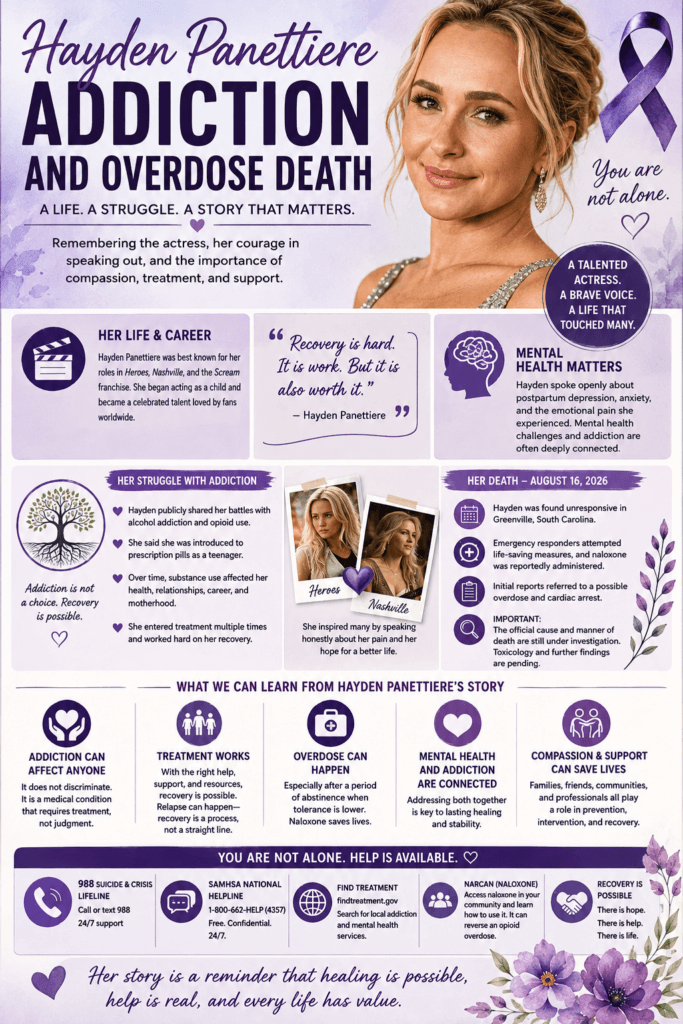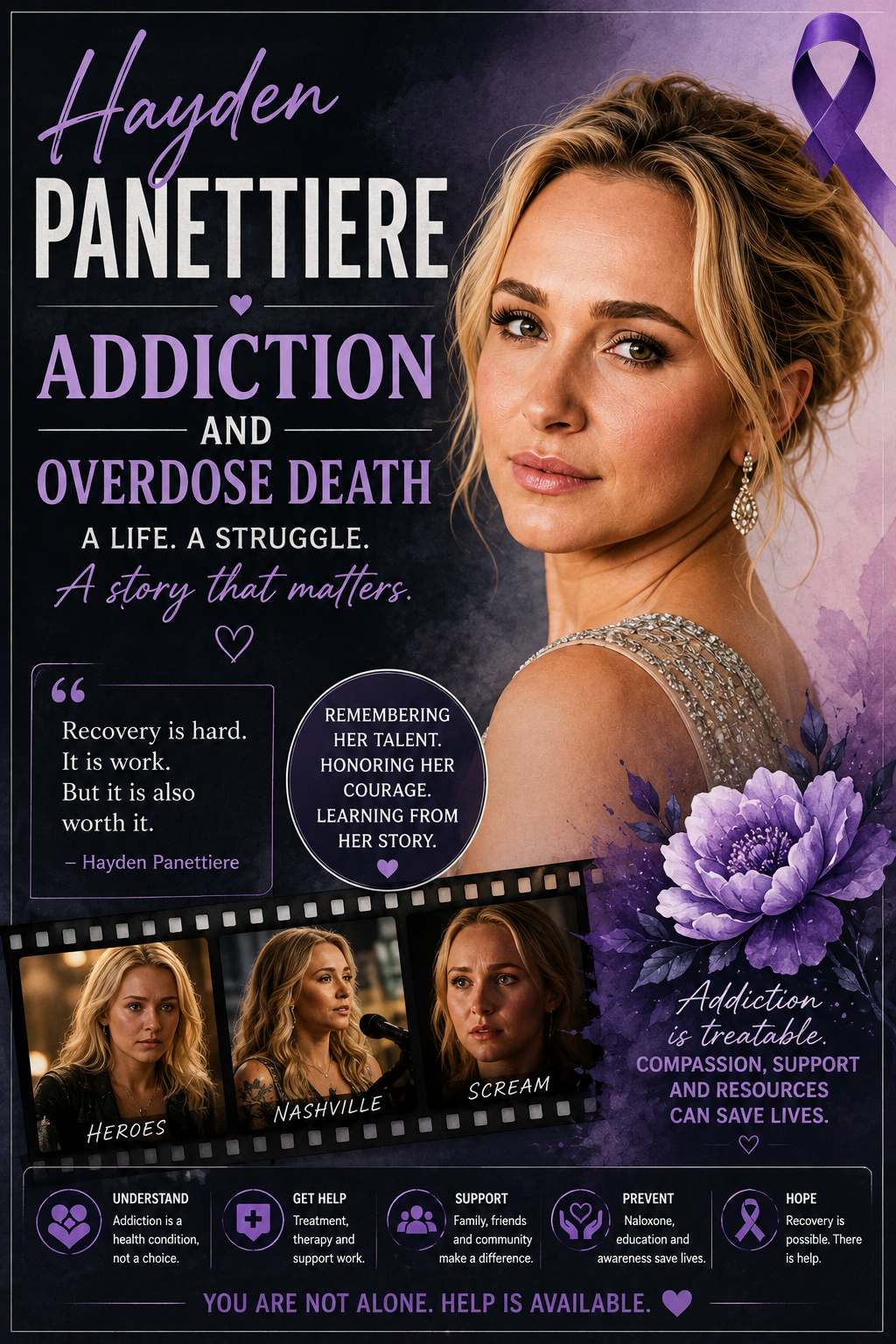
Hayden Panettiere’s public struggles with alcohol and opioid addiction brought attention to the complicated reality of substance use disorder, mental health challenges, and recovery. Throughout her life, the actress spoke openly about addiction, postpartum depression, treatment, and the difficult process of rebuilding her health and relationships. Her death at age 36 in August 2026 generated reports of a possible overdose, but an overdose should not be presented as the confirmed cause of death unless established by the official investigation and toxicology findings. Her story provides an opportunity to examine addiction with compassion while emphasizing treatment, relapse prevention, overdose awareness, and the importance of long-term recovery support.
Hayden Panettiere: Addiction, Recovery, and Her Death
Hayden Panettiere was an actress known for her roles in Heroes, Nashville, and the Scream franchise. Behind her successful career, she publicly described serious struggles with alcohol and opioid addiction, depression, and the pressures associated with growing up in the entertainment industry. In a 2022 interview, Panettiere characterized her addiction as a “cycle of self-destruction” and discussed eventually seeking treatment.
Panettiere died on August 16, 2026, at age 36 after being found unresponsive in Greenville, South Carolina. Initial emergency communications mentioned a possible overdose, and recent reporting says naloxone and CPR were attempted. However, authorities have not officially determined that an overdose caused her death. An autopsy reportedly found no trauma; foul play is not suspected, and the cause of death remains under investigation.
Understanding Her Addiction
Panettiere had been unusually open about her substance-use history. She previously disclosed problems involving both opioids and alcohol and said substance use increasingly affected her life and health. She also described severe postpartum depression after the birth of her daughter and later discussed using alcohol to numb depression, trauma, and emotional pain.
Several aspects of her experience illustrate broader principles of addiction:
- Addiction can affect anyone. Professional success, wealth, talent, and public recognition do not provide immunity from substance use disorder.
- Mental health and addiction can interact. Depression, trauma, grief, stress, and substance use may reinforce one another, making integrated treatment particularly important.
- Addiction can become physically dangerous. Panettiere wrote that a physician had warned her that continued heavy drinking could threaten her life.
- Treatment can require considerable time. She described receiving intensive treatment and experiencing significant withdrawal symptoms during recovery.
- Recovery is not necessarily linear. Periods of sobriety or successful treatment do not mean that continued recovery support is unnecessary.
Understanding the Possible Overdose
Reports surrounding Panettiere’s death have understandably raised questions about overdose because of her previous addiction and because naloxone was reportedly administered. But naloxone is appropriately given when an opioid overdose is suspected; its administration does not establish the eventual medical cause of death.
This distinction is especially important when discussing a public figure. As of the latest report, authorities have not released a final cause of death. Therefore, referring to Panettiere’s death as a possible or suspected overdose is more accurate than stating that she died from an overdose.
Lessons From Her Story
Panettiere’s experiences can help families and communities understand several important principles about addiction and recovery:
- Encourage treatment before substance use reaches a medical crisis.
- Treat co-occurring depression, trauma, anxiety, and other mental health problems alongside addiction.
- Keep naloxone available when opioid exposure is possible and teach family members how to recognize an overdose.
- Maintain professional and social recovery support even after a person appears to be doing well.
- Respond to recurrence of substance use with rapid treatment rather than shame.
- Recognize that families also need education, boundaries, counseling, and emotional support.
- Avoid defining someone solely by their addiction or assuming that addiction explains every medical problem or death.
Hayden Panettiere’s life should ultimately be understood as more than a story about addiction or the circumstances surrounding her death. She was an accomplished actress who also chose to speak publicly about deeply personal struggles with substance use and mental health. Her experiences demonstrate why addiction requires compassionate, evidence-based treatment and sustained recovery support—and why speculation should not replace medical evidence when determining someone’s cause of death
Self-Management Strategies for Understanding Hayden Panettiere’s Addiction and Possible Overdose Death
Hayden Panettiere’s experiences provide an opportunity to understand addiction as a complex health condition rather than simply a matter of poor choices or willpower. She publicly discussed struggles with alcohol, substance use, postpartum depression, and treatment. Panettiere died on August 16, 2026, at age 36. Although emergency reports mentioned a possible overdose and naloxone was reportedly administered, authorities have not yet announced an official cause of death, so her death should not currently be described as a confirmed overdose.
Recognize Personal Triggers
Self-management begins with identifying circumstances that increase cravings or emotional distress. Panettiere had previously discussed how mental-health difficulties and major life experiences intersected with her substance-use struggles.
Helpful strategies include:
- Keeping a journal of cravings, emotions, situations, and responses.
- Identifying high-risk people, places, and situations.
- Recognizing loneliness, grief, conflict, depression, or overwhelming stress as possible vulnerabilities.
- Developing alternative responses before a trigger becomes a crisis.
Develop a Relapse-Prevention Plan
Addiction recovery is often a continuing process. The CDC describes opioid use disorder as a chronic, relapsing but treatable condition and emphasizes that recovery is possible.
A personal recovery plan can include:
- Warning signs that indicate recovery is becoming unstable.
- A therapist, clinician, sponsor, peer, or trusted person to contact.
- Strategies for managing cravings.
- Regular treatment appointments.
- A plan for immediately returning to professional care if substance use resumes.
Manage Mental Health Alongside Addiction
Panettiere publicly discussed postpartum depression as well as addiction. Her experience illustrates why emotional and substance-use problems should not automatically be treated as unrelated issues.
Self-management can involve maintaining therapy appointments, taking prescribed medications appropriately, practicing stress-management techniques, and reporting worsening depression or other symptoms to a healthcare professional rather than attempting to manage severe distress with alcohol or drugs.
Understand Overdose Risk
People with a history of opioid use should understand that overdose risk can change over time. The CDC identifies several risk factors, including a history of substance use disorder and returning to a previously tolerated opioid dose after tolerance has decreased.
Important precautions include:
- Keeping naloxone readily available when opioid exposure is possible.
- Teaching trusted people how to recognize and respond to an overdose.
- Avoid combinations of opioids with other substances that can increase risk.
- Recognizing that reduced tolerance can make returning to opioid use especially dangerous.
- Seek evidence-based treatment for opioid use disorder rather than attempting recovery entirely alone.
Build a Daily Recovery Routine
Recovery becomes easier to protect when healthy behaviors become part of everyday life. Sleep, nutrition, physical activity, meaningful activities, social connection, and regular treatment can provide structure during periods of emotional instability.
Small goals may be more sustainable than attempting to change everything immediately. A person might concentrate on attending today’s appointment, getting adequate sleep, contacting a supportive friend, or practicing one coping technique rather than trying to solve every recovery challenge at once.
Avoid Isolation
Addiction often thrives in secrecy and isolation. Panettiere’s willingness to speak publicly about her experiences also demonstrates the value of discussing addiction rather than hiding it because of stigma.
Self-management can include:
- Maintaining contact with supportive family and friends.
- Participating in counseling or peer-recovery programs.
- Asking for help when cravings intensify.
- Being honest with treatment providers about substance use or relapse.
- Avoiding people or environments that repeatedly undermine recovery.
Social support can make a meaningful difference during opioid-use-disorder recovery, according to the CDC.
Learn From Setbacks Without Giving Up
A recurrence of substance use should be taken seriously, particularly because of overdose risk, but it does not mean that treatment or recovery has permanently failed. Instead, it can indicate that treatment needs to be resumed or modified. Professional support should be sought quickly rather than allowing shame to delay care.
Separate Facts From Speculation
This is particularly important when learning from Panettiere’s death. Her history of addiction provides valuable context for discussing recovery and overdose prevention, but it does not prove how she died. Authorities have reported no evidence of trauma or foul play, while the cause of death remains under investigation.
The broader self-management lesson from Hayden Panettiere’s story is therefore not simply “avoid drugs.” Effective recovery involves understanding triggers, treating mental health concerns, maintaining professional treatment, building supportive relationships, preparing for relapse risk, carrying naloxone when appropriate, and asking for help early. Addiction is treatable, and sustained recovery often depends on having multiple layers of support rather than relying on willpower alone.
Family Support Strategies for Understanding Hayden Panettiere’s Addiction and Possible Overdose Death
Hayden Panettiere’s experience can help families understand how addiction affects not only the individual but also parents, partners, children, and other loved ones. Panettiere publicly discussed alcohol addiction, substance use, postpartum depression, trauma, and treatment. She died on August 16, 2026, at age 36. Although emergency communications referenced a possible overdose and naloxone was reportedly administered, an official cause of death has not yet been announced, so it is important not to describe the overdose as confirmed.
Learn About Addiction as a Health Condition
Families are better prepared to help when they understand substance use disorder rather than interpreting every behavior as selfishness or lack of willpower. Panettiere described years of difficulty with alcohol and other substances and underwent intensive treatment during her recovery efforts.
Families can:
- Learn about cravings, tolerance, withdrawal, relapse, and overdose.
- Understand that recovery may involve setbacks and repeated treatment.
- Recognize that addiction can alter judgment, priorities, and relationships.
- Replace shame and accusations with informed, compassionate conversations.
Recognize Mental Health Problems Alongside Addiction
Panettiere also spoke publicly about severe postpartum depression following the birth of her daughter. Her experience demonstrates why families should pay attention to depression, trauma, grief, anxiety, and other emotional difficulties when substance use is present.
Family members can encourage professional evaluation when they notice persistent sadness, isolation, hopelessness, dramatic behavioral changes, loss of interest, worsening substance use, or difficulty functioning. Treating mental health and addiction together may be more effective than concentrating exclusively on substance use.
Communicate Without Shame
Conversations about addiction can quickly become confrontational. Families can express concern while avoiding humiliation, threats, or moral judgments.
Helpful approaches include:
- Saying, “I’m concerned about what I’m seeing.”
- Asking how the person is feeling rather than immediately accusing them of using.
- Listening without automatically trying to solve every problem.
- Encouraging treatment instead of demanding promises to “just stop.”
- Discussing difficult issues when the person is sober, and the situation is safe.
Establish Healthy Boundaries
Supporting someone with addiction does not mean accepting every behavior associated with substance use. Families can remain compassionate while establishing clear limits that protect everyone involved.
Boundaries might include refusing to provide money for substances, not allowing intoxicated driving, protecting children from unsafe situations, and declining to cover up serious consequences of substance use. Boundaries should focus on safety rather than punishment.
Support Treatment Without Trying to Become the Therapist
Family members can encourage treatment, provide transportation, help locate services, attend appropriate family sessions, and celebrate recovery progress. However, relatives cannot personally control another person’s sobriety.
Panettiere’s history included professional treatment and trauma therapy, illustrating that significant addiction often requires more than determination or family encouragement alone.
Prepare for an Overdose Emergency
When opioids are involved or potentially involved, families should learn overdose-response skills. Reports surrounding Panettiere’s death indicate that naloxone and CPR were attempted after she was found unresponsive, although this does not establish that an opioid overdose caused her death.
Families concerned about opioid overdose can:
- Keep naloxone readily accessible.
- Make sure several family members know how to administer it.
- Learn to recognize unresponsiveness and dangerously abnormal or absent breathing.
- Call emergency services immediately when an overdose is suspected.
- Stay with the person until professional help arrives.
Watch for Relapse Warning Signs
Families often notice changes before a crisis develops. Increasing isolation, secrecy, missed treatment appointments, reconnecting with high-risk environments, worsening depression, escalating substance use, or abandoning previously helpful recovery routines may indicate that additional support is needed.
Rather than waiting for the situation to become severe, families can encourage the person to reconnect promptly with addiction treatment or mental health professionals.
Protect Children and Other Family Members
Addiction affects the entire household. Children may experience confusion, fear, instability, or a misplaced sense of responsibility for an adult’s behavior. Adults should reassure children that they are not responsible for managing another person’s addiction and provide age-appropriate explanations without exposing them unnecessarily to frightening details.
Family counseling may also help relatives process anger, grief, damaged trust, and uncertainty.
Avoid Speculation After a Death
Panettiere’s case provides another important lesson for families dealing with a suspected substance-related death. A person’s addiction history does not automatically establish their cause of death. AP reports that no trauma was found and no foul play is suspected, while the cause remains under investigation.
Families can protect themselves and the dignity of their loved one by waiting for toxicology, autopsy, and other official findings rather than relying on rumors or assumptions.
Take Care of the Family, Too
Supporting someone with addiction can produce exhaustion, anxiety, resentment, grief, and fear. Family members also deserve care. Counseling, family therapy, peer-support groups, healthy boundaries, adequate rest, and maintaining relationships outside the addiction crisis can help prevent the entire family’s life from revolving around substance use.
Hayden Panettiere’s story demonstrates that family support can be powerful, but family members cannot cure addiction by themselves. Their most constructive roles are to encourage evidence-based treatment, communicate compassionately, establish appropriate boundaries, prepare for emergencies, support long-term recovery, and care for their own emotional well-being. Her death also reinforces an important principle: compassion and factual accuracy should coexist—until authorities establish the cause, her death should be discussed as involving a reported possible overdose, not a confirmed overdose death.
Community Resource Strategies for Understanding Hayden Panettiere’s Addiction and Possible Overdose Death
Hayden Panettiere’s public experiences with addiction and mental-health challenges can help communities understand why substance use disorder requires more than individual determination. She openly discussed alcohol addiction and postpartum depression and sought treatment during her life. Panettiere died at age 36 on August 16, 2026. Although emergency communications reportedly referenced an overdose, authorities have not announced an official cause of death, and the investigation remains ongoing.
Expand Access to Evidence-Based Addiction Treatment
Communities need accessible treatment before someone reaches a medical crisis. Treatment may involve counseling, behavioral therapies, medical care, peer support, and medications when clinically appropriate. SAMHSA identifies medications including buprenorphine, methadone, and naltrexone among evidence-based options used in substance-use treatment.
Community strategies include:
- Expanding outpatient and residential addiction services.
- Connecting emergency departments and primary-care practices with addiction-treatment programs.
- Increasing access to medications for opioid use disorder.
- Offering affordable services regardless of insurance status.
- Providing continuing recovery support after formal treatment ends.
- Developing programs that address both substance use and mental health conditions.
Increase Community Naloxone Access
Naloxone is a lifesaving medication that can reverse an opioid overdose when administered in time. The CDC recommends expanding naloxone availability among people at risk, families, community members, and first responders. Naloxone is available over the counter throughout the United States and may also be distributed through community organizations and syringe-service programs.
Communities can:
- Provide free or low-cost naloxone.
- Train families and community members to administer it.
- Place naloxone in accessible community locations.
- Educate the public about the warning signs of an overdose.
- Encourage people to call 911 immediately after administering naloxone.
Integrate Mental Health and Addiction Services
Panettiere’s history also illustrates the importance of addressing mental health alongside addiction. She publicly discussed postpartum depression as well as alcohol addiction.
Community mental-health centers, addiction programs, hospitals, and primary-care practices can screen people for both conditions. Integrated programs can address depression, anxiety, trauma, grief, substance use, and other concerns instead of requiring people to navigate completely separate systems.
Strengthen Peer Recovery Resources
Professional treatment is important, but recovery also happens within communities. Recovery community organizations, peer specialists, recovery coaches, and mutual-support groups can provide continuing encouragement and connection.
Useful community services may include:
- Peer recovery coaching.
- Recovery community centers.
- Family education and support groups.
- Sober social activities.
- Employment and vocational assistance.
- Housing and transportation support.
- Recovery programs following hospitalization or rehabilitation.
These resources can reduce isolation and provide continuing support after intensive treatment ends.
Educate Families and the Public About Overdose
Community education can teach people to recognize an opioid overdose. Warning signs can include inability to awaken, slow or shallow breathing, choking or gurgling sounds, discoloration of the lips or nails, and pinpoint pupils. When an opioid overdose is suspected, the CDC recommends administering naloxone if available, calling 911, supporting breathing, placing the person on their side to reduce choking risk, and remaining with them until emergency help arrives.
Reduce Stigma Through Community Education
Celebrity stories can generate public discussion about addiction, but communities should use these conversations responsibly. Panettiere should not be defined exclusively by addiction, nor should her addiction history be treated as proof that an overdose caused her death.
Schools, healthcare organizations, workplaces, faith communities, and advocacy groups can:
- Present addiction as a treatable health condition.
- Encourage people to seek treatment earlier.
- Avoid stigmatizing terms and stereotypes.
- Share recovery stories alongside discussions of overdose.
- Teach people that relapse or recurrence of substance use requires renewed intervention rather than rejection.
Improve Connections Between Services
People experiencing addiction often need more than addiction treatment alone. Housing instability, transportation problems, childcare needs, financial difficulties, domestic violence, and untreated medical or psychiatric conditions can interfere with recovery.
Effective community systems connect addiction treatment with mental health services, primary care, housing assistance, social services, family programs, and peer recovery support so that people do not have to navigate every problem independently.
Use Panettiere’s Story Responsibly
Panettiere’s death can encourage conversations about addiction and overdose prevention, but factual accuracy matters. Recent AP reporting states that an autopsy showed no trauma, no foul play is suspected, and the cause of death remains under investigation.
The larger community lesson is that preventing addiction-related deaths requires a network of support. Accessible treatment, mental health services, naloxone, overdose education, peer recovery programs, family resources, and stigma reduction can work together to protect people throughout recovery. Panettiere’s public struggles can help start that conversation, while the official investigation—not speculation—should determine how her death is ultimately described.
Frequently Asked Questions
Here are some common questions:
1. Did Hayden Panettiere struggle with addiction?
Yes. Panettiere publicly discussed substance-use problems, particularly alcohol addiction, as well as significant mental-health challenges. She wrote about these experiences in her 2026 memoir, This Is Me: A Reckoning.
2. When did Hayden Panettiere die?
Panettiere died on August 16, 2026, at age 36. She was found unresponsive in Greenville, South Carolina, and emergency personnel were unable to revive her.
3. Did Hayden Panettiere die from an overdose?
That has not been officially established. Emergency dispatch information referenced a possible overdose, but authorities have not announced an official cause of death. An autopsy reportedly found no signs of trauma, and the investigation remains ongoing.
4. Was naloxone used when she was found?
According to recent reporting, naloxone (Narcan) was administered, and CPR was performed after she was discovered unresponsive. Naloxone use does not prove that an opioid overdose caused someone’s death; it is appropriately administered when an opioid overdose is suspected.
5. Did Hayden Panettiere experience depression?
Panettiere openly discussed postpartum depression following the birth of her daughter in 2014. She sought treatment and later spoke publicly about the experience, helping bring attention to maternal mental health.
6. Did addiction affect her personal life?
Panettiere described addiction and emotional difficulties as having significant consequences in her life. Her public accounts discussed treatment, motherhood, relationships, mental health, and the challenges of recovering while living under intense public scrutiny.
7. Did Hayden Panettiere receive treatment?
Yes. She previously sought professional treatment, including treatment for postpartum depression, and publicly discussed efforts to recover from substance-use problems. Her experience illustrates why addiction recovery may require continuing professional and social support rather than a single episode of treatment.
8. Does relapse mean addiction treatment has failed?
No. Substance use disorders can be chronic and relapsing conditions. A recurrence of substance use can indicate that treatment needs to be resumed, intensified, or modified. Recovery can involve multiple attempts and different combinations of medical, psychological, and social support.
9. Why is overdose risk important after a period of abstinence?
Opioid tolerance can decrease after someone stops using. Returning to a previously tolerated amount can therefore increase overdose risk. Naloxone availability, overdose education, evidence-based opioid-use-disorder treatment, and continuing recovery support can reduce risk.
10. What can families learn from Panettiere’s story?
Families can learn to recognize addiction and mental-health warning signs, encourage professional treatment, establish healthy boundaries, maintain naloxone when opioid exposure is possible, and respond to relapse with rapid intervention rather than shame.
11. Why shouldn’t her death simply be called an “overdose death”?
Because a person’s history of addiction is not proof of their cause of death. Current reporting says Panettiere’s cause of death remains under investigation. Until authorities release definitive findings, “possible or suspected overdose” is more accurate than “fatal overdose.”
12. What is the larger message of Hayden Panettiere’s story?
Her experiences demonstrate that fame and professional success do not protect someone from addiction, depression, trauma, or other emotional difficulties. They also highlight the importance of reducing stigma, making treatment accessible, supporting long-term recovery, and treating people experiencing addiction with dignity rather than defining them by their illness.
Conclusion
Hayden Panettiere’s experiences demonstrate that addiction can affect people regardless of talent, success, wealth, or public recognition. Her willingness to discuss alcohol and opioid addiction helped expose struggles that are often hidden by stigma and shame. At the same time, her death reminds us to distinguish a person’s documented history of addiction from an officially determined cause of death. Rather than allowing speculation to define her story, the broader lesson should focus on the importance of accessible addiction treatment, mental health care, supportive families and communities, naloxone availability, and continuing recovery services. Addiction is a serious but treatable condition, and earlier intervention combined with sustained support can protect lives and give people meaningful opportunities for recovery.
Video: What Hayden Panettiere’s Journey Teaches Us #RecoveryJourney #PostpartumDepression