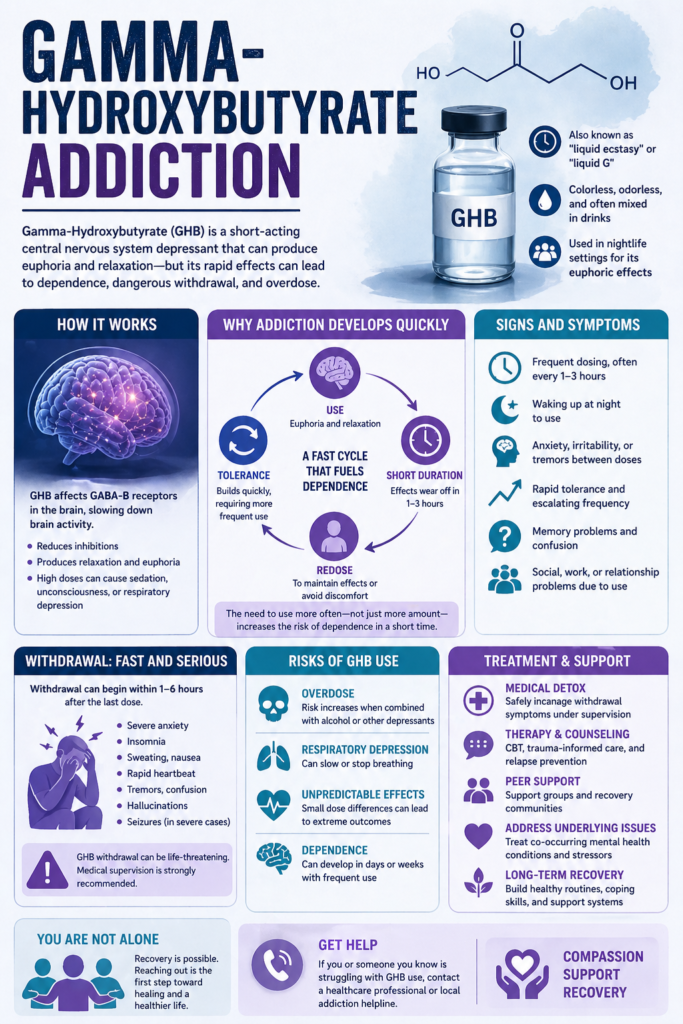
Gamma-Hydroxybutyrate Use Disorder represents a uniquely challenging form of addiction due to the drug’s rapid onset, short duration, and narrow margin between desired and harmful effects. Commonly used in recreational and nightlife settings, GHB can initially produce relaxation and euphoria, but its pharmacological profile quickly fosters dependence through frequent, repeated dosing. Unlike many other substances, the cycle of intoxication and withdrawal can occur within hours, accelerating the transition from voluntary use to compulsive behavior. This compressed cycle not only increases the risk of overdose and medical complications but also complicates recognition and intervention, making GHB addiction a critical yet often underappreciated issue in contemporary addiction medicine.
What is GHB—and why does it hook people so quickly?
Gamma-Hydroxybutyrate Use Disorder refers to a pattern of compulsive use of GHB despite harm. Gamma-hydroxybutyrate (GHB) is a central nervous system depressant that can produce euphoria, relaxation, and disinhibition at low doses—but quickly becomes sedating and dangerous as doses rise.
What makes GHB particularly risky is its rapid onset and short duration. Users often redose every 1–3 hours to maintain effects. That cycle—relief, crash, repeat—can accelerate the transition from casual use to dependence in a matter of weeks.
Why does dependence develop so fast?
GHB acts on GABA-B receptors and related pathways that regulate inhibition in the brain. With repeated exposure:
- The brain downregulates inhibitory signaling, creating tolerance
- Users need more frequent dosing to avoid discomfort
- Abrupt gaps between doses lead to rebound excitation (anxiety, agitation)
This creates a tight feedback loop: use to feel good → use to feel normal → use to avoid feeling bad.
Recognizing the signs
GHB addiction can look different from other substance use disorders because of its dosing pattern. Common signs include:
- Clock-driven use (waking at night to dose)
- Rapid tolerance and escalating frequency
- Anxiety or tremors between doses
- Cognitive fog or memory lapses
- Withdrawal symptoms within hours of the last use
Because the drug clears quickly, people may appear “fine” and then deteriorate rapidly.
Withdrawal: the part many underestimate
GHB withdrawal can be severe and unpredictable, sometimes resembling alcohol or benzodiazepine withdrawal but with a faster onset. Symptoms may include:
- Severe anxiety, insomnia, restlessness
- Tachycardia (fast heart rate), sweating
- Confusion, delirium, or hallucinations
- In some cases, seizures or medical instability
Unlike many substances, withdrawal can begin within 1–6 hours after the last dose in heavy users. This is why medical supervision is strongly recommended.
Treatment and recovery
There’s no single “magic bullet,” but effective care usually combines:
1. Medically supervised detox
Often uses cross-tolerant medications (e.g., GABAergic agents) to stabilize withdrawal safely.
2. Behavioral treatment
Cognitive behavioral therapy (CBT), relapse prevention, and structured support help rebuild routines and coping strategies.
3. Addressing context
GHB use is sometimes tied to club scenes, sexual contexts, or performance/escape patterns—treatment works better when these environments are acknowledged and addressed.
4. Long-term support
Peer support groups, therapy, and sometimes medication for co-occurring conditions (anxiety, depression) improve outcomes.
Why this topic matters now
GHB has a reputation as a “niche” substance, but its high dependence potential and dangerous withdrawal profile make it clinically significant. Increased awareness among clinicians and the public can prevent delayed recognition—one of the biggest risks with this drug.
Final thought
GHB addiction doesn’t always look dramatic at first—it often starts as controlled, even strategic use. But the drug’s pharmacology quickly narrows that control. Understanding how and why that happens is key to early intervention and safer recovery paths.
Understanding GHB Addiction: Practical Self-Management Strategies for Awareness and Control
What are you dealing with?
Gamma-Hydroxybutyrate Use Disorder is a fast-developing pattern of dependence on GHB, a short-acting depressant that can create a cycle of frequent dosing and rapid withdrawal. Because the drug wears off quickly, people often find themselves using it not just to feel good, but to avoid feeling bad.
Self-management doesn’t replace professional care—especially with GHB, where withdrawal can be medically serious—but it can help you understand patterns, reduce harm, and recognize when to seek help.
1. Map your use honestly (without judgment)
Start by tracking:
- When you use (time of day, frequency)
- Why do you use (stress, sleep, social, habit)
- What happens after (relief, anxiety, crash)
Look for patterns like:
- Dosing on a schedule rather than desire
- Used to prevent withdrawal symptoms
- Increasing frequency despite intentions to cut back
This step is about awareness, not guilt—you’re gathering data.
2. Learn your early warning signs
GHB dependence escalates quickly, so subtle changes matter. Watch for:
- Needing doses closer together
- Waking up at night to use
- Feeling anxious or shaky between doses
- Planning your day around availability or timing
Recognizing these signs early gives you a chance to intervene before things intensify.
3. Understand your “trigger loops.”
Instead of just “triggers,” think in loops:
- Cue → boredom, anxiety, social setting
- Behavior → dosing
- Reward → relief, euphoria, or just feeling normal
Ask:
- What emotional state leads to use?
- What does GHB fix in the moment?
Once you see the loop, you can start to interrupt it—even slightly.
4. Build small interruption strategies
You don’t have to overhaul everything at once. Try:
- Delay the dose by 10–20 minutes
- Change environment (leave the room, go outside)
- Substitute behaviors (hydration, snack, short walk, texting someone)
These aren’t cures—they’re friction points that weaken automatic use patterns over time.
5. Stabilize routines (especially sleep)
GHB often disrupts natural rhythms:
- Irregular sleep cycles
- Nighttime dosing
- Energy crashes
Focus on:
- Consistent sleep/wake times (even imperfectly)
- Reducing nighttime dosing when safe
- Creating non-drug wind-down routines
Even partial structure helps your brain recalibrate stability.
6. Know when self-management isn’t enough
This is critical with GHB.
Seek medical help if:
- You’re using it every few hours or around the clock
- You experience withdrawal symptoms quickly (within hours)
- You’ve tried to stop and felt severe anxiety, confusion, or physical symptoms
GHB withdrawal can escalate fast—this isn’t a situation to “push through” alone.
7. Reduce harm if you’re still using
If stopping isn’t immediate, focus on safety:
- Avoid combining with alcohol or other depressants
- Measure doses carefully (GHB has a narrow margin of safety)
- Don’t use alone if possible
- Keep hydration and nutrition consistent
These steps don’t eliminate risk—but they lower the chance of acute harm.
8. Reframe control
Instead of “I should just stop,” shift to:
- “What is this substance doing for me?”
- “What am I trying to regulate?”
- “What’s one small thing I can change today?”
That mindset moves you from self-judgment to strategic awareness.
Final thought
GHB addiction is less about lack of willpower and more about a drug that compresses the cycle of relief and withdrawal into hours instead of days. Self-management starts with seeing that clearly.
From there, even small insights—tracking a pattern, delaying a dose, recognizing a trigger—can begin to loosen the cycle and point you toward safer, more sustainable change.
Supporting a Loved One with GHB Addiction: Family Strategies for Understanding and Response
Start with what you’re actually facing
Gamma-Hydroxybutyrate Use Disorder can develop quickly because GHB is short-acting and often used frequently throughout the day (and night). Many families feel confused by how fast things escalate—someone may appear stable one moment and unwell the next.
Understanding this rapid cycle is key: your loved one may not just be “choosing to use”—they may be trying to avoid withdrawal symptoms that begin within hours.
1. Learn the pattern, not just the behavior
Instead of focusing only on “they’re using,” try to understand:
- Timing: Are they dosing every few hours?
- Function: Are they using to sleep, cope with anxiety, or avoid withdrawal?
- Changes: Are routines becoming more rigid or secretive?
This shifts your role from reacting to behavior → understanding the system driving it.
2. Recognize early warning signs that families often miss
GHB use doesn’t always look like other addictions. Watch for:
- Waking up at night to take something
- Sudden anxiety, sweating, or agitation between doses
- Rapid mood shifts within hours
- Planning daily life around dosing schedules
These signs often indicate physiological dependence, not just recreational use.
3. Communicate in a way that keeps the door open
Direct confrontation can backfire, especially if the person feels judged or misunderstood.
Try:
- Curiosity over accusation: “I’ve noticed your sleep has been really disrupted—what’s going on?”
- Specific observations instead of labels
- Short, calm conversations rather than emotional overload
Avoid:
- Ultimatums (unless safety is at stake)
- Debates about “why can’t you just stop?”
The goal is ongoing dialogue, not a single breakthrough conversation.
4. Understand the risks of withdrawal
This is one of the most important pieces for families.
GHB withdrawal can:
- Begin within 1–6 hours after the last dose
- Escalate to confusion, delirium, or medical instability
- Become dangerous without supervision
If your loved one is using frequently, encourage medical support rather than abrupt stopping at home.
5. Support treatment without forcing control
You can’t make someone recover—but you can shape the environment around them.
Helpful approaches:
- Offer to help find or attend appointments
- Reduce barriers (transportation, scheduling, childcare)
- Frame treatment as support, not punishment
Less helpful:
- Monitoring every move
- Trying to “manage” their use yourself
- Taking full responsibility for their recovery
Think: support structure, not surveillance system.
6. Set boundaries that protect you
Support doesn’t mean unlimited tolerance.
Healthy boundaries might include:
- Not providing money that could fund substance use
- Protecting your own time, sleep, and emotional bandwidth
- Being clear about what you can and cannot handle
Boundaries are not about control—they’re about sustainability.
7. Take care of yourself (this is not optional)
Families often burn out trying to “fix” the situation.
Consider:
- Therapy or support groups for yourself
- Learning about addiction from reliable sources
- Creating space where your life isn’t entirely defined by the situation
You’re more effective as a support when you’re not depleted.
8. Reframe what progress looks like
With GHB, progress may be:
- Longer gaps between doses
- Willingness to talk openly
- Considering medical help
- Fewer high-risk situations
These are meaningful steps—even if they’re not immediate abstinence.
Final thought
GHB addiction can feel chaotic and unpredictable from the outside. But when you understand its fast biological cycle and dependence pattern, the situation becomes more interpretable—and therefore more manageable.
Your role isn’t to control the outcome. It’s to:
- Stay informed
- Stay connected
- Stay grounded
That combination creates the best chance for change—without losing yourself in the process.
Building Community Support for GHB Addiction: Resource Strategies That Make a Difference
Why community matters here
Gamma-Hydroxybutyrate Use Disorder often progresses quickly because GHB is short-acting and can require frequent dosing to avoid withdrawal. That speed can leave individuals and families feeling overwhelmed before they even realize what’s happening.
Community resources act as a buffer and bridge—connecting people to care, reducing isolation, and catching problems earlier.
1. Map what actually exists in your community
Start with a practical inventory:
- Local addiction treatment centers (outpatient and inpatient)
- Emergency departments are familiar with substance withdrawal
- Mental health clinics and crisis services
- Peer support groups (in-person and virtual)
- Harm reduction programs
Many people don’t seek help simply because they don’t know where to go. A clear map—whether personal or shared—lowers that barrier.
2. Recognize the gaps specific to GHB
Not all services are equally prepared for GHB-related issues.
Common gaps:
- Limited awareness of rapid-onset withdrawal
- Misclassification as alcohol or benzodiazepine issues
- Lack of protocols for high-frequency dosing patterns
Communities can respond by:
- Providing education to clinicians and first responders
- Developing clear referral pathways for GHB-specific care
- Encouraging collaboration between emergency and addiction services
3. Use harm reduction as an entry point
Not everyone is ready for abstinence-based treatment. Community strategies should include:
- Education on dose timing risks
- Warnings about combining GHB with other depressants
- Access to safe spaces or check-ins
- Nonjudgmental outreach
Harm reduction builds trust first, which often leads to treatment later.
4. Strengthen peer support networks
People with lived experience can reach individuals that formal systems often can’t.
Effective peer strategies:
- Support groups tailored to club/drug-use cultures where GHB is more common
- Online communities for real-time connection
- Peer recovery coaches who understand short-cycle dependence
These networks reduce isolation and provide practical, experience-based insight.
5. Improve coordination between services
Fragmentation is a major barrier.
Better outcomes happen when:
- Emergency care → direct referral to addiction services
- Mental health providers screen for substance use patterns
- Community organizations share information and pathways
Think of it as a continuum, not isolated services.
6. Make resources visible and accessible
Even strong services fail if they’re hard to find or use.
Key strategies:
- Simple, centralized resource directories
- 24/7 helplines or chat-based support
- Outreach in places where GHB use may occur (nightlife settings, online spaces)
- Reducing stigma in messaging (“support” vs. “treatment compliance”)
Accessibility is not just location—it’s language, tone, and timing.
7. Support families as part of the system
Families are often the first to notice problems—but the last to be supported.
Community resources should include:
- Family education on GHB-specific risks
- Counseling or support groups for caregivers
- Guidance on when to seek emergency care
When families are informed, they become early responders, not just bystanders.
8. Advocate for adaptive policy and funding
Sustainable change requires system-level support.
Communities can push for:
- Funding for specialized addiction services
- Training programs on emerging substances like GHB
- Data collection to better understand local trends
- Policies that integrate mental health and substance use care
Final thought
GHB addiction can feel like an individual problem—but it rarely is. It’s shaped by availability, knowledge gaps, stigma, and system readiness.
Strong community strategies don’t just react—they:
- Anticipate patterns
- Build connections
- Lower barriers to help
When those pieces are in place, people are far more likely to move from crisis to support—and from support to recovery.
Frequently Asked Questions
Here are some common questions:
1. What is GHB?
Gamma-hydroxybutyrate (GHB) is a central nervous system depressant that can produce relaxation, euphoria, and reduced inhibitions at low doses. It is sometimes used recreationally, especially in nightlife settings.
2. Why is GHB addictive?
GHB is short-acting, meaning its effects wear off quickly (often within 1–3 hours). This leads to:
- Frequent redosing
- Rapid tolerance
- A cycle of use → crash → reuse
Over time, people begin using it not just for pleasure, but to avoid withdrawal symptoms.
3. How quickly can dependence develop?
Dependence can develop within days to weeks, especially with regular or around-the-clock use. This is much faster than many other substances.
4. What are the signs of GHB addiction?
Common signs include:
- Using every few hours
- Waking up at night to doze
- Anxiety or tremors between doses
- Memory problems or confusion
- Increasing frequency despite negative consequences
5. What makes GHB withdrawal dangerous?
GHB withdrawal can begin within 1–6 hours after the last dose and may include:
- Severe anxiety and insomnia
- Rapid heart rate and sweating
- Confusion or delirium
- Hallucinations
- Seizures (in severe cases)
It can become life-threatening, so medical supervision is often necessary.
6. Can someone stop using GHB on their own?
For heavy or frequent users, stopping suddenly can be unsafe. Medical detox is strongly recommended because withdrawal can escalate quickly.
7. What increases the risk of overdose?
Risk is higher when:
- Doses are not measured carefully
- GHB is combined with alcohol or other depressants
- There is variability in concentration (common with illicit use)
Because GHB has a narrow safety margin, small dose differences can have significant effects.
8. How is GHB addiction treated?
Treatment typically includes:
- Medical detox to manage withdrawal safely
- Behavioral therapies (e.g., CBT, relapse prevention)
- Support for co-occurring mental health conditions
- Long-term recovery support (therapy, peer groups)
9. Is recovery possible?
Yes. With appropriate support, many people recover. Early recognition and treatment improve outcomes significantly.
10. Why is GHB addiction often overlooked?
- It is less commonly discussed than other substances
- Symptoms can be rapid and fluctuating
- It may be mistaken for alcohol or other drug use
This can delay proper diagnosis and care.
11. How can families help?
Families can:
- Learn the signs of dependence and withdrawal
- Encourage medical care rather than abrupt stopping
- Communicate without judgment
- Set healthy boundaries
12. When should someone seek urgent help?
Immediate medical attention is needed if someone has:
- Confusion or hallucinations
- Severe agitation
- Seizures
- Difficulty breathing or unconsciousness
Conclusion
Understanding GHB addiction requires recognizing that its intensity is driven less by individual choice and more by the drug’s powerful neurobiological and behavioral reinforcement patterns. The rapid cycling between use and withdrawal creates a self-perpetuating loop that can be difficult to interrupt without appropriate support. Effective responses must therefore integrate medical, psychological, and social approaches, with particular attention to early identification and safe management of withdrawal. By increasing awareness, improving clinical readiness, and reducing stigma, individuals, families, and communities can better respond to this complex condition and support pathways toward stabilization and recovery.
Video: This Is Why GHB Is So Addictive #substanceabuse #addiction #facts