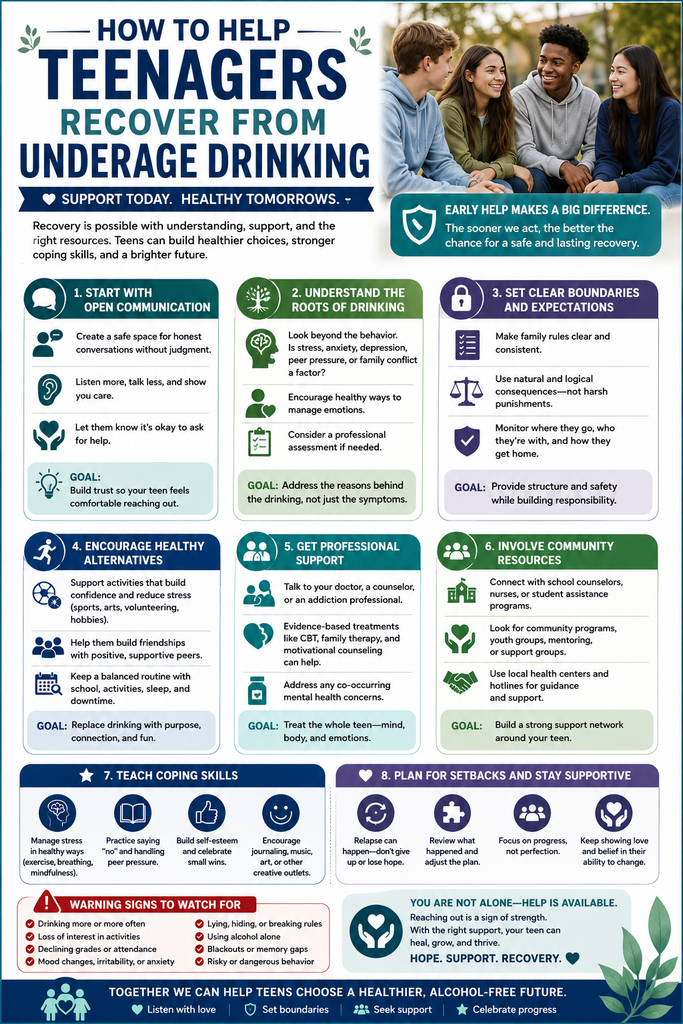
Underage drinking can affect a teenager’s physical health, emotional well-being, relationships, academic performance, judgment, and future risk for alcohol-related problems. Because adolescence is an important period of brain and social development, helping teenagers recover requires more than simply telling them to stop drinking. Effective recovery involves understanding why alcohol use began, identifying triggers and peer influences, screening for co-occurring mental health concerns, and teaching healthier ways to manage stress and emotions. Parents, healthcare professionals, schools, counselors, and community organizations can work together to create a supportive environment that combines clear boundaries with compassion, accountability, early intervention, and, when needed, evidence-based treatment.
Helping Teenagers Recover From Underage Drinking
Underage drinking is more than a disciplinary issue. For some teenagers, alcohol use may develop in response to peer pressure, experimentation, stress, family conflict, trauma, anxiety, depression, or a desire to fit in. When drinking becomes frequent or causes problems at school, home, or in relationships, early intervention is important. Recovery should focus not only on stopping alcohol use but also on understanding why the teenager drinks and what need the alcohol is serving.
Why Alcohol Is Especially Concerning During Adolescence
Adolescence is a period of significant brain development, particularly in areas involved in judgment, impulse control, emotional regulation, planning, and decision-making. Alcohol can impair attention, memory, coordination, and judgment and increase the likelihood of accidents and other risky behaviors. Starting alcohol use at a young age is also associated with a greater risk of alcohol-related problems later in life.
Identify the Reasons Behind Drinking
Teenagers drink for different reasons. Some experiment out of curiosity, while others use alcohol to manage uncomfortable emotions or social situations. Effective recovery begins by exploring factors such as peer influence, bullying, academic pressure, family stress, loneliness, trauma, depression, anxiety, impulsivity, and other substance use.
Rather than asking only, “How do we make this teenager stop drinking?” treatment should also ask, “What is alcohol doing for this teenager, and what healthier strategies can meet that need?”
Use an Individualized Assessment
Not every teenager who drinks has an alcohol use disorder. A healthcare or behavioral-health professional can assess the frequency and quantity of alcohol use, consequences, cravings, loss of control, other substance use, mental health symptoms, family environment, school functioning, and safety concerns.
Screening tools designed for adolescents can help clinicians identify risk and determine whether brief intervention, outpatient counseling, intensive treatment, or another level of care is appropriate.
Treat Mental Health and Alcohol Problems Together
Alcohol use and mental health difficulties can reinforce each other. A teenager may drink to temporarily escape anxiety or depression, while alcohol can subsequently worsen mood, sleep, impulsivity, and emotional instability.
When both conditions are present, integrated treatment is important. Counseling approaches may include cognitive behavioral therapy, motivational interviewing or motivational enhancement strategies, family-based interventions, and other evidence-based adolescent treatments.
Strengthen Family Involvement
Parents and caregivers can play a major role in recovery. Effective family support combines warmth, communication, monitoring, predictable expectations, and appropriate boundaries.
Parents should know where their teenager is, who they are spending time with, and whether alcohol is accessible. At the same time, conversations should create enough psychological safety for teenagers to disclose mistakes, cravings, peer pressure, or setbacks without expecting every disclosure to result solely in punishment.
Change the Social Environment
Recovery becomes more difficult when alcohol remains easily accessible or when a teenager’s social life revolves around drinking. Families can help adolescents identify high-risk situations and develop alternative activities, such as sports, clubs, volunteering, employment, hobbies, creative activities, or supportive peer groups.
Learning how to refuse alcohol without becoming socially isolated can be an important recovery skill.
Teach Practical Coping Skills
Simply telling teenagers not to drink does not teach them what to do when the next trigger occurs. Recovery programs should help adolescents develop strategies for managing stress, anger, boredom, loneliness, cravings, peer pressure, rejection, and difficult emotions.
Healthy sleep, regular physical activity, structured routines, supportive friendships, problem-solving skills, and enjoyable alcohol-free activities can strengthen recovery.
Create a Recovery and Safety Plan
Teenagers should know what to do if they encounter alcohol or feel tempted to drink. A practical plan might identify trusted adults to contact, safe transportation, ways to leave a party, strategies for handling peer pressure, and steps to take after a return to alcohol use.
Parents should also discuss alcohol poisoning. A teenager who cannot be awakened, has abnormal or very slow breathing, repeatedly vomits while poorly responsive, has a seizure, or shows other signs of severe intoxication requires immediate emergency medical attention.
Respond to Setbacks Constructively
A return to drinking does not mean that all previous progress has disappeared. It should trigger questions about what happened beforehand: Was there peer pressure? A mental health problem? Family conflict? Easy alcohol access? A breakdown in coping strategies?
The treatment and recovery plan can then be adjusted to address those vulnerabilities while maintaining clear expectations regarding alcohol use.
Focus on Development, Not Just Abstinence
The broader goal of adolescent recovery is to help a young person build a life in which alcohol is no longer needed as a coping mechanism or source of belonging. Recovery includes improving emotional regulation, decision-making, family relationships, academic functioning, self-esteem, healthy friendships, and future goals.
Early intervention matters. When families, healthcare professionals, schools, counselors, and community resources work together, teenagers can develop healthier coping strategies and move toward adulthood with stronger skills for managing stress, relationships, and future exposure to alcohol.
Self-Management Strategies to Help Teenagers Recover From Underage Drinking
Self-management is an important part of helping teenagers reduce or stop underage drinking. The goal is not simply to tell a teenager “don’t drink.” Adolescents need practical skills to recognize triggers, manage emotions, respond to peer pressure, and make healthier decisions when adults are not present. These strategies work best alongside appropriate family involvement and professional treatment when alcohol use has become problematic.
1. Identify personal drinking triggers. Teenagers can learn to recognize the situations, thoughts, and emotions that increase their desire to drink. Common triggers include peer pressure, parties, boredom, stress, loneliness, anxiety, depression, conflict, and wanting to fit in. Keeping a brief journal of triggers and responses can reveal patterns.
2. Understand the reasons behind alcohol use. Encourage the teenager to ask, “What am I trying to get from drinking?” Alcohol may provide temporary confidence, emotional escape, relaxation, or social acceptance. Identifying the underlying need makes it possible to develop healthier ways of meeting it.
3. Develop a personal alcohol-avoidance plan. Teenagers should decide ahead of time how they will handle situations involving alcohol. This might include avoiding certain parties, bringing an alcohol-free drink, attending events with supportive friends, arranging transportation, or contacting a trusted adult when they feel uncomfortable.
4. Practice responses to peer pressure. Adolescents can rehearse simple responses such as, “No thanks, I don’t drink,” or “I’m good.” They should also know that leaving a situation is an acceptable response. Practicing beforehand can make refusal easier when social pressure occurs.
5. Replace drinking with healthier coping strategies. Exercise, music, art, gaming in moderation, sports, journaling, relaxation exercises, spending time outdoors, and talking with supportive people can provide healthier ways to manage difficult emotions. The best alternatives are activities the teenager actually enjoys and will realistically use.
6. Build emotional-regulation skills. Teenagers can learn to recognize emotions before they become overwhelming. Techniques such as slow breathing, mindfulness, grounding, taking a short break from conflict, and identifying thoughts behind emotions can reduce impulsive decisions involving alcohol.
7. Choose supportive friendships. Recovery can be difficult when a teenager’s social group regularly drinks. Encourage relationships with peers who respect the decision not to use alcohol. This does not necessarily mean abandoning every existing friendship, but stronger boundaries may be necessary around people or situations that repeatedly encourage drinking.
8. Establish a healthy daily routine. Regular sleep, nutritious meals, exercise, school attendance, hobbies, and planned social activities provide structure. Too much unstructured time, chronic sleep deprivation, and isolation can make emotional problems and substance-use behaviors more difficult to manage.
9. Set small, measurable recovery goals. Large goals can feel overwhelming. Smaller goals—such as avoiding alcohol this weekend, attending every counseling appointment this month, improving school attendance, or practicing one coping strategy each day—allow teenagers to recognize progress and build confidence.
10. Monitor mental health symptoms. Depression, anxiety, trauma, ADHD, behavioral difficulties, or other mental health concerns may contribute to alcohol use. Teenagers should learn to recognize changes in mood, sleep, concentration, motivation, and behavior and discuss concerning symptoms with a trusted adult or healthcare professional.
11. Develop a trusted-adult network. Self-management does not mean managing recovery alone. A teenager should identify several safe adults—such as parents, relatives, counselors, coaches, teachers, or healthcare professionals—who can provide support when cravings, emotional distress, or difficult situations occur.
12. Create a plan for setbacks. If drinking occurs again, the teenager should be encouraged to disclose it rather than hide it. The focus should be on identifying what led to the episode, addressing immediate safety concerns, and strengthening the recovery plan. Consequences and boundaries may still be appropriate, but shame alone does not teach recovery skills.
13. Recognize when self-management is not enough. Frequent intoxication, inability to control drinking, worsening school or family functioning, alcohol-related injuries, other substance use, severe psychiatric symptoms, or repeated unsuccessful attempts to stop indicate a need for professional assessment. Treatment may involve adolescent-focused counseling, family therapy, outpatient treatment, or more intensive behavioral health services, depending on severity.
Key Takeaway
Helping teenagers recover from underage drinking means teaching them how to recognize triggers, regulate emotions, resist peer pressure, choose healthier relationships, develop alcohol-free coping strategies, and ask for help early. Self-management should promote increasing independence while keeping supportive adults involved. The ultimate goal is not simply getting a teenager through adolescence without alcohol—it is helping them develop the emotional and decision-making skills they can carry into adulthood.
Family Support Strategies to Help Teenagers Recover From Underage Drinking
Family support can play a major role in helping teenagers reduce or stop alcohol use. Because adolescents are still developing emotionally, socially, and neurologically, recovery should combine clear expectations and appropriate supervision with communication, encouragement, and professional support when needed. The goal is not simply to punish drinking behavior but to understand what is contributing to it and help the teenager develop healthier ways of coping.
1. Create open, nonjudgmental communication. Parents and caregivers should make it possible for teenagers to discuss alcohol, peer pressure, mistakes, and emotional difficulties. Conversations are generally more productive when adults listen first, ask questions, and avoid immediately turning every disclosure into an argument or lecture.
2. Establish clear family expectations about alcohol. Teenagers need to understand that underage drinking is unsafe and unacceptable while also knowing what consequences will occur if family rules are violated. Expectations and consequences should be reasonable, predictable, and consistently enforced.
3. Understand why the teenager is drinking. Families should look beyond the alcohol itself. Drinking may be connected to peer pressure, social anxiety, depression, trauma, bullying, academic difficulties, family conflict, boredom, or a desire for acceptance. Addressing these underlying factors can be essential for sustained recovery.
4. Reduce access to alcohol at home. Parents should know what alcohol is present in the household and limit teenagers’ access to it. Adults should also avoid unintentionally normalizing heavy drinking or providing alcohol to teenagers under the assumption that supervised drinking eliminates risk.
5. Know the teenager’s environment. Appropriate parental monitoring remains important during adolescence. Parents should know where their teenager is going, who they are spending time with, how they will get home, and whether alcohol is likely to be available. Monitoring should be balanced with increasing independence as trust and responsible behavior develop.
6. Help develop a peer-pressure plan. Families can practice realistic scenarios with teenagers before parties and social events. Discuss how they can refuse alcohol, contact a parent without embarrassment, arrange safe transportation, or leave an uncomfortable environment. Having a predetermined exit plan can make it easier to make good decisions under pressure.
7. Encourage alcohol-free activities and relationships. Sports, hobbies, volunteering, employment, clubs, creative activities, and family outings can provide meaningful alternatives to alcohol-centered social situations. Encourage friendships with peers who respect the teenager’s recovery goals.
8. Model healthy coping behaviors. Teenagers learn from what adults do as well as what they say. Family members can demonstrate healthier responses to stress through exercise, communication, relaxation, hobbies, appropriate social support, and responsible alcohol use.
9. Support professional treatment when needed. Parents should consider evaluation by a pediatrician, primary-care clinician, addiction professional, or mental health professional when drinking becomes recurrent or causes significant problems. Counseling may involve motivational approaches, cognitive behavioral strategies, and family-based interventions specifically designed for adolescents.
10. Address mental health and alcohol use together. Depression, anxiety, trauma, ADHD, behavioral problems, and other conditions can coexist with alcohol misuse. Families should communicate changes in mood, sleep, school performance, relationships, or behavior to healthcare professionals. Treating only the drinking while overlooking an important mental health problem can leave a major contributor to alcohol use unresolved.
11. Avoid shame and stigmatizing labels. Calling a teenager an “alcoholic,” “bad kid,” or “failure” can damage communication and discourage disclosure. Families can disapprove of drinking while separating the behavior from the teenager’s identity. The message should communicate both accountability and the possibility of change.
12. Develop a family safety plan. Parents and teenagers should establish what to do if alcohol is used. Teenagers should know they can contact a trusted adult for safe transportation rather than driving or riding with an impaired driver. Families should also learn the warning signs of severe alcohol intoxication and know when emergency medical attention is necessary.
13. Respond constructively to setbacks. If the teenager drinks again, families should examine what happened before the episode. Identifying triggers, peer influences, emotional distress, or weaknesses in the existing plan can provide information for preventing another episode. A setback should lead to reassessment rather than abandonment of recovery efforts.
14. Recognize and reinforce progress. Recovery involves more than counting alcohol-free days. Families can recognize improvements in honesty, communication, school attendance, coping skills, relationships, responsibility, and willingness to seek help. Positive reinforcement helps teenagers see recovery as personal growth rather than endless punishment.
Key Takeaway
Families can become powerful partners in adolescent recovery by combining connection with boundaries. Teenagers need adults who communicate openly, establish clear expectations, monitor safety, reduce alcohol access, recognize mental health concerns, support treatment, and encourage healthy independence. The most effective family response is neither ignoring underage drinking nor relying solely on punishment. It is creating an environment where teenagers are held accountable while receiving the skills, relationships, and support they need to make healthier decisions and move toward lasting recovery.
Community Resource Strategies to Help Teenagers Recover From Underage Drinking
Community resources can play an important role in helping teenagers recover from underage drinking. While families provide essential day-to-day support, adolescents may also need assistance from healthcare professionals, schools, behavioral health programs, peer networks, and community organizations. The strongest approach connects these resources so that the teenager receives consistent support across home, school, healthcare, and social environments.
1. Connect teenagers with adolescent-focused healthcare. Pediatricians, family medicine clinicians, and adolescent health providers can screen for risky alcohol use, assess physical and mental health, identify other substance use, and determine whether specialized treatment is needed. Routine healthcare visits also provide opportunities for confidential, developmentally appropriate conversations about alcohol.
2. Use specialized adolescent substance-use treatment. When drinking becomes frequent, difficult to control, or associated with significant consequences, families can seek programs specifically designed for adolescents. Depending on the severity, treatment may include outpatient counseling, intensive outpatient programs, family-based treatment, or other structured behavioral health services.
3. Coordinate with school resources. School counselors, psychologists, nurses, social workers, and student-assistance programs can identify academic or behavioral changes and connect teenagers with appropriate services. With suitable privacy protections and family involvement, schools can also help develop plans for attendance, academic recovery, and emotional support.
4. Address mental health through community behavioral-health services. Depression, anxiety, trauma, ADHD, behavioral difficulties, and other mental health concerns may contribute to adolescent alcohol use. Community mental health centers and adolescent behavioral-health programs can provide assessment, psychotherapy, psychiatric services, and family interventions. When alcohol use and a mental health disorder occur together, both should be addressed.
5. Incorporate youth-appropriate peer support. Peer-support and recovery programs can reduce isolation and show teenagers that alcohol-free social connections are possible. Families should look for programs designed for adolescents rather than automatically placing teenagers into adult-oriented environments.
6. Provide healthy recreational alternatives. Community centers, sports leagues, arts programs, libraries, volunteer organizations, after-school programs, and youth clubs can provide structured alcohol-free activities. These resources are particularly useful when boredom, social isolation, or an alcohol-using peer group contributes to drinking.
7. Strengthen mentoring relationships. Coaches, teachers, counselors, youth leaders, and trained community mentors can provide additional positive adult relationships. A teenager who feels uncomfortable discussing something with a parent may sometimes be willing to speak with another trusted adult.
8. Support the entire family. Community resources should not focus exclusively on the teenager. Family counseling, parent education, and caregiver support programs can help adults improve communication, establish boundaries, recognize warning signs, and respond more effectively to alcohol use.
9. Address social barriers to recovery. Transportation problems, financial difficulties, unstable housing, food insecurity, lack of insurance, and limited access to behavioral healthcare can interfere with treatment. Community case managers, social workers, health centers, and social-service organizations can help families navigate these barriers.
10. Develop community prevention partnerships. Schools, healthcare organizations, parents, law enforcement, youth organizations, and local leaders can work together to reduce adolescent access to alcohol and provide education about its risks. Effective prevention should emphasize healthy decision-making and early intervention rather than relying exclusively on fear or punishment.
11. Create a coordinated recovery network. When several organizations are involved, communication and coordination are important. With appropriate consent and privacy protections, families, clinicians, schools, and community providers can establish shared goals and clarify who is responsible for different aspects of the teenager’s recovery.
12. Maintain resources after drinking stops. Community support should not automatically end when a teenager becomes alcohol-free. Continuing counseling, positive peer relationships, mentoring, extracurricular activities, and family support can help adolescents maintain their progress as they navigate future stress and social pressures.
Key Takeaway
Helping teenagers recover from underage drinking requires more than asking them to stop drinking. Communities can create a network of protection and opportunity by connecting adolescents to healthcare, behavioral health treatment, schools, supportive peers, mentors, recreational programs, and family services. When these resources work together, teenagers have more opportunities to address the reasons behind alcohol use, strengthen coping skills, rebuild relationships, and develop an alcohol-free identity.
The long-term goal is not simply preventing the next drink. It is helping teenagers build the skills, relationships, confidence, and community connections necessary to enter adulthood with healthier ways of managing stress, emotions, relationships, and social pressure.
Frequently Asked Questions
Here are some common questions:
1. Why do teenagers start drinking alcohol?
Teenagers may experiment with alcohol because of curiosity, peer pressure, stress, a desire to fit in, family conflict, boredom, or easy access to alcohol. Some adolescents may also use alcohol to cope with anxiety, depression, trauma, loneliness, or other emotional difficulties. Understanding the reason behind the drinking is an important part of developing an effective recovery plan.
2. How should parents respond when they discover their teenager is drinking?
Parents should address the behavior clearly while keeping communication open. Rather than beginning with accusations or shame, ask what happened, how often alcohol is being used, who the teenager drinks with, and what situations trigger drinking. Clear expectations and appropriate consequences can coexist with supportive communication.
3. Does underage drinking mean a teenager has an alcohol use disorder?
No. Experimenting with alcohol does not automatically mean an adolescent has an alcohol use disorder. However, repeated drinking, cravings, difficulty controlling use, declining school performance, relationship problems, risky behavior, or continued drinking despite consequences may indicate a more serious problem that deserves professional assessment.
4. What warning signs should families watch for?
Possible warning signs include sudden changes in friends, declining grades, missing school, secrecy, mood changes, unexplained alcohol odors, lying about whereabouts, loss of interest in activities, disrupted sleep, increased conflict, unexplained injuries, or alcohol-related disciplinary problems. No single sign proves alcohol misuse, so patterns of behavior are more informative.
5. How can families help without becoming overly controlling?
Parents can establish reasonable rules, know where their teenager is, monitor access to alcohol, and maintain appropriate consequences while gradually allowing independence as responsible behavior improves. The goal is supportive supervision rather than constant surveillance.
6. Should parents remove alcohol from the home?
Reducing a teenager’s access to alcohol is a reasonable safety strategy. Families should securely store or remove alcohol when necessary and avoid providing alcohol to teenagers. Parents should also consider what messages their own drinking behavior communicates.
7. How can teenagers handle peer pressure to drink?
Teenagers can practice short refusal responses, spend time with supportive peers, avoid high-risk parties, arrange safe transportation, and develop an exit plan before entering situations where alcohol might be available. Practicing these strategies beforehand can make them easier to use under pressure.
8. What healthy activities can replace drinking?
Sports, exercise, music, art, volunteering, clubs, hobbies, employment, outdoor activities, and alcohol-free social events can provide a sense of connection and purpose. Alternatives are most effective when they align with the teenager’s genuine interests rather than merely filling time.
9. Should mental health problems be evaluated too?
Yes, particularly when there are signs of depression, anxiety, trauma, ADHD, severe mood changes, or other behavioral concerns. Alcohol may sometimes be used as an unhealthy coping mechanism. When mental health and substance-use problems occur together, addressing both is important.
10. When should professional treatment be considered?
Professional assessment should be considered when alcohol use becomes frequent, the teenager cannot reliably stop, drinking causes significant problems, other substances are involved, mental health symptoms are worsening, or previous attempts to change the behavior have been unsuccessful. A pediatrician, primary care clinician, adolescent behavioral health professional, or addiction specialist can help determine the appropriate intervention.
11. What treatments can help teenagers with problematic alcohol use?
Treatment should be individualized. Approaches can include motivational interventions, cognitive behavioral therapy, family-based treatment, counseling for co-occurring mental health conditions, and structured adolescent substance-use programs. Family participation can be particularly valuable because adolescents continue to depend heavily on their home environment.
12. Should parents punish a teenager who drinks again during recovery?
Families still need boundaries and consequences, but punishment alone rarely addresses why the drinking occurred. A return to alcohol should prompt discussion about triggers, peer pressure, emotional difficulties, access to alcohol, and weaknesses in the existing recovery plan. The plan can then be strengthened.
13. How can schools support recovery?
School counselors, nurses, psychologists, social workers, and student-assistance programs may provide support or referrals. Schools can also help address academic difficulties, bullying, social problems, or attendance issues that may be contributing to stress.
14. How can parents rebuild trust after repeated drinking or lying?
Trust usually returns gradually. Parents can establish specific expectations regarding alcohol, school, communication, transportation, and whereabouts. As the teenager consistently demonstrates responsible behavior, independence and privileges can gradually increase.
15. What should teenagers do if they are at a party where alcohol is being used?
They should have a predetermined safety plan, such as contacting a parent or another trusted adult, leaving with a sober friend, or using safe transportation. Teenagers should know that avoiding an unsafe ride is more important than avoiding parental disappointment.
16. How should families respond to alcohol poisoning?
Severe alcohol intoxication can become a medical emergency. A person who is difficult or impossible to wake, has abnormal or dangerously slow breathing, repeatedly vomits while poorly responsive, experiences a seizure, or shows other signs of serious medical deterioration needs immediate emergency medical evaluation. Do not assume someone can simply “sleep it off.”
17. How long does recovery from problematic drinking take?
There is no universal timeline. Recovery depends on the severity and duration of alcohol use, mental health, family environment, peer influences, motivation, and available support. Some teenagers need brief intervention, while others require longer-term treatment and monitoring.
18. What is the most important message for a teenager in recovery?
The teenager should understand that recovery involves accountability without defining themselves by their mistakes. They can learn healthier coping skills, change their social environment, rebuild trust, address underlying emotional problems, and make different decisions moving forward.
Conclusion
Helping teenagers recover from underage drinking is a process of building healthier behaviors, stronger coping skills, supportive relationships, and greater confidence in making alcohol-free decisions. Families can encourage recovery through open communication, appropriate supervision, consistent boundaries, and recognition of progress, while healthcare professionals and community resources can address alcohol use and underlying mental health or social concerns. Setbacks should be taken seriously, but they can also provide opportunities to identify triggers and strengthen the recovery plan. By combining personal responsibility, family involvement, professional care, positive peer relationships, and community support, teenagers can develop skills that extend beyond avoiding alcohol and help them navigate stress, relationships, peer pressure, and future challenges throughout adulthood.
Video: Stop the fight: How to have the ‘alcohol talk’ with your teen #Parenting #Communication