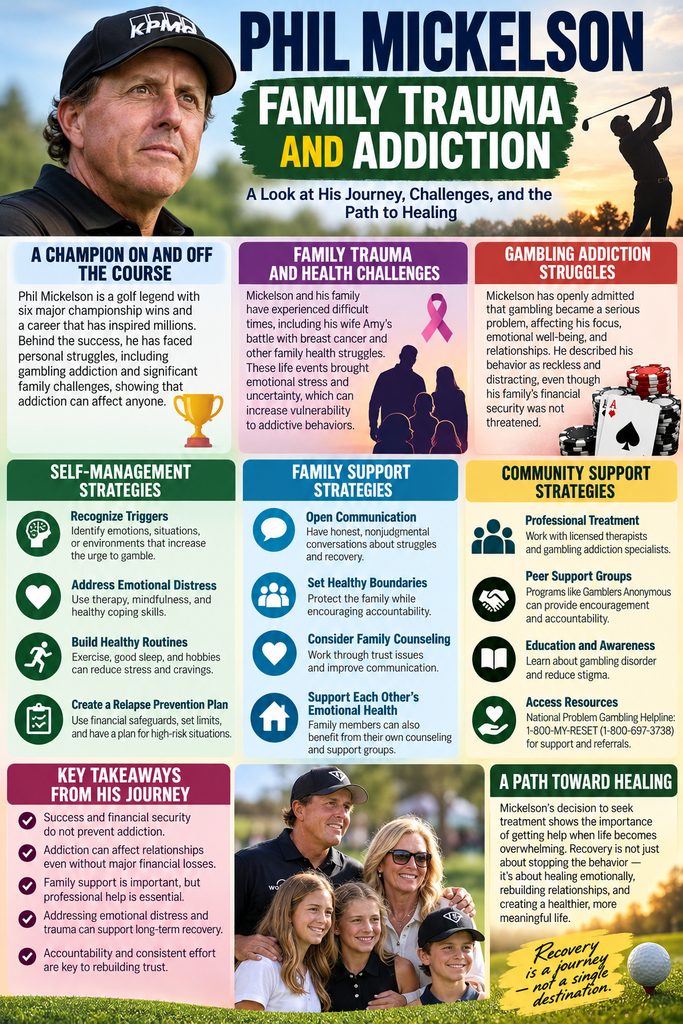
Phil Mickelson, one of professional golf’s most recognizable figures, has achieved extraordinary athletic success while facing personal challenges involving gambling, family relationships, and public scrutiny. Known for his six major championship victories and charismatic personality, Mickelson has also spoken openly about the destructive effects of his gambling behavior and the importance of rebuilding trust with loved ones.
His experience offers an opportunity to examine how behavioral addiction can affect even highly successful individuals. Unlike substance addiction, gambling disorder does not involve consuming alcohol or drugs, yet it can activate powerful reward pathways in the brain and contribute to compulsive behavior, financial losses, emotional distress, and family instability.
Mickelson’s story also highlights the importance of distinguishing documented family hardships from assumptions about psychological trauma. His wife’s experience with breast cancer and his family’s other health challenges are publicly known, but these events should not automatically be characterized as the cause of his gambling problems.
Understanding his journey through self-management, family support, and community resources provides valuable lessons for individuals and families facing gambling addiction.
Phil Mickelson’s Family Trauma and Addiction Treatment in 2026
In September 2026, reports emerged that Mickelson had voluntarily entered a treatment facility for concerns described by his representatives as “family trauma and addiction.” His representatives later confirmed he had returned home, but they did not disclose the length of treatment, the specific clinical concerns addressed, or details about the family circumstances involved.
Earlier in 2026, Mickelson stepped away from professional golf, withdrawing from the Masters and other tournaments while citing family health concerns. His extended absence suggested that personal and family matters took priority over competition.
The term family trauma can describe distressing experiences that disrupt emotional security, relationships, or family functioning. However, the precise nature of Mickelson’s reported family trauma has not been publicly established.
For individuals experiencing addiction alongside family-related distress, treatment may involve addressing both compulsive behaviors and the emotional consequences of damaged relationships.
Understanding Phil Mickelson’s Gambling Addiction
Mickelson publicly discussed his gambling difficulties in 2022, describing his behavior as reckless and embarrassing. He acknowledged receiving hundreds of hours of therapy and credited his wife, Amy, with supporting him.
In September 2023, he further explained that gambling had affected his ability to remain emotionally present with his loved ones. He said his family’s financial security had not been threatened, but his distraction and compulsive behavior had damaged important relationships.
His experience demonstrates that gambling addiction is not defined solely by financial losses.
Potential consequences include:
- Emotional disconnection: Becoming mentally preoccupied with gambling instead of family relationships.
- Loss of control: Continuing to gamble despite recognizing harmful consequences.
- Relationship difficulties: Creating mistrust, resentment, and emotional distance.
- Psychological distress: Experiencing anxiety, guilt, shame, or fear surrounding gambling behavior.
- Impaired priorities: Allowing gambling to interfere with responsibilities, relationships, and personal well-being.
- Difficulty rebuilding trust: Discovering that stopping gambling does not automatically repair previous harm.
Gambling disorder is recognized as a behavioral addiction because it involves persistent, problematic gambling behavior that causes significant distress or impairment.
How Family Trauma Can Affect Addiction Recovery
Family trauma and addiction can interact in complicated ways. Emotional distress may increase vulnerability to compulsive behaviors, while addiction itself can contribute to instability and painful experiences within a family.
Mickelson’s reported treatment for family trauma and addiction brings attention to the importance of addressing these problems together rather than treating addictive behavior in isolation.
For some individuals, gambling may temporarily provide excitement, distraction, or relief from uncomfortable emotions. However, relying on gambling to regulate emotional distress can reinforce unhealthy patterns.
Possible connections between family trauma and addiction include:
- Chronic family stress increasing emotional vulnerability.
- Gambling becoming a way to escape difficult feelings.
- Secrecy and compulsive behavior weakening family communication.
- Unresolved conflict contributing to emotional withdrawal.
- Shame and guilt making it difficult to seek professional assistance.
- Family members developing anxiety or mistrust because of repeated disappointments.
These are general clinical considerations, not confirmed explanations for Mickelson’s personal behavior.
Self-Management Strategies for Gambling Addiction and Trauma
Self-management involves recognizing harmful behavioral patterns, developing emotional awareness, and making deliberate choices that support long-term recovery.
Mickelson has described receiving extensive professional assistance and learning to become more present in everyday life. His experience illustrates why personal responsibility and treatment can work together.
1. Recognize gambling triggers
Individuals should identify situations, emotions, or environments that increase the urge to gamble.
Helpful strategies include:
- Maintaining a journal documenting gambling urges and emotional triggers.
- Recognizing the influence of stress, boredom, loneliness, and excitement.
- Avoiding gambling applications, betting websites, and high-risk environments.
- Using gambling self-exclusion programs and financial safeguards.
- Developing alternative responses to difficult emotions.
2. Address underlying emotional distress
Trauma-informed psychotherapy may help individuals understand how stressful experiences influence their thoughts, emotions, and behaviors.
Cognitive behavioral therapy (CBT) is an evidence-supported treatment for gambling disorder. Depending on the individual’s circumstances, trauma-focused treatment may also be appropriate.
Recovery strategies include:
- Practicing mindfulness and emotional regulation.
- Identifying distorted beliefs about gambling and winning.
- Learning healthy responses to shame and guilt.
- Developing stress-management techniques.
- Participating consistently in professional counseling.
3. Establish healthy daily routines
Structured routines can reduce unoccupied time and help individuals regain a sense of control.
Regular exercise, adequate sleep, meaningful hobbies, and social activities can support psychological well-being.
For someone accustomed to high-pressure competition, learning to experience enjoyment without gambling-related excitement may be an important adjustment.
4. Develop a relapse-prevention plan
Relapse prevention requires identifying warning signs before compulsive behavior escalates.
Individuals can create a written plan that includes trusted contacts, professional resources, financial restrictions, and specific steps for responding to gambling urges.
A recurrence of gambling should prompt reassessment and additional support rather than abandonment of treatment.
Family Support Strategies: Rebuilding Trust and Emotional Connection
Family relationships can play an important role in addiction recovery, but they may also require healing.
Mickelson has repeatedly acknowledged his wife, Amy, as important to his recovery. Their family has experienced significant health challenges, including Amy’s breast cancer diagnosis in 2009 and his mother’s cancer diagnosis shortly afterward. These experiences are documented family hardships, although no direct causal relationship with his gambling addiction has been established.
His public statements also recognize that repairing relationships requires time and consistent effort.
Encourage honest communication
Families benefit from creating opportunities to discuss addiction without immediately escalating into blame or confrontation.
Supportive communication may involve:
- Encouraging honest conversations about gambling and emotional distress.
- Listening to family members affected by addictive behavior.
- Discussing financial concerns and rebuilding transparency.
- Establishing realistic expectations for recovery.
- Recognizing that forgiveness and restored trust may develop at different rates.
Establish healthy boundaries
Supporting someone with addiction does not mean ignoring harmful behavior.
Family members may need boundaries around money, secrecy, gambling, and personal responsibilities.
Healthy boundaries protect everyone involved while keeping the person in recovery accountable for their choices.
Consider family counseling
Family therapy can help address damaged trust, emotional withdrawal, and unhealthy communication patterns.
Counseling may provide opportunities to:
- Understand how addiction has affected each family member.
- Discuss painful experiences in a structured environment.
- Improve communication and conflict resolution.
- Establish shared expectations for recovery.
- Develop healthier ways of managing family stress.
Family participation should be voluntary and safe. Loved ones are not responsible for controlling another person’s addiction.
Support family members’ emotional health
Spouses, children, and other relatives may experience significant distress when addiction affects their household.
They may benefit from independent counseling, peer support, and opportunities to maintain their own relationships and interests.
Successful family recovery involves healing for everyone affected, not simply stopping the addictive behavior.
Community Support Strategies for Long-Term Recovery
Community support provides opportunities for accountability, education, and connection beyond immediate family relationships.
Professional treatment and peer-support networks can reduce isolation and help individuals maintain behavioral changes.
Professional addiction treatment
Licensed mental health professionals and gambling addiction specialists can evaluate gambling behavior, identify co-occurring conditions, and recommend appropriate treatment.
Treatment options may include:
- Individual cognitive behavioral therapy.
- Trauma-informed psychotherapy when clinically indicated.
- Outpatient addiction counseling.
- Intensive treatment programs when additional structure is needed.
- Financial counseling and gambling-specific relapse prevention.
Peer-support programs
Organizations such as Gamblers Anonymous provide opportunities for individuals to connect with others experiencing gambling-related problems.
Peer support can help participants discuss cravings, setbacks, relationship difficulties, and recovery goals.
Family members may also benefit from Gam-Anon, which offers support for people affected by another person’s gambling.
Community education and prevention
Communities can reduce gambling-related harm by increasing awareness of behavioral addiction and improving access to treatment.
Helpful approaches include:
- Offering educational programs about gambling disorder.
- Promoting responsible discussions about sports betting.
- Improving access to affordable behavioral health services.
- Encouraging early screening for problematic gambling.
- Reducing stigma surrounding addiction treatment.
- Providing confidential support for families experiencing gambling-related distress.
Professional sports organizations may also contribute through education about gambling risks and access to mental health resources.
The Importance of Accountability in Phil Mickelson’s Recovery
Recovery involves more than acknowledging addiction. It also requires accepting responsibility for the consequences of past decisions and demonstrating meaningful behavioral change.
Mickelson’s representatives have emphasized his commitment to becoming a better husband and father. In 2026, his public circumstances also included allegations of inappropriate conduct, which his representatives disputed in part. These allegations should be distinguished from his acknowledged gambling history and should not be presented as proven facts or as evidence of a particular diagnosis.
Accountability in addiction recovery may involve:
- Acknowledging harm without minimizing its impact.
- Respecting affected individuals’ experiences and boundaries.
- Continuing treatment even when immediate crises have passed.
- Demonstrating reliability through consistent behavior.
- Accepting that rebuilding relationships can take considerable time.
Recovery is a continuing process rather than a single declaration of change.
Lessons From Phil Mickelson’s Journey
Mickelson’s experiences highlight several important principles about addiction, emotional distress, and recovery.
First, professional success and financial security do not prevent addiction. People can maintain successful careers while facing significant personal difficulties.
Second, addiction can damage relationships even when financial losses are manageable. Emotional absence, secrecy, and impaired judgment can have lasting consequences.
Third, family support can provide encouragement, but professional treatment and personal accountability remain essential.
Finally, addressing emotional distress alongside addiction may help individuals develop healthier coping strategies and more stable relationships.
His decision to seek treatment in 2026 reinforces the importance of obtaining additional help when circumstances require it. The full details of his treatment and current recovery status remain private.
Finding Help for Gambling Addiction and Family Trauma
Individuals experiencing gambling-related problems do not have to wait until financial or family circumstances become severe before seeking assistance.
In the United States, the National Council on Problem Gambling provides information and treatment referrals through the National Problem Gambling Helpline at 1-800-MY-RESET (1-800-697-3738).
Individuals can also consult licensed mental health professionals for assessment of gambling disorder, trauma-related symptoms, and other psychological concerns.
Seeking assistance early may help prevent further harm and support healthier family relationships.
Conclusion: Recovery Beyond the Golf Course
Phil Mickelson’s journey illustrates how gambling addiction and family-related distress can affect someone whose public life has been defined by exceptional professional achievement.
His public acknowledgment of gambling problems, appreciation for family support, and reported decision to pursue further treatment in 2026 offer important opportunities to discuss behavioral addiction and recovery.
The broader lesson is that lasting recovery requires more than stopping a harmful behavior. It involves emotional healing, personal accountability, rebuilding relationships, and developing meaningful connections with others.
Through self-management, family support, and community resources, individuals affected by addiction can work toward healthier behaviors and stronger relationships.
Recovery is not measured only by victories, financial achievements, or public recognition. It also shows up in everyday choices that build responsibility, connection, and lasting personal change.
Frequently Asked Questions and Answers
1. What addiction has Phil Mickelson struggled with?
Phil Mickelson has publicly acknowledged struggling with gambling addiction. In 2023, he explained that his gambling had progressed beyond recreational entertainment into compulsive behavior. Although he maintained financial security, his gambling negatively affected his emotional availability and relationships with loved ones. He has discussed receiving professional therapy and working toward recovery.
2. Did Phil Mickelson enter treatment for family trauma and addiction in 2026?
Yes. On September 30, 2026, Mickelson’s representatives confirmed that he had voluntarily entered a treatment facility earlier in the year for family trauma and addiction. He had returned home by the time the information became public. The specific addiction addressed during this treatment, the length of his stay, and the details of his family circumstances were not disclosed.
3. What family trauma has Phil Mickelson experienced?
Mickelson and his family have experienced significant challenges, including his wife Amy’s breast cancer diagnosis in 2009 and other family health concerns. In 2026, he withdrew from several professional golf tournaments to address private family health matters. Although his representatives confirmed treatment for family trauma, they have not explained the specific circumstances involved. It would be inaccurate to assume that previously reported family illnesses caused his addiction.
4. How did gambling addiction affect Phil Mickelson’s family?
Mickelson acknowledged that gambling prevented him from being emotionally present with the people he loved. He explained that the problem was not financial insecurity but the emotional damage caused by his preoccupation with gambling. His experience illustrates how behavioral addiction can weaken relationships through distraction, secrecy, and reduced emotional connection.
5. How did Phil Mickelson’s wife support his recovery?
Amy Mickelson has been an important source of support throughout her husband’s publicly discussed gambling difficulties. Mickelson has credited her love, patience, and commitment with helping him navigate challenging periods. However, family support does not replace professional treatment or personal responsibility.
6. What is gambling addiction, and how does it affect the brain?
Gambling disorder is a recognized behavioral addiction characterized by persistent gambling despite harmful consequences. Gambling activates reward-related brain circuits involving dopamine, which drives motivation and reinforces behavior. Unpredictable rewards can strengthen gambling behavior, making it hard to stop even when someone recognizes the harm.
7. Can family trauma contribute to gambling addiction?
Yes. Family trauma, chronic stress, and unresolved emotional distress can increase vulnerability to addictive behaviors. Some individuals use gambling to escape anxiety, sadness, or overwhelming emotions. However, trauma does not inevitably cause addiction, and not everyone with gambling disorder has experienced significant trauma. The precise relationship between Mickelson’s family circumstances and gambling history remains private.
8. What self-management strategies help individuals overcome gambling addiction?
Effective self-management begins with recognizing triggers and developing healthier responses to gambling urges.
- Identify emotions and situations that encourage gambling.
- Block gambling websites and consider self-exclusion programs.
- Establish financial safeguards and spending limits.
- Practice mindfulness, exercise, and healthy stress management.
- Participate in cognitive behavioral therapy.
- Develop a relapse-prevention plan with professional guidance.
These strategies can improve recovery outcomes when combined with appropriate treatment.
9. How can families support someone recovering from gambling addiction?
Families can provide emotional encouragement while maintaining clear boundaries. Open communication, financial transparency, and realistic expectations are important. Family counseling may help rebuild trust and address unresolved conflicts. Loved ones should also protect their own emotional health rather than assuming responsibility for controlling another person’s behavior.
10. Why is rebuilding trust important after gambling addiction?
Gambling addiction can damage relationships through secrecy, emotional withdrawal, broken promises, and financial concerns. Even after gambling stops, loved ones may need time to feel secure again. Rebuilding trust requires honesty, accountability, consistent behavior, and respect for boundaries. Recovery involves repairing relationships rather than simply eliminating gambling.
11. What role does professional therapy play in gambling addiction recovery?
Professional therapy helps individuals understand compulsive behavior, identify triggers, and develop healthier coping strategies. Cognitive behavioral therapy is an evidence-supported treatment for gambling disorder. When trauma-related symptoms are present, clinicians may also recommend trauma-focused psychotherapy. Mickelson has previously described participating in hundreds of hours of therapy to address his gambling difficulties.
12. Can gambling addiction occur without major financial losses?
Yes. Gambling disorder is not determined exclusively by the amount of money lost. Individuals may experience serious psychological, emotional, occupational, and relationship consequences even when they remain financially secure. Mickelson’s public statements illustrate how compulsive gambling can interfere with family relationships without causing financial ruin.
13. What community resources are available for gambling addiction?
Individuals and families can access professional counseling, addiction treatment programs, financial counseling, and peer-support organizations. Gamblers Anonymous provides mutual support for people experiencing gambling problems, while Gam-Anon supports affected family members. In the United States, you can reach the National Problem Gambling Helpline at 1-800-MY-RESET (1-800-697-3738) for confidential assistance and referrals.
14. Has Phil Mickelson completely recovered from addiction?
Mickelson stated in 2023 that he had stopped gambling and was working to repair relationships affected by his addiction. His representatives subsequently confirmed that he sought additional treatment for family trauma and addiction in 2026. However, his current clinical status and the specific conditions addressed in that treatment have not been publicly disclosed. Recovery is an ongoing process, and completing a treatment program does not necessarily mean that every challenge has been resolved.
15. Why did Phil Mickelson step away from professional golf in 2026?
Mickelson withdrew from major tournaments and missed most of the 2026 competitive season while citing family health concerns. His representatives later confirmed that he had received treatment for family trauma and addiction. Although these developments occurred during the same period, the complete reasons for his extended absence remain private.
16. What are the warning signs of gambling addiction?
Common warning signs include increasing preoccupation with gambling, difficulty stopping, chasing losses, concealing gambling activities, borrowing money to gamble, and neglecting responsibilities. Some individuals also experience irritability when attempting to reduce gambling. Persistent gambling despite relationship, emotional, or financial harm is another important warning sign.
17. How can someone manage emotional trauma without turning to gambling?
Healthy coping strategies include professional counseling, physical activity, mindfulness, journaling, supportive relationships, and structured daily routines. Trauma-focused treatment may help individuals process distressing experiences without relying on addictive behaviors for temporary relief. Building emotional regulation skills is particularly important for long-term recovery.
18. Can gambling addiction and family trauma be treated together?
Yes. Integrated treatment can address gambling behavior alongside trauma-related symptoms, anxiety, depression, or relationship difficulties. A clinician may combine gambling-focused cognitive behavioral therapy with appropriate trauma treatment and family counseling. Treatment should be individualized because the relationship between addiction and emotional distress differs among individuals.
19. What can families learn from Phil Mickelson’s experience?
Mickelson’s public experiences demonstrate that addiction can affect individuals regardless of fame, professional achievement, or financial security. His acknowledgment of the damage to his relationships highlights the importance of emotional availability, accountability, and honest communication. Families can support recovery by offering encouragement and healthy boundaries while recognizing that professional help may be necessary.
20. What is the most important lesson from Phil Mickelson’s addiction and recovery journey?
The central lesson is that recovery involves more than stopping addictive behavior. It also requires emotional healing, rebuilding trust, accepting responsibility, and developing healthier relationships.
Mickelson’s willingness to discuss his gambling difficulties and seek professional assistance illustrates the importance of recognizing harmful patterns and obtaining help. His experience also reminds us that recovery is personal, often complicated, and deserving of both accountability and appropriate privacy.
Video: