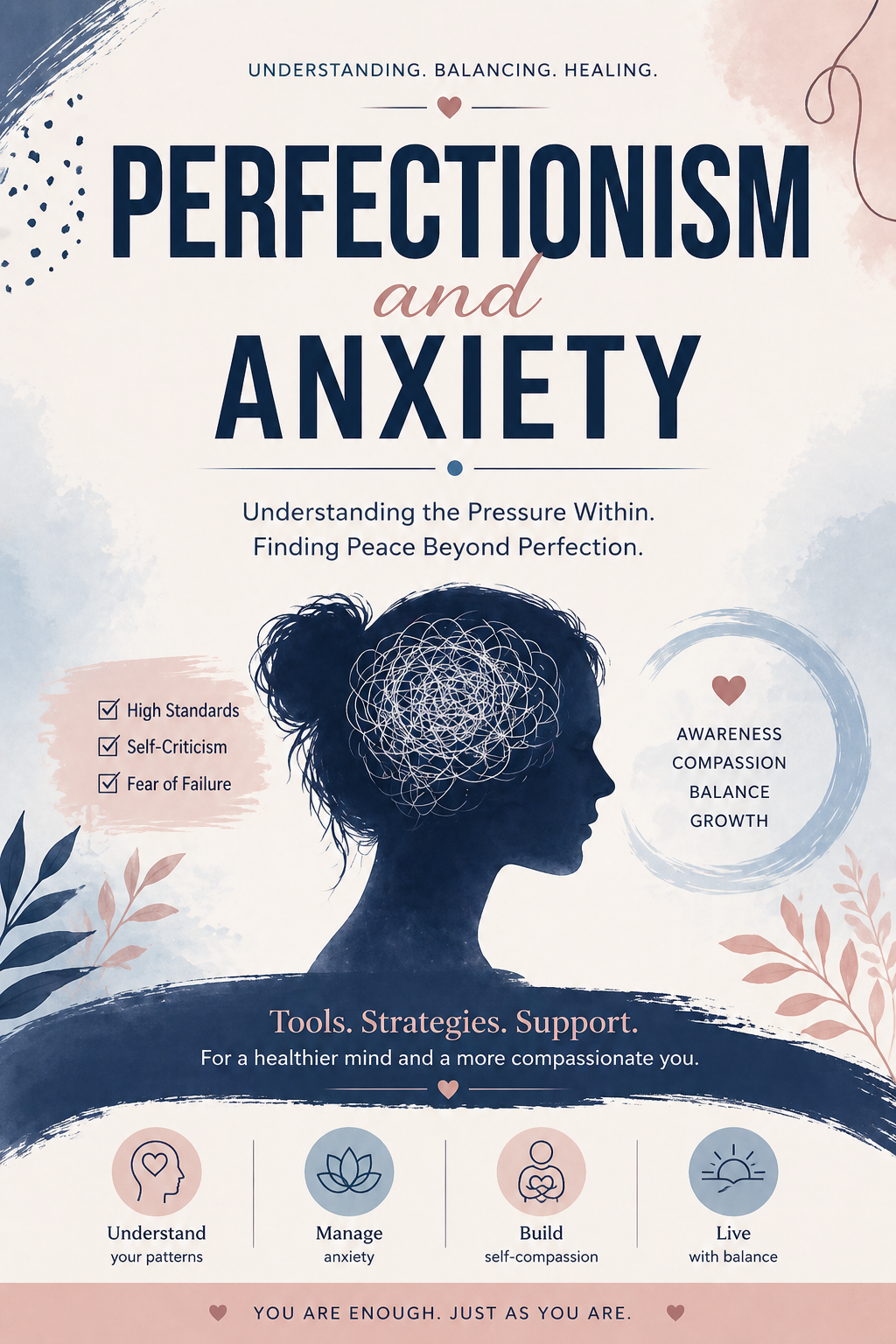
Perfectionism and anxiety are closely linked patterns that can significantly impact how individuals think, feel, and function in daily life. While striving for high standards can be motivating, perfectionism often goes beyond healthy ambition and becomes driven by fear of failure, self-criticism, and the need for control. This creates a constant internal pressure to meet unrealistic expectations, which in turn fuels anxiety. Understanding how perfectionism contributes to anxious thoughts and behaviors is essential for recognizing why even small tasks or mistakes can feel overwhelming.
Perfectionism and Anxiety: When High Standards Become Heavy Pressure
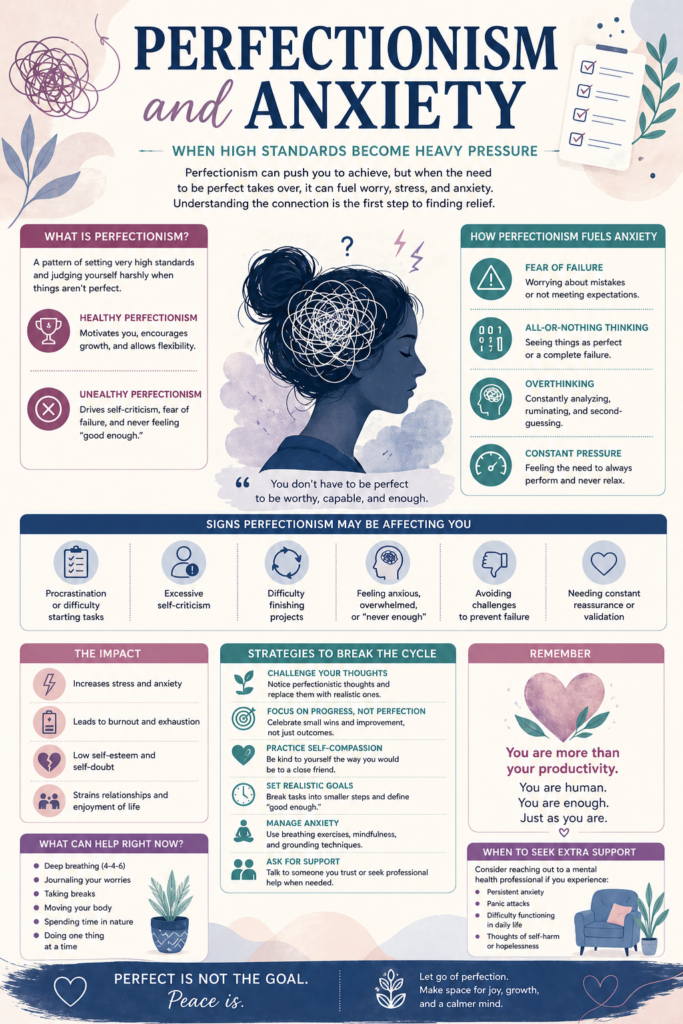
Perfectionism is often seen as a strength—associated with discipline, ambition, and success. But beneath the surface, it can also drive intense anxiety. When the desire to do well turns into the need to do everything perfectly, it creates a constant sense of pressure that can feel difficult to escape. Understanding the connection between perfectionism and anxiety is key to breaking this cycle and developing a healthier, more sustainable mindset.
What Is Perfectionism, Really?
Perfectionism isn’t just about wanting to do your best. It often involves:
- Setting unrealistically high standards
- Being overly critical of mistakes
- Linking self-worth to performance
- Feeling like “good enough” is never enough
There are two common forms:
- Adaptive perfectionism → motivates growth and achievement
- Maladaptive perfectionism → fuels stress, fear, and self-criticism
It’s the second type that is most strongly linked to anxiety.
How Perfectionism Fuels Anxiety
Perfectionism and anxiety are closely connected through several psychological patterns:
1. Fear of Failure
Perfectionists often see mistakes as unacceptable rather than part of learning. This creates constant worry about “getting it wrong.”
2. All-or-Nothing Thinking
If something isn’t perfect, it feels like a failure. This rigid thinking increases pressure and reduces flexibility.
3. Overthinking and Rumination
Replaying situations, second-guessing decisions, and worrying about outcomes can keep the mind stuck in a loop.
4. Constant Pressure
The belief that you must always perform at a high level creates ongoing stress, even in everyday tasks.
Common Signs of Perfectionism-Driven Anxiety
- Procrastination due to fear of not doing something perfectly
- Difficulty starting or finishing tasks
- Excessive self-criticism
- Feeling tense, overwhelmed, or “on edge.”
- Avoiding challenges to prevent failure
- Needing constant reassurance
These patterns can interfere with productivity, relationships, and overall well-being.
The Hidden Cost
While perfectionism may lead to short-term success, long-term it can:
- Increase burnout and exhaustion
- Reduce creativity and risk-taking
- Damage self-esteem
- Strain relationships
- Maintain or worsen anxiety
What starts as a drive to succeed can turn into a cycle of pressure → anxiety → avoidance → more pressure.
Breaking the Cycle
Reducing perfectionism doesn’t mean lowering your standards—it means making them more realistic and flexible.
1. Shift from “Perfect” to “Progress.”
Focus on improvement rather than flawless outcomes.
2. Challenge All-or-Nothing Thinking
Ask yourself:
- “Is this really a failure, or just not perfect?”
3. Set Realistic Goals
Break tasks into manageable steps and define what “done” actually means.
4. Practice Self-Compassion
Treat yourself with the same understanding you would offer someone else.
5. Allow Imperfection
Intentionally doing something imperfectly can help reduce fear over time.
When Anxiety Takes Over
If perfectionism is causing significant anxiety, it may help to:
- Learn stress management techniques (breathing, grounding)
- Talk to a therapist or counselor
- Explore cognitive-behavioral strategies to reframe thinking patterns
Support can make a big difference in changing long-standing habits.
Final Thoughts
Perfectionism often promises control and success—but delivers pressure and anxiety instead. By understanding how these patterns work, you can begin to shift from rigid expectations to a more balanced approach.
You don’t have to stop caring or striving. The goal is to care in a way that supports your well-being—not one that constantly works against it.
Managing Perfectionism and Anxiety: Practical Self-Management Strategies
Perfectionism and anxiety often go hand in hand, creating a cycle of pressure, overthinking, and emotional exhaustion. While striving for high standards can be motivating, it becomes harmful when it fuels constant worry and self-criticism. The key to breaking this cycle isn’t lowering your goals—it’s learning how to manage your thoughts, expectations, and emotional responses in a healthier way.
Why Self-Management Matters
Without awareness, perfectionism can operate on autopilot:
- You set unrealistic expectations
- You feel anxious about meeting them
- You become overwhelmed or avoid tasks
- You criticize yourself, reinforcing the cycle
Self-management helps you interrupt this pattern, giving you more control over both your mindset and your reactions.
1. Recognize Your Perfectionism Triggers
Start by identifying when perfectionism shows up most.
Ask yourself:
- Do I feel pressure to perform perfectly in certain situations?
- What thoughts come up when I make a mistake?
- When does my anxiety spike the most?
Common triggers include:
- Deadlines
- Being evaluated by others
- Trying something new
- Fear of criticism
Awareness turns automatic reactions into something you can work with.
2. Challenge All-or-Nothing Thinking
Perfectionism thrives on extremes:
- “If it’s not perfect, it’s a failure.”
Practice replacing that with:
- “This is good enough for now.”
- “Progress still counts.”
This shift reduces pressure and allows you to move forward rather than get stuck.
3. Set Realistic, Flexible Goals
Instead of vague or extreme expectations, define clear and achievable targets:
- Break tasks into smaller steps
- Decide what “done” actually looks like
- Allow room for adjustment
Example:
- Instead of “This has to be flawless,” → “I’ll complete a solid first draft today.”
4. Use Time Limits to Prevent Overworking
Perfectionism often leads to over-editing or overthinking.
Try:
- Setting a timer for tasks
- Stopping when time is up—even if it’s not perfect
- Moving on to the next step
This builds tolerance for letting things be incomplete or imperfect.
5. Practice Self-Compassion
Perfectionists tend to be highly self-critical.
When you notice this, pause and ask:
- “Would I speak this way to someone else?”
Replace harsh thoughts with:
- “I’m doing the best I can right now.”
- “Mistakes are part of learning.”
Self-compassion reduces anxiety and improves resilience.
6. Learn to Sit with Discomfort
Letting go of perfection can feel uncomfortable at first.
You might notice:
- Anxiety when submitting work
- Urges to double-check everything
- Fear of judgment
Instead of avoiding these feelings, practice tolerating them. Over time, the discomfort decreases.
7. Reduce Overthinking and Rumination
Perfectionism often keeps your mind stuck in loops.
Helpful strategies:
- Write down your thoughts to get them out of your head
- Set a “worry window” (a limited time to think things through)
- Redirect focus to action rather than analysis
Action breaks the cycle of endless thinking.
8. Focus on Effort, Not Just Outcome
Shift your attention from results to process:
- What did you learn?
- What effort did you put in?
- What improved compared to last time?
This builds a more balanced sense of achievement.
9. Build a Healthier Relationship with Mistakes
Instead of viewing mistakes as failures, reframe them as:
- Feedback
- Opportunities to improve
- A normal part of growth
This reduces fear and makes it easier to take risks.
10. Know When to Seek Support
If perfectionism and anxiety are significantly affecting your life, support can help.
Options include:
- Therapy (especially cognitive-behavioral approaches)
- Stress management techniques
- Coaching or structured support programs
You don’t have to manage everything alone.
Final Thoughts
Perfectionism and anxiety can feel like they’re pushing you to succeed—but often, they’re holding you back. Self-management is about learning to work with your mindset instead of being controlled by it.
You don’t need to stop striving—you just need to shift how you define success. When you move from perfection to progress, you create space for growth, confidence, and a healthier, more sustainable way of achieving your goals.
Supporting a Loved One with Perfectionism and Anxiety: Family Strategies That Make a Difference
Perfectionism and anxiety often exist quietly beneath the surface, showing up as stress, overthinking, procrastination, or emotional overwhelm. For families, it can be confusing—what looks like high achievement or strong motivation may actually be driven by fear of failure and intense internal pressure. Understanding this dynamic is the first step toward offering meaningful support that reduces anxiety rather than unintentionally increasing it.
Why Family Support Matters
People struggling with perfectionism and anxiety are often highly self-critical. Without supportive responses, they may feel:
- Constant pressure to meet expectations
- Fear of disappointing others
- Difficulty relaxing or feeling “good enough.”
Family interactions can either reinforce this pressure or help create a safer, more balanced environment.
1. Shift the Focus from Perfection to Effort
Many perfectionists tie their self-worth to outcomes.
Families can help by:
- Praising effort, persistence, and progress—not just results
- Saying things like: “I’m proud of how hard you worked on this,” instead of only celebrating success
This reduces the belief that only perfection is acceptable.
2. Avoid Reinforcing Unrealistic Standards
Well-meaning comments can sometimes increase pressure, such as:
- “You always do everything perfectly.”
- “I know you’ll get it exactly right.”
Instead, normalize imperfection:
- “It’s okay if it’s not perfect—what matters is that you tried.”
3. Encourage Healthy Perspectives on Mistakes
Perfectionists often fear mistakes intensely.
Families can:
- Share their own mistakes and what they learned
- Reinforce that mistakes are part of growth
- Avoid harsh criticism or overreaction
This helps reframe mistakes as learning opportunities rather than failures.
4. Create a Low-Pressure Environment
High-pressure environments can worsen anxiety.
Supportive changes include:
- Reducing unnecessary expectations
- Allowing flexibility in performance
- Encouraging balance between work and rest
A calmer environment helps reduce the constant sense of urgency.
5. Support Open Conversations About Stress
Perfectionists may hide their anxiety to maintain an image of competence.
Encourage openness by:
- Asking: “How are you feeling about everything?”
- Listening without immediately offering solutions
- Validating their experience: “That sounds really stressful.”
Feeling understood can significantly reduce emotional intensity.
6. Help Break the Overthinking Cycle
When someone is stuck overanalyzing, families can gently guide them back to action:
- “What’s one small step you could take right now?”
- Encourage starting rather than waiting for perfect conditions
This helps shift from thinking → doing, which reduces anxiety.
7. Model Healthy Behavior
Family members set powerful examples.
Model:
- Accepting imperfections
- Taking breaks without guilt
- Responding calmly to mistakes
These behaviors show that it’s possible to function without constant perfection.
8. Encourage Balance and Self-Care
Perfectionism often leads to overworking and burnout.
Support:
- Regular breaks and downtime
- Activities not tied to performance (hobbies, relaxation)
- Healthy sleep and routines
Balance helps regulate both stress and anxiety levels.
9. Recognize Warning Signs
Watch for signs that perfectionism and anxiety are becoming overwhelming:
- Avoidance or procrastination
- Constant self-criticism
- Emotional distress or irritability
- Difficulty completing tasks
These may indicate the need for additional support.
10. Encourage Professional Support When Needed
If anxiety becomes persistent or disruptive, professional help can be valuable.
Families can:
- Normalize seeking help
- Offer to assist in finding resources
- Frame it as support, not failure
Therapy can help individuals develop healthier thinking patterns and coping strategies.
Final Thoughts
Supporting someone with perfectionism and anxiety isn’t about pushing them to do more—it’s about helping them feel safe enough to do less perfectly. When families shift from pressure to understanding, they create an environment where growth, confidence, and emotional balance can develop.
You don’t need to have perfect responses. Consistency, patience, and empathy often make the biggest difference in helping someone move from constant pressure to healthier self-acceptance.
Community Resources for Perfectionism and Anxiety: Building Support Beyond Yourself
Perfectionism and anxiety can feel like deeply personal struggles—driven by internal pressure, self-criticism, and constant overthinking. But they don’t develop in isolation, and they don’t have to be managed alone. Community resources offer education, skill-building, and connection, helping individuals better understand these patterns and develop healthier ways of thinking, feeling, and responding.
Why Community Support Matters
Perfectionism and anxiety often thrive in silence:
- Unrealistic expectations go unchallenged
- Self-criticism becomes normalized
- Stress builds without release
Community resources provide an external perspective and structure, making it easier to recognize patterns and break the cycle.
1. Counseling and Therapy Services
Community-based therapy services are among the most effective forms of support.
They help individuals:
- Identify perfectionistic thinking patterns
- Reduce anxiety through evidence-based techniques
- Develop healthier coping strategies
Approaches like cognitive-behavioral therapy (CBT) are especially useful for challenging rigid thinking and reducing overthinking.
2. Workshops and Skill-Building Programs
Many communities offer workshops focused on:
- Stress management
- Emotional regulation
- Time management and productivity
- Building self-compassion
These programs provide practical tools that can be applied immediately in daily life, helping individuals move from theory to action.
3. Support Groups and Peer Networks
Peer support groups create a space where people can openly discuss their experiences with perfectionism and anxiety.
Benefits include:
- Realizing you’re not alone
- Learning from others’ coping strategies
- Reducing shame and self-judgment
Hearing others describe similar struggles can shift the mindset from “something is wrong with me” to “this is something I can work through.”
4. Educational Resources and Public Programs
Community education initiatives—through libraries, schools, or health organizations—often provide:
- Talks or seminars on mental health
- Printed or online materials
- Guided exercises and tools
These resources help individuals understand:
- How perfectionism develops
- Why anxiety persists
- What strategies are effective
Knowledge creates awareness, and awareness creates change.
5. School and Workplace Initiatives
Educational institutions and workplaces increasingly offer support programs such as:
- Mental health awareness training
- Stress reduction workshops
- Counseling services
These environments are often where perfectionism is most active, making them key places for early intervention and support.
6. Mindfulness and Wellness Programs
Community centers and organizations often provide classes in:
- Mindfulness and meditation
- Yoga or relaxation techniques
- Stress reduction practices
These approaches help calm the nervous system and reduce the intensity of anxiety, making it easier to step back from perfectionistic thinking.
7. Online Communities and Digital Tools
Accessible online platforms offer:
- Forums and discussion groups
- Self-guided courses
- Apps for anxiety management and habit tracking
These tools allow individuals to explore support privately and at their own pace, which can be especially helpful for those hesitant to seek in-person help.
8. Coaching and Personal Development Programs
Some communities offer coaching focused on:
- Goal setting
- Productivity without burnout
- Overcoming perfectionism in work or school
These programs emphasize balanced achievement, helping individuals succeed without excessive pressure.
9. Crisis and Emotional Support Services
When anxiety becomes overwhelming, crisis support services can provide:
- Immediate emotional support
- Grounding techniques
- Guidance for next steps
These services act as a safety net during high-stress moments.
Final Thoughts
Perfectionism and anxiety may feel like internal struggles, but they are deeply influenced by environment, expectations, and learned patterns. Community resources provide the tools, support, and perspective needed to challenge those patterns and build healthier ones.
You don’t have to rely on willpower alone. Whether through therapy, workshops, peer support, or educational programs, reaching outside yourself can make a significant difference. Over time, these supports help shift perfectionism from a source of pressure into something more flexible—allowing for growth, balance, and a more sustainable sense of well-being.
Frequently Asked Questions
Here are some common questions:
1. What is the connection between perfectionism and anxiety?
Perfectionism often creates constant pressure to meet unrealistic standards, which leads to worry, fear of failure, and overthinking—all key features of anxiety. The need to “get everything right” keeps the mind in a state of stress.
2. Is perfectionism always unhealthy?
No. There are two types:
- Healthy (adaptive) → motivates growth and achievement
- Unhealthy (maladaptive) → driven by fear, self-criticism, and anxiety
It becomes a problem when it negatively affects your mental health or daily life.
3. Why do perfectionists feel so anxious?
Because they often:
- Fear of making mistakes
- Tie self-worth to performance
- Expect constant high achievement
- Overanalyze outcomes
This creates a never-ending cycle of pressure and worry.
4. Can perfectionism cause procrastination?
Yes, very commonly. When expectations are too high, people may:
- Avoid starting tasks
- Delay finishing work
- Feel stuck or overwhelmed
This is sometimes called “perfection paralysis.”
5. What are common signs of perfectionism-driven anxiety?
- Constant self-criticism
- Fear of failure or judgment
- Difficulty finishing tasks
- Overthinking decisions
- Feeling tense or overwhelmed
- Avoiding challenges
6. Why do small mistakes feel so overwhelming?
Perfectionists often use all-or-nothing thinking, where:
- A small mistake = total failure
This magnifies minor issues into major concerns.
7. Can perfectionism affect relationships?
Yes. It can lead to:
- Unrealistic expectations of others
- Difficulty accepting differences
- Fear of being judged or rejected
- Trouble relaxing or being present
This can create stress in personal and professional relationships.
8. Is perfectionism linked to other mental health issues?
Yes. It is often associated with:
- Anxiety disorders
- Depression
- Burnout
- Low self-esteem
These conditions can reinforce each other over time.
9. Can perfectionism be changed?
Yes, but it takes practice. Change involves:
- Recognizing patterns
- Challenging unrealistic thoughts
- Allowing imperfection
- Building self-compassion
It’s about progress, not perfection.
10. How can I reduce anxiety related to perfectionism?
Helpful strategies include:
- Setting realistic goals
- Breaking tasks into smaller steps
- Using time limits
- Practicing relaxation techniques
- Focusing on effort rather than outcome
11. Why do I feel like I’m never “good enough”?
Perfectionism often ties self-worth to achievement. No matter how well you do, it can feel like:
- “I should have done better.”
This keeps satisfaction just out of reach.
12. Is it possible to still be successful without perfectionism?
Yes—often more so. Letting go of perfectionism can:
- Improve productivity
- Increase creativity
- Reduce burnout
- Strengthen confidence
Balanced effort is more sustainable than constant pressure.
13. Should I seek help for perfectionism and anxiety?
If it’s affecting your daily life, relationships, or well-being, support can help. Therapy (especially cognitive-behavioral approaches) is very effective in addressing these patterns.
14. What’s the biggest misconception about perfectionism?
That leads to better outcomes. In reality, extreme perfectionism often leads to:
- Stress
- Avoidance
- Burnout
- Reduced performance over time
15. What’s the most important takeaway?
Perfectionism may feel like it’s pushing you forward, but often it’s holding you back through anxiety and pressure. Learning to accept “good enough” can lead to greater success, better mental health, and a more balanced life.
Conclusion
Recognizing the connection between perfectionism and anxiety is a crucial step toward creating a healthier and more balanced mindset. When individuals learn to shift from rigid expectations to more flexible, realistic standards, the intensity of anxiety can begin to decrease. Rather than striving for flawlessness, focusing on progress, self-compassion, and adaptability allows for growth without constant pressure. Ultimately, understanding this relationship empowers individuals to break the cycle of perfectionism and anxiety, leading to improved well-being and a more sustainable approach to success.
Video: How perfectionism creates a cycle of anxiety #psychology #wellbeing