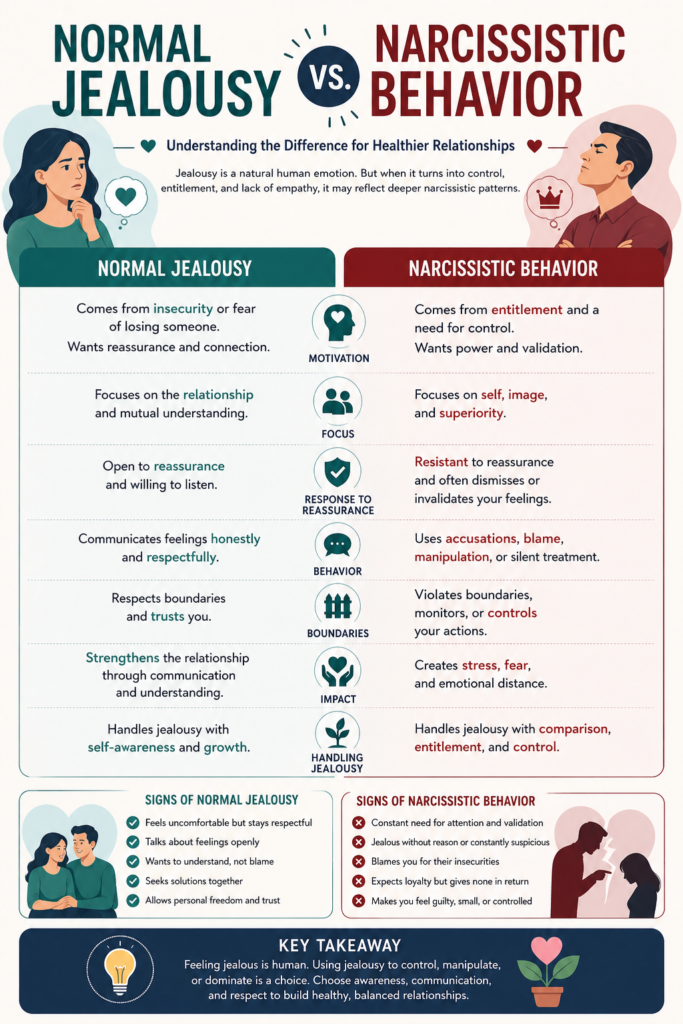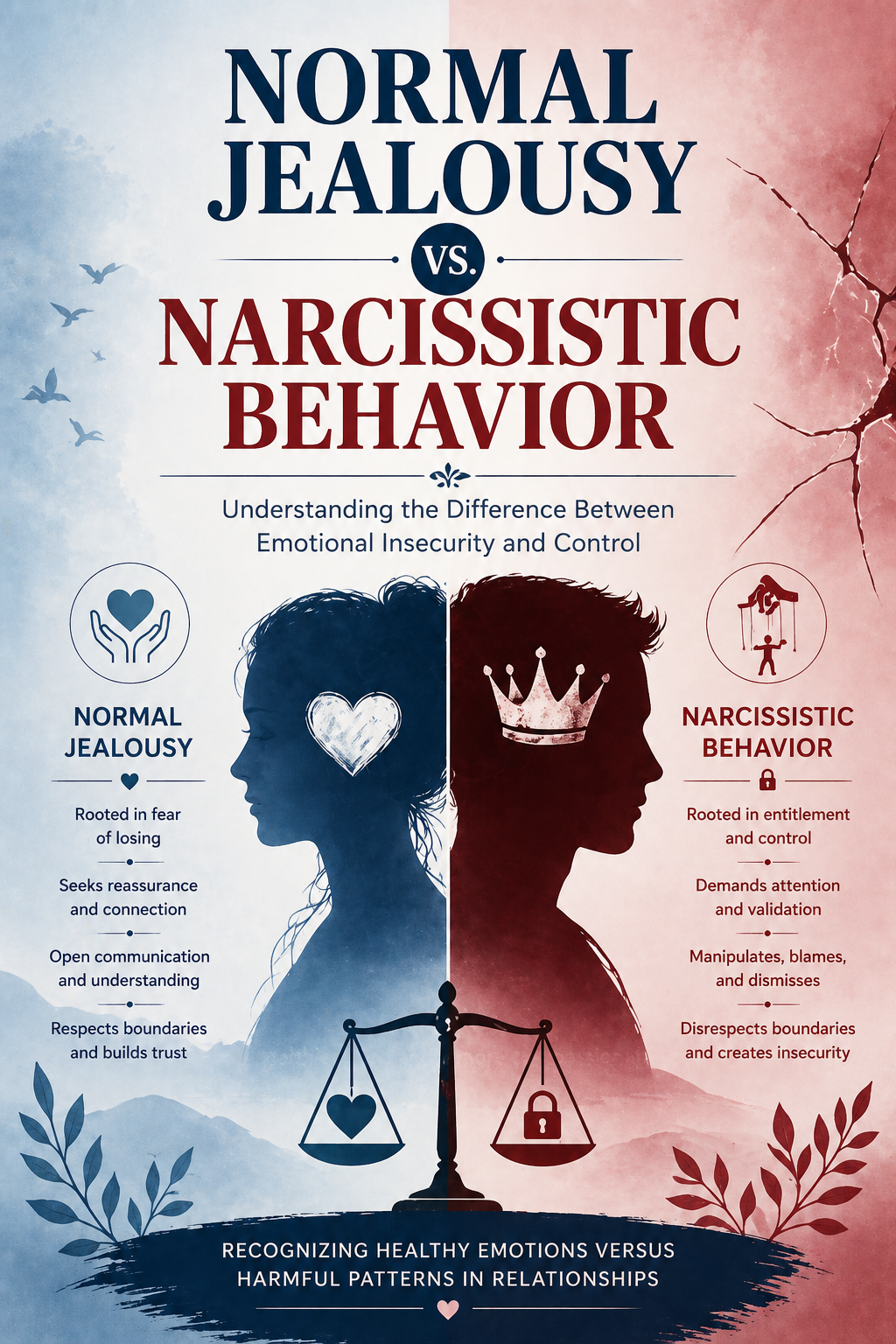
Jealousy is a common emotional reaction that many people experience in relationships, typically arising from fear of loss, insecurity, or the need for connection. However, not all forms of jealousy are the same. In some instances, what seems like jealousy may actually reveal deeper patterns tied to narcissistic behavior, including entitlement, control, and a lack of empathy. Recognizing the difference between normal jealousy and narcissistic behavior is crucial for understanding relationship dynamics, as they stem from vastly different motivations and lead to very different outcomes.
Normal Jealousy vs. Narcissistic Behavior: Understanding the Key Differences
Jealousy is a common human emotion—one that most people experience at some point in relationships. It can arise from fear of losing someone, insecurity, or feeling left out. But not all jealousy is the same. In some cases, what looks like jealousy may actually reflect narcissistic behavior, which operates from a very different psychological place. Understanding the difference between normal jealousy and narcissistic patterns is essential for recognizing healthy versus unhealthy relationship dynamics.
What Is Normal Jealousy?
Normal jealousy is typically situational and emotionally driven, not controlling or extreme.
It often involves:
- Fear of losing a valued relationship
- Temporary insecurity or comparison
- A desire for reassurance or connection
Key Characteristics:
- Awareness: The person recognizes their feelings
- Communication: They can express concerns openly
- Flexibility: They can be reassured and calm down
- Respect for boundaries: They don’t try to control the other person
In this form, jealousy can actually lead to honest conversations and stronger connections when handled well.
What Is Narcissistic Behavior?
Narcissistic behavior is not just about insecurity—it’s rooted in entitlement, control, and a need for validation.
Instead of fear of loss, the underlying mindset is often:
- “I deserve control or special treatment.”
- “My needs come first.”
- “I should not feel threatened or challenged.”
Key Characteristics:
- Control: Monitoring, restricting, or dictating behavior
- Entitlement: Expecting loyalty without reciprocity
- Lack of empathy: Dismissing the other person’s feelings
- Blame-shifting: Turning issues back onto the other person
- Intensity: Reactions are disproportionate and persistent
This behavior often creates power imbalances and emotional strain in relationships.
Key Differences at a Glance
| Normal Jealousy | Narcissistic Behavior |
|---|---|
| Based on insecurity or fear | Based on entitlement and control |
| Temporary and situational | Persistent and pattern-based |
| Open to reassurance | Resistant to reassurance |
| Respects boundaries | Violates or pushes boundaries |
| Leads to communication | Leads to conflict or control |
How It Feels in a Relationship
With Normal Jealousy:
- You may feel temporarily uncomfortable, but communication improves things
- There is space for mutual understanding
- Both people’s feelings are considered
With Narcissistic Behavior:
- You may feel controlled, criticized, or constantly “on edge.”
- Your perspective may be dismissed or minimized
- The focus is often one-sided
Why the Difference Matters
Confusing the two can lead to:
- Accepting unhealthy behavior as “normal.”
- Staying in dynamics that are emotionally draining
- Misunderstanding your own or your partner’s needs
Recognizing the difference allows for:
- Healthier boundaries
- Clearer communication
- Better relationship decisions
When to Be Concerned
Jealousy may signal a deeper issue when it:
- Turns into control or monitoring
- Leads to accusations without evidence
- Creates fear rather than connection
- Doesn’t improve with reassurance
These patterns may indicate something beyond typical emotional insecurity.
Final Thoughts
Jealousy, in its normal form, is part of being human—it reflects care, attachment, and vulnerability. But when it shifts into control, entitlement, and lack of empathy, it becomes something entirely different.
Understanding the difference between normal jealousy and narcissistic behavior isn’t about labeling people—it’s about recognizing patterns that either support or harm relationships. With that awareness, you can respond more clearly, set healthier boundaries, and build connections based on respect rather than control.
Managing Emotional Reactions: Self-Strategies to Understand Jealousy vs. Narcissistic Behavior
Jealousy can be uncomfortable—but it’s also human. The challenge is knowing when it reflects normal emotional insecurity versus when it crosses into patterns that resemble narcissistic behavior, such as control, entitlement, or lack of empathy. Self-management isn’t about eliminating jealousy—it’s about understanding your reactions, regulating them, and recognizing healthy versus unhealthy patterns.
Why Self-Management Matters
Without awareness, jealousy can quickly escalate:
- You feel insecure or threatened
- You react emotionally (overthinking, questioning, comparing)
- You may act in ways that create tension (seeking reassurance, withdrawing, or controlling)
Self-management helps you pause and ask:
“What am I actually feeling—and how should I respond?”
1. Identify the Root of Your Jealousy
Jealousy is often a surface emotion. Underneath, there may be:
- Fear of losing someone
- Insecurity about self-worth
- Past experiences (betrayal, rejection)
- Comparison to others
Ask yourself:
- “What am I really afraid of right now?”
Understanding the root helps you respond with clarity rather than react automatically.
2. Distinguish Feeling from Behavior
It’s important to separate:
- Feeling jealous (normal)
- Acting in controlling or entitled ways (potentially unhealthy)
Healthy self-check:
- Am I expressing my feelings—or trying to control someone else’s behavior?
- Am I seeking reassurance—or demanding it?
This distinction is key in avoiding narcissistic patterns.
3. Challenge Entitlement Thinking
Narcissistic behavior often involves beliefs like:
- “They shouldn’t do anything that makes me uncomfortable.”
- “I deserve constant reassurance or attention.”
Replace with:
- “I can feel uncomfortable without controlling the situation.”
- “Relationships involve trust, not control.”
This shift builds emotional maturity and reduces reactive behavior.
4. Regulate Your Emotional Response
Jealousy can trigger strong reactions. Before responding:
- Pause and breathe
- Step away if needed
- Avoid immediate confrontation
This prevents escalation and gives you space to respond thoughtfully rather than react impulsively.
5. Communicate, Don’t Accuse
When addressing jealousy:
Instead of:
- “Why are you doing this?”
Try:
- “I noticed I felt a bit insecure earlier, and I want to talk about it.”
This approach:
- Reduces defensiveness
- Encourages understanding
- Keeps communication healthy
6. Build Internal Security
The less your self-worth depends on others, the less intense jealousy becomes.
Work on:
- Self-confidence
- Personal goals and identity
- Emotional independence
Ask:
- “Who am I outside of this relationship?”
Internal stability reduces the need for external validation.
7. Watch for Patterns, Not One-Time Reactions
Everyone experiences jealousy—but patterns matter.
Reflect:
- Is this occasional and situational?
- Or frequent, intense, and leading to controlling behavior?
Consistent patterns of control, blame, or entitlement may indicate something deeper than normal jealousy.
8. Practice Empathy
Ask yourself:
- “How would I feel if someone treated me the way I’m responding right now?”
Empathy helps shift from self-focused reactions to mutual understanding, which is essential for healthy relationships.
9. Accept Discomfort Without Acting on It
You don’t have to eliminate jealousy—you can learn to tolerate it.
- Sit with the feeling
- Let it pass without immediate action
- Remind yourself that emotions are temporary
This builds emotional resilience.
10. Know When to Reflect Deeper or Seek Support
If jealousy frequently turns into:
- Controlling behavior
- Conflict or distrust
- Emotional distress
It may help to:
- Reflect more deeply on patterns
- Talk to a counselor or therapist
- Work on underlying insecurities
Final Thoughts
Understanding the difference between normal jealousy and narcissistic behavior starts with self-awareness and responsibility. You can’t always control what you feel—but you can control how you respond.
Healthy relationships aren’t built on eliminating difficult emotions—they’re built on handling them with honesty, respect, and balance. When you learn to manage jealousy thoughtfully, you create space for trust, connection, and emotional growth instead of control and conflict.
Supporting Healthy Relationships: Family Strategies for Understanding Jealousy vs. Narcissistic Behavior
Jealousy can be a normal part of relationships, but when it becomes controlling or rooted in entitlement, it may reflect deeper, unhealthy patterns. For families, it can be difficult to tell the difference—or to know how to respond without making the situation worse. The goal of family support isn’t to take sides or “fix” behavior, but to encourage awareness, reinforce healthy boundaries, and promote emotionally balanced responses.
Why Family Support Matters
Family dynamics often shape how people understand and express emotions like jealousy.
Without guidance, individuals may:
- Normalize controlling behavior
- Misinterpret insecurity as entitlement
- Struggle to communicate emotions in healthy ways
With supportive strategies, families can help distinguish between:
- Normal emotional reactions (insecurity, fear, vulnerability)
- Unhealthy patterns (control, blame, lack of empathy)
1. Educate on Healthy vs. Unhealthy Jealousy
Families can help by clarifying the difference:
- Normal jealousy → involves feelings, communication, and respect
- Narcissistic behavior → involves control, entitlement, and disregard for others
Having open conversations about these differences builds awareness and emotional insight.
2. Model Healthy Emotional Expression
Family members set powerful examples.
Model:
- Expressing feelings without blame (“I felt uncomfortable when…”)
- Respecting boundaries
- Handling insecurity without controlling others
This shows that emotions can be managed without becoming harmful behaviors.
3. Encourage Accountability, Not Blame
If someone shows signs of controlling or entitled behavior:
Avoid:
- Shaming (“You’re the problem”)
- Ignoring the behavior
Instead:
- Address it calmly: “I noticed this situation caused tension—what were you feeling?”
- Encourage reflection rather than defensiveness
Accountability helps individuals recognize patterns without shutting down.
4. Support Open, Nonjudgmental Communication
People are more likely to change when they feel safe expressing themselves.
Families can:
- Listen without interrupting
- Validate feelings (“That sounds difficult”)
- Avoid immediately taking sides
This creates space to explore whether the reaction stems from insecurity or from something more controlling.
5. Reinforce Healthy Boundaries
Boundaries are essential in distinguishing normal jealousy from unhealthy behavior.
Families should:
- Support individuals in setting limits
- Avoid excusing controlling actions
- Reinforce that respect is non-negotiable
Example:
- “It’s okay to feel jealous, but it’s not okay to control someone’s actions.”
6. Avoid Enabling Unhealthy Patterns
Sometimes families unintentionally reinforce problematic behavior by:
- Making excuses (“They’re just protective”)
- Minimizing concerns
- Encouraging dependence or control
Instead, gently redirect toward healthier perspectives and responsibility.
7. Promote Empathy and Perspective-Taking
Encourage individuals to consider others’ feelings:
- “How do you think that made them feel?”
- “What would it be like if someone treated you that way?”
Empathy helps shift focus from control to mutual respect and understanding.
8. Recognize Warning Signs
Families should be aware of patterns that go beyond normal jealousy:
- Persistent need to control or monitor
- Lack of empathy for others’ feelings
- Blaming others for emotional reactions
- Escalating conflict instead of resolving it
These signs may indicate the need for deeper intervention or support.
9. Encourage Healthy Relationship Skills
Support the development of:
- Communication skills
- Emotional regulation
- Conflict resolution
These skills help individuals move away from reactive or controlling behavior toward balanced, respectful interactions.
10. Suggest Professional Support When Needed
If patterns become persistent or harmful, outside support can help.
Families can:
- Normalize counseling or therapy
- Encourage learning about healthy relationships
- Offer support in seeking help
Professional guidance can address underlying issues such as insecurity, attachment patterns, or personality traits.
Final Thoughts
Understanding the difference between normal jealousy and narcissistic behavior is essential for maintaining healthy relationships. Families play a key role in shaping this understanding—not by controlling outcomes, but by modeling healthy behavior, reinforcing boundaries, and encouraging self-awareness.
Support doesn’t mean ignoring problems or accepting harmful behavior. It means creating an environment where emotions are acknowledged, but respect and accountability remain the foundation of every relationship.
Community Resources for Understanding Jealousy vs. Narcissistic Behavior: Building Healthier Relationship Awareness
Jealousy is a normal human emotion, but when it shifts into patterns of control, entitlement, or lack of empathy, it may reflect deeper relational issues often associated with narcissistic behavior. Many people struggle to recognize this difference on their own, especially when emotions are intense or relationships are complicated. Community resources play a crucial role in helping individuals gain perspective, develop healthy relationship skills, and recognize when behavior crosses from emotional response into unhealthy patterns.
Why Community Support Matters
Without outside input, it’s easy to:
- Normalize controlling or possessive behavior
- Misinterpret insecurity as entitlement
- Stay stuck in unhealthy relationship dynamics
Community resources provide:
- Education about emotional and behavioral patterns
- Support from others with similar experiences
- Tools for building healthier relationships
They help shift understanding from confusion to clarity.
1. Counseling and Therapy Services
Professional counseling is one of the most effective ways to understand relationship patterns.
Therapists can help individuals:
- Differentiate between normal jealousy and controlling behavior
- Identify underlying issues (insecurity, attachment styles, past experiences)
- Develop healthier communication and emotional regulation skills
Couples or family therapy can also address relationship dynamics in real time.
2. Relationship and Communication Workshops
Many community organizations offer workshops focused on:
- Healthy communication
- Conflict resolution
- Boundary setting
- Emotional awareness
These programs help participants:
- Recognize unhealthy patterns
- Learn how to express jealousy without control
- Understand the role of respect and mutual accountability
3. Support Groups and Peer Networks
Peer groups provide a space to share experiences and gain insight.
Benefits include:
- Hearing others describe similar situations
- Learning what healthy vs. unhealthy behavior looks like in real life
- Reducing isolation and self-doubt
For example, someone might realize:
- “What I thought was normal jealousy is actually controlling behavior.”
This perspective shift can be powerful.
4. Educational Programs and Public Awareness Initiatives
Community education—through libraries, nonprofits, or health organizations—often includes:
- Seminars on healthy relationships
- Resources on emotional intelligence
- Information about personality traits and behavior patterns
These programs help individuals:
- Understand the difference between emotional reactions and behavioral patterns
- Recognize red flags early
- Build awareness before problems escalate
5. Domestic Violence and Relationship Support Services
In more severe cases, controlling or entitled behavior may escalate into emotional or psychological harm.
Community services can provide:
- Safety planning
- Emotional support
- Guidance on setting boundaries or leaving unhealthy situations
These resources are essential when behavior crosses the line into harmful or unsafe territory.
6. School and Workplace Programs
Educational institutions and workplaces increasingly offer training on:
- Emotional intelligence
- Healthy relationship dynamics
- Respectful communication
Early exposure to these concepts helps individuals:
- Develop awareness before patterns become ingrained
- Understand boundaries and mutual respect
- Recognize unhealthy behavior in themselves and others
7. Online Communities and Digital Resources
Accessible online platforms offer:
- Articles and educational content
- Discussion forums
- Self-assessment tools
These resources allow individuals to:
- Explore sensitive topics privately
- Reflect on their own behavior or relationships
- Learn at their own pace
8. Coaching and Personal Development Programs
Some community-based coaching programs focus on:
- Building self-awareness
- Improving relationship skills
- Developing emotional regulation
These programs can help individuals shift from:
- Reactive or controlling behavior → intentional and balanced responses
9. Crisis and Immediate Support Services
If relationship dynamics become overwhelming or emotionally distressing, crisis services can provide:
- Immediate emotional support
- Guidance on next steps
- Referrals to ongoing care
These services act as a safety net during high-stress situations.
Final Thoughts
Understanding the difference between normal jealousy and narcissistic behavior is not always straightforward—especially when emotions and relationships are involved. Community resources provide the education, support, and perspective needed to recognize these patterns clearly.
You don’t have to figure it out alone. Whether through therapy, workshops, support groups, or educational programs, reaching beyond your own perspective can help you build relationships based on respect, balance, and emotional awareness—rather than control or confusion.
The more informed and supported you are, the easier it becomes to choose healthier dynamics—for yourself and for the people around you.
Frequently Asked Questions
Here are some common questions:
1. Is jealousy always a bad thing?
No. Jealousy is a normal human emotion that can signal care, attachment, or insecurity. It becomes a problem only when it leads to control, mistrust, or harmful behavior.
2. How can I tell if my jealousy is normal?
Normal jealousy usually:
- Is temporary and situation-based
- Can be communicated openly
- Improves with reassurance
- Respects the other person’s boundaries
If it leads to understanding rather than conflict, it’s likely healthy.
3. What makes jealousy “narcissistic”?
It’s not just the feeling—it’s the behavior and mindset behind it. Narcissistic patterns often involve:
- Entitlement (“I deserve control”)
- Lack of empathy
- Blaming others
- Needing constant validation
4. Can someone have both normal jealousy and narcissistic traits?
Yes. People are complex. Someone may experience normal jealousy at times, but also show unhealthy patterns in certain situations. What matters is the overall pattern and consistency.
5. Why does narcissistic behavior feel so intense?
Because it often involves:
- Strong reactions to perceived threats
- A need to maintain control or superiority
- Difficulty tolerating insecurity
This can make situations escalate quickly.
6. Does narcissistic behavior come from insecurity, too?
Sometimes, yes—but it’s handled differently.
- Normal jealousy → seeks reassurance and connection
- Narcissistic behavior → seeks control and dominance
The difference is in how the insecurity is expressed.
7. Can reassurance fix both types of jealousy?
- Normal jealousy: usually improves with reassurance and communication
- Narcissistic behavior: often does not improve, because the issue is deeper than insecurity
8. What are the signs I might be dealing with unhealthy behavior?
- Feeling controlled or monitored
- Being blamed for someone else’s emotions
- Constant accusations without evidence
- Your feelings are being dismissed
- Walking on eggshells
These go beyond normal jealousy.
9. Can normal jealousy turn into something unhealthy?
Yes, if it’s not managed. When jealousy is:
- Ignored
- Suppressed
- Acted impulsively
It can gradually become more intense or controlling.
10. How should I respond to my own jealousy?
- Pause before reacting
- Identify the underlying feeling
- Communicate calmly
- Avoid controlling behaviors
Self-awareness helps keep jealousy healthy and manageable.
11. How should I respond to someone else’s unhealthy behavior?
- Set clear boundaries
- Stay calm and avoid escalation
- Don’t accept blame for their emotions
- Seek support if needed
You are responsible for your actions—not theirs.
12. Can narcissistic behavior change?
Change is possible, but it requires:
- Self-awareness
- Willingness to take responsibility
- Often professional support
Without these, patterns tend to continue.
13. Why do people confuse control with love?
Because intense attention or possessiveness can be mistaken for care. In reality:
- Healthy love = respect and trust
- Control = fear and insecurity expressed outwardly
14. Is it okay to feel unsure about what I’m experiencing?
Yes. These dynamics can be confusing, especially when emotions are involved. Taking time to reflect and learn is an important step toward clarity.
15. What’s the most important takeaway?
Jealousy itself isn’t the issue—it’s how it’s handled.
- Healthy jealousy → leads to communication and connection
- Narcissistic behavior → leads to control and imbalance
Understanding the difference helps you build relationships based on respect, trust, and emotional safety.
Conclusion
Recognizing the difference between normal jealousy and narcissistic behavior allows for healthier, more balanced relationships. While normal jealousy can be managed through communication, reassurance, and self-awareness, narcissistic patterns often require stronger boundaries and deeper reflection. Understanding these distinctions helps individuals respond more effectively, avoid normalizing harmful behaviors, and foster relationships built on mutual respect rather than control. Ultimately, awareness is the key to navigating emotional reactions in ways that support both personal well-being and healthy connections.
Video: How Jealousy Becomes Narcissism #psychology #emotionalabuse