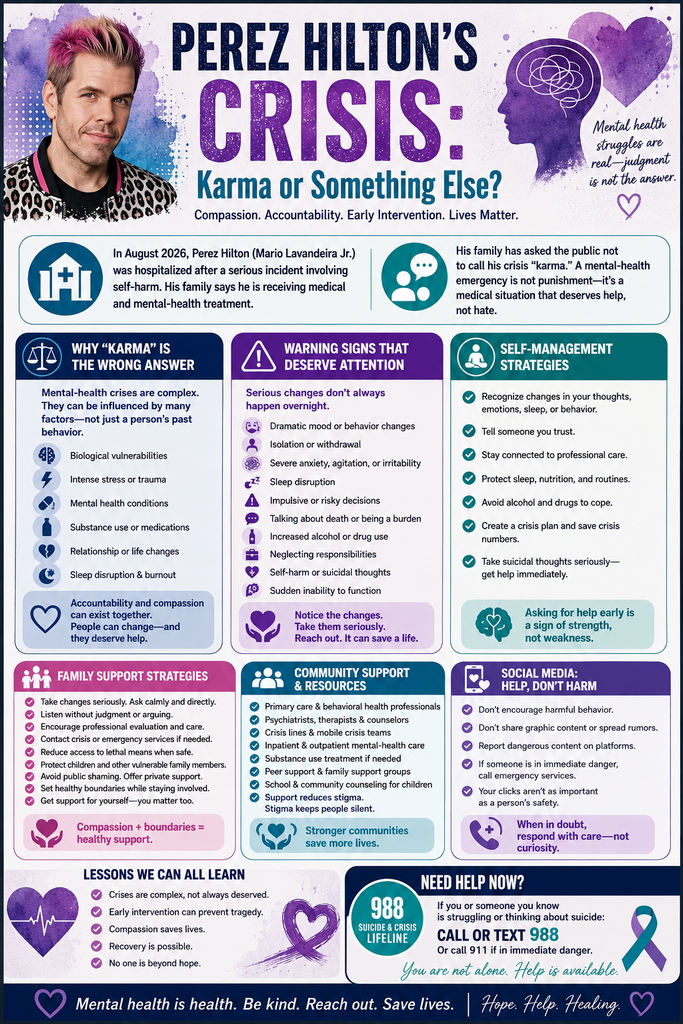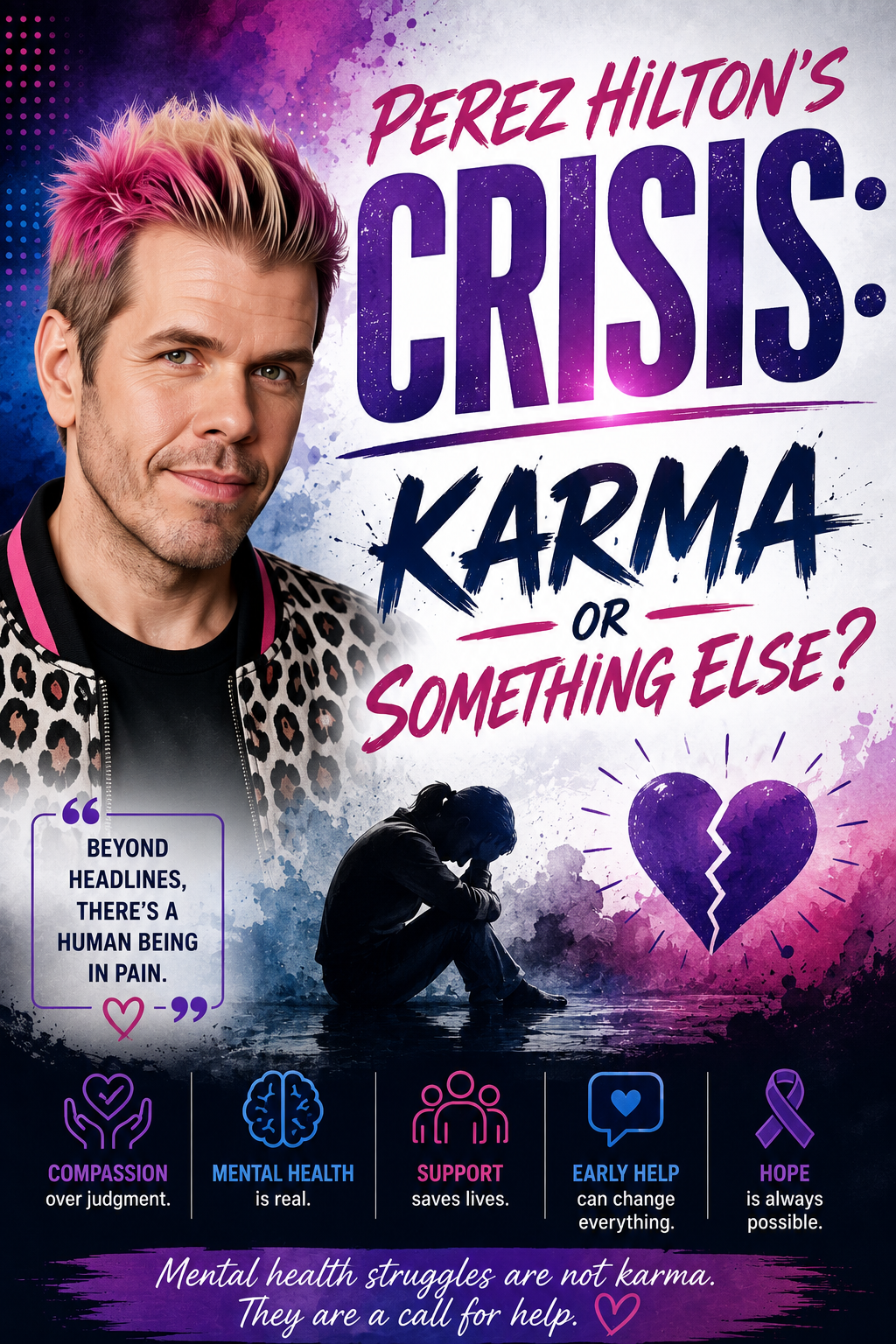
When a controversial public figure experiences a personal crisis, people may be tempted to describe the situation as “karma.” Perez Hilton’s recent mental-health crisis has prompted exactly that kind of reaction online. But a life-threatening mental-health emergency is not an appropriate moment for celebration, punishment, or amateur diagnosis. It is an opportunity to discuss compassion, accountability, psychological distress, family safety, and the importance of getting professional help.
Perez Hilton, whose real name is Mario Lavandeira Jr., became famous for celebrity gossip and provocative commentary. Over the years, he has also publicly addressed and apologized for aspects of his earlier behavior. In August 2026, Hilton was hospitalized following a serious incident involving self-harm. His family subsequently reported that he was receiving inpatient medical and mental-health care.
His family has specifically said that comments describing the crisis as “karma” have been painful. Whatever someone thinks about Hilton’s past behavior, a mental-health crisis should not be interpreted as proof that a person “deserved” to suffer.
Why “Karma” Is the Wrong Mental-Health Explanation
Attributing another person’s suffering to karma can create a comforting but misleading story: that bad behavior leads directly to bad outcomes. Human psychology is considerably more complicated.
Mental-health crises can involve combinations of biological vulnerability, severe stress, physical illness, major life changes, sleep disruption, relationship difficulties, trauma, substance use, medication issues, or psychiatric conditions. Without a complete clinical evaluation, outsiders cannot know what caused a particular person’s crisis.
Accountability and compassion can also exist together.
We can acknowledge that someone has hurt other people while recognizing that the person experiencing a medical or psychiatric emergency deserves appropriate treatment.
A Crisis Can Have Warning Signs
Serious psychological deterioration does not always appear suddenly. Changes may develop over days, weeks, or longer.
Warning signs that deserve attention can include:
- Dramatic changes in behavior or personality
- Increasing isolation
- Severe agitation, anxiety, or emotional instability
- Significant sleep disruption
- Impulsive or unusually risky decisions
- Expressions of hopelessness or feeling trapped
- Increasing alcohol or drug use
- Neglecting normal responsibilities
- Talking about death, suicide, or being a burden
- Self-harming behavior
- Sudden inability to function safely
No single behavior proves that someone has a psychiatric disorder. What matters is recognizing significant changes and taking them seriously.
Self-Management Strategies
When someone notices that their thoughts, emotions, or behavior are becoming increasingly difficult to manage, early action can be critical.
- Recognize changes in yourself. Pay attention to major changes in sleep, mood, thinking, impulsivity, anxiety, or daily functioning.
- Tell someone what is happening. Secrecy and isolation can make a crisis harder to manage.
- Stay connected with professional care. A primary-care clinician, therapist, psychiatrist, or other qualified professional can evaluate concerning changes.
- Protect sleep and routine. Regular sleep, meals, physical activity, and structured daily activities can support emotional stability.
- Avoid using alcohol or drugs to cope. Substances can worsen judgment and complicate psychiatric symptoms.
- Create a crisis plan. Identify trusted contacts, healthcare providers, crisis resources, and a safe environment before an emergency develops.
- Treat suicidal thoughts as urgent. Thoughts of suicide or serious self-harm require immediate attention rather than waiting to see whether they disappear.
Seeking help early is a form of intervention, not weakness.
Family Support Strategies
A severe mental-health crisis affects the entire family. Loved ones may experience fear, confusion, anger, guilt, and uncertainty about what to do next.
Families can:
- Take major behavioral changes seriously.
- Ask directly and calmly about safety and suicidal thoughts when concerned.
- Listen without turning the conversation into an argument.
- Encourage professional mental-health evaluation.
- Contact emergency or crisis services when there is immediate danger.
- Reduce access to potentially lethal means when it can be done safely.
- Protect children and other vulnerable family members from dangerous or traumatic situations.
- Avoid publicly shaming someone during or after a psychiatric emergency.
- Maintain reasonable boundaries while supporting treatment.
- Seek counseling or emotional support for themselves.
Family support does not mean ignoring harmful behavior. Healthy support combines compassion with safety, accountability, and appropriate boundaries.
Protecting Children During an Adult’s Crisis
Hilton’s situation also raises an important issue that can be overlooked when attention focuses exclusively on the individual in crisis: children may need support too.
According to Hilton’s family, children and other relatives were present shortly before the crisis escalated and were removed from the situation for their protection. Experiences involving frightening adult behavior can be distressing for children.
After a serious family crisis, caregivers should prioritize stability, predictable routines, age-appropriate explanations, reassurance, and professional support when needed. Children should never be expected to become the emotional caretaker of an adult experiencing a psychiatric emergency.
Community Support Strategies
Mental-health emergencies require more than individual willpower. Communities need systems capable of responding before distress becomes tragedy.
Helpful resources can include:
- Primary-care and behavioral-health professionals
- Psychiatrists and psychiatric nurse practitioners
- Licensed counselors and therapists
- Crisis-response teams
- Hospital emergency departments
- Inpatient psychiatric treatment when necessary
- Outpatient and intensive outpatient mental-health programs
- Substance-use treatment when alcohol or drugs are involved
- Peer-support and family-support organizations
- School and community counseling resources for affected children
- Suicide-prevention and crisis services
Communities can also help by reducing stigma. People are more likely to disclose frightening thoughts or worsening symptoms when they believe asking for help will lead to support rather than humiliation.
Social Media Is Not a Substitute for Crisis Care
Hilton’s situation also demonstrates a challenge of the social-media era. A person’s psychological deterioration can unfold before thousands of viewers in real time.
When someone appears to be in immediate danger online, viewers should not encourage the behavior, repost graphic material for entertainment, or treat the situation as a spectacle. Reporting dangerous content through the platform and contacting emergency services when sufficient identifying information is available may help initiate a real-world response.
The goal should be safety—not views, screenshots, gossip, or viral content.
Accountability Does Not Require Cruelty
Perez Hilton has spent much of his career discussing the lives and mistakes of other public figures. That history inevitably influences how some people respond to his own difficulties.
But there is an important distinction between accountability and retaliation.
Accountability means acknowledging the harm, accepting responsibility, making changes, and repairing what can be repaired.
Cruelty says: You hurt others, so you deserve to suffer.
Mental-health advocacy should reject the second message.
A person’s previous mistakes do not make self-harm, suicide, addiction, or psychiatric deterioration acceptable forms of punishment.
What Perez Hilton’s Crisis Can Teach Us
The most constructive lesson is not whether someone received “karma.” It is how we respond when another human being becomes psychologically unsafe.
A crisis can remind us to recognize behavioral changes earlier, listen when someone says they are struggling, protect children and family members, involve professionals when necessary, and resist turning another person’s darkest moment into entertainment.
It can also remind public figures—and everyone else—that professional success does not create immunity from mental-health problems.
Conclusion
Perez Hilton’s crisis should not become a debate about whether suffering was deserved. Based on publicly available information, the exact clinical explanation for what happened should be left to the professionals caring for him rather than being diagnosed from social media footage or headlines.
The broader lesson applies far beyond one celebrity: mental-health emergencies require intervention, safety, treatment, and compassion.
We can hold people accountable for past behavior without celebrating their suffering. We can protect family members without abandoning the person in crisis. And we can recognize that sometimes the most important response to alarming behavior is not judgment but a simple question:
“Are you safe, and how can we get you help?”
If someone is in immediate danger or experiencing suicidal thoughts in the United States, call or text 988 for the Suicide & Crisis Lifeline, or call 911 for an immediate life-threatening emergency.
Frequently Asked Questions
Here are some common questions:
1. What happened to Perez Hilton?
According to public reports in August 2026, Perez Hilton experienced a serious crisis that led to hospitalization. His family indicated that he was receiving medical and mental health care. Because his complete medical information is private, it is important not to speculate about a specific diagnosis.
2. Why are some people calling his crisis “karma”?
Perez Hilton built a career around provocative celebrity commentary and has faced criticism for how he treated some public figures. Consequently, some people have interpreted his current difficulties as consequences for his past behavior. However, describing a mental-health emergency as “karma” can stigmatize psychological distress and imply that someone deserves to suffer.
3. Is a mental-health crisis a form of karma?
There is no medical or psychological basis for diagnosing a mental-health crisis as “karma.” Mental-health emergencies can result from complex interactions among psychological, biological, social, environmental, and situational factors.
4. Can we hold someone accountable while still showing compassion?
Yes. Accountability and compassion are not opposites. Someone can be expected to acknowledge harmful behavior and make amends while still deserving appropriate medical care, safety, dignity, and humane treatment during a crisis.
5. Does Perez Hilton have a specific mental-health disorder?
The public should not diagnose him based on social-media posts, videos, or news reports. Only qualified healthcare professionals with access to an individual’s history and clinical evaluation can make an appropriate diagnosis.
6. What warning signs may indicate a mental-health crisis?
Potential warning signs can include:
- Major or unusual changes in behavior
- Severe agitation or emotional distress
- Increasing isolation
- Significant sleep disturbances
- Hopelessness or feeling trapped
- Increased alcohol or drug use
- Impulsive or dangerous behavior
- Talking about death or suicide
- Self-harming behavior
- Difficulty functioning or remaining safe
These signs do not automatically indicate a particular diagnosis, but significant or rapidly worsening changes should be taken seriously.
7. Why is early intervention important?
Early intervention may prevent psychological distress from escalating into self-harm, suicide attempts, hospitalization, substance misuse, or other dangerous situations. Treatment can begin before someone reaches a perceived “rock bottom.”
8. What should someone do if they recognize a crisis developing in themselves?
Tell a trusted person and seek professional assistance as soon as possible. Staying connected with healthcare providers, maintaining basic routines, avoiding alcohol and recreational drugs, and having a crisis or safety plan can also help. Immediate danger requires emergency assistance.
9. How should family members respond to alarming behavior?
Family members should take concerning behavioral changes seriously and approach the individual calmly. They can listen without ridicule, ask directly about safety when appropriate, encourage professional evaluation, and obtain emergency assistance when there is immediate danger.
10. Should families ask directly about suicide?
Yes. Asking someone directly whether they are thinking about suicide does not cause suicidal thoughts. A direct question can provide an opportunity for someone to disclose what they are experiencing and receive appropriate help.
11. What role should social media play during someone’s crisis?
Social media should not become an audience for someone’s most vulnerable moments. Viewers should avoid encouraging dangerous behavior, spreading rumors, sharing graphic material, or attempting to diagnose the person. Dangerous content can be reported to the platform, and emergency services may be appropriate when someone appears to be in immediate danger.
12. Can past harmful behavior contribute to emotional distress later?
Past actions can have psychological and social consequences, including damaged relationships, regret, guilt, criticism, and conflict. However, those possibilities should not be used to claim that a particular event caused someone’s psychiatric crisis without clinical evidence.
13. Why is the word “karma” potentially harmful in conversations about mental health?
It can imply that depression, self-harm, addiction, or another psychological crisis is deserved punishment. Someone hearing that message may become more ashamed or reluctant to seek help for their own symptoms.
14. What community resources can help someone experiencing a mental-health crisis?
Resources may include primary care clinicians, therapists, psychiatrists, crisis response teams, emergency departments, inpatient or outpatient behavioral health programs, substance use treatment services, peer support organizations, and community mental health centers.
15. What is the main lesson from Perez Hilton’s situation?
The larger lesson is that accountability does not require cruelty. We can disagree with someone’s behavior, acknowledge any harm they may have caused, and still respond humanely when that person is experiencing a serious crisis.
A mental-health emergency should prompt concern about safety, professional evaluation, treatment, support, and early intervention—not public celebration of another person’s suffering.
Video: Why We Need To Talk About The Perez Hilton Hate #truth #popculture #mentalhealth