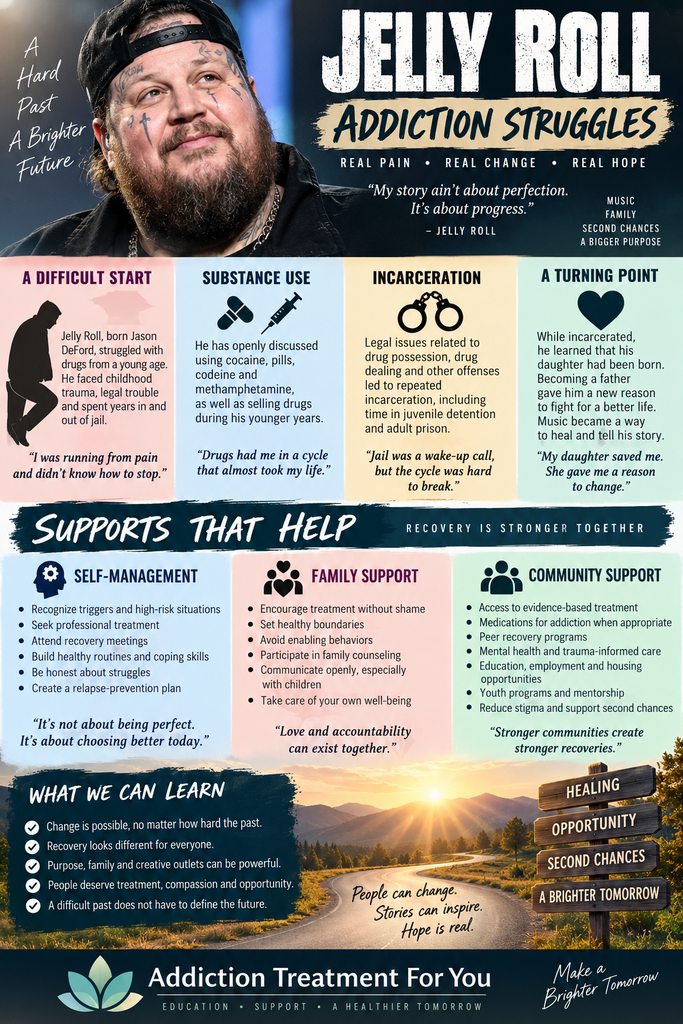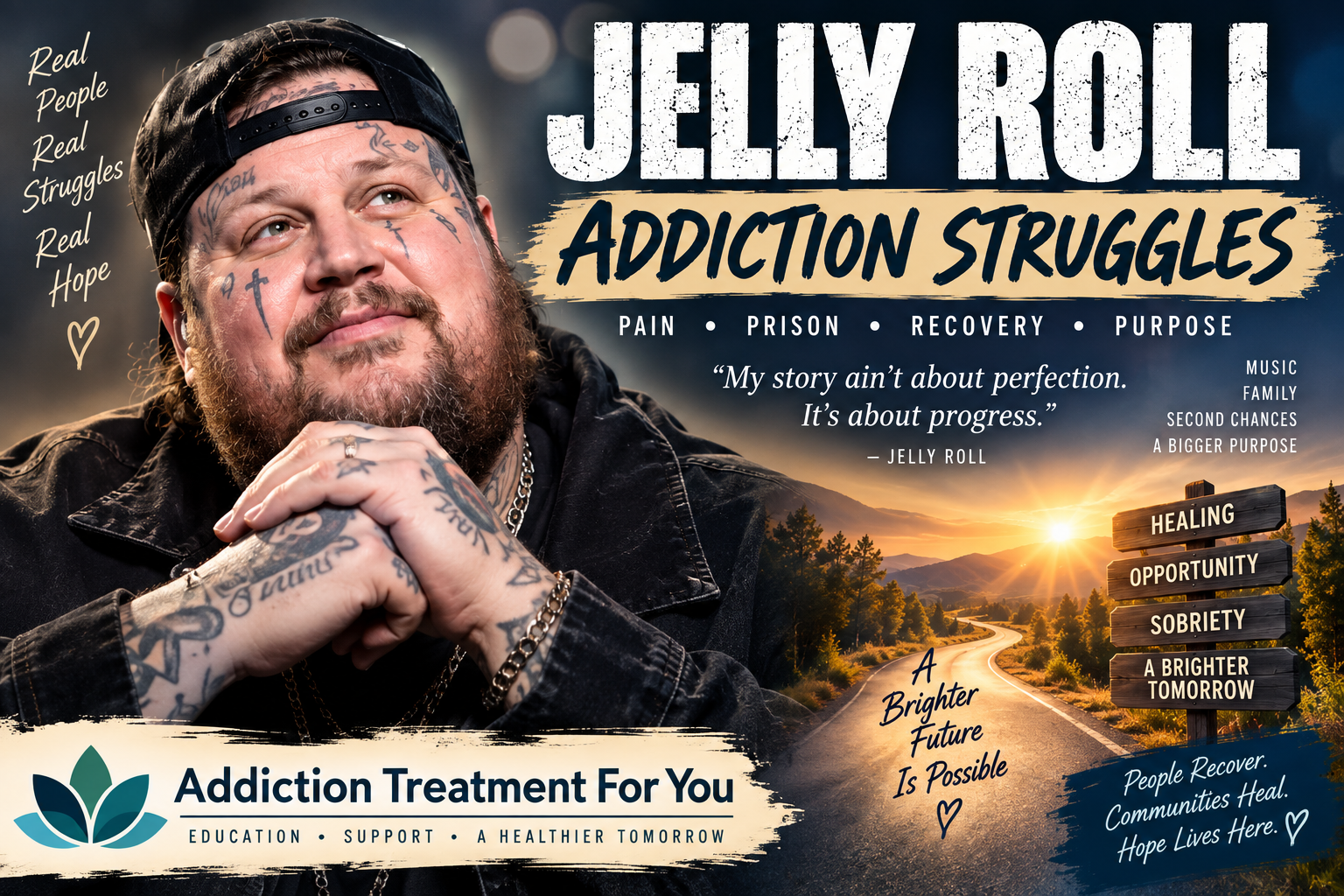
Jelly Roll, born Jason DeFord, has built much of his music around addiction, incarceration, regret, family, and personal change. Long before becoming a successful country artist, he experienced repeated incarceration and heavy drug use. He has publicly discussed using substances including cocaine, pills, codeine, and methamphetamine during his younger years. He has also described selling drugs and spending years cycling through the criminal justice system.
His story is important because it shows that recovery does not always follow a simple or perfectly straight path. Jelly Roll has said that he stopped using substances he believed were likely to kill him, including cocaine, pills, and codeine. At the same time, he has been careful not to describe himself as completely sober because he has continued to acknowledge alcohol and marijuana use.
Addiction, Incarceration, and a Turning Point
Jelly Roll began getting into serious trouble while he was young. He has described entering juvenile detention as a teenager and spending much of the following decade moving in and out of correctional facilities. Drug possession, drug dealing, failed drug tests, and other offenses became part of a destructive cycle.
One of his biggest turning points occurred while he was incarcerated. A correctional officer told him that his daughter had been born. Jelly Roll has described fatherhood as a major motivation to reconsider the direction of his life. Music eventually became one of the pathways through which he could build a different future.
His transformation did not mean that every struggle disappeared. Instead, his public story illustrates how recovery may involve gradually changing behaviors, recognizing dangerous patterns, accepting responsibility, and developing healthier sources of meaning.
Self-Management Strategies
People experiencing substance use problems need an individualized treatment plan rather than simply copying a celebrity’s recovery path. Helpful self-management strategies can include:
- Recognize high-risk substances and situations. Identifying which people, environments, emotions, and substances trigger loss of control can help interrupt the cycle before it escalates.
- Seek professional treatment. Addiction treatment may include medical evaluation, counseling, behavioral therapies, medications for certain substance use disorders, and ongoing recovery support.
- Build accountability. Regular contact with counselors, recovery groups, sponsors, peers, or trusted individuals can reduce the likelihood of isolation.
- Develop healthier coping skills. Exercise, music, journaling, meditation, hobbies, and structured routines can provide alternatives for managing stress and difficult emotions.
- Address shame without ignoring responsibility. A person can acknowledge past harm while still believing that change is possible.
- Create a relapse-prevention plan. Knowing triggers, warning signs, emergency contacts, and specific actions to take when cravings intensify can provide structure during vulnerable periods.
Jelly Roll has said that he still attends recovery meetings even though he does not describe himself as traditionally or completely sober. His comments highlight an important distinction: one person’s approach should not automatically be treated as the appropriate recovery goal for someone else.
Family Support Strategies
Addiction affects entire families. Jelly Roll has spoken publicly about addiction within his family and about the effect substance use can have on children. Family support can be powerful, but support does not require ignoring harmful behavior.
Families can help by:
- Learning that substance use disorder is a treatable health condition rather than simply a failure of character.
- Encouraging professional treatment without humiliation or constant criticism.
- Establishing clear boundaries around money, housing, substance use, and unacceptable behavior.
- Avoiding behaviors that unintentionally make continued substance use easier.
- Participating in family counseling or family recovery programs when appropriate.
- Talking honestly with children in developmentally appropriate ways.
- Recognizing that family members also deserve counseling, rest, and emotional support.
Love and accountability can exist together. Families cannot force another person to recover, but they can create an environment that supports treatment while protecting their own well-being.
Community Support Strategies
Jelly Roll’s journey also illustrates why recovery extends beyond the individual. He has used his platform to discuss addiction, fentanyl, incarceration, and rehabilitation and has supported programs for young people. He has spoken about wanting rehabilitation and opportunities for at-risk youth rather than relying exclusively on punishment.
Communities can strengthen recovery by:
- Expanding affordable access to evidence-based addiction treatment.
- Providing medications for opioid and alcohol use disorders when clinically appropriate.
- Making naloxone widely available and teaching people how to respond to an overdose.
- Supporting peer-recovery specialists and recovery community organizations.
- Improving mental-health services and trauma-informed care.
- Creating education, employment, and housing opportunities for people rebuilding their lives after addiction or incarceration.
- Developing youth programs that provide mentorship, creative outlets, and alternatives to substance use.
- Reducing stigma so people feel safer asking for help before reaching a crisis.
What We Can Learn From Jelly Roll’s Journey
Jelly Roll’s story should not be viewed as a universal blueprint for sobriety. His own public descriptions make clear that his recovery does not fit a traditional abstinence model. What his experience can demonstrate is that people can make substantial changes after years of substance use, incarceration, and destructive behavior.
Recovery can involve more than stopping a substance. It may require rebuilding relationships, learning new coping skills, finding meaningful work, accepting responsibility for past decisions, and developing a sense of purpose.
Conclusion
Jelly Roll’s journey from addiction and repeated incarceration to music, fatherhood, and advocacy demonstrates how dramatically a person’s direction can change. Becoming a father helped motivate him to reconsider his future, while music gave him an outlet for experiences involving addiction, shame, pain, and redemption. Today, he also uses his public platform to discuss addiction and the need for rehabilitation and community support.
The larger lesson is not that everyone should follow Jelly Roll’s particular path. Addiction recovery is highly individual. Evidence-based treatment, healthy coping strategies, supportive families, and accessible community resources can work together to give people a stronger foundation for lasting change. A difficult past can remain part of someone’s story without determining every chapter that follows.
Frequently Asked Questions
Here are some common questions:
1. Who is Jelly Roll?
Jelly Roll, whose real name is Jason DeFord, is an American singer-songwriter known for blending country, rock, and hip-hop. He has spoken publicly about his past experiences with substance use, incarceration, and rebuilding his life.
2. What substances has Jelly Roll struggled with?
Jelly Roll has publicly discussed past use of cocaine, pills, codeine, and other drugs. He has described a period of his life in which substance use, drug dealing, and legal problems became interconnected.
3. Has Jelly Roll struggled with addiction since he was young?
He has described becoming involved with drugs and the criminal justice system during adolescence. His experiences included juvenile detention followed by repeated periods of incarceration as a young adult.
4. Did Jelly Roll go to prison because of drugs?
Drug-related offenses were among the legal problems he has discussed publicly. His criminal history also included other offenses, so it is more accurate to describe incarceration as part of a broader pattern of legal difficulties rather than attributing every incarceration solely to addiction.
5. What was a major turning point in Jelly Roll’s life?
Jelly Roll has described learning that his daughter had been born while he was incarcerated as an important turning point. Fatherhood gave him additional motivation to change the direction of his life.
6. Is Jelly Roll completely sober today?
Jelly Roll has not consistently described himself as completely abstinent from all substances. He has publicly discussed stopping drugs he considered especially dangerous while also acknowledging continued alcohol and marijuana use. For that reason, his personal approach should not be presented as a universal model of sobriety.
7. Does Jelly Roll attend recovery meetings?
He has publicly discussed attending Alcoholics Anonymous meetings and visiting recovery communities. Recovery meetings can provide connection and support, although treatment needs vary from person to person.
8. How did music help Jelly Roll?
Music became an important way for Jelly Roll to express experiences involving addiction, incarceration, regret, relationships, and personal change. Creative activities can be valuable coping tools, although they are not substitutes for professional addiction treatment when treatment is needed.
9. What self-management strategies can help someone struggling with addiction?
Helpful strategies may include identifying triggers, creating structured routines, avoiding high-risk situations, developing healthier coping skills, attending treatment or recovery meetings, and creating a relapse-prevention plan. Treatment should be individualized, particularly when withdrawal or overdose risks are present.
10. How can families support someone with addiction?
Families can learn about substance use disorders, encourage evidence-based treatment, communicate without humiliation, establish healthy boundaries, avoid enabling harmful behaviors, and consider family counseling. Family members should also protect their own physical and emotional well-being.
11. Why is community support important in recovery?
Recovery can be strengthened by accessible healthcare, counseling, peer recovery programs, medications for substance use disorders when appropriate, naloxone availability, stable housing, education, employment opportunities, and supportive social relationships.
12. Does relapse mean treatment has failed?
No. Substance use disorders can involve recurrence of symptoms. A return to substance use should be taken seriously, but it can signal that treatment or the recovery plan needs to be reassessed rather than proving that recovery is impossible.
13. What can people learn from Jelly Roll’s story?
His public story illustrates that a history involving substance use and incarceration does not prevent someone from making significant changes later in life. It also demonstrates that recovery experiences differ, so one celebrity’s approach should not replace individualized medical and behavioral healthcare.
14. Why does Jelly Roll talk openly about his past?
He has incorporated his experiences with addiction, incarceration, family, and change into his music and public advocacy. Speaking openly about these experiences can contribute to conversations about stigma, rehabilitation, and second chances.
15. What is the main message behind Jelly Roll’s addiction journey?
One useful takeaway is that meaningful change can occur even after years of harmful behavior. Recovery can involve treatment, accountability, healthier coping strategies, supportive relationships, purpose, and continued effort—and there is no single recovery pathway that works for everyone.
Video: Jelly Roll’s Daughter: The Reason He Changed Everything