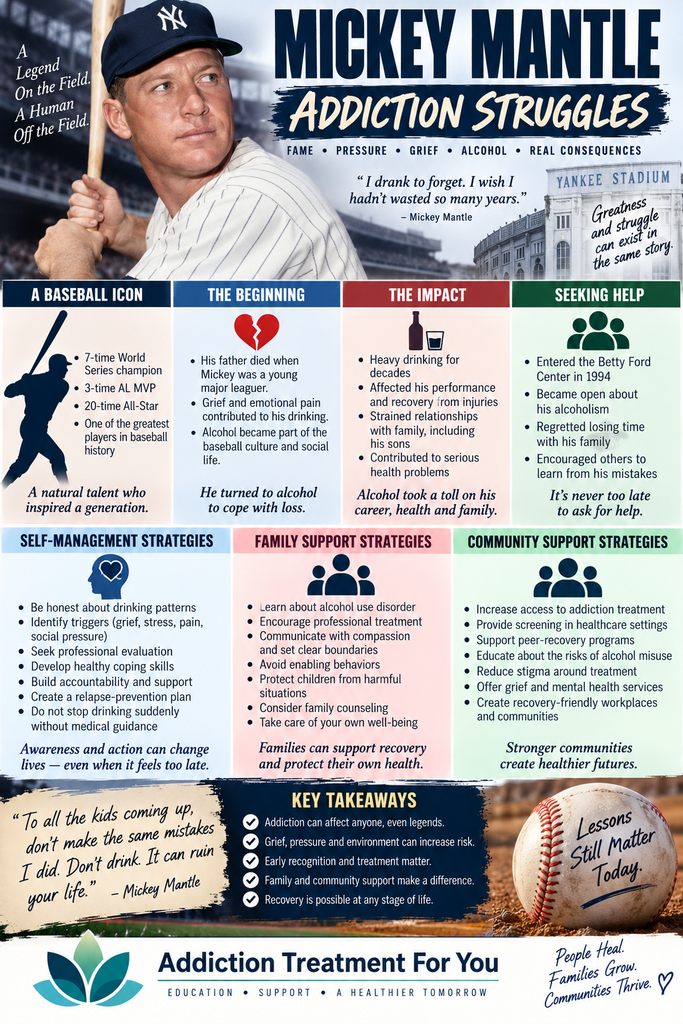
Mickey Mantle was one of baseball’s most celebrated players, but behind his extraordinary career was a decades-long struggle with alcohol. The New York Yankees star later acknowledged that heavy drinking damaged his health, affected his relationships, and likely shortened his playing career. Mantle eventually entered treatment at the Betty Ford Center in 1994 and became publicly candid about his alcoholism and regrets.
His story offers an important lesson about addiction: exceptional talent, fame, money, and professional success do not protect someone from developing a substance use disorder. It also demonstrates how addiction can affect an entire family and why seeking treatment sooner can make an enormous difference.
How Mickey Mantle’s Drinking Began
Mantle described his father’s death as an important point in the development of his drinking. His father, Elvin “Mutt” Mantle, died from Hodgkin lymphoma shortly after Mickey’s first season with the Yankees. Mantle later said he was devastated by the loss and used alcohol partly as an escape from his grief.
Drinking also became embedded in the social environment surrounding professional baseball during that era. Mantle eventually recognized that his alcohol use interfered with rehabilitation from injuries and contributed to lost opportunities during his career.
When Drinking Became a Family Problem
Mantle’s alcoholism did not affect him alone. His family later described the consequences in A Hero All His Life, a memoir written by his wife Merlyn and their sons. His sons also experienced serious problems involving alcohol or other substances, and Mantle later expressed regret that drinking had often replaced healthier father-son relationships.
After treatment, Mantle acknowledged that he had behaved more like a drinking companion than a father to his sons and said that the relationship had begun to change once he became sober.
This illustrates an important principle in addiction care: substance use disorders frequently have consequences throughout the family system. Partners and children may experience instability, conflict, emotional distance, enabling behaviors, or their own substance-related problems.
Mickey Mantle Finally Sought Treatment
After approximately four decades of heavy drinking, Mantle entered the Betty Ford Center in 1994. Reports from the period indicate that medical warnings about the seriousness of his alcohol-related health problems helped push him toward treatment.
His recovery came late in his life. In 1995, Mantle was seriously ill with cirrhosis, hepatitis, and liver cancer and underwent a liver transplant. He died from cancer on August 13, 1995, at age 63.
His medical history should not be simplified into the claim that alcohol alone caused everything that happened to him. His illnesses involved multiple medical factors. What is well documented is that Mantle himself came to recognize the serious consequences of his drinking.
Self-Management Strategies for Addiction
Mantle’s experience demonstrates why recognizing an alcohol problem early is so important. Someone struggling with alcohol does not need to wait until severe medical, occupational, or family consequences develop before seeking help.
Helpful self-management strategies can include:
- Recognize patterns honestly. Track when, why, and how much alcohol is being consumed.
- Identify triggers. Grief, loneliness, stress, social pressure, pain, and major life transitions can contribute to drinking.
- Seek professional assessment. A healthcare professional can evaluate alcohol use, withdrawal risk, mental health, medications, and physical complications.
- Develop healthier coping mechanisms. Exercise, counseling, structured activities, hobbies, mindfulness, and meaningful relationships can provide alternatives to drinking.
- Build accountability. Treatment programs, recovery meetings, counselors, sponsors, and trusted friends can provide continued support.
- Create a relapse-prevention plan. Identify triggers, warning signs, coping strategies, and people to contact before a crisis occurs.
People who drink heavily or regularly should not necessarily stop suddenly without medical guidance, because alcohol withdrawal can sometimes become severe or life-threatening.
Family Support Strategies
Mantle’s story is particularly powerful when viewed through his family’s experiences. Addiction can gradually change what becomes considered “normal” within a household.
Families can support recovery by:
- Learning about alcohol use disorder as a treatable medical condition.
- Encouraging professional treatment rather than relying solely on promises to stop.
- Communicating concerns when the person is sober and the situation is safe.
- Establishing clear boundaries around unacceptable behavior.
- Avoiding covering up consequences caused by drinking.
- Participating in family counseling or support programs.
- Protecting children from unsafe or unpredictable situations.
- Seeking emotional support for themselves rather than focusing exclusively on the person drinking.
Supporting someone does not require protecting them from every consequence of their substance use. Healthy boundaries can coexist with compassion.
Community Support Strategies
Mantle’s experience occurred during an era when addiction was often hidden, minimized, or treated primarily as a personal weakness. Modern communities have more opportunities to approach alcohol use disorder through healthcare, prevention, treatment, and recovery support.
Communities can help by:
- Expanding access to affordable addiction and mental-health treatment.
- Providing screening for unhealthy alcohol use in healthcare settings.
- Increasing access to evidence-based behavioral therapies.
- Providing medications for alcohol use disorder when medically appropriate.
- Supporting peer-recovery and mutual-help programs.
- Offering grief and trauma counseling.
- Educating families about addiction and enabling behaviors.
- Supporting recovery-friendly employment and community programs.
- Reducing stigma surrounding treatment and relapse.
What Mickey Mantle’s Story Can Teach Us
Mantle achieved extraordinary success while experiencing serious problems with alcohol. That combination can make addiction particularly difficult for families and outsiders to recognize. Someone may continue working, earning money, maintaining relationships, or achieving professional success while still experiencing a serious substance use disorder.
His later willingness to discuss his mistakes also mattered. Shortly before his death, Mantle publicly warned young people not to follow his example and expressed regret about how he had treated his health and family.
His story should not be remembered simply as one of athletic greatness followed by illness. It can also help families understand how denial, grief, social environments, family dynamics, and delayed treatment can interact with addiction.
Conclusion
Mickey Mantle’s struggle with alcoholism reminds us that addiction can exist behind extraordinary achievement. For decades, alcohol was intertwined with his grief, social life, baseball career, health, and family relationships. Treatment eventually brought sobriety and greater recognition of what his drinking had cost him, although that realization came relatively late in his life.
For people and families facing similar struggles today, the message need not be one of hopelessness. Early recognition, professional treatment, healthier coping strategies, family boundaries, and strong community resources can change the course of addiction. A person does not have to wait for a medical crisis, broken relationship, or other devastating consequence before asking for help.
Frequently Asked Questions
Here are some common questions:
1. Did Mickey Mantle struggle with alcoholism?
Yes. Mickey Mantle publicly acknowledged that he had a serious drinking problem. Alcohol was part of his life for decades, including during and after his legendary baseball career with the New York Yankees.
2. When did Mickey Mantle begin drinking heavily?
Mantle drank during his years as a professional baseball player, and his alcohol use became increasingly problematic over time. Drinking was also common within parts of the professional baseball culture of his era.
3. Did grief contribute to Mickey Mantle’s drinking?
Mantle spoke about the devastating effect of losing his father, Elvin “Mutt” Mantle, who died of Hodgkin lymphoma in 1952. Grief and emotional pain can contribute to unhealthy substance use, although addiction usually develops through a combination of biological, psychological, social, and environmental factors.
4. Did alcohol affect Mickey Mantle’s baseball career?
Mantle later expressed regret about his drinking and believed it interfered with his health and ability to take better care of himself. Despite these problems, he had an extraordinary career that included three American League MVP awards, 20 All-Star selections, and seven World Series championships.
5. How did alcoholism affect Mickey Mantle’s family?
Mantle’s drinking affected his relationships with his wife and sons. Members of his family later discussed addiction within the household, demonstrating how a substance use disorder can have consequences extending well beyond the individual.
6. Did Mickey Mantle’s sons also experience addiction problems?
Yes. Substance-related problems affected members of the Mantle family, including his sons. This does not mean that a parent’s addiction automatically causes addiction in a child. Substance use disorders can involve a complex interaction of genetics, environment, stress, learned behaviors, and individual circumstances.
7. When did Mickey Mantle seek treatment for alcoholism?
Mantle entered the Betty Ford Center for alcohol treatment in 1994, when he was in his early 60s. He subsequently became much more open publicly about his alcoholism and the consequences of his drinking.
8. Did Mickey Mantle become sober?
Mantle reported becoming sober after entering treatment. His experience demonstrates that people can seek recovery even after decades of problematic alcohol use.
9. Did alcohol cause Mickey Mantle’s liver disease?
Mantle developed severe liver disease, including cirrhosis, and later liver cancer. Heavy alcohol consumption was an important part of his medical history, but his complex illnesses should not be reduced to a single cause. He underwent a liver transplant in 1995 and died later that year.
10. What self-management strategies can help someone struggling with alcohol?
Recognizing drinking patterns, identifying triggers, seeking professional assessment, developing healthier coping skills, addressing grief or mental-health concerns, building a support network, and creating a relapse-prevention plan can all help. People with significant alcohol dependence should seek medical advice before abruptly stopping because severe alcohol withdrawal can be dangerous.
11. How can families help someone with alcohol addiction?
Families can learn about alcohol use disorder, encourage evidence-based treatment, communicate concerns without humiliation, establish healthy boundaries, avoid enabling harmful behavior, and consider counseling or family support programs. Family members also need to protect their own emotional and physical health.
12. What community resources can support alcohol recovery?
Communities can provide medical care, addiction counseling, peer-recovery programs, mutual-help groups, mental-health services, family education, and medications for alcohol use disorder when clinically appropriate. Accessible treatment can help people receive care before severe consequences occur.
13. Does someone have to “hit rock bottom” before getting treatment?
No. A person can seek treatment at any stage of an alcohol problem. Waiting for a medical emergency, job loss, arrest, or family crisis can allow preventable harm to accumulate.
14. What did Mickey Mantle say about his drinking near the end of his life?
After becoming seriously ill, Mantle spoke publicly about regretting his lifestyle and warned younger people against repeating his mistakes. His willingness to discuss his past became an important part of his final public message.
15. What can we learn from Mickey Mantle’s addiction journey?
Mantle’s story demonstrates that extraordinary talent, wealth, popularity, and professional success do not make someone immune to addiction. It also shows why early recognition, professional treatment, family support, healthier coping mechanisms, and community resources matter.
16. What is the most important message for families?
Addiction does not have to remain hidden because someone appears successful on the outside. Families can respond with compassion while maintaining boundaries and encouraging treatment. Asking for help earlier can provide more opportunities to protect health, relationships, and quality of life.
Video: Why fame couldn’t save Mickey Mantle #celebrity #addiction #history