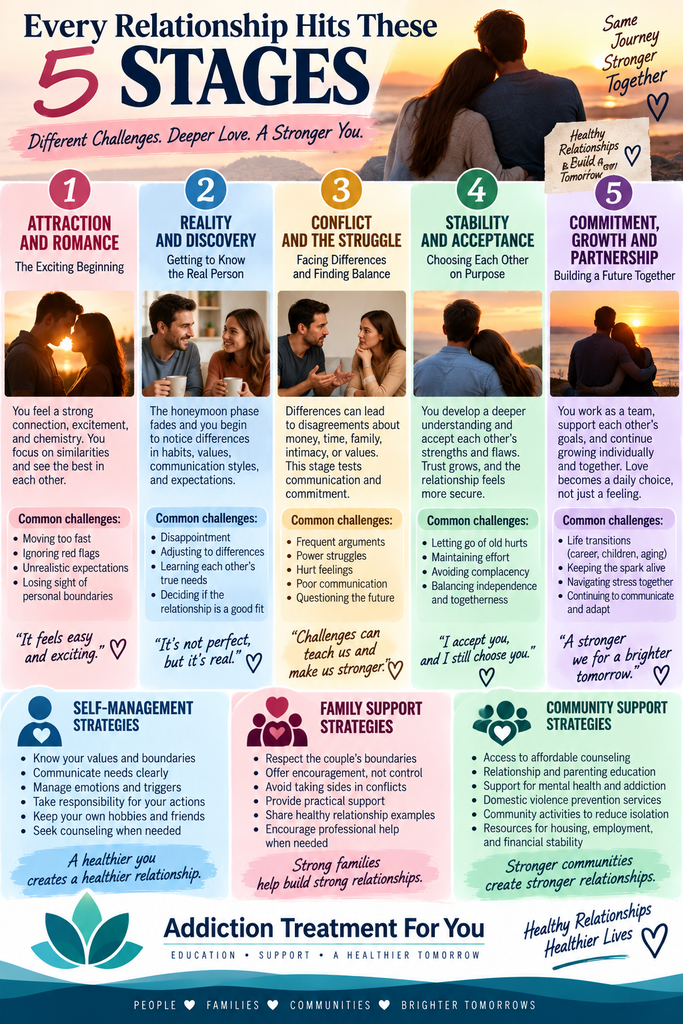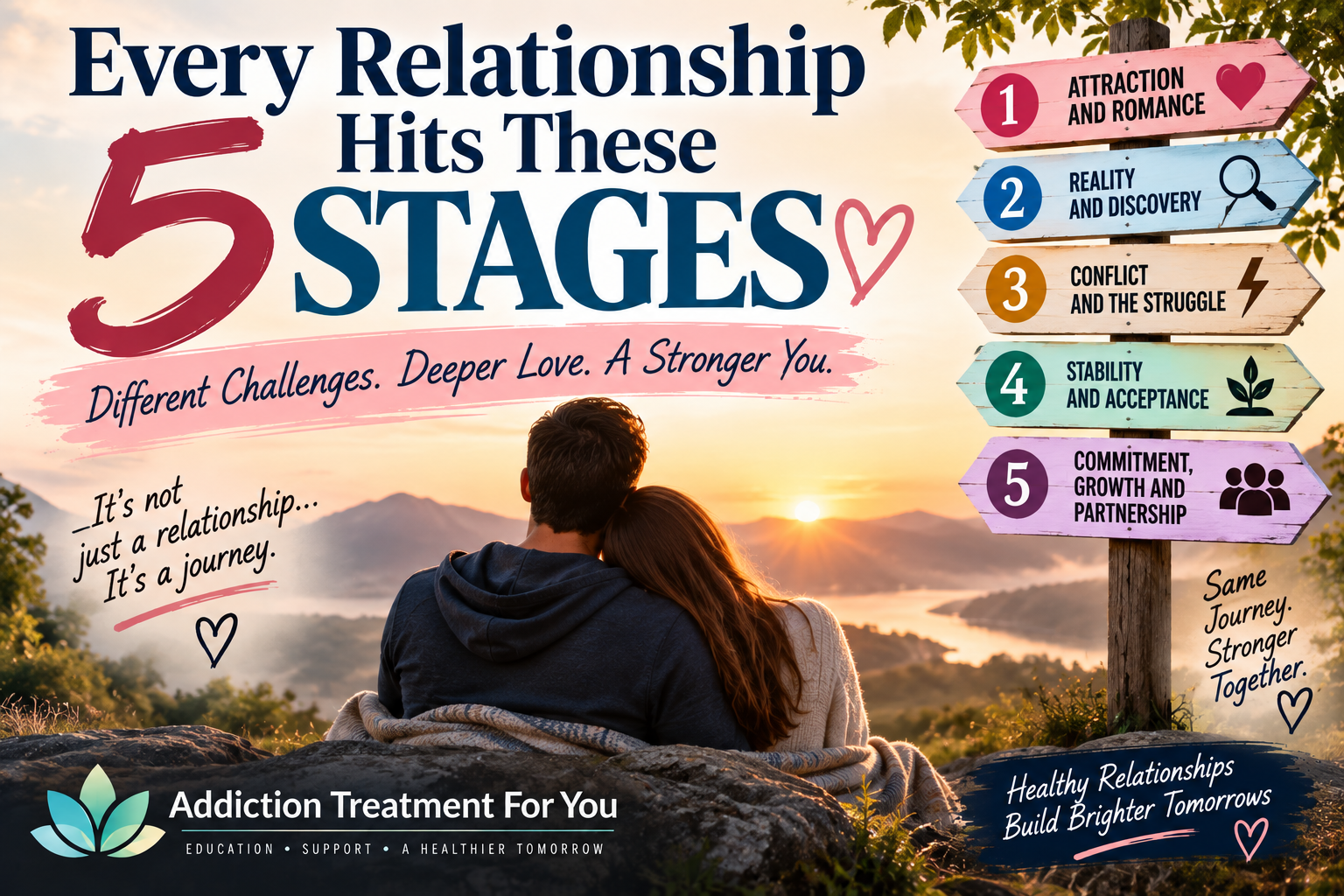
Relationships rarely stay exactly as they were at the beginning. Excitement may eventually give way to familiarity, differences become more noticeable, conflicts emerge, and couples must decide how they will grow together. Although there is no scientifically established rule that every relationship passes through exactly five stages, a five-stage framework can be a helpful way to understand common changes that occur in long-term relationships.
Rather than assuming that conflict means love is disappearing, understanding these stages can help partners recognize that healthy relationships require communication, boundaries, flexibility, and continued effort.
Stage 1: Attraction and Romance
The beginning of a relationship is often filled with excitement, curiosity, affection, and strong attraction. Partners may focus heavily on their similarities while overlooking differences.
During this period, people may spend significant amounts of time together and feel unusually optimistic about the relationship. Everything can seem easier because many of life’s harder questions have not yet emerged.
Healthy strategies during this stage include:
- Enjoy the excitement without rushing major decisions.
- Continue maintaining friendships, hobbies, and personal interests.
- Communicate honestly about values and expectations.
- Pay attention to behavior rather than relying only on chemistry.
- Respect each other’s boundaries.
- Avoid assuming intense attraction automatically means long-term compatibility.
Romance is valuable, but a sustainable relationship eventually needs more than attraction.
Stage 2: Reality and Discovery
As the relationship becomes more familiar, idealization often decreases. Partners begin to notice habits, personality differences, communication styles, financial attitudes, family expectations, and emotional needs that were less obvious at first.
This transition can feel disappointing if someone expects the honeymoon period to last forever.
A partner might begin wondering, “Why aren’t things like they were before?”
Nothing necessarily has gone wrong. The relationship may simply be becoming more realistic.
This is when couples begin learning whether they can accept differences without constantly trying to change each other.
Stage 3: Conflict and the Power Struggle
Differences can eventually create conflict. Couples may argue about money, intimacy, household responsibilities, parenting, work, relatives, friendships, technology, jealousy, or how much time they spend together.
Conflict itself does not automatically indicate an unhealthy relationship. How people handle conflict matters considerably.
Helpful conflict-management strategies include:
- Discuss one problem at a time.
- Avoid insults, humiliation, threats, and name-calling.
- Listen before preparing a response.
- Take temporary breaks when emotions become overwhelming.
- Clearly communicate needs rather than expecting mind-reading.
- Accept responsibility when you have caused harm.
- Look for solutions rather than trying to win every disagreement.
Repeated intimidation, coercive control, threats, or violence should not be dismissed as an ordinary relationship stage.
Stage 4: Stability and Acceptance
Couples who successfully work through differences may develop greater stability. Instead of expecting a partner to be perfect, each person develops a more realistic understanding of the other’s strengths, weaknesses, preferences, and limitations.
The relationship may feel less intense than during the honeymoon period, but it can become emotionally deeper.
Trust develops through repeated experiences of reliability.
Partners begin understanding that healthy love can mean:
“I know who you are, and I continue choosing to build this relationship with you.”
Stability should not mean ignoring serious problems. Acceptance means recognizing ordinary human imperfections while maintaining appropriate boundaries.
Stage 5: Commitment, Growth, and Partnership
Long-term commitment involves creating a shared life while allowing both people to continue developing individually.
Couples may face children, aging parents, career changes, financial difficulties, illnesses, grief, retirement, relocation, or other major transitions. Each change can temporarily challenge the relationship.
Healthy partnerships adapt rather than expecting everything to remain unchanged.
At this stage, love becomes increasingly intentional. Partners continue creating connection through affection, communication, shared experiences, intimacy, appreciation, and mutual support.
Self-Management Strategies
A healthy relationship begins partly with understanding yourself. Partners cannot control one another, but they can take responsibility for their own behaviors and emotional responses.
Helpful self-management strategies include:
- Identify your emotional triggers.
- Learn to regulate anger before responding.
- Communicate needs directly.
- Maintain friendships and interests outside the relationship.
- Examine unrealistic expectations about love.
- Recognize patterns learned from previous relationships or childhood.
- Apologize when appropriate and change the behavior connected to the apology.
- Maintain healthy personal boundaries.
- Seek counseling when recurring patterns become difficult to change independently.
Self-awareness can turn the question from “Why does my partner keep making me feel this way?” toward “What is happening between us, and what can I control about my response?”
Family Support Strategies
Extended families can either strengthen or complicate romantic relationships. Parents, siblings, children, and other relatives may influence expectations, traditions, finances, childcare, and major decisions.
Families can support healthy relationships by:
- Respecting the couple’s boundaries.
- Avoiding unnecessary involvement in disagreements.
- Providing support without automatically taking sides.
- Respecting cultural and family differences.
- Offering practical assistance during stressful periods.
- Avoiding pressure to remain in an unsafe relationship.
- Encouraging professional counseling when appropriate.
- Respecting the couple’s need to make their own decisions.
Support should strengthen a couple’s ability to solve problems rather than allowing relatives to control the relationship.
Community Support Strategies
Relationships do not exist in isolation. Financial security, healthcare, childcare, employment, housing, social connection, and access to mental-health services can all influence relationship stress.
Communities can strengthen relationships by:
- Expanding access to affordable individual and couples counseling.
- Providing parenting and relationship education.
- Supporting domestic-violence prevention and survivor services.
- Offering substance-use and mental-health treatment.
- Creating community activities that reduce social isolation.
- Providing family support during pregnancy, parenting, illness, and caregiving.
- Improving access to financial and housing assistance.
- Normalizing seeking help before a relationship reaches a crisis.
Strong relationships often benefit from strong communities.
Relationships May Move Backward and Forward
These five stages should not be viewed as a staircase where couples permanently complete one level before moving to the next.
A couple may experience stability for years and then suddenly return to conflict after a job loss, illness, betrayal, a new baby, a financial problem, or another major transition. Long-term partners may also rediscover romance and excitement after decades together.
Relationships are dynamic.
The goal is therefore not to reach a mythical stage where disagreements disappear. The goal is to develop skills that allow partners to respond constructively when circumstances change.
When Relationship Problems Are More Than a “Stage”
Not every difficult relationship should be preserved.
Physical violence, sexual coercion, threats, stalking, severe intimidation, financial control, and persistent emotional abuse should not be normalized as a predictable relationship phase.
Likewise, untreated addiction, repeated betrayal, or serious mental-health difficulties may require professional intervention rather than relying solely on better communication.
Couples counseling can be valuable for many relationship problems, but situations involving abuse require particular attention to individual safety and specialized professional support.
Conclusion
The idea that relationships move through five stages—romance, reality, conflict, stability, and commitment—can provide a useful framework for understanding how love changes. It should not, however, be treated as a universal psychological law.
A healthy relationship is not one without disagreements. It is one in which both partners can communicate, maintain boundaries, repair conflict, respect individuality, and adapt to life’s inevitable changes.
The butterflies of early romance may change, but that does not necessarily mean love has disappeared. For many couples, the deeper stages of a relationship are built when two imperfect people learn how to understand each other, work through differences, and repeatedly choose behaviors that protect trust.
Healthy love is not about staying permanently in the honeymoon stage. It is about learning how to grow when the honeymoon ends.
Frequently Asked Questions
Here are some common questions:
1. What are the five stages of a relationship?
A commonly used framework describes the stages as attraction and romance; reality and discovery; conflict or power struggle; stability and acceptance; and commitment and growth. These stages can help explain how relationships change over time, but they are not a universal scientific sequence that every couple follows exactly.
2. Does every relationship really go through all five stages?
No. Relationships develop differently depending on personality, circumstances, culture, attachment patterns, previous experiences, and life events. Couples may skip stages, experience several simultaneously, or return to earlier challenges.
3. What happens during the attraction and romance stage?
Partners often experience strong attraction, excitement, curiosity, and emotional connection. Differences may receive less attention because each person is concentrating on what they enjoy about the other.
4. How long does the honeymoon stage last?
There is no fixed timeline. The intensity of early romance naturally changes as partners become more familiar with one another. A reduction in excitement does not necessarily mean that love is disappearing.
5. What is the reality and discovery stage?
Partners begin seeing each other more realistically. Differences involving habits, communication, finances, intimacy, family, values, and expectations may become more noticeable.
6. Why do couples sometimes start arguing more after the honeymoon period?
As partners become more comfortable, previously overlooked differences can become important. Conflict may emerge over boundaries, responsibilities, money, sex, family, parenting, or communication.
7. Does frequent conflict mean the relationship is failing?
Not necessarily. Disagreement occurs in healthy relationships. More important is how conflict is handled. Respectful communication and repair are very different from intimidation, humiliation, threats, coercion, or violence.
8. What happens during the conflict or power-struggle stage?
Partners may attempt to negotiate whose preferences, habits, expectations, or priorities will guide the relationship. This stage can expose differences in communication and conflict-management styles.
9. How can couples manage conflict more effectively?
Helpful strategies include:
- Discuss one issue at a time.
- Listen without immediately becoming defensive.
- Communicate needs clearly.
- Avoid insults, threats, and name-calling.
- Take a temporary break when emotions become overwhelming.
- Accept responsibility for harmful behavior.
- Focus on solving the problem rather than winning the argument.
- Seek professional counseling when problems repeatedly remain unresolved.
10. What is the stability and acceptance stage?
Partners develop a more realistic understanding of each other’s strengths and weaknesses. Trust can deepen as both people repeatedly demonstrate reliability, respect, and emotional availability.
11. Does acceptance mean tolerating everything your partner does?
No. Healthy acceptance involves recognizing normal human imperfections. It does not require accepting abuse, manipulation, repeated betrayal, coercive control, or other harmful behavior.
12. What happens during the commitment and growth stage?
Partners increasingly function as a team while maintaining their individual identities. The relationship becomes less dependent on constant excitement and more focused on trust, companionship, shared goals, intimacy, and intentional commitment.
13. Can couples move backward through the stages?
Yes. A new baby, job loss, illness, grief, financial problems, relocation, caregiving responsibilities, or other major changes can create new periods of conflict or adjustment. Relationships are dynamic rather than perfectly linear.
14. Can couples return to the romance stage?
Couples can experience renewed excitement and intimacy throughout a relationship. Dating each other again, trying new activities, traveling, expressing affection, and intentionally spending time together can help restore connection.
15. What self-management skills help create healthier relationships?
Self-awareness is important. Learning emotional triggers, communicating needs directly, regulating anger, maintaining personal interests, setting boundaries, taking responsibility for mistakes, and examining unhealthy relationship patterns can strengthen partnerships.
16. How can families support a couple?
Families can respect boundaries, provide encouragement without controlling decisions, avoid unnecessarily taking sides during disagreements, offer practical assistance during difficult periods, and encourage professional help when appropriate.
17. How can communities support healthy relationships?
Affordable counseling, parenting education, mental-health and addiction treatment, domestic-violence services, financial resources, social programs, and supportive community networks can reduce some of the pressures couples face.
18. When should couples consider counseling?
Counseling may be useful when the same conflicts repeatedly occur, communication consistently breaks down, emotional or physical intimacy has significantly changed, trust has been damaged, or major life transitions become difficult to manage together.
19. Is couples counseling appropriate when abuse is occurring?
Not necessarily. When there is physical violence, sexual coercion, stalking, intimidation, or coercive control, individual safety should be prioritized, and specialized professional support may be more appropriate than standard couples counseling.
20. What is the biggest lesson from the five-stage relationship framework?
Healthy relationships are not defined by remaining permanently in the excitement of early romance. They are often strengthened through communication, realistic expectations, healthy boundaries, conflict repair, mutual respect, and the willingness to adapt as life changes.
Video: