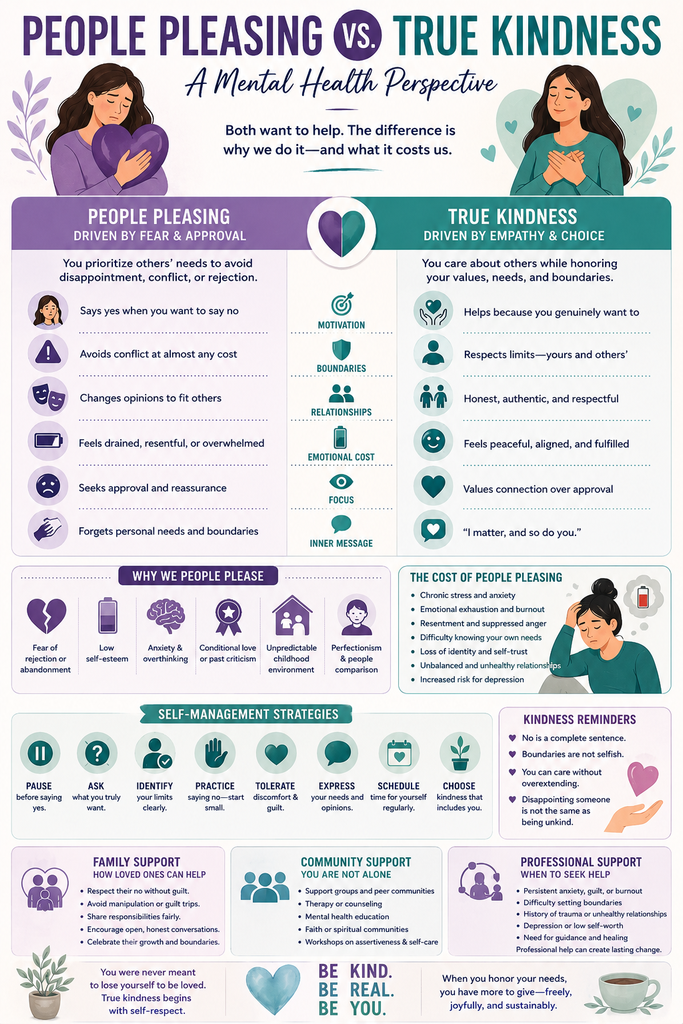
Being kind and being a people pleaser can look remarkably similar from the outside. Both may involve helping others, saying yes to requests, avoiding unnecessary conflict, or putting another person’s needs first. The important difference often lies in what is happening internally.
True kindness generally comes from empathy, personal values, and genuine choice. People-pleasing is more likely to be driven by fear—fear of rejection, criticism, conflict, abandonment, or disappointing someone. A person may appear generous while privately feeling exhausted, anxious, resentful, or unable to express what he actually wants.
Understanding this difference can help people develop relationships based on mutual respect rather than sacrificing themselves to maintain approval.
What Is People Pleasing?
People pleasing describes a pattern of prioritizing other people’s expectations while repeatedly neglecting your own needs, feelings, or boundaries. It is not a formal mental health diagnosis by itself.
A people pleaser may automatically say yes before considering whether they have the time, energy, or desire to help. Saying no can produce guilt or anxiety, even when the request is unreasonable.
Common behaviors include:
- Saying yes when you really want to say no
- Apologizing excessively
- Avoiding disagreements at almost any cost
- Changing opinions to fit the people around you
- Feeling responsible for other people’s emotions
- Seeking reassurance or approval
- Having difficulty asking for help
- Giving more than you can emotionally or financially afford
- Feeling guilty when establishing boundaries
- Hiding anger, sadness, or disappointment
- Becoming anxious when someone appears upset with you
The problem is not kindness. The problem begins when being accepted by others consistently requires abandoning yourself.
What Is True Kindness?
True kindness allows both people to matter.
A genuinely kind person can be compassionate without agreeing to every request. He can help someone because he wants to while recognizing that his own time, health, finances, and emotional needs are also important.
Healthy kindness may sound like:
“I care about you, but I can’t do that today.”
“I understand that you’re disappointed, but this is the decision I need to make.”
“I want to help, but this is what I’m realistically able to offer.”
Kindness does not require unlimited availability.
People Pleasing vs. True Kindness
The motivation behind the behavior often reveals the difference.
People pleasing says:
“If I say no, they might not like me.”
True kindness says:
“I’ll help because I genuinely want to.”
People pleasing says:
“I have to keep everyone happy.”
True kindness says:
“I can care about someone’s feelings without being responsible for controlling them.”
People pleasing says:
“My needs can wait.”
True kindness says:
“Your needs matter, and mine do too.”
Healthy relationships make room for generosity and boundaries at the same time.
Why Do People Become People-Pleasers?
People-pleasing can develop for many reasons. For some individuals, it may have been an adaptive strategy learned early in life.
A child who discovers that staying agreeable reduces conflict may carry that behavior into adulthood. Someone who received affection primarily when performing well, behaving perfectly, or caring for others may begin connecting approval with personal worth.
Possible contributing experiences include:
- Fear of rejection or abandonment
- Low self-esteem
- Anxiety
- Perfectionism
- Growing up around unpredictable conflict
- Receiving conditional praise or affection
- Being expected to care for others at a young age
- Bullying or repeated criticism
- Previous emotionally unhealthy relationships
- Difficulty tolerating another person’s disappointment
These experiences do not guarantee that someone will become a people pleaser, but they can help explain why saying no feels much more threatening than it appears from the outside.
The Mental Health Cost of Constantly Pleasing Others
People pleasing can temporarily reduce conflict, which reinforces the behavior. Unfortunately, the long-term emotional cost can become substantial.
A person may experience:
- Chronic stress
- Anxiety
- Emotional exhaustion
- Burnout
- Resentment
- Difficulty recognizing personal needs
- Loss of identity
- Relationship dissatisfaction
- Suppressed anger
- Low self-esteem
Ironically, trying to prevent relationship problems can eventually create them. Someone who repeatedly agrees to things he does not want may become resentful toward people who never realized he wanted to say no.
Healthy communication gives others an opportunity to know the real person rather than the permanently agreeable version presented to avoid rejection.
Self-Management Strategies
Changing people-pleasing behavior does not mean becoming selfish or uncaring. The goal is learning to make kindness a choice rather than an obligation driven by fear.
Helpful strategies include:
- Pause before automatically agreeing to a request.
- Practice saying, “Let me think about it and get back to you.”
- Ask yourself whether you are saying yes from generosity or fear.
- Notice physical signs of discomfort when your boundaries are being crossed.
- Identify your emotional, financial, physical, and time limits.
- Start practicing “no” with smaller requests.
- Stop giving lengthy explanations for every boundary.
- Allow other people to experience reasonable disappointment.
- Notice when you are trying to manage another person’s emotions.
- Practice expressing opinions even when others disagree.
- Schedule time for your own interests and needs.
- Challenge the belief that disagreement automatically means rejection.
- Recognize that self-care and kindness can exist together.
Before saying yes, ask yourself three questions:
Do I genuinely want to do this?
Do I realistically have the capacity to do it?
Will I resent saying yes later?
The answers can reveal whether generosity is becoming self-sacrifice.
Learn to Tolerate the Discomfort of Saying No
For a longtime people pleaser, establishing boundaries may initially feel wrong.
Guilt does not necessarily mean you have done something wrong.
Sometimes guilt simply means you are doing something unfamiliar.
A person might say:
- “I can’t commit to that right now.”
- “That doesn’t work for me.”
- “I’m available for an hour, but I can’t stay all day.”
- “I appreciate you asking, but I’ll have to decline.”
- “I understand you’re upset, but my answer is still no.”
Assertiveness can be respectful without being aggressive.
Family Support Strategies
Families sometimes unintentionally reinforce people-pleasing. One family member may become known as “the responsible one,” “the helper,” or the person everyone calls during a crisis.
When that individual finally establishes boundaries, relatives may interpret the change as selfishness.
Families can support healthier behavior by:
- Respecting a person’s no without repeatedly pressuring him.
- Avoiding guilt-based statements such as, “After everything I’ve done for you.”
- Asking instead of assuming that someone will help.
- Sharing caregiving and household responsibilities.
- Encouraging honest disagreement.
- Avoiding ridicule when someone expresses emotional needs.
- Recognizing effort without making approval dependent on performance.
- Supporting appropriate privacy and independence.
- Discussing family expectations openly.
- Respecting financial boundaries.
- Learning the difference between helping and overfunctioning for someone.
Healthy families do not require one member to continually sacrifice himself to keep everyone else comfortable.
Community and Professional Support Strategies
Sometimes people-pleasing patterns are deeply ingrained and difficult to change on one’s own. Professional and community support can help individuals understand where these behaviors developed and practice healthier alternatives.
Resources may include:
- Primary care professionals
- Licensed mental health counselors
- Psychologists
- Psychiatrists when additional mental health conditions require evaluation
- Cognitive behavioral therapy
- Assertiveness or communication-skills programs
- Support groups
- Peer-support communities
- Community mental health centers
- Healthy relationship education programs
Therapy may be particularly useful when people-pleasing is associated with significant anxiety, trauma-related experiences, depression, unhealthy relationships, or severely impaired self-esteem.
What Happens When You Stop People Pleasing?
One of the most difficult discoveries is that some people may not like your new boundaries.
That does not automatically mean the boundaries are unhealthy.
Someone who benefited from unlimited access to your time, money, attention, or emotional labor may resist when those limits change.
At the same time, boundaries should not become punishment or a method of controlling others. Healthy boundaries communicate what you will and will not participate in while recognizing that other adults are responsible for their own choices.
As people-pleasing decreases, relationships may become more honest. Some relationships strengthen. Others may change.
Both outcomes can provide important information.
Kindness Without Losing Yourself
True kindness includes compassion for other people, but also for yourself.
You can help someone without rescuing them.
You can love someone without agreeing with them.
You can support someone without taking responsibility for every consequence they experience.
You can say no without becoming cruel.
You can disappoint someone and still be a good person.
The goal is not to stop caring. The goal is to care without disappearing.
Conclusion
People-pleasing and true kindness may look similar, but their emotional foundations can be very different. People-pleasing is often motivated by fear, guilt, anxiety, or the need for approval. Genuine kindness comes from empathy and choice while leaving room for personal boundaries.
Breaking a long-standing people-pleasing pattern can feel uncomfortable because the person is learning that acceptance does not have to be earned through constant sacrifice.
Self-management can help individuals identify automatic behaviors and practice assertiveness. Families can respect boundaries without guilt or manipulation, while therapists and community resources can provide additional support when these patterns cause significant distress.
The healthiest goal is not to become less kind.
It is to become kind enough to include yourself.
Frequently Asked Questions
Here are some common questions:
1. What is the difference between people pleasing and true kindness?
The main difference is often motivation. True kindness generally comes from empathy, personal values, and genuine choice. People-pleasing is more likely to be driven by fear of rejection, criticism, conflict, or disappointing others.
2. Is people-pleasing a mental health disorder?
No. People-pleasing is not a formal mental health diagnosis. However, persistent people-pleasing behaviors may occur alongside anxiety, low self-esteem, perfectionism, trauma-related patterns, or unhealthy relationship dynamics.
3. What are common signs of people-pleasing?
Common signs include:
- Saying yes when you want to say no
- Apologizing excessively
- Avoiding disagreement
- Feeling responsible for everyone’s emotions
- Seeking frequent approval or reassurance
- Ignoring your own needs
- Feeling guilty about setting boundaries
- Changing your opinions to fit in
- Feeling resentful after helping others
- Becoming anxious when someone is disappointed with you
4. Can a kind person still say no?
Absolutely. Saying no does not automatically make someone selfish or unkind. Healthy kindness recognizes that your time, energy, finances, health, and emotional needs also matter.
5. Why do some people become people-pleasers?
People-pleasing can develop for many reasons. Someone may have learned that staying agreeable reduced conflict, earned approval, or helped maintain relationships. Fear of rejection, criticism, abandonment, perfectionism, and previous unhealthy relationships may also contribute.
6. Can childhood experiences contribute to people pleasing?
Yes. Some children learn to closely monitor other people’s emotions, particularly in unpredictable or highly critical environments. Behaviors that once helped a child feel safe or accepted can sometimes continue into adulthood even when they are no longer helpful.
7. Is people pleasing the same as being compassionate?
No. Compassion does not require continually sacrificing yourself. Healthy compassion allows you to care about another person’s needs while recognizing your own.
8. Why do people pleasers have difficulty saying no?
Saying no may trigger guilt, anxiety, or fears such as, “They’ll be angry,” “They won’t like me,” or “I’m being selfish.” Learning to tolerate these uncomfortable feelings is an important part of developing healthier boundaries.
9. Can people-pleasing lead to burnout?
Yes. Continually putting other people’s needs ahead of your own can contribute to chronic stress, emotional exhaustion, resentment, and burnout, especially when the person rarely receives adequate rest or support.
10. Why do people pleasers sometimes become resentful?
A person may repeatedly agree to requests despite privately wanting to decline. Over time, the difference between what the person says and what they actually want can create frustration and resentment.
11. What does true kindness look like?
True kindness can involve:
- Helping because you genuinely want to
- Respecting your own limits
- Being honest about what you can provide
- Allowing others to solve their own problems
- Showing empathy without taking responsibility for everything
- Giving without expecting approval in return
- Respecting both your needs and another person’s needs
12. Are boundaries selfish?
Healthy boundaries are not inherently selfish. Boundaries communicate what you can accept, provide, or participate in. They can actually strengthen relationships by reducing resentment and clarifying expectations.
13. How can someone begin overcoming people-pleasing?
Start with small changes. Pause before answering requests, practice saying “Let me think about it,” identify your limits, express small disagreements, and occasionally say no without providing a lengthy explanation.
14. Why do I feel guilty after setting a healthy boundary?
Guilt does not always mean you have done something wrong. If you are accustomed to prioritizing everyone else, setting a boundary may initially feel uncomfortable simply because it is unfamiliar.
15. What can I say when I need to establish a boundary?
Simple responses can be effective:
“I can’t do that today.”
“I appreciate you asking, but I’ll have to decline.”
“I can help for an hour, but I can’t stay longer.”
“That doesn’t work for me.”
A respectful boundary does not require a lengthy defense.
16. What if someone becomes angry when I start setting boundaries?
Another person’s disappointment does not automatically mean your boundary is inappropriate. People who were accustomed to your constant availability may need time to adjust. At the same time, boundaries should communicate your limits rather than being used to punish or control someone else.
17. How can families support someone who struggles with people pleasing?
Families can respect a person’s no, share responsibilities fairly, avoid guilt trips, encourage honest opinions, and stop assuming that the same person will always handle everyone’s problems.
18. Can therapy help with people pleasing?
Yes. Therapy can help someone explore why approval feels so important, identify unhealthy beliefs, develop assertiveness, tolerate conflict, and establish healthier relationship boundaries. Cognitive behavioral and other therapeutic approaches may be useful depending on the individual’s needs.
19. When should someone seek professional help?
Professional support may be helpful when people-pleasing contributes to severe anxiety, depression, burnout, unhealthy relationships, inability to make independent decisions, significant resentment, or a persistent loss of personal identity.
20. How can I tell whether I’m being kind or people-pleasing?
Before agreeing to something, ask yourself:
“Do I genuinely want to do this?”
“Do I realistically have the capacity?”
“Am I saying yes because I’m afraid of what will happen if I say no?”
“Will I resent this decision later?”
Your answers can reveal whether the behavior is coming primarily from generosity or fear.
21. What is the most important lesson about people-pleasing and kindness?
You do not have to become less caring to develop healthier boundaries. The goal is to make kindness something you freely choose, rather than something you feel forced to provide to earn acceptance.
Video: People Pleasing vs. True Kindness