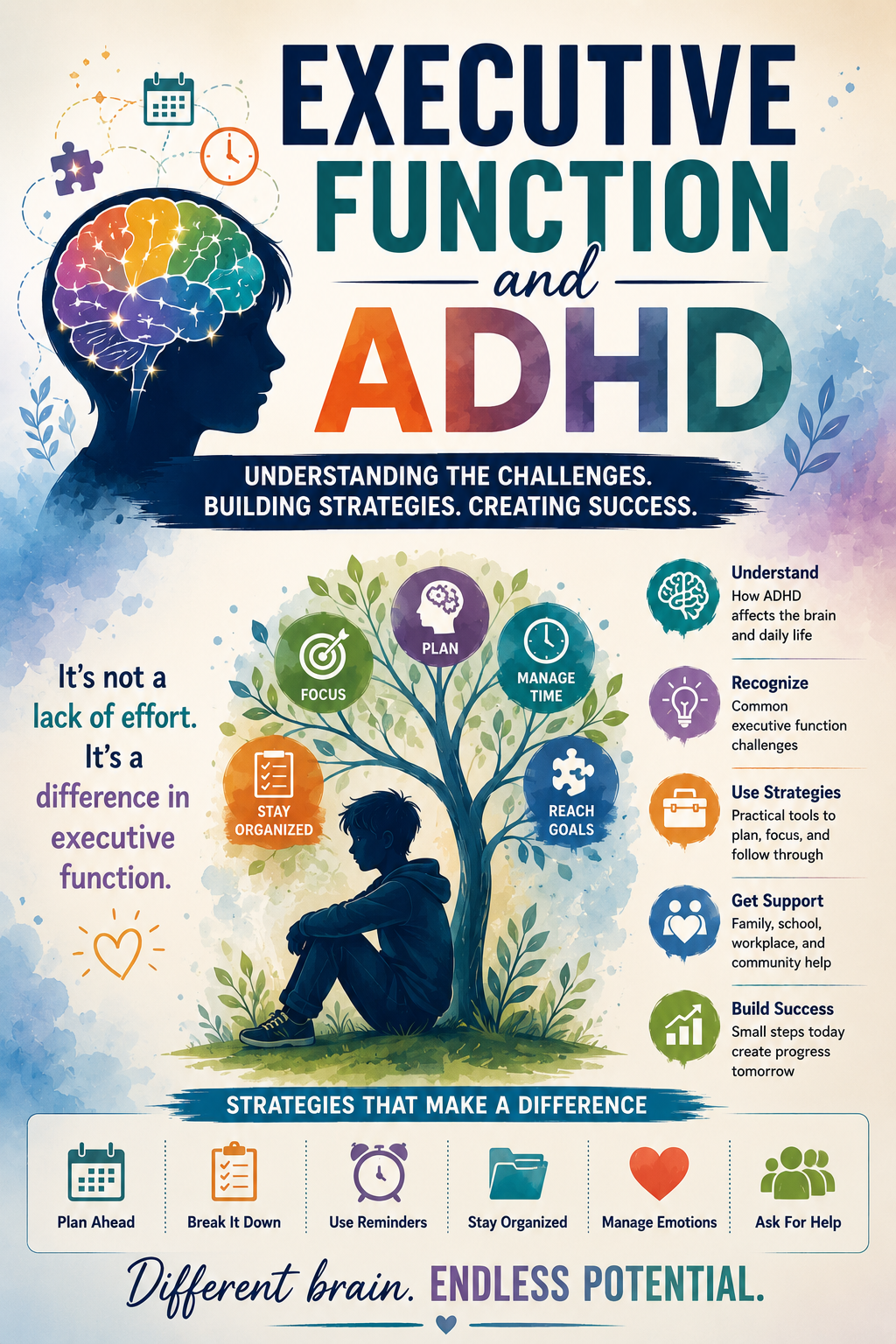
A person with attention-deficit/hyperactivity disorder (ADHD) may understand exactly what needs to be done and still struggle to begin, organize, prioritize, or finish the task. From the outside, this can be mistaken for laziness, lack of motivation, irresponsibility, or a lack of care. In reality, ADHD is a neurodevelopmental disorder that can significantly affect executive functioning—the mental processes that help people regulate behavior and work toward goals.
Understanding executive function can change the conversation around ADHD. Instead of repeatedly asking, “Why can’t you just do it?” families, educators, employers, and individuals can begin asking a more productive question: “What support or system would make this easier to accomplish?”
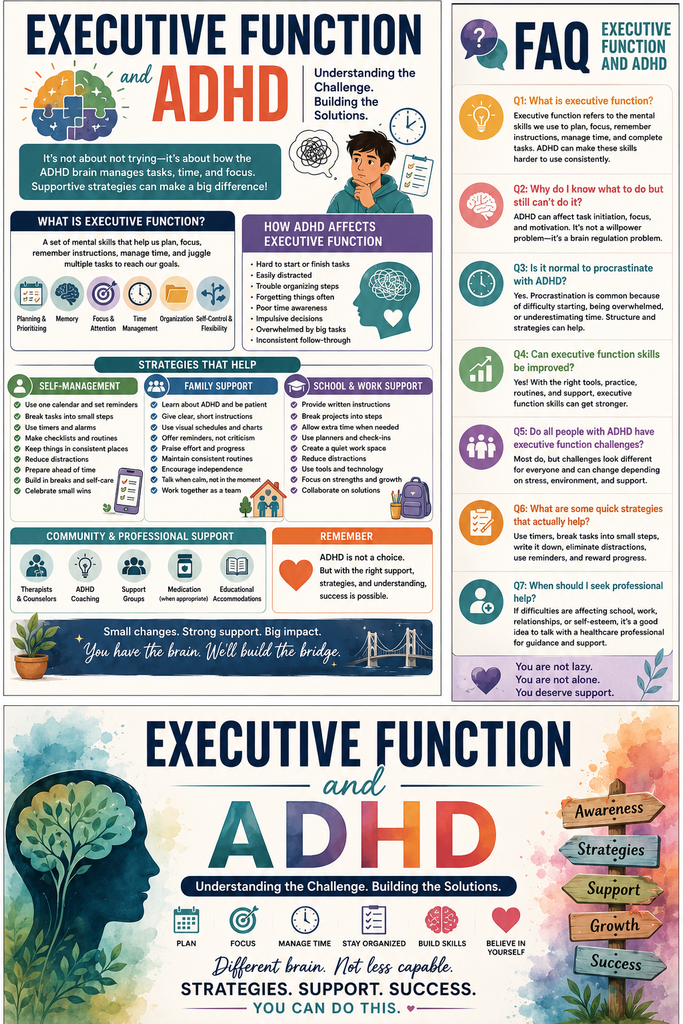
What Is Executive Function?
Executive functions are a collection of higher-level cognitive abilities that help people manage everyday life. They allow us to organize information, control impulses, shift attention, remember instructions, regulate emotions, estimate time, and complete multistep activities.
Executive functioning may involve:
- Planning and prioritizing
- Starting tasks
- Sustaining attention
- Working memory
- Organizing materials and information
- Managing time
- Controlling impulses
- Monitoring progress
- Shifting between activities
- Regulating behavior and emotions
- Completing tasks
Everyone occasionally struggles with these abilities. With ADHD, however, difficulties can be frequent enough to interfere with school, employment, relationships, finances, household responsibilities, and other areas of functioning.
How ADHD Can Affect Executive Function
ADHD does not look the same in every person. Some individuals primarily struggle with attention and organization, while others experience prominent hyperactivity or impulsivity. Many experience a combination.
Executive-function difficulties might look like:
- Knowing about a deadline but waiting until the last moment
- Frequently losing keys, phones, paperwork, or other belongings
- Beginning several projects without completing them
- Forgetting instructions shortly after hearing them
- Underestimating how long activities will take
- Becoming distracted during routine tasks
- Having difficulty deciding which task should come first
- Feeling overwhelmed by projects containing multiple steps
- Interrupting conversations or acting before considering consequences
- Struggling to transition from an enjoyable activity to a necessary one
These behaviors can create a frustrating gap between intention and action.
The person may genuinely want to complete the assignment, pay the bill, clean the house, or answer the email. Wanting to do something and consistently activating the processes necessary to accomplish it are not always the same thing.
Working Memory and ADHD
Working memory allows us to temporarily hold and manipulate information while completing a task.
For example, someone cooking dinner may need to remember what is already in the oven while measuring another ingredient and responding to a timer.
When working memory is challenged, a person may:
- Forget why they entered a room
- Lose track of instructions
- Forget part of a multistep task
- Have difficulty following lengthy conversations
- Forget an idea before writing it down
- Repeatedly misplace belongings
External reminders can reduce the amount of information the brain must hold internally.
ADHD and “Time Blindness”
Some people with ADHD describe difficulty sensing or estimating the passage of time, sometimes referred to as “time blindness.”
A task that feels like it will take ten minutes may actually take an hour. Conversely, a short break may unexpectedly become much longer.
This can contribute to:
- Chronic lateness
- Missed deadlines
- Procrastination
- Overscheduling
- Difficulty preparing for transitions
- Staying absorbed in an activity longer than intended
Visible clocks, alarms, calendars, timers, and scheduled transition warnings can make time more concrete.
Task Initiation: “I Know I Need to Do It”
One of the most misunderstood executive-function difficulties is task initiation.
A person may sit for an hour thinking about starting an assignment without actually beginning it. Criticism may make the situation worse by adding shame and anxiety to an already difficult task.
Breaking the first step into something extremely small can help.
Instead of:
“Clean the entire kitchen.”
Try:
“Put the dishes in the sink.”
Instead of:
“Write the report.”
Try:
“Open the document and write the title.”
Starting creates momentum.
ADHD, Motivation, and Interest
People with ADHD are sometimes accused of being inconsistent because they may struggle intensely with one task while focusing for hours on another.
Attention in ADHD is not simply absent. It can be difficult to regulate.
Novel, interesting, urgent, challenging, or rewarding activities may hold attention more easily than repetitive tasks with delayed rewards.
This helps explain why someone may spend hours on an engaging hobby but struggle for twenty minutes with paperwork.
Self-Management Strategies
Executive-function challenges often improve when important information and structure are moved outside the brain and into the environment.
Useful strategies include:
- Use one calendar rather than several competing systems.
- Set alarms for appointments, transitions, and medications.
- Keep frequently used items in consistent locations.
- Create visible checklists for recurring routines.
- Break large projects into small, concrete actions.
- Choose the three most important tasks for the day.
- Use timers to create short periods of focused work.
- Schedule breaks rather than waiting until exhaustion.
- Reduce unnecessary phone and computer notifications.
- Prepare clothing, meals, bags, and paperwork ahead of time.
- Write information down immediately instead of relying on memory.
- Create automatic payments and reminders for recurring bills when appropriate.
- Use visual cues where tasks actually occur.
- Build routines around existing habits.
- Reward completion of difficult or boring tasks.
- Protect adequate sleep, exercise, nutrition, and recovery time.
The best organizational system is not necessarily the most sophisticated one. It is the one the person can consistently use.
Try the “Make It Smaller” Strategy
When a task feels overwhelming, keep breaking it down until the first step feels manageable.
“Organize the house” becomes:
“Organize the bedroom.”
Then:
“Organize the dresser.”
Then:
“Put away five shirts.”
Executive-function support often works by reducing the number of decisions required at once.
Family Support Strategies
ADHD affects families as well as individuals. Forgotten responsibilities, lateness, unfinished chores, impulsive decisions, or lost belongings can create understandable frustration.
Support works best when accountability and compassion go hand in hand.
Families can:
- Learn about ADHD and executive functioning.
- Avoid automatically interpreting forgetfulness as disrespect.
- Give clear and specific requests.
- Break complex responsibilities into manageable steps.
- Use shared calendars for important family events.
- Establish predictable household routines.
- Provide advance notice before transitions.
- Recognize progress rather than focusing only on mistakes.
- Discuss consequences calmly and consistently.
- Encourage independence instead of completing every difficult task for the person.
- Ask what type of reminder is actually helpful.
- Avoid repeatedly using labels such as “lazy,” “careless,” or “irresponsible.”
Family members should also maintain their own boundaries. Understanding ADHD explains behavior, but it does not mean other people must absorb every consequence.
Supporting Children and Teenagers
Children with ADHD are still developing executive functions, so expectations should consider both developmental level and individual needs.
Parents and caregivers can:
- Post morning and bedtime routines.
- Use short, specific instructions.
- Give one or two directions at a time.
- Provide predictable homework locations.
- Use timers and visual schedules.
- Break homework into shorter sessions.
- Prepare backpacks and clothing the night before.
- Coordinate with teachers when difficulties affect school.
- Praise effort, strategy use, and improvement.
- Gradually transfer responsibility as skills develop.
The goal is not to manage the child’s life indefinitely. It is to provide temporary external structure while helping the child develop greater independence.
School and Workplace Support
Executive-function difficulties can become especially noticeable when environments require extensive organization and independent time management.
Helpful school strategies may include:
- Written instructions
- Assignment planners
- Organizational assistance
- Reduced-distraction testing environments when appropriate
- Breaking large assignments into intermediate deadlines
- Regular communication among students, families, and educators
At work, strategies might include:
- Written priorities
- Project-management tools
- Calendar reminders
- Quiet workspaces when available
- Scheduled focus periods
- Breaking projects into milestones
- Regular check-ins with supervisors when appropriate
Formal accommodations depend on individual circumstances and applicable laws or institutional policies.
Community and Professional Support Strategies
ADHD should be appropriately evaluated rather than diagnosed solely from social-media descriptions or online checklists. Other conditions—including anxiety, depression, sleep disorders, substance use, learning disorders, and some medical conditions—can cause overlapping symptoms.
Helpful resources may include:
- Primary care professionals
- Pediatricians
- Psychiatrists
- Psychologists
- Qualified ADHD specialists
- Licensed therapists
- School counselors and psychologists
- Occupational therapists when appropriate
- ADHD coaching
- Parent-training programs
- Community mental health services
- ADHD education and support organizations
A comprehensive evaluation considers symptoms, developmental history, impairment, and whether another condition better explains the difficulties.
Treatment Can Include More Than One Approach
ADHD treatment is individualized.
Depending on age, symptoms, medical history, and functional impairment, treatment may involve:
- Behavioral interventions
- Parent training
- Organizational and skills-based strategies
- School or workplace accommodations
- Psychotherapy when appropriate
- ADHD medication when clinically indicated
- Treatment of coexisting mental or physical health conditions
Medication can be highly beneficial for some people, but medication does not automatically create calendars, organize rooms, establish routines, or teach every executive-function skill. Environmental strategies and behavioral systems may remain important.
ADHD Is an Explanation, Not a Character Judgment
One of the most damaging consequences of untreated or misunderstood ADHD can be years of negative messages.
“You’re lazy.”
“You don’t care.”
“You never finish anything.”
“You could succeed if you just tried harder.”
Repeated criticism can influence self-esteem and make individuals reluctant to attempt difficult tasks.
A more useful approach separates the person from the problem:
Instead of “You’re disorganized,” try “Our current organization system isn’t working. What could we change?”
Instead of “You never remember anything,” try “Let’s find a way to make this reminder visible.”
This approach does not remove responsibility. It makes success more achievable.
Conclusion
Executive-function challenges are a central part of daily life for many people with ADHD. Difficulties with planning, working memory, task initiation, organization, attention regulation, impulse control, and time management can make seemingly simple responsibilities surprisingly difficult.
Self-management strategies can externalize memory, simplify tasks, and create predictable routines. Families can combine understanding with accountability, while schools, workplaces, healthcare professionals, and community resources can provide additional structure and treatment.
Most importantly, struggling with executive functioning does not mean a person lacks intelligence, ambition, or concern for others.
Sometimes the problem is not knowing what to do.
It is building the bridge between knowing and doing.
With appropriate treatment, practical systems, supportive relationships, and repeated practice, that bridge can become much easier to cross.
Frequently Asked Questions
Here are some common questions:
1. What is executive function?
Executive function refers to mental skills used to plan, organize, remember information, regulate attention and behavior, manage time, and complete tasks.
2. How does ADHD affect executive functioning?
ADHD can make it harder to initiate tasks, maintain attention, organize activities, remember instructions, manage time, control impulses, and follow projects through to completion.
3. Does executive dysfunction mean someone is lazy?
No. A person can genuinely want to complete something yet struggle to translate intention into action. Executive-function difficulties are not simply a lack of effort.
4. Why can someone with ADHD focus intensely on certain activities?
Attention in ADHD can be difficult to regulate rather than simply deficient. Interesting, novel, rewarding, or urgent activities may hold attention much more effectively than repetitive or low-interest responsibilities.
5. What is “time blindness” in ADHD?
“Time blindness” is an informal term describing difficulty accurately perceiving or estimating time. It can contribute to lateness, missed deadlines, overscheduling, or spending much longer than intended on an activity.
6. Why do people with ADHD procrastinate?
Procrastination can be related to difficulty initiating tasks, feeling overwhelmed by multiple steps, distractibility, poor time estimation, perfectionism, or difficulty maintaining motivation for delayed rewards.
7. Can executive-function skills improve?
Yes. Appropriate ADHD treatment combined with routines, environmental modifications, organizational strategies, behavioral skills, and practice can improve everyday functioning.
8. What are some quick strategies that may help?
Use timers and alarms, write information down, maintain one calendar, break projects into very small steps, reduce distractions, create consistent locations for belongings, and select a few priorities each day.
9. How can families help?
Families can provide clear expectations, predictable routines, visual reminders, shared calendars, and positive reinforcement while gradually encouraging independence.
10. Can medication improve executive functioning?
ADHD medications can improve core symptoms and functioning for many people when clinically appropriate. Medication does not replace every organizational or behavioral skill, so practical strategies may still be necessary.
11. Can adults have executive-function problems from ADHD?
Yes. ADHD is not limited to childhood. Adults may struggle with deadlines, finances, household responsibilities, organization, relationships, appointments, and workplace demands.
12. When should someone seek professional help?
Consider an evaluation when attention, organization, impulsivity, forgetfulness, or time-management difficulties consistently interfere with school, employment, relationships, or everyday responsibilities. Other conditions can produce similar symptoms, so a comprehensive professional evaluation is important.
Video: Executive Function and ADHD