Growing up with a narcissistic parent can leave lasting emotional and psychological effects. Children raised in households dominated by manipulation, excessive criticism, emotional neglect, or conditional affection may struggle with self-esteem, emotional regulation, and relationships well into adulthood. Some may develop similar narcissistic behaviors, while others become overly accommodating, anxious, or fearful of conflict.
But can narcissism actually be inherited?
Research suggests that narcissistic personality traits develop through a complex interaction of genetic predispositions, temperament, early childhood experiences, parenting styles, and social influences. Although narcissistic traits can run in families, having a narcissistic parent does not mean a child will develop narcissistic personality disorder (NPD).
The challenge is understanding how unhealthy patterns are passed between generations and learning how to interrupt them.
Breaking the cycle involves developing self-awareness, addressing childhood emotional wounds, establishing healthy boundaries, and building relationships based on empathy, accountability, and mutual respect.
Through self-management, family support, and community resources, individuals can learn to recognize inherited or learned narcissistic behaviors and develop healthier ways of relating to themselves and others.
Understanding Narcissism: Personality Traits Versus Personality Disorder
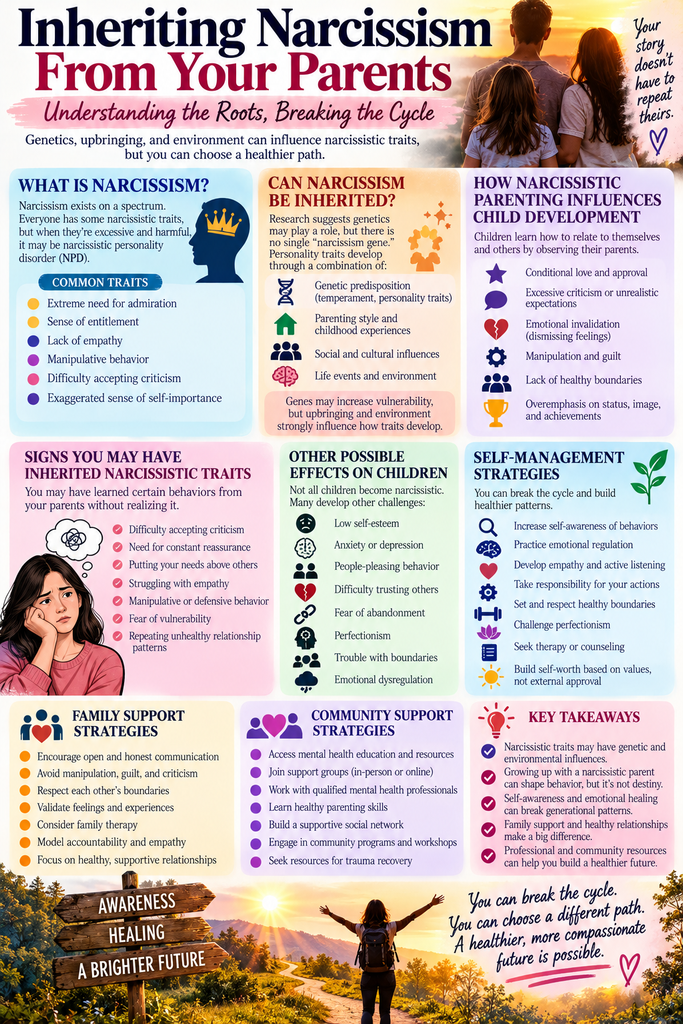
Narcissism exists along a spectrum of personality characteristics.
Some self-confidence, ambition, and desire for recognition are normal and can be healthy. Problems arise when these traits become rigid, excessive, and harmful to relationships or everyday functioning.
Narcissistic personality disorder is a recognized mental health condition involving a persistent pattern of grandiosity, a need for admiration, and difficulties with empathy, beginning by early adulthood and occurring across multiple contexts.
Common characteristics associated with problematic narcissism
- Excessive need for admiration: Constantly seeking praise, recognition, or validation.
- Sense of entitlement: Expecting special treatment or believing ordinary rules should not apply.
- Difficulty with empathy: Struggling to recognize or respond appropriately to other people’s feelings and needs.
- Sensitivity to criticism: Reacting defensively, angrily, or with shame when confronted with perceived failure.
- Manipulative behavior: Using guilt, pressure, or other tactics to influence relationships.
- Interpersonal exploitation: Taking advantage of others to meet personal needs.
- Grandiosity: Exaggerating accomplishments, abilities, or importance.
- Fragile self-esteem: Depending heavily on external approval to maintain a positive self-image.
Not everyone who demonstrates these behaviors has NPD. A clinical diagnosis requires a comprehensive evaluation by a qualified mental health professional.
Key lesson: Narcissistic traits are not the same as narcissistic personality disorder, and difficult parenting alone does not establish that a parent has a personality disorder.
Can Narcissism Be Inherited Genetically?
Genetics may contribute to the development of narcissistic personality traits, but there is no single narcissism gene.
Twin and personality research suggests that narcissistic characteristics have a heritable component. However, heritability estimates vary depending on which traits are measured and how researchers define narcissism.
Genetic influences may affect temperament, emotional sensitivity, reward seeking, impulsivity, and other characteristics that interact with childhood experiences.
How genetic influences may contribute
- Temperament: Some children may naturally be more emotionally reactive or sensitive to criticism.
- Personality predispositions: Traits involving dominance, reward sensitivity, or interpersonal behavior may have genetic influences.
- Emotional regulation: Biological differences can influence how individuals respond to frustration or perceived rejection.
- Environmental interactions: Genetic predispositions may be expressed differently depending on family relationships and life experiences.
- Developmental experiences: Supportive caregiving, healthy boundaries, and emotional security may influence how personality traits develop.
Importantly, genetic predisposition is not destiny.
A child may inherit certain personality tendencies without developing maladaptive narcissistic behaviors or NPD.
How Narcissistic Parenting Can Influence Child Development
Children learn about relationships by observing how caregivers communicate, manage emotions, resolve disagreements, and respond to other people’s needs.
When a parent consistently prioritizes personal admiration, dismisses a child’s emotions, or uses control to maintain authority, the child may develop unhealthy beliefs about love, trust, and self-worth.
However, not every child raised in such an environment develops narcissistic traits.
Some children respond by becoming excessively independent, emotionally withdrawn, people-pleasing, or highly sensitive to rejection.
Parenting patterns that may affect emotional development
Conditional affection: Children may learn that love and approval depend on achievement, obedience, or meeting parental expectations.
Excessive criticism: Persistent humiliation or unrealistic expectations may contribute to shame, insecurity, and fear of failure.
Emotional invalidation: Dismissing a child’s feelings may interfere with healthy emotional expression and regulation.
Overvaluation: Repeatedly telling children they are inherently superior to others, without teaching empathy or accountability, may encourage entitlement.
Manipulation and guilt: Children may learn to use guilt, emotional pressure, or avoidance rather than healthy communication.
Poor boundaries: A parent who treats a child as an extension of themselves may interfere with the child’s developing independence.
These experiences can shape development, but they do not automatically lead to a personality disorder.
The Cycle of Generational Narcissistic Behaviors
Generational patterns occur when families repeat beliefs, emotional responses, and relationship behaviors across generations.
For example, a child who grows up watching a parent respond to criticism with anger may learn to associate vulnerability with weakness.
As an adult, that individual may repeat similar defensive behaviors in romantic relationships or parenting.
The cycle may continue unless people recognize and address these patterns.
Examples of generational patterns
- A parent uses criticism to control behavior, and the child later uses criticism in adult relationships.
- A child receives affection only after achieving success and later equates personal worth with accomplishment.
- A parent avoids taking responsibility, teaching the child to respond defensively to mistakes.
- A household discourages emotional expression, making vulnerability difficult.
- A parent consistently disregards boundaries, and the child struggles to recognize healthy relationship limits.
- Family members prioritize appearances over emotional honesty.
These patterns are learned behaviors, not inevitable outcomes.
The goal of breaking the cycle isn’t to blame previous generations, but to recognize harmful patterns and build healthier alternatives.
Emotional Consequences of Growing Up With Narcissistic Parenting
Growing up in a persistently invalidating or controlling environment can affect emotional development and adult relationships.
Children may learn to suppress their needs, constantly seek approval, or remain highly alert to changes in a parent’s mood.
Others may adopt controlling or self-protective behaviors to avoid feeling vulnerable.
Potential long-term emotional effects
- Low self-esteem or unstable self-worth.
- Difficulty trusting others.
- Excessive people-pleasing.
- Fear of abandonment or rejection.
- Problems establishing boundaries.
- Perfectionism and intense self-criticism.
- Emotional avoidance or difficulty expressing vulnerability.
- Anxiety, depression, or trauma-related symptoms.
- Difficulty accepting responsibility or tolerating criticism.
- Repeated involvement in unhealthy relationships.
These experiences are not unique to children of parents with narcissistic traits and should not be used to diagnose either the parent or the child.
Can Children of Narcissistic Parents Become Narcissistic Themselves?
Yes, some children may develop narcissistic traits after growing up in environments characterized by entitlement, emotional invalidation, inconsistent affection, or excessive emphasis on status.
However, others develop very different coping patterns.
For example, one child may respond to criticism by becoming defensive and controlling, while another may become highly self-critical and avoid conflict.
Individual temperament, supportive relationships, peer experiences, and other environmental factors influence these outcomes.
Signs that someone may be repeating unhealthy patterns
- Becoming extremely defensive when criticized.
- Frequently blaming others for personal mistakes.
- Struggling to apologize sincerely.
- Seeking constant reassurance or admiration.
- Dismissing other people’s emotional experiences.
- Using guilt or emotional pressure during disagreements.
- Having difficulty respecting boundaries.
- Viewing relationships primarily through control or competition.
Recognizing these patterns does not mean someone has NPD.
Self-awareness provides an opportunity to change behaviors before they cause further harm.
Self-Management Strategies: Breaking the Cycle of Narcissistic Behaviors
Self-management involves recognizing unhealthy emotional patterns, accepting personal responsibility, and developing healthier coping and relationship skills.
Individuals who grew up with narcissistic parenting may benefit from examining both behaviors they learned and emotional wounds they experienced.
Practical self-management strategies
- Develop self-awareness: Identify recurring patterns of defensiveness, entitlement, emotional avoidance, or excessive approval-seeking.
- Practice emotional regulation: Use mindfulness, grounding techniques, and stress-management skills before responding to conflict.
- Learn to accept criticism: Distinguish constructive feedback from personal attacks.
- Build empathy: Practice listening and considering other people’s experiences without immediately redirecting attention to yourself.
- Take responsibility: Acknowledge mistakes and make meaningful behavioral changes.
- Set healthy boundaries: Respect your limits and others’.
- Challenge perfectionism: Recognize that mistakes do not determine personal worth.
- Build stable self-esteem: Ground confidence in personal values rather than constant external validation.
- Seek psychotherapy: Work with a qualified clinician to address persistent relationship difficulties or personality patterns.
The importance of personal accountability
One of the most important steps in breaking generational patterns is recognizing the difference between understanding behavior and excusing it.
A difficult childhood may help explain why certain coping strategies developed, but it does not remove responsibility for harmful adult behavior.
Individuals can acknowledge childhood experiences while choosing healthier responses.
Healing Childhood Emotional Wounds
Children raised in emotionally unpredictable environments may develop coping strategies designed to maintain safety or approval.
These strategies can become problematic in adulthood when they interfere with trust, intimacy, or emotional expression.
Healing involves identifying these learned responses and replacing them with healthier behaviors.
Strategies for emotional healing
Recognize childhood experiences: Identify patterns of criticism, invalidation, control, or emotional neglect without assuming that every difficult interaction was abusive.
Challenge negative beliefs: Replace rigid thoughts such as “I must always be perfect to deserve love” with more balanced perspectives.
Develop emotional awareness: Learn to identify and communicate feelings instead of suppressing them or acting them out.
Practice self-compassion: Recognize that you developed childhood coping strategies under difficult circumstances.
Build secure relationships: Develop connections based on mutual respect, honesty, and consistency.
Seek professional support: Therapy can help address trauma-related symptoms, emotional regulation, and interpersonal difficulties.
Recovery does not require forgetting the past. It involves reducing the influence of harmful experiences on present decisions.
Family Support Strategies: Creating Healthier Relationships
Families can play an important role in changing generational patterns.
However, meaningful change requires willingness to recognize harmful behavior, respect boundaries, and communicate more effectively.
Family support should not involve excusing emotional abuse or pressuring individuals to maintain unsafe relationships.
Practical family support strategies
- Encourage open communication: Let family members express their emotions without ridicule or retaliation.
- Practice active listening: Listen to understand, not to defend or criticize immediately.
- Respect personal boundaries: Recognize each family member’s right to privacy, independence, and emotional safety.
- Avoid comparisons: Don’t rank siblings or use achievements to determine personal worth.
- Model accountability: Apologize when appropriate and show you’re willing to change your behavior.
- Validate emotions: Acknowledge feelings even when disagreements remain.
- Avoid manipulation: Replace guilt, threats, and emotional pressure with respectful communication.
- Consider family therapy: Seek professional guidance when relationships are sufficiently safe for collaborative work.
- Protect children from adult conflict: Don’t put children in the middle of disagreements or expect them to manage parental emotions.
When family reconciliation is not appropriate
Some relationships involve persistent emotional abuse, intimidation, or coercive control.
In these situations, individual therapy, limited contact, or separation may be healthier than trying to reconcile.
Family healing does not always require restoring close relationships. Sometimes it means establishing safe boundaries and ending harmful patterns.
Parenting Differently: Preventing Narcissistic Patterns in the Next Generation
Parents who experienced emotionally harmful childhood environments may worry about repeating the same behaviors with their own children.
The good news is that parents can learn and strengthen their parenting skills.
Healthy parenting emphasizes emotional security, appropriate boundaries, empathy, accountability, and consistent support.
Strategies for raising emotionally healthy children
- Provide affection that is not dependent on achievement.
- Recognize and validate children’s emotions.
- Teach empathy and consideration for others.
- Establish consistent, age-appropriate boundaries.
- Encourage independence and personal responsibility.
- Avoid humiliation, excessive criticism, and comparisons.
- Model healthy conflict resolution.
- Apologize when parental behavior causes harm.
- Praise effort, kindness, persistence, and responsible choices.
- Encourage children to express disagreement respectfully.
Parents do not need to be perfect.
Consistent efforts to repair mistakes, maintain emotional safety, and demonstrate healthy relationships can make a meaningful difference.
Community Support Strategies: Ending Generational Emotional Harm
Community resources can help individuals recognize unhealthy relationship patterns and access appropriate support.
Schools, healthcare organizations, counseling services, and community programs can provide education about emotional development, healthy parenting, and personality disorders.
Community-based support strategies
- Expand mental health education: Teach the differences between personality traits, personality disorders, and emotionally harmful behaviors.
- Improve access to psychotherapy: Support affordable counseling for individuals and families.
- Offer parenting education: Provide programs focused on emotional regulation, attachment, communication, and positive discipline.
- Develop peer-support opportunities: Create safe spaces for adults recovering from difficult childhood experiences.
- Promote trauma-informed care: Encourage healthcare professionals to recognize the effects of adverse childhood experiences.
- Support school-based mental health services: Help children develop emotional literacy and healthy relationship skills.
- Address emotional abuse: Provide resources for individuals experiencing manipulation, intimidation, or coercive control.
- Reduce mental health stigma: Encourage people to seek treatment without shame or fear of judgment.
Communities can support healthier family relationships by making education and professional services more accessible.
Treatment Options for Narcissistic Traits and Personality Disorders
Psychotherapy is the primary treatment approach for persistent narcissistic personality patterns and narcissistic personality disorder.
Treatment may focus on emotional regulation, interpersonal functioning, self-esteem, empathy, and responses to criticism.
There is no medication specifically approved to treat NPD, although medications may be appropriate for co-occurring conditions such as depression or anxiety.
Psychotherapeutic approaches that may help
Psychodynamic psychotherapy: Explores longstanding emotional patterns, self-esteem regulation, and interpersonal relationships.
Cognitive behavioral therapy (CBT): Helps individuals identify distorted thinking patterns and develop healthier responses.
Schema therapy: Addresses deeply established beliefs and coping patterns that may originate in childhood.
Mentalization-based approaches: Focus on improving the ability to understand one’s own mental states and those of others.
Dialectical behavior therapy skills: May help with emotional regulation, distress tolerance, and interpersonal effectiveness.
Evidence for specific treatments in NPD remains limited compared with some other psychiatric disorders. Treatment should be individualized and delivered by appropriately trained clinicians.
Can Narcissistic Personality Patterns Change?
Personality characteristics are relatively stable, but they are not completely fixed.
Individuals can develop greater self-awareness, improve emotional regulation, strengthen empathy, and learn healthier relationship behaviors.
Change may be difficult when someone consistently denies problems or blames others for all conflict.
However, motivation, therapeutic engagement, and sustained behavioral practice can support improvement.
Signs of meaningful progress
- Accepting responsibility without immediately shifting blame.
- Listening to criticism without retaliating.
- Demonstrating greater empathy.
- Respecting boundaries.
- Offering sincere apologies followed by behavioral change.
- Managing disappointment without manipulation.
- Developing healthier, more reciprocal relationships.
- Maintaining treatment engagement.
Measure improvement through consistent behavior over time, not promises alone.
Helpful Mental Health and Family Support Resources
National Alliance on Mental Illness (NAMI)
Provides mental health education, support groups, and resources for individuals and families.
Website: nami.org
SAMHSA
Offers information about mental health treatment and access to professional services.
Treatment locator: FindTreatment.gov
National Domestic Violence Hotline
Provides confidential support for individuals experiencing emotional abuse, coercive control, or other forms of domestic abuse.
Website: thehotline.org
Phone: 1-800-799-SAFE (7233)
988 Suicide & Crisis Lifeline
Provides crisis support for individuals experiencing severe emotional distress or suicidal thoughts.
Call or text 988 in the United States.
Website: 988lifeline.org
Breaking the Cycle: A Healthier Path Forward
Breaking generational patterns of narcissistic behavior requires awareness, responsibility, emotional healing, and consistent behavioral change.
Individuals who experienced emotionally harmful parenting may need time to recognize how childhood relationships shaped their beliefs and coping strategies.
Some may struggle with people-pleasing and low self-esteem, while others may recognize controlling, defensive, or self-centered patterns in their own behavior.
Neither outcome is inevitable or permanent.
Five principles for breaking generational patterns
- Awareness: Recognize unhealthy behaviors without automatically labeling yourself or others with a personality disorder.
- Accountability: Take responsibility for personal actions and their effects on relationships.
- Emotional healing: Address childhood distress, shame, and learned coping strategies.
- Healthy relationships: Practice empathy, set boundaries, show respect, and communicate honestly.
- Professional support: Seek psychotherapy or family services when persistent patterns interfere with well-being.
Conclusion: You Can Inherit Traits Without Repeating Harmful Patterns
Growing up with a parent who demonstrates narcissistic traits can influence emotional development, self-esteem, and relationship patterns. Genetics may contribute to personality characteristics, while childhood experiences can shape how individuals understand themselves and interact with others.
However, having a narcissistic parent does not guarantee that a child will develop narcissistic personality disorder or repeat harmful behaviors.
Understanding the difference between genetic vulnerability, learned behavior, and emotional trauma is essential for breaking unhealthy generational cycles.
Self-management encourages awareness and accountability. Family support promotes healthier communication and emotional safety. Community resources provide access to education, counseling, and supportive relationships.
Most importantly, individuals can recognize their upbringing’s influence without letting it determine their future.
You may inherit certain personality traits and learn unhealthy behaviors from your parents, but you can also develop new skills, establish healthier relationships, and choose a different path for the next generation.
Your childhood may help explain your patterns, but it does not have to define the relationships you build tomorrow.
Frequently Asked Questions and Answers
Understanding Narcissism and Genetics
1. Can narcissism be inherited from your parents?
Yes, narcissistic personality traits can have a genetic component. Research involving twins suggests that certain narcissistic characteristics are partly heritable. However, genetics do not determine whether someone will develop narcissistic personality disorder. Childhood experiences, parenting styles, temperament, and social influences also contribute to personality development.
2. Is narcissism genetic or learned behavior?
Narcissism can involve both genetic predispositions and learned behaviors. Inherited temperament and personality characteristics may influence emotional responses and interpersonal behavior. Children may also learn patterns involving entitlement, defensiveness, manipulation, or emotional invalidation by observing caregivers. Neither genetics nor upbringing alone fully explains the development of narcissistic traits.
3. Is there a specific gene responsible for narcissistic personality disorder?
No. Researchers have not identified a single gene responsible for narcissistic personality disorder. Personality characteristics are complex and likely influenced by many genetic variations interacting with environmental factors. Having relatives with narcissistic traits does not guarantee that someone will develop the disorder.
4. What is the difference between narcissistic traits and narcissistic personality disorder?
Narcissistic traits may include excessive self-focus, sensitivity to criticism, entitlement, or a strong need for admiration. Narcissistic personality disorder involves a persistent, pervasive pattern of grandiosity, need for admiration, and difficulties with empathy that significantly affects relationships or functioning. Only a qualified mental health professional can diagnose it.
5. Can narcissism skip a generation?
Narcissistic traits may appear more prominently in some family members than others, but there is no established inheritance pattern demonstrating that narcissism predictably skips generations. Differences in temperament, childhood experiences, parenting, and other environmental influences can affect how personality traits develop.
6. If both parents have narcissistic traits, will their children develop narcissism?
Not necessarily. Having two parents with narcissistic traits may expose children to certain genetic and environmental influences, but it does not guarantee the development of NPD. Protective factors such as supportive relationships, emotional education, healthy boundaries, and positive experiences outside the home can influence development.
Narcissistic Parenting and Childhood Development
7. How does growing up with a narcissistic parent affect a child?
Children raised in consistently controlling, critical, or emotionally invalidating environments may develop low self-esteem, anxiety, perfectionism, difficulty trusting others, or problems establishing boundaries. Some may adopt defensive or controlling behaviors themselves. Outcomes vary, and not every child exposed to these parenting patterns experiences lasting psychological difficulties.
8. What are common signs of narcissistic parenting?
Potentially harmful parenting behaviors may include:
- Making affection dependent on achievement or obedience.
- Frequently criticizing or humiliating a child.
- Dismissing or minimizing the child’s feelings.
- Expecting the child to meet the parent’s emotional needs.
- Violating personal boundaries.
- Using guilt or manipulation to control behavior.
- Showing favoritism or comparing siblings.
- Refusing to acknowledge mistakes.
These behaviors can be harmful without establishing that the parent has NPD.
9. Can a narcissistic parent cause low self-esteem in their child?
Yes. Persistent criticism, conditional approval, and emotional invalidation may contribute to unstable self-esteem. Children may begin to believe that their worth depends on pleasing others or achieving perfection. Supportive relationships and psychotherapy can help individuals develop a more stable sense of self-worth.
10. Why do some children of narcissistic parents become people-pleasers?
People-pleasing can develop when children learn that avoiding conflict or meeting a parent’s expectations helps maintain emotional safety. As adults, they may struggle to say no, express disagreement, or prioritize personal needs. Therapy and assertiveness training can help replace these learned responses with healthier boundaries.
11. Can children of narcissistic parents develop narcissistic traits themselves?
Yes, some children may develop similar traits through genetic influences, learned behaviors, or other developmental factors. For example, they may imitate defensiveness, entitlement, or difficulty accepting criticism. Others may develop very different coping styles. Childhood exposure does not determine adult personality.
12. Why do siblings raised by the same narcissistic parent turn out differently?
Siblings may have different temperaments, relationships with caregivers, peer experiences, and interpretations of family events. Parents may also treat children differently. These factors can influence emotional development and explain why one sibling becomes highly independent while another struggles with insecurity or interpersonal difficulties.
Recognizing Generational Patterns
13. What is generational narcissism?
Generational narcissism is an informal term describing narcissistic traits or unhealthy interpersonal behaviors that appear across multiple generations of a family. It is not a formal psychiatric diagnosis. Such patterns may involve both inherited personality tendencies and learned behaviors, including emotional invalidation, excessive criticism, or poor boundaries.
14. How can someone recognize narcissistic behaviors learned from their parents?
Possible patterns include:
- Becoming defensive when receiving feedback.
- Frequently blaming others for mistakes.
- Having difficulty apologizing.
- Seeking excessive validation.
- Dismissing other people’s emotions.
- Using guilt to influence relationships.
- Struggling to respect boundaries.
- Reacting strongly to perceived rejection.
These behaviors do not automatically indicate NPD, but recognizing them can create opportunities for personal growth.
15. Can someone have narcissistic behaviors without realizing it?
Yes. People may repeat childhood behaviors without recognizing their impact on others. For example, someone raised in a highly critical household may believe harsh criticism is a normal form of communication. Feedback, self-reflection, and psychotherapy can help increase awareness and encourage healthier behavior.
16. Can narcissistic parents unintentionally teach their children manipulation?
Children learn interpersonal behaviors through observation. When caregivers repeatedly use guilt, blame, threats, or emotional pressure, children may adopt similar communication strategies. These behaviors can become habitual even when the individual does not consciously intend to manipulate others.
17. Is narcissism the same as generational trauma?
No. Narcissism refers to personality traits or, in its clinical form, a personality disorder. Generational trauma describes how the effects of traumatic experiences may influence subsequent generations through family relationships, learned responses, and environmental circumstances. The two concepts may overlap, but they are not interchangeable.
Self-Management and Emotional Healing
18. Can someone break the cycle of narcissistic behaviors?
Yes. Individuals can recognize unhealthy patterns, develop emotional regulation skills, practice empathy, and learn more effective communication. Psychotherapy may help address persistent interpersonal difficulties and longstanding beliefs. Meaningful change requires consistent effort, accountability, and willingness to respond differently.
19. What self-management strategies help individuals overcome learned narcissistic behaviors?
Helpful strategies include:
- Practicing self-awareness and reflection.
- Identifying emotional triggers.
- Learning to accept constructive criticism.
- Developing empathy and active listening.
- Taking responsibility for mistakes.
- Respecting personal boundaries.
- Practicing emotional regulation.
- Challenging entitlement and perfectionism.
- Seeking professional counseling when needed.
The goal is to develop healthier relationships rather than simply avoiding a diagnostic label.
20. How can someone develop empathy after growing up with emotionally invalidating parents?
Empathy can grow by listening without interrupting, considering others’ perspectives, asking questions about emotional experiences, and recognizing the impact of one’s own behavior. Psychotherapy may help individuals understand interpersonal patterns and develop more effective emotional responses.
21. Can therapy help adults raised by narcissistic parents?
Yes. Therapy may help individuals process emotionally harmful childhood experiences, challenge negative beliefs, establish boundaries, and improve relationship skills. Depending on individual needs, cognitive behavioral therapy, schema therapy, psychodynamic psychotherapy, or trauma-focused approaches may be appropriate.
22. How can someone stop feeling guilty for setting boundaries with a narcissistic parent?
Setting boundaries may initially trigger guilt, especially if someone was raised to prioritize a parent’s needs. People can remind themselves that boundaries protect emotional well-being and don’t necessarily mean rejection. Practicing assertive communication, staying consistent, and seeking support can reduce excessive guilt over time.
23. Is it possible to forgive a narcissistic parent without continuing the relationship?
Yes. Forgiveness is a personal process and does not require reconciliation, renewed contact, or excusing harmful behavior. Some individuals find forgiveness meaningful, while others focus on acceptance, grief, or emotional distance. Prioritize safety and healthy boundaries over pressure to forgive.
Family Support and Healthy Relationships
24. How can families break generational patterns of narcissistic behavior?
Families can improve communication, recognize harmful patterns, respect boundaries, and model accountability. Parents can encourage emotional expression, avoid excessive criticism, and demonstrate healthy conflict resolution. Family therapy may help when participants are willing to engage, and the environment is sufficiently safe.
25. How can parents avoid passing unhealthy narcissistic behaviors to their children?
Parents can focus on:
- Providing consistent affection and emotional security.
- Teaching empathy and respect.
- Establishing age-appropriate boundaries.
- Encouraging independence.
- Avoiding comparisons and humiliation.
- Modeling healthy apologies.
- Validating children’s emotions.
- Praising effort rather than superiority.
- Demonstrating accountability.
- Seeking parenting support when needed.
Healthy parenting does not require perfection. Consistent care and a willingness to repair mistakes matter.
26. Should someone confront a parent about narcissistic behavior?
Confrontation is not always necessary or helpful. Before starting a difficult conversation, consider the parent’s likely response, your own emotional safety, and what you hope to accomplish. A therapist can help develop communication strategies. When a relationship involves intimidation or abuse, establishing boundaries without confrontation may be safer.
27. Can a relationship with a narcissistic parent improve?
Some relationships improve when both parties acknowledge harmful patterns, respect boundaries, and demonstrate consistent behavioral change. However, improvement is not guaranteed. Individuals should evaluate relationships based on actual behavior rather than promises and should not feel obligated to maintain harmful contact.
28. How can someone protect their children from a grandparent who displays narcissistic behaviors?
Parents can establish clear expectations regarding respectful communication, discipline, privacy, and emotional safety. They may supervise interactions, address inappropriate comments, or limit contact when necessary. Decisions should focus on the child’s well-being and the grandparent’s actual behavior rather than an assumed diagnosis.
Community Support and Professional Treatment
29. What community resources can help people affected by narcissistic parenting?
Community mental health clinics, licensed therapists, parenting programs, peer-support groups, and family counseling services may provide assistance. Individuals experiencing emotional abuse or coercive control may also benefit from domestic violence support organizations. Resources should emphasize emotional safety and evidence-based care.
30. Can narcissistic personality disorder be treated successfully?
Psychotherapy may help individuals with NPD improve emotional regulation, self-esteem, interpersonal functioning, and accountability. However, research on specific treatment outcomes remains limited, and progress varies. There is no medication specifically approved for NPD, although medications may treat co-occurring conditions such as depression or anxiety.
31. How can communities help prevent harmful generational parenting patterns?
Communities can provide parenting education, school-based mental health programs, affordable counseling, trauma-informed services, and support for families experiencing stress. Programs that promote emotional literacy, healthy communication, and positive discipline may help reduce harmful relationship patterns.
32. Where can individuals find support for emotional healing and family difficulties?
Several organizations provide resources:
- National Alliance on Mental Illness (NAMI): Mental health education, support groups, and family resources. nami.org
- SAMHSA: Mental health treatment referrals. FindTreatment.gov
- National Domestic Violence Hotline: Confidential support for emotional abuse and coercive control. thehotline.org
- 988 Suicide & Crisis Lifeline: Crisis support in the United States by calling or texting 988.
Breaking the Cycle and Moving Forward
33. Does having narcissistic traits mean someone is a bad person?
No. Personality traits do not determine a person’s moral worth. What matters is recognizing harmful behavior, taking responsibility, and working to change. With appropriate support, individuals can develop healthier relationship skills and improve emotional functioning.
34. Can someone heal from narcissistic parenting without receiving an apology?
Yes. Emotional healing does not depend on receiving an apology or acknowledgment from a parent. People can process childhood experiences, set boundaries, strengthen self-worth, and build healthier relationships regardless of whether a parent changes.
35. What is the most important lesson about inheriting narcissism from parents?
The most important lesson is that genetics and childhood experiences can shape personality, but they don’t determine a person’s future. People can recognize unhealthy patterns, develop empathy, set boundaries, and learn healthier ways to relate to others.
Video: The Hidden Way Narcissism Gets Passed to Kids #shorts #parenting