Billy Joel is known around the world as the “Piano Man,” a celebrated singer-songwriter whose career has included decades of hit songs, major awards, and sold-out performances. Behind that extraordinary success, however, Joel has spoken publicly about periods when alcohol became a serious problem in his life. His experiences demonstrate an important reality about substance misuse: professional success, wealth, talent, and fame do not protect someone from developing an unhealthy relationship with alcohol.
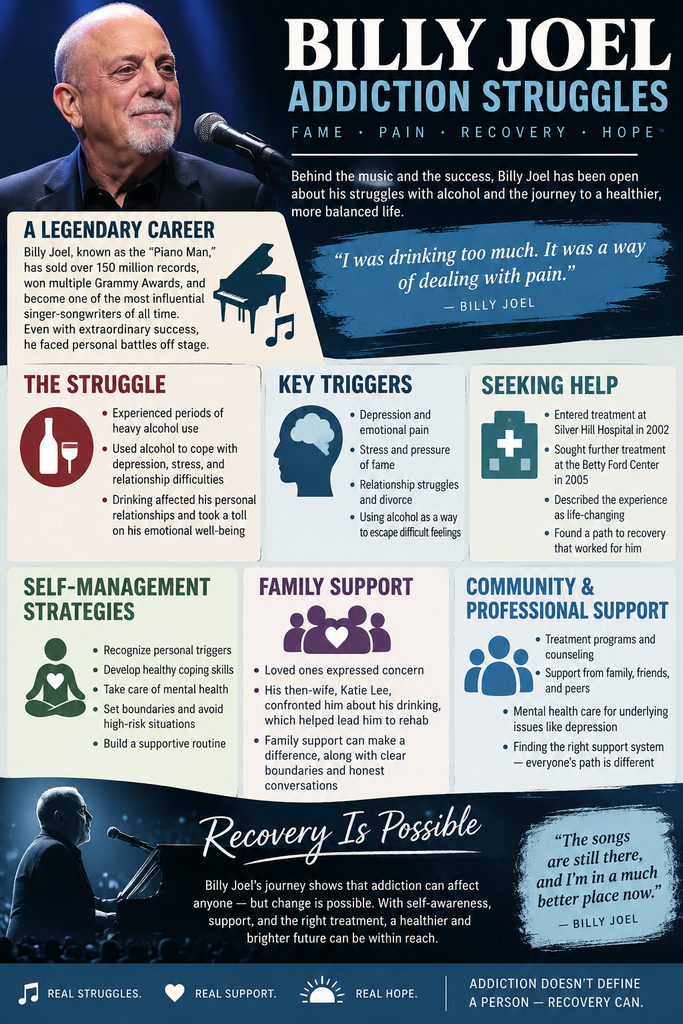
Joel has described periods of excessive drinking, particularly during emotionally difficult times. In interviews, he has connected some of his heavier drinking with depression, relationship problems, divorce, and other stressful experiences. He has also acknowledged using alcohol as a way of coping with emotional pain. This pattern—using alcohol to temporarily escape distress—is sometimes called self-medication and can create a cycle in which short-term relief contributes to longer-term problems.
Billy Joel’s Struggles With Alcohol
Joel sought treatment at Silver Hill Hospital in Connecticut in 2002. In 2005, he entered the Betty Ford Center for treatment related to alcohol abuse. He later described completing approximately a month there and said the experience helped him recognize that he did not have to continue drinking the way he had been. Public accounts from Joel and people close to him have also described how his drinking affected relationships.
Joel’s experience is somewhat different from the traditional recovery narrative. He has publicly said that Alcoholics Anonymous and the 12-step approach were not the recovery methods he chose for himself. In later interviews, he described dramatically reducing his drinking and avoiding hard liquor; more recent reporting has described him as having stopped drinking. His experience should not be interpreted as evidence that everyone with alcohol use disorder can safely return to controlled drinking. Recovery plans need to be individualized, and some people are safest with complete abstinence.
Emotional Pain and Alcohol Use
One important lesson from Joel’s story is the connection between emotional distress and substance use. Joel has spoken about depression and periods when drinking increased following painful events or relationship difficulties. In one interview, when discussing whether he had been self-medicating, he acknowledged drinking too much during difficult periods.
Alcohol may temporarily numb sadness, anxiety, loneliness, or stress, but it does not resolve the underlying problem. Over time, heavy alcohol consumption can contribute to additional emotional, physical, occupational, and relationship difficulties.
Recovery therefore involves more than simply removing alcohol. Understanding why a person drinks can be an important part of developing healthier coping strategies.
Self-Management Strategies
Someone struggling with alcohol does not need to follow Billy Joel’s exact path. Instead, his experiences can encourage people to examine their own relationship with alcohol and seek an individualized treatment plan.
Helpful self-management strategies may include:
- Recognizing personal drinking triggers, including loneliness, depression, conflict, grief, stress, and major life changes.
- Keeping track of when, why, and how much alcohol is consumed.
- Talking honestly with a healthcare or behavioral-health professional about drinking patterns.
- Developing healthier responses to stress, such as exercise, music, relaxation techniques, hobbies, or social connection.
- Receiving treatment for depression, anxiety, trauma, or other co-occurring mental health conditions when appropriate.
- Avoiding people, environments, and situations strongly associated with problematic drinking.
- Creating a written plan for responding to cravings and high-risk situations.
- Building regular sleep, nutrition, physical activity, and daily routines.
- Seeking professional treatment rather than relying solely on willpower.
- Remembering that a return to drinking does not mean recovery is impossible; it signals a need to reassess the recovery plan.
People who drink heavily or regularly should not suddenly stop drinking without medical guidance, because alcohol withdrawal can sometimes become dangerous or life-threatening.
How Families Can Provide Support
Billy Joel’s story also illustrates how substance misuse can affect partners and family members. In the 2025 documentary Billy Joel: And So It Goes, former partners discussed the impact his drinking had on their relationships, while Joel discussed entering treatment after his then-wife Katie Lee confronted him about his drinking.
Families can support recovery without attempting to control another person’s behavior.
Helpful family strategies include:
- Express concerns calmly and specifically, rather than resorting to shame or insults.
- Discuss observable behaviors and consequences rather than arguing over labels such as “alcoholic.”
- Encourage medical and behavioral-health evaluation.
- Learn about alcohol use disorder as a treatable health condition.
- Avoid covering up repeated consequences caused by substance use.
- Establish reasonable boundaries that protect everyone in the household.
- Do not provide money or assistance that unintentionally supports continued substance use.
- Recognize signs of alcohol poisoning, withdrawal, or other emergencies.
- Consider counseling or support groups for family members.
- Continue offering encouragement while recognizing that the individual ultimately has to participate in recovery.
Support and boundaries can exist together. Loving someone does not require protecting that person from every consequence of their substance use.
Community Support and Treatment Resources
Recovery does not have to occur alone. Community resources can provide different levels of assistance depending on a person’s needs.
Options may include:
- Primary-care providers and addiction medicine specialists.
- Mental health counselors and psychiatrists.
- Medically supervised alcohol withdrawal management when necessary.
- Residential or outpatient addiction treatment programs.
- Peer recovery coaches and recovery community organizations.
- Alcoholics Anonymous and other 12-step programs.
- Non-12-step alternatives such as SMART Recovery.
- Family counseling and family support programs.
- Community mental health centers.
- Crisis and suicide-prevention services when emotional distress becomes dangerous.
No single recovery program works for everyone. Billy Joel has been open about not identifying with the 12-step approach, but other people find 12-step communities extremely helpful. The important principle is finding evidence-informed treatment and support that match the person’s clinical needs, beliefs, risks, and circumstances.
What Billy Joel’s Journey Can Teach Us
Billy Joel’s history challenges the stereotype that addiction only affects people whose lives appear visibly unstable. Someone can continue working, performing, creating, or achieving professionally while experiencing significant problems with alcohol.
His experiences also highlight how substance misuse can intersect with depression, relationships, stress, and coping. Recovery may require examining these underlying issues rather than concentrating exclusively on the substance.
Another important lesson is that recovery does not look identical for everyone. Treatment may involve medical care, psychotherapy, rehabilitation, peer support, family involvement, lifestyle changes, or combinations of these approaches. What helped one celebrity should never automatically become a treatment recommendation for another person.
Conclusion
Billy Joel’s struggles with alcohol reveal a human story behind an extraordinary musical career. He publicly acknowledged drinking excessively, sought treatment, and eventually described substantial changes in his relationship with alcohol. His journey reminds us that recognizing a problem can be difficult and that outside concern from loved ones may sometimes help someone confront behavior they have minimized.
For people struggling today, the larger message is not to copy Billy Joel’s particular recovery path. It is to recognize that change is possible and that there are many legitimate routes to recovery. Self-awareness can help identify triggers, families can provide support while maintaining healthy boundaries, and communities can make professional treatment and recovery resources more accessible.
Addiction can become part of someone’s story without becoming the final chapter.
Frequently Asked Questions
Here are some common questions:
1. Has Billy Joel publicly discussed problems with alcohol?
Yes. Billy Joel has spoken publicly about periods of excessive drinking and how alcohol became connected with emotional difficulties in his life. He has described recognizing that his drinking had become unhealthy and eventually seeking professional help.
2. What substance did Billy Joel primarily struggle with?
His publicly documented substance-related difficulties have primarily involved alcohol. It is best to avoid assuming other substance-use disorders unless they have been reliably documented by Joel or credible sources.
3. Why did Billy Joel drink heavily?
Joel has associated periods of heavier drinking with emotional pain, depression, relationship difficulties, divorce, and stress. His experience illustrates how some people may use alcohol to temporarily cope with uncomfortable emotions.
4. Did Billy Joel ever enter rehabilitation?
Yes. Joel sought treatment at Silver Hill Hospital in Connecticut in 2002 and entered the Betty Ford Center for alcohol-related treatment in 2005.
5. Did Billy Joel consider himself an alcoholic?
Joel’s own descriptions of his drinking and recovery have not always fit neatly into traditional labels. When discussing a public figure, it is more accurate to describe what the person has publicly reported rather than independently diagnosing them with alcohol use disorder.
6. Did Billy Joel attend Alcoholics Anonymous?
Joel has discussed trying Alcoholics Anonymous but has said the 12-step approach was not the right fit for him. This does not mean AA is ineffective. Many people benefit from AA, while others find different evidence-based or peer-support approaches more suitable.
7. Did Billy Joel completely stop drinking?
His relationship with alcohol has changed over time, and accounts from different periods should not be treated as identical. He has previously described greatly reducing his alcohol consumption and avoiding hard liquor, while more recent reporting has described him as no longer drinking.
8. Can someone with an alcohol problem learn to drink moderately?
Some people reduce risky drinking, while others need or choose complete abstinence. A celebrity’s experience should not be used to determine what is safe for someone else. People with alcohol use disorder should discuss their goals with an addiction-trained healthcare professional.
9. What role did family and loved ones play in Billy Joel’s journey?
People close to Joel expressed concern about his drinking. His former wife, Katie Lee, has also discussed confronting him about his alcohol use and encouraging treatment. Supportive intervention from loved ones can sometimes help a person recognize that professional assistance is needed.
10. What self-management strategies can people learn from his experience?
Helpful strategies include identifying emotional triggers, recognizing when alcohol is being used to escape difficult feelings, developing healthier coping skills, maintaining supportive relationships, addressing mental health concerns, and seeking professional assistance before consequences become more severe.
11. How can families help someone struggling with alcohol?
Families can:
- Talk about concerning behavior without humiliation or name-calling.
- Encourage professional assessment and treatment.
- Establish healthy and consistent boundaries.
- Avoid enabling harmful drinking behaviors.
- Learn about alcohol use disorder and recovery.
- Seek counseling or family support for themselves.
- Have an emergency plan for severe intoxication, withdrawal, or suicidal behavior.
12. What community resources can support alcohol recovery?
Resources can include addiction medicine providers, therapists, outpatient and residential treatment programs, community mental health centers, AA, SMART Recovery, peer recovery programs, family counseling, and other local recovery organizations.
13. Is depression connected with problematic alcohol use?
It can be. Depression and alcohol problems frequently occur together, and alcohol may worsen depressive symptoms even when someone initially drinks to escape them. Both conditions should be professionally evaluated when they occur together.
14. Is it dangerous for a heavy drinker to suddenly stop drinking?
Potentially. Alcohol withdrawal can cause serious complications, including seizures and delirium tremens in some people. Someone who drinks heavily or has previously experienced significant withdrawal should obtain medical guidance rather than attempting abrupt withdrawal alone.
15. What is the biggest lesson from Billy Joel’s addiction struggles?
His story demonstrates that addiction and problematic alcohol use can affect people regardless of talent, wealth, fame, or professional success. It also shows the importance of recognizing unhealthy coping patterns, accepting help, addressing emotional well-being, and finding an individualized path toward recovery.
Video: Billy Joel Opens Up About His Private Alcohol Struggle