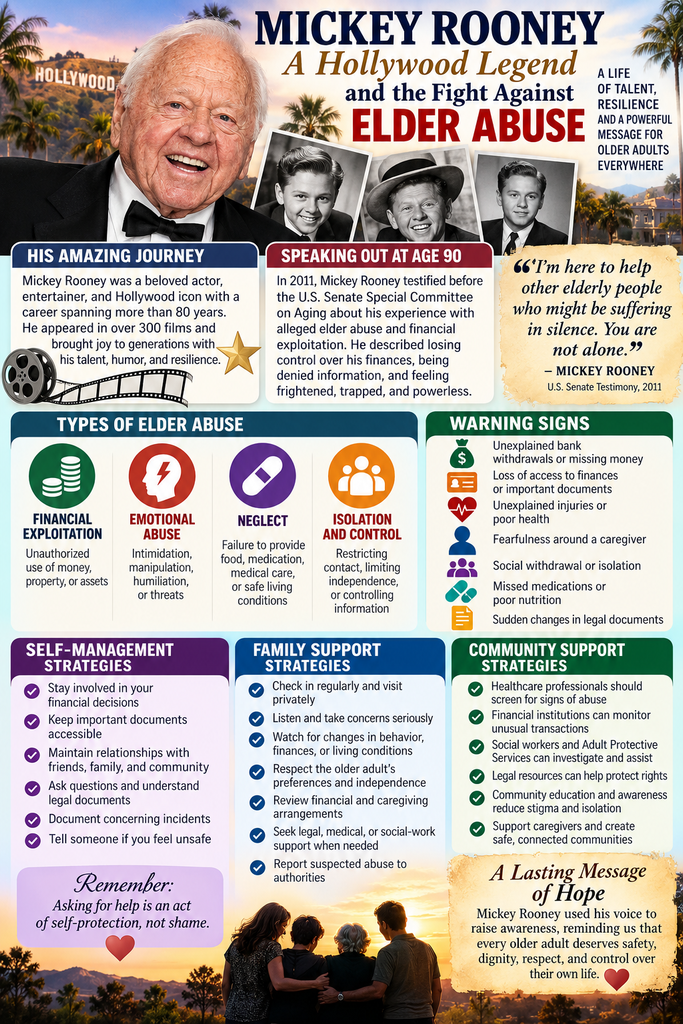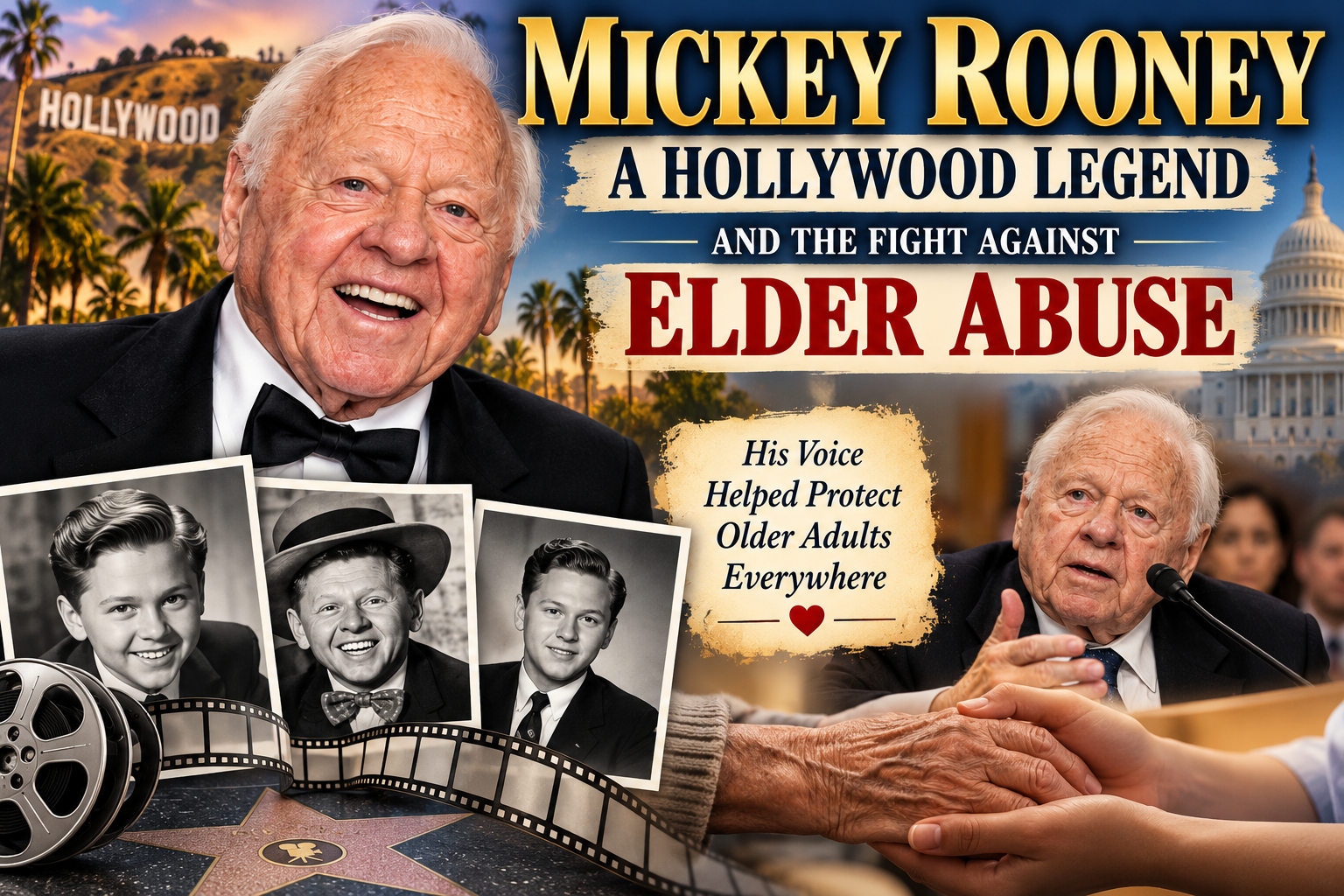
Mickey Rooney was one of Hollywood’s most recognizable entertainers, with a career spanning more than eight decades. Yet late in his life, Rooney became known for something beyond acting: speaking publicly about his experience with alleged elder abuse and financial exploitation. His story showed an important reality: age, fame, professional success, and wealth do not necessarily protect an older adult from mistreatment.
In March 2011, at age 90, Rooney testified before the U.S. Senate Special Committee on Aging during a hearing on elder abuse, neglect, and financial exploitation. He described being financially exploited, denied information about his finances, and feeling that attempts to speak up had been silenced.
Mickey Rooney’s Experience With Elder Abuse
Rooney’s difficulties became public after he sought legal protection involving his stepson, Christopher Aber, and Aber’s wife. Court documents contained allegations that Rooney had been deprived of control over his finances and subjected to emotional and other forms of mistreatment. A judge issued protective orders, and an attorney was appointed as temporary conservator of Rooney’s estate. The Abers denied wrongdoing; the dispute over the stay-away order was later resolved without an admission of the allegations.
During his Senate testimony, Rooney described the emotional consequences of losing control over his life. He said he felt frightened, trapped, frustrated, and powerless. He also reported that his money had been taken or misused and that he had been denied access to information about his own financial affairs.
His experience highlights several forms of mistreatment that can occur together:
- Financial exploitation: Unauthorized or inappropriate use of an older person’s money, property, income, or assets.
- Emotional or psychological abuse: Intimidation, threats, humiliation, manipulation, or controlling behavior.
- Neglect: Failure to provide necessities such as adequate food, medication, medical care, hygiene, or safe living conditions.
- Isolation and control: Restricting contact with other people or limiting access to transportation, communication, identification, or financial information.
Rooney’s allegations included withholding food and medication, restricting his independence, and controlling his finances and identification.
Why Mickey Rooney’s Story Matters
One particularly powerful aspect of Rooney’s story was his willingness to speak publicly about something many older adults may feel embarrassed or frightened to disclose. He told the Senate that he shared his experience not primarily to gain sympathy but to encourage other older adults who might be suffering silently.
His message was essentially that elder abuse can happen to anyone.
The person causing harm may also be someone the older adult knows, trusts, loves, or depends upon. That relationship can make recognizing and reporting abuse especially complicated. An older adult may fear retaliation, losing a caregiver, becoming isolated, creating family conflict, or being placed in a nursing facility.
Rooney’s experience therefore offers lessons not only about recognizing elder abuse but also about restoring an older person’s autonomy, dignity, safety, and voice.
Self-Management Strategies for Older Adults
An older adult who can participate in managing personal affairs can take steps that may reduce vulnerability. These measures cannot guarantee prevention, and responsibility for abuse always belongs to the person committing it, but safeguards can make exploitation more difficult to conceal.
- Remain involved in financial decisions. Regularly review bank accounts, credit cards, retirement income, and bills.
- Keep important documents accessible. Know where identification, insurance information, wills, financial records, and legal documents are located.
- Maintain relationships outside the home. Regular contact with friends, relatives, healthcare professionals, neighbors, or community groups can reduce isolation.
- Be cautious when granting financial authority. Understand powers of attorney and other documents before signing them.
- Ask questions. A person has the right to understand how their money and healthcare are being managed.
- Document concerning incidents. When safe, record unusual transactions, threats, missing belongings, injuries, medication problems, or controlling behavior.
- Tell someone. A healthcare professional, attorney, social worker, trusted relative, Adult Protective Services agency, or law-enforcement professional may be able to help.
One lesson from Rooney’s testimony is especially important: asking for help is an act of self-protection, not a reason for shame.
Family Support Strategies
Families can provide an important layer of protection, particularly when an older adult becomes increasingly dependent upon another person.
Family members should pay attention to changes that do not have a reasonable explanation. Sudden social withdrawal, fearfulness around a caregiver, unpaid bills despite adequate income, unexplained bank withdrawals, missing belongings, changes in legal documents, poor hygiene, missed medications, or unexplained injuries deserve attention.
Families can also:
- Visit and communicate privately with the older adult.
- Ask open-ended questions rather than immediately making accusations.
- Listen seriously when the person reports mistreatment.
- Respect the older adult’s preferences and decision-making capacity.
- Avoid allowing one individual to have unchecked control over every aspect of finances and care when safeguards are appropriate.
- Periodically review financial and caregiving arrangements with the older adult’s consent.
- Obtain legal, medical, social-work, or financial expertise when concerns arise.
- Report suspected abuse to the appropriate authorities when necessary.
Families should remember that protecting an older person does not automatically mean taking control away from them. Whenever possible, the goal should be safety with the greatest achievable level of independence and autonomy.
Community Support Strategies
Elder abuse prevention cannot depend entirely upon victims and their families. Healthcare systems, financial institutions, social-service organizations, legal professionals, and communities also have important roles.
Healthcare professionals may be among the few people who regularly interact privately with an isolated older adult. Clinicians should remain alert for unexplained injuries, poor nutrition, medication problems, fearfulness, excessively controlling caregiver behavior, or inconsistencies between the patient’s account and another person’s explanation.
Banks and financial institutions can also play an important role by recognizing unusual transactions or abrupt changes in financial behavior. Social workers, Adult Protective Services, legal-aid programs, aging agencies, and law enforcement can provide additional pathways for investigation and assistance.
Communities can strengthen protection by improving professional education, increasing public awareness of elder abuse, supporting caregivers, reducing social isolation among older adults, and making reporting resources easier to find.
From Hollywood Star to Elder-Abuse Advocate
Perhaps the most significant part of Mickey Rooney’s experience was what he did after his allegations became public. Instead of keeping the situation private, he used his visibility to draw attention to people with fewer resources or less public recognition.
During his Senate testimony, Rooney emphasized that older adults deserve control over their own lives and should not have to live in fear. He encouraged people experiencing abuse to speak out and maintain hope that someone would listen.
His testimony helped put a recognizable face on an issue that frequently remains hidden behind closed doors.
Understanding the Larger Lesson
Elder abuse is not simply a financial problem. Losing control over money, identification, medications, relationships, transportation, or everyday decisions can gradually strip a person of independence.
Rooney’s story illustrates why warning signs should be taken seriously even when an older adult appears successful, financially secure, or surrounded by family. It also reminds healthcare professionals and families to speak with older adults rather than simply speaking for them.
Protection should involve more than preventing physical harm. It should include preserving dignity, autonomy, financial security, social connection, and the individual’s right to participate in decisions about their own life.
Conclusion
Mickey Rooney spent most of his life entertaining audiences, but one of his final public roles became that of an elder-abuse advocate. At 90 years old, he appeared before Congress and described feeling financially exploited, frightened, and powerless. His decision to speak publicly turned an intensely personal experience into a broader warning about older adults’ vulnerability.
His journey demonstrates the importance of self-advocacy, attentive families, responsible healthcare professionals, financial safeguards, accessible community resources, and systems that take older adults seriously when they report mistreatment.
Most importantly, Rooney’s story reminds us that growing older should never mean surrendering the fundamental rights to safety, dignity, respect, and control over one’s own life.
Frequently Asked Questions
Here are some common questions:
1. Who was Mickey Rooney?
Mickey Rooney was an American actor and entertainer whose career spanned more than eight decades. Late in his life, he also became a prominent public voice about elder abuse after describing his own experience before the U.S. Senate.
2. Did Mickey Rooney say he was a victim of elder abuse?
Yes. In March 2011, at age 90, Rooney testified before the U.S. Senate Special Committee on Aging and explicitly identified himself as a victim of elder abuse. He described financial exploitation, emotional mistreatment, loss of independence, and feeling powerless.
3. Who did Mickey Rooney accuse of abusing him?
Before his Senate appearance, Rooney had obtained a temporary restraining order involving his stepson, Christopher Aber. Court filings contained allegations involving financial control and physical and emotional mistreatment. Aber disputed the allegations, and he and his wife later agreed to a stay-away arrangement without admitting wrongdoing.
4. What did Mickey Rooney say happened to his finances?
In his Senate testimony, Rooney said his money had been taken and misused and that he had been denied information about his own financial affairs. He described gradually losing control over even basic decisions in his life.
5. What forms of elder abuse did Rooney discuss?
Rooney’s testimony addressed several forms of elder mistreatment, particularly financial exploitation and emotional abuse. He also explained that elder abuse can involve physical abuse and that mistreatment by a family member can make it especially difficult for an older adult to seek help.
6. Why didn’t Mickey Rooney seek help sooner?
Rooney said he suffered silently for years. He described feeling frightened, trapped, frustrated, and helpless. He also explained that when abuse involves someone close to the older adult, concerns about family relationships, criticism, and disbelief can make speaking out particularly difficult.
7. Why was his Senate testimony important?
Rooney brought national attention to an often-hidden problem. The Senate’s March 2, 2011 hearing specifically addressed elder abuse, neglect, and financial exploitation, and Rooney appeared as both a victim and advocate.
8. Can elder abuse happen to wealthy or famous people?
Yes. Rooney’s experience illustrates that celebrity, wealth, or professional success does not necessarily prevent exploitation. His central message was that if it could happen to someone as publicly recognizable as him, other older adults could also be vulnerable.
9. What warning signs of financial elder abuse should families watch for?
Possible warning signs include unexplained withdrawals, missing money or possessions, sudden changes to financial or legal documents, unpaid bills despite adequate resources, loss of access to accounts, and another person exercising unusually restrictive control over the older adult’s finances.
Rooney’s experience also shows why families should pay attention when an older person suddenly loses access to identification, financial information, medication, transportation, or opportunities to communicate privately.
10. How can older adults protect themselves?
Helpful self-management strategies include:
- Regularly reviewing bank and credit-card statements.
- Keeping important identification and legal documents accessible.
- Understanding documents before signing them.
- Maintaining relationships with several trusted people rather than becoming socially isolated.
- Asking questions about financial and healthcare decisions.
- Reporting suspicious financial activity.
- Speaking privately with a healthcare professional, attorney, social worker, Adult Protective Services worker, or another trusted person when something feels wrong.
These precautions can reduce vulnerability, although responsibility for abuse always rests with the person committing it.
11. How can families help prevent elder abuse?
Families can maintain regular contact, visit privately when possible, listen carefully to concerns, monitor unexplained changes in finances or behavior, and ensure the older adult remains involved in decisions whenever they have the capacity.
Families should focus on protecting safety without unnecessarily taking away independence.
12. What role can healthcare professionals play?
Healthcare professionals can watch for unexplained injuries, medication problems, malnutrition, fearfulness, social isolation, or controlling behavior by another person. Private conversations with the older adult can be particularly important when abuse or coercion is suspected.
13. What can communities do?
Communities can strengthen protections by educating the public about elder abuse, supporting caregivers, reducing older-adult isolation, improving access to Adult Protective Services and legal assistance, and strengthening coordination among healthcare professionals, financial institutions, social services, and law enforcement. Recent Senate discussions continue to emphasize awareness, community intervention, and coordinated responses.
14. What happened with Rooney’s legal case?
Rooney pursued legal action involving his stepson. Reporting after Rooney’s death stated that a $2.86 million settlement was reached without an admission of the allegations, but the judgment was considered uncollectible because of the stepson’s financial circumstances.
15. What is the most important lesson from Mickey Rooney’s story?
His experience demonstrates that elder abuse can involve much more than physical violence. Financial control, intimidation, isolation, manipulation, and loss of personal autonomy can also be forms or warning signs of mistreatment.
Rooney ultimately used his public platform to encourage older adults not to remain silent. His story reinforces a simple principle: every older adult deserves safety, dignity, respect, financial security, independence, and a voice in decisions affecting their life.
Video: