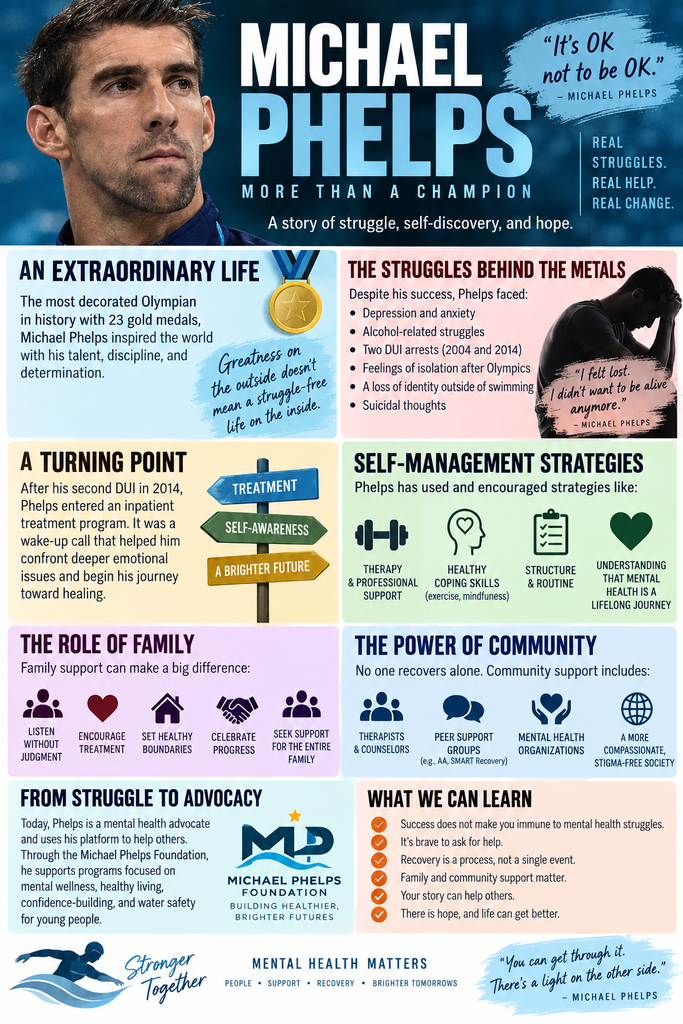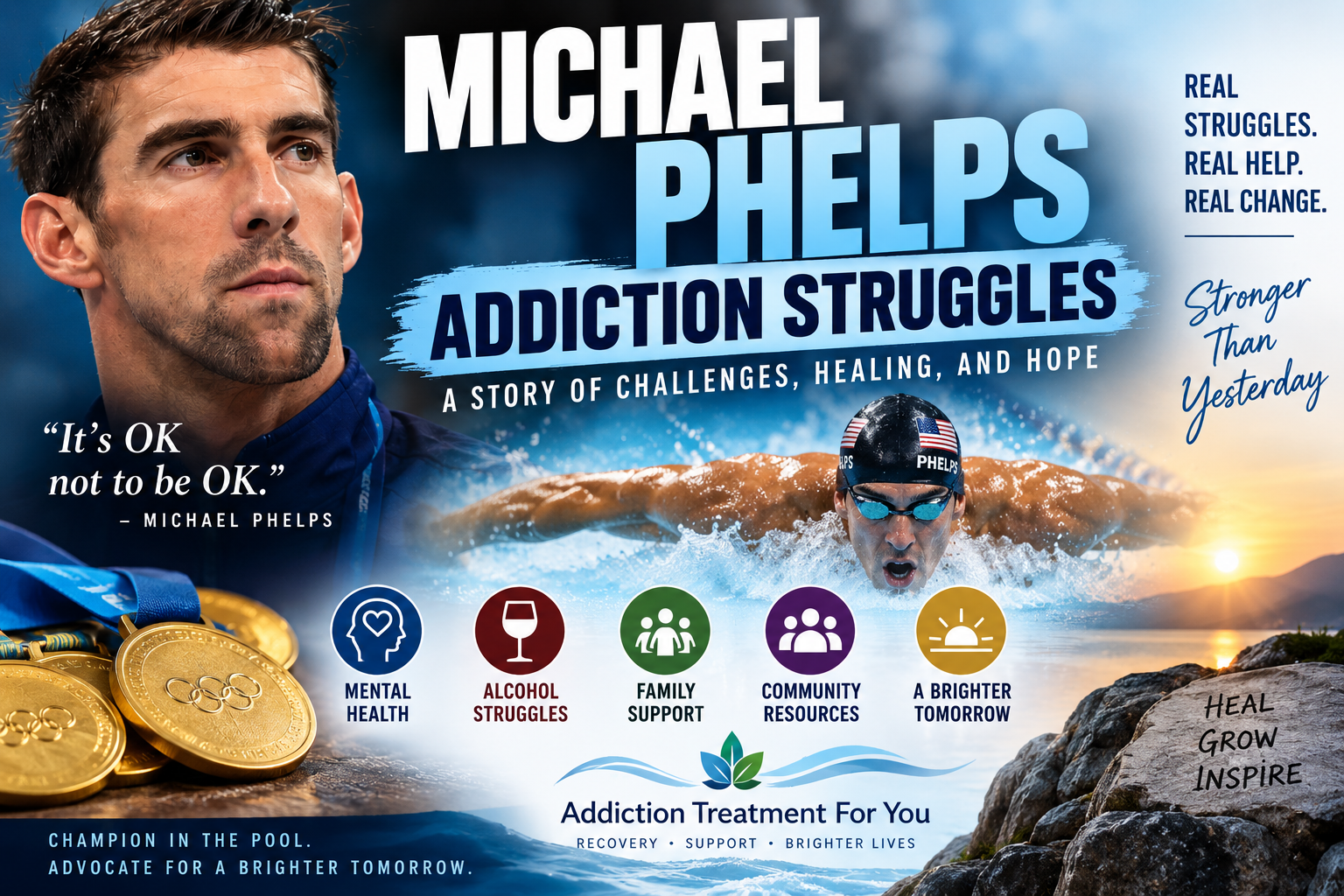
Michael Phelps is known around the world as the most decorated Olympian in history, but his achievements in the swimming pool tell only part of his story. Behind the medals, records, and public success, Phelps has spoken openly about periods of depression, anxiety, alcohol-related problems, and suicidal thoughts. His experiences demonstrate an important lesson about addiction and mental health: extraordinary achievement does not protect someone from emotional distress or unhealthy coping behaviors.
Phelps has not consistently described himself as having alcohol addiction, so it is more accurate to discuss his alcohol-related struggles, treatment, and recovery journey rather than diagnose him. After his second DUI arrest in 2014, Phelps entered an inpatient treatment program. He later described this period as a turning point that forced him to confront emotional issues he had previously avoided.
Success Did Not Eliminate Emotional Pain
From the outside, Phelps appeared to have almost everything an athlete could want. Yet he has described experiencing depression following Olympic competitions and struggling with his identity outside swimming. After years of intense focus on performance, the transition away from competition could leave him questioning what comes next.
Phelps has explained that he initially compartmentalized difficult emotions rather than fully addressing them. Over time, those feelings kept returning.
His experience illustrates why families should avoid assuming that someone who is successful, wealthy, physically fit, or highly motivated cannot experience substance-related or mental health problems. Achievement and psychological wellness are not the same thing.
Alcohol, Consequences, and a Turning Point
Phelps’s history included two DUI arrests, the first in 2004 and the second in 2014. Following the 2014 incident, he entered residential treatment. Reports from the period describe treatment as an opportunity for him to examine his behavior and broader emotional struggles rather than simply concentrating on athletic performance.
Phelps later disclosed that around this period he experienced profound depression and thoughts of not wanting to live. Instead of continuing to isolate himself, he ultimately sought professional help. He has said that therapy continued after he left inpatient treatment.
His story demonstrates that a crisis can become a point at which a person recognizes that existing coping strategies are no longer working.
Self-Management Strategies
Recovery and emotional wellness require more than simply deciding not to engage in a harmful behavior. Sustainable change often involves understanding the emotions, thoughts, situations, and relationships surrounding that behavior.
Helpful self-management strategies include:
- Recognize warning signs early. Increasing isolation, depression, impulsive behavior, escalating alcohol use, sleep disruption, and loss of motivation deserve attention.
- Seek professional treatment. Therapy can help identify underlying emotional problems and develop healthier coping strategies.
- Identify personal triggers. Stress, loneliness, major transitions, performance pressure, shame, and unresolved emotional pain can contribute to unhealthy coping.
- Create structure. Regular sleep, exercise, meals, meaningful activities, and planned downtime can provide stability.
- Develop coping alternatives. Exercise, mindfulness, journaling, hobbies, social connection, and relaxation techniques can provide healthier responses to stress.
- Separate identity from achievement. A person’s worth should not depend entirely on career success, athletic performance, appearance, or public recognition.
- Practice emotional honesty. Recognizing sadness, anxiety, anger, fear, or loneliness can make it easier to seek appropriate support instead of attempting to escape uncomfortable feelings.
Phelps has continued to discuss the importance of therapy and understanding his mental health rather than treating emotional wellness as a problem that simply disappears.
Family Support Strategies
Family members can have an important role in recovery, but supporting someone does not mean controlling them or protecting them from every consequence.
Families can help by:
- Listening without immediately criticizing or lecturing.
- Encouraging professional mental health and substance-use assessment when appropriate.
- Learning about depression, substance use disorders, relapse, and recovery.
- Establishing reasonable boundaries around unsafe behavior.
- Avoiding enabling behaviors such as repeatedly covering up serious consequences.
- Recognizing improvements without expecting immediate perfection.
- Encouraging healthy routines and relationships.
- Asking directly about emotional well-being rather than focusing only on alcohol or drugs.
- Seeking counseling or support for themselves when a loved one’s struggles affect the entire family.
Phelps’s story also highlights the importance of relationships that allow someone to be valued as a person rather than solely for what they accomplish.
Community Support Strategies
Recovery is easier when individuals and families do not have to manage serious problems alone. Community resources can create additional layers of accountability, treatment, education, and connection.
Helpful resources may include:
- Licensed therapists and counselors
- Addiction medicine professionals
- Primary care and behavioral health providers
- Intensive outpatient or residential treatment when clinically appropriate
- Peer recovery specialists
- Alcoholics Anonymous, SMART Recovery, or other peer-support programs
- Family programs such as Al-Anon
- Athlete mental-health programs
- Community mental-health organizations
- Crisis intervention services
- Educational programs that reduce stigma around asking for help
Community support is particularly important because stigma can cause people to hide symptoms until a problem becomes severe.
Turning Personal Struggle Into Advocacy
Phelps eventually began speaking publicly about mental health, helping challenge the assumption that elite athletes must always appear emotionally strong. His advocacy has also become part of the work associated with the Michael Phelps Foundation. The Foundation currently incorporates mental wellness, emotional resilience, healthy living, confidence-building, and water safety into programs for young people.
This transformation is significant. Recovery does not necessarily mean erasing a difficult chapter of life. For some people, recovery involves understanding that chapter well enough to apply its lessons to help themselves and others.
What Can We Learn From Michael Phelps?
Michael Phelps’s journey reminds us that addiction-related behaviors and mental illness do not have a single appearance. Someone can perform at an extraordinary level while privately experiencing significant emotional distress.
His experience also demonstrates why treatment should consider the whole person. Addressing alcohol use without considering depression, identity, stress, relationships, coping skills, and other mental-health concerns may leave important drivers of harmful behavior untreated.
For individuals in recovery, the lesson is not that everyone should follow Phelps’s exact path. Treatment is individualized. The broader message is that recognizing a problem, accepting professional help, developing healthier coping skills, and maintaining supportive relationships can create opportunities for meaningful change.
Conclusion
Michael Phelps will always be remembered for what he accomplished in the swimming pool, but his willingness to discuss what happened outside it may have an equally important impact. His experiences with alcohol-related consequences, depression, treatment, therapy, and mental-health advocacy show that vulnerability and achievement can exist in the same person.
Recovery should not be viewed simply as stopping alcohol or another substance. It can involve learning why unhealthy coping developed, addressing underlying mental-health concerns, rebuilding relationships, creating structure, and discovering an identity and purpose beyond past behavior.
For families, his journey provides another lesson: support the person, encourage treatment, maintain healthy boundaries, and remember that recovery is a process rather than a single event.
Frequently Asked Questions
Here are some common questions:
1. Did Michael Phelps struggle with addiction?
Michael Phelps has publicly discussed serious alcohol-related struggles, but he has not consistently identified himself as having alcohol addiction or alcohol use disorder. In a 2016 interview, he said he did not know whether he was an alcoholic. Therefore, it is more accurate to describe his experience as involving problematic alcohol use, alcohol-related consequences, treatment, and mental-health struggles rather than assigning him a diagnosis.
2. What substance did Michael Phelps struggle with?
Alcohol was a significant part of the problems Phelps publicly discussed. His alcohol use became particularly concerning because it was associated with dangerous behavior and legal consequences, including DUI arrests.
3. How many DUI arrests did Michael Phelps have?
Phelps had two DUI arrests, one in 2004 and another in 2014. The second arrest became an important turning point in his life and eventually contributed to his decision to seek treatment.
4. Did Michael Phelps go to rehab?
Yes. Following his 2014 DUI arrest, Phelps entered an alcohol-treatment program. He later described treatment as an experience that helped him confront parts of himself and his emotional life that he had previously avoided.
5. Did mental health contribute to Michael Phelps’ struggles?
Mental health was a major part of his story. Phelps has openly discussed depression, anxiety, suicidal thoughts, and periods of emotional difficulty following Olympic competitions. He has explained that he previously compartmentalized many of these emotions rather than addressing them.
6. Why did Michael Phelps experience depression despite being so successful?
Phelps has described experiencing “post-Olympic depression” and questioning his identity and purpose after major competitions. His experience illustrates that professional success, fame, wealth, and physical fitness do not necessarily protect someone from depression or other mental-health problems.
7. Did Michael Phelps experience suicidal thoughts?
Yes. Phelps has spoken publicly about reaching a point after his second DUI when he did not want to be alive. His disclosures have since become an important part of his mental-health advocacy.
8. What helped Michael Phelps begin changing his life?
One major turning point was recognizing that he needed help instead of continuing to suppress his emotions. Treatment, therapy, communication, self-awareness, exercise, sleep, and other healthy routines have become important tools in managing his mental health.
9. What self-management strategies can someone learn from his journey?
Phelps’s experience highlights several strategies that may help people facing substance-use or mental-health challenges:
- Recognize unhealthy behaviors and emotional warning signs.
- Seek professional help rather than hiding problems.
- Identify personal triggers and patterns.
- Use therapy and healthy coping strategies.
- Maintain regular sleep, exercise, and daily routines.
- Communicate when struggling rather than becoming isolated.
- View mental-health management as an ongoing process.
These strategies should complement individualized professional treatment rather than replace it.
10. How can families support someone experiencing similar problems?
Families can listen without excessive judgment, encourage professional treatment, learn about addiction and mental illness, establish healthy boundaries, avoid enabling dangerous behavior, and recognize progress. Families may also benefit from counseling or peer-support programs of their own.
11. Why are community resources important in recovery?
Treatment providers, therapists, peer-support groups, recovery organizations, crisis services, and community mental-health programs provide resources that families alone cannot always supply. Community support can also decrease isolation and help normalize asking for assistance.
12. Is Michael Phelps involved in mental-health advocacy today?
Yes. Phelps became a prominent advocate after publicly sharing his mental-health experiences. His Michael Phelps Foundation now incorporates mental wellness alongside water safety and healthy-living education. Its programs emphasize emotional awareness, resilience, confidence, goal-setting, and healthy coping skills.
13. What can people in recovery learn from Michael Phelps?
One of the strongest lessons is that success does not make someone immune to addiction-related behavior or mental illness. People can appear highly successful while experiencing severe problems privately. Seeking treatment can be a sign that someone recognizes change is necessary—not evidence of weakness.
14. Does recovery mean mental-health problems disappear completely?
Not necessarily. Phelps has described mental health as something he continues to manage rather than something that simply disappeared after treatment. This is an important recovery principle: improvement can coexist with ongoing attention to emotional wellness.
15. What is the biggest message from Michael Phelps’ journey?
His story demonstrates the importance of recognizing problems, seeking help, accepting professional treatment, developing healthier coping skills, and staying connected with supportive people. Recovery and mental wellness are often ongoing processes rather than one-time achievements.
Video: You didn’t know this about Michael Phelps 🥺 #michaelphelps #mentalhealth