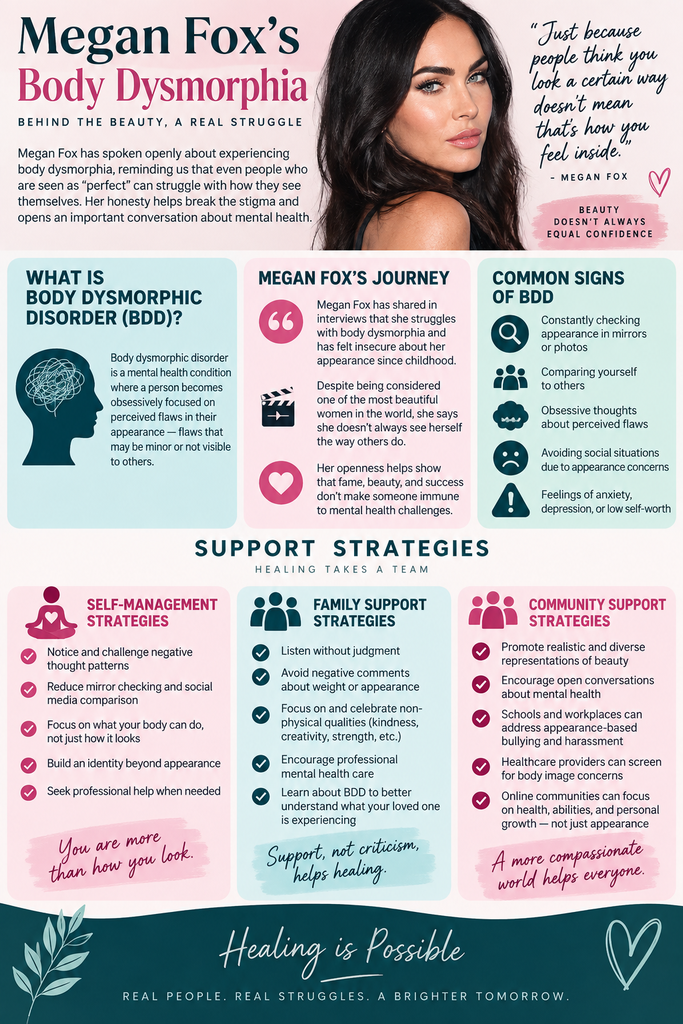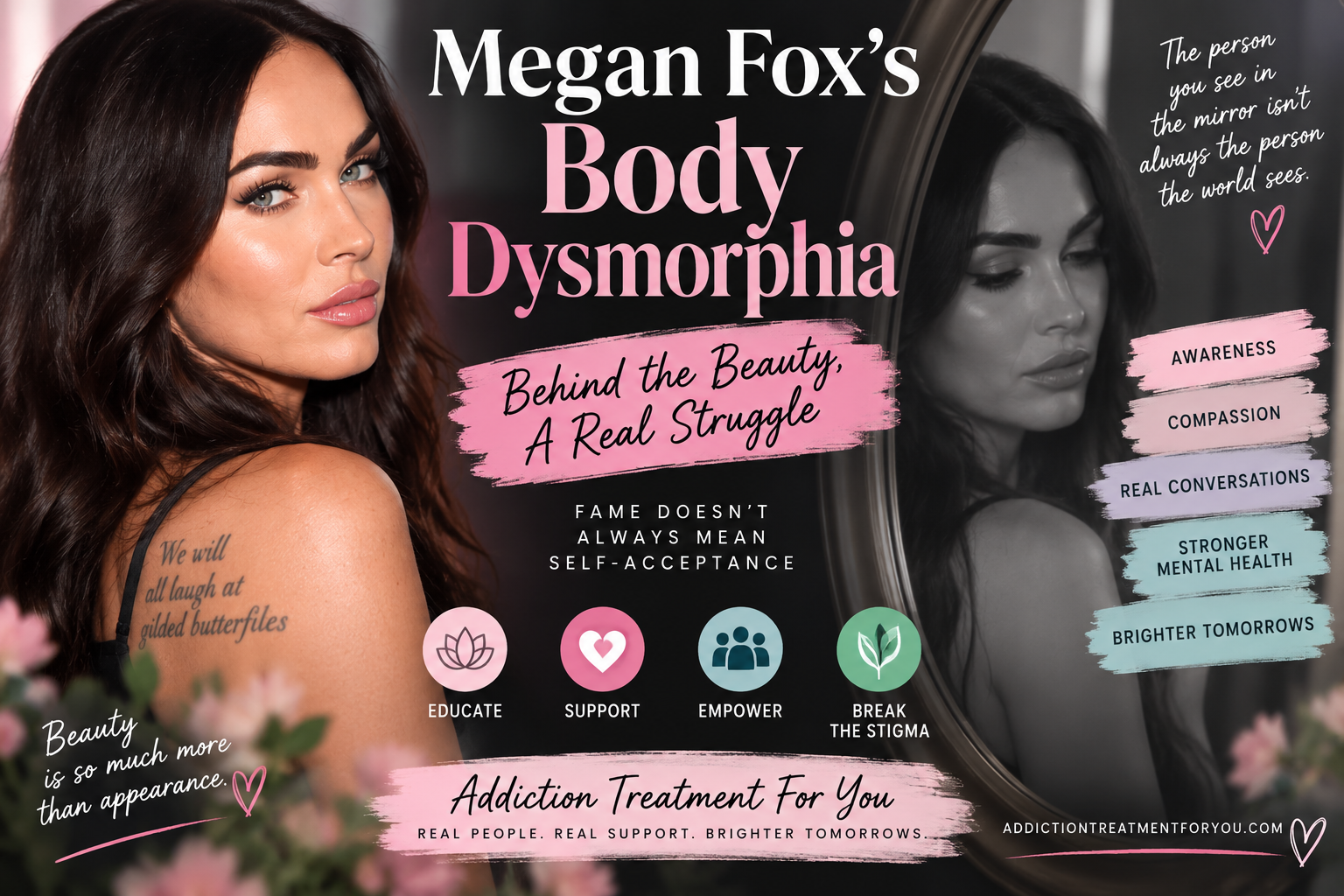
Megan Fox has long been portrayed by Hollywood and the media as a symbol of physical beauty. Yet her public image demonstrates an important mental health lesson: being considered attractive by others does not necessarily determine how a person sees themselves. Fox has openly discussed experiencing body dysmorphia and deep insecurities, providing an opportunity to better understand the difference between public perception and internal self-image.
Megan Fox’s Experience With Body Dysmorphia
In a 2021 interview with British GQ, Fox disclosed that she experiences body dysmorphia and described having significant insecurities. She pointed out that people may look at someone they consider beautiful and assume that person must feel confident or have an easy life, when their internal experience may be completely different.
Fox spoke about the issue again in connection with the 2023 Sports Illustrated Swimsuit Issue. She explained that she does not see herself the way other people see her and described struggling with her body image since childhood. She characterized learning to love herself as an ongoing journey.
Her disclosure challenges the assumption that beauty, fame, compliments, or professional success automatically protect someone from poor body image.
What Is Body Dysmorphic Disorder?
Body dysmorphic disorder, commonly called BDD or body dysmorphia, is a mental health disorder involving intense preoccupation with perceived flaws in physical appearance. The perceived flaw may seem minor or may not be noticeable to other people.
BDD is more than occasionally disliking a photograph or wishing that part of the body looked different. Concerns can become repetitive, distressing, and disruptive to everyday life. People may repeatedly check mirrors, compare themselves to others, seek reassurance, attempt to conceal perceived flaws, or avoid situations due to concerns about their appearance.
BDD can also occur alongside other mental health problems, including depression, anxiety, eating disorders, and substance-use problems. Severe cases can be associated with self-harm or suicidal thinking, making professional assessment especially important when symptoms significantly interfere with daily functioning.
The Difference Between How Others See Us and How We See Ourselves
Fox’s experience illustrates one of the most difficult aspects of body dysmorphia. External reassurance may not correct an internal perception.
A person can repeatedly hear “You look beautiful” while still focusing intently on something they believe is wrong with their appearance. This is why telling someone with significant body-image concerns to simply be more confident may accomplish very little.
Instead, recovery involves developing healthier ways of responding to thoughts about appearance and learning that personal value extends far beyond physical characteristics.
Self-Management Strategies
Healthy self-management does not mean someone must overcome BDD alone. Instead, these strategies can complement appropriate professional treatment.
- Recognize negative thought patterns. Notice thoughts such as “I have to look perfect” or “Everyone is noticing this flaw” and learn to question whether those conclusions are accurate.
- Reduce repetitive checking. Excessive mirror checking, photographing, measuring, comparing, or seeking reassurance can reinforce appearance-related anxiety.
- Limit unhealthy social comparison. Curating social media feeds and reducing exposure to accounts that consistently prompt appearance comparisons may be helpful.
- Focus on function instead of perfection. Appreciating what the body allows a person to do can gradually shift attention away from appearance alone.
- Develop identity outside appearance. Creativity, relationships, education, work, kindness, spirituality, hobbies, and personal accomplishments can strengthen a broader sense of self.
- Seek professional treatment when needed. Persistent or distressing symptoms deserve evaluation by a qualified mental health professional.
Family Support Strategies
Family members and close friends can play an important role, but support should not become endless reassurance about appearance.
Families can listen without minimizing the person’s distress. Statements such as “There’s nothing wrong with you, so stop worrying” may be well-intended but fail to address what the person is experiencing.
Family members can:
- Listen without criticizing or mocking appearance concerns.
- Avoid repeatedly discussing weight, attractiveness, dieting, or perceived physical imperfections.
- Compliment qualities unrelated to appearance, including courage, humor, compassion, creativity, and perseverance.
- Encourage professional mental health care when symptoms interfere with relationships, work, school, eating, or everyday activities.
- Learn about BDD so behaviors are recognized as possible symptoms rather than simply vanity or attention-seeking.
- Avoid participating excessively in reassurance rituals or repeated appearance comparisons.
The goal is not to convince someone that they are physically perfect. It is to help them understand that they do not need physical perfection to have worth.
Community Support Strategies
Schools, healthcare systems, workplaces, entertainment organizations, and online communities can also contribute to healthier attitudes about appearance.
Communities can promote media literacy so people understand how lighting, makeup, posing, filters, editing, cosmetic procedures, and carefully selected images can create unrealistic expectations.
Healthcare professionals can screen for significant body-image distress and refer individuals for appropriate mental health evaluation. Schools can address bullying and appearance-based harassment while teaching young people that bodies naturally differ.
Online communities can also encourage conversations centered on health, abilities, relationships, accomplishments, and personal development, rather than constantly ranking bodies by attractiveness.
What Megan Fox’s Story Can Teach Us
Perhaps the most important lesson from Megan Fox’s disclosure is that appearance and self-perception are not the same thing. Someone may receive enormous amounts of public praise for their appearance while privately experiencing intense insecurity.
Her comments also demonstrate why it is risky to assume we understand someone’s mental health simply by looking at them. Fame, attractiveness, wealth, or professional achievement do not eliminate psychological distress.
Body dysmorphia should therefore be approached with compassion rather than judgment. A person’s distress is not automatically superficial simply because it involves appearance.
Moving From Appearance Toward Self-Acceptance
Self-acceptance does not require believing that every feature of the body is perfect. A healthier goal may be learning that imperfections do not determine a person’s value.
For someone struggling with body dysmorphia, progress can involve challenging distorted thoughts, reducing compulsive appearance-related behaviors, developing healthier coping skills, accepting appropriate professional help, and building an identity that extends beyond the mirror.
Megan Fox’s willingness to discuss her experience reminds us that the person others see and the person someone sees in the mirror can feel remarkably different. Her story can help open a larger conversation about body image, unrealistic beauty expectations, and the importance of treating mental health concerns seriously.
Ultimately, healing is less about achieving the “perfect” appearance and more about reaching a place where appearance no longer determines self-worth.
Frequently Asked Questions
Here are some common questions:
1. Has Megan Fox publicly discussed body dysmorphia?
Yes. Megan Fox has publicly said that she experiences body dysmorphia and significant insecurities. In a 2023 Sports Illustrated Swimsuit interview, she explained that she does not see herself the way other people see her and described her struggle with body image as beginning in childhood.
2. When did Megan Fox first publicly discuss body dysmorphia?
Fox publicly discussed body dysmorphia in a 2021 British GQ Style interview, saying she had body dysmorphia and “a lot of deep insecurities.” She returned to the subject in her 2023 Sports Illustrated Swimsuit interview.
3. How does Megan Fox describe her body image?
Fox has explained that she does not see herself the way other people see her. In 2023, she described struggling to love her body throughout her life and said that learning to love herself may be an ongoing journey.
4. Did Megan Fox struggle with body image as a child?
According to Fox, her awareness and concerns about her body began when she was young. She recalled becoming preoccupied with the idea that she was supposed to look a certain way, though she was unsure why those concerns had developed so early.
5. How can someone considered beautiful still experience body dysmorphia?
Body dysmorphia is about a person’s internal perception of their appearance, not simply how attractive other people consider them. Fox herself has highlighted this difference, explaining that someone who appears beautiful and confident to others may experience significant insecurity internally.
6. What is body dysmorphic disorder?
Body dysmorphic disorder, or BDD, is a mental health condition characterized by excessive preoccupation with perceived flaws in appearance. These concerns can cause significant distress and interfere with everyday functioning. It is much more than occasionally feeling dissatisfied with one’s appearance.
7. What are common signs of body dysmorphic disorder?
Possible signs include excessive mirror checking or mirror avoidance, repeatedly comparing one’s appearance to others, seeking frequent reassurance, attempting to hide perceived flaws, excessive grooming, and avoiding social activities due to appearance concerns.
8. Is body dysmorphia the same as low self-esteem?
No. Low self-esteem may involve negative feelings about many aspects of oneself. Body dysmorphic disorder involves persistent and distressing preoccupation with perceived appearance flaws. Someone can have low self-esteem without BDD, although the two can occur together.
9. Is body dysmorphia the same as an eating disorder?
No. They are separate mental health conditions, although symptoms can overlap and a person may experience both. BDD generally centers on perceived defects in appearance, while eating disorders involve disturbances in eating behavior and often concerns involving weight, shape, or food.
10. Can social media make body-image problems worse?
For some people, yes. Constant exposure to carefully selected, filtered, edited, or idealized images can encourage unhealthy comparison. Someone who already struggles with body image may benefit from recognizing triggering content, limiting comparison-based social-media use, and following accounts that promote realistic and diverse representations of people.
11. What self-management strategies may help?
Helpful strategies can include recognizing distorted appearance-related thoughts, reducing excessive mirror checking and reassurance-seeking, limiting unhealthy comparisons, focusing on what the body can do rather than only on how it looks, and developing interests and sources of identity unrelated to appearance. Professional treatment should be considered when symptoms are persistent or interfere with daily life.
12. How can families support someone struggling with body dysmorphia?
Families can listen without judgment, avoid criticizing appearance or weight, emphasize qualities unrelated to physical appearance, learn about BDD, and encourage professional treatment. Family members should also be careful not to become part of repeated reassurance rituals.
13. What can communities do to promote healthier body image?
Schools, healthcare professionals, workplaces, media organizations, and online communities can promote realistic representations of diverse bodies, teach media literacy, address appearance-based bullying, expand mental health education, and make professional resources more accessible.
14. Can body dysmorphic disorder be treated?
Yes. BDD is treatable. Evidence-based approaches can include cognitive behavioral therapy (CBT), and medication may be appropriate for some individuals. Treatment should be individualized by qualified healthcare or mental health professionals.
15. What can we learn from Megan Fox’s experience?
Fox’s experience demonstrates that external beauty, fame, compliments, and professional success do not necessarily lead to a positive body image. Her disclosures help challenge the assumption that we can determine someone’s confidence or mental well-being simply by looking at them.
Video: Why even Megan Fox doesn’t feel perfect #meganfox #beautystandards