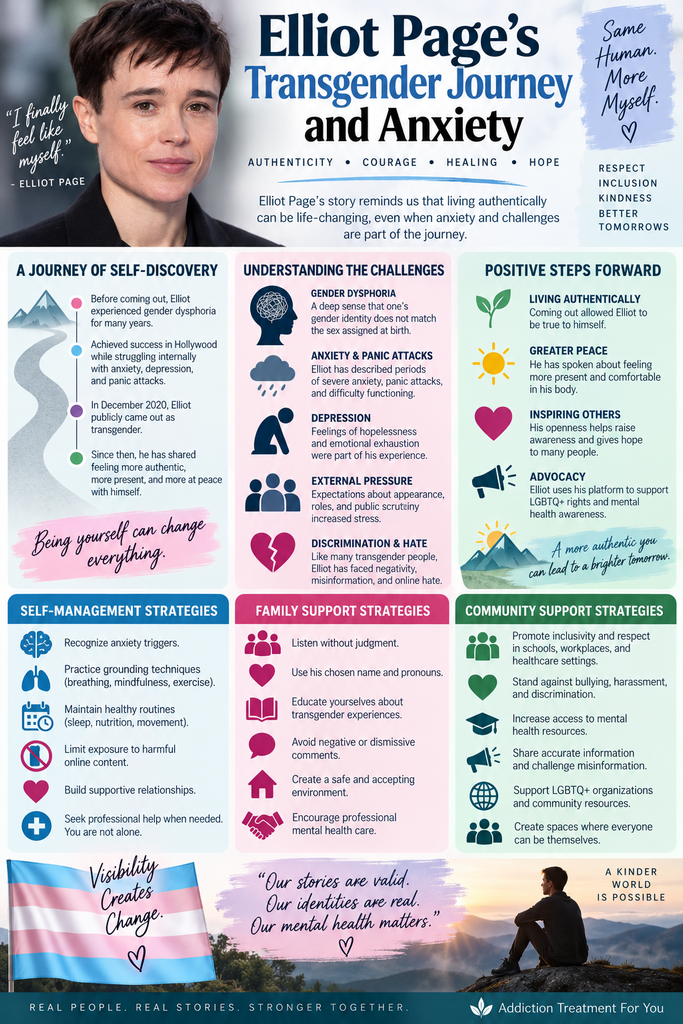
For years, actor Elliot Page achieved extraordinary professional success while privately experiencing significant emotional distress. His story demonstrates that fame and achievement do not necessarily protect someone from anxiety, depression, panic, or struggles surrounding identity. Page has spoken openly about gender dysphoria, severe anxiety, depression, panic attacks, and the difficulty of functioning during particularly challenging periods of his life.
His journey also offers a broader lesson about mental health: anxiety can have many contributing factors, and understanding the person behind the symptoms is often essential to providing meaningful support.
Living With Gender Dysphoria and Anxiety
Page has described experiencing gender dysphoria for decades. He recalled a persistent feeling that something was wrong and an urge to escape the discomfort he experienced in his body.
As his acting career grew, Page also faced expectations surrounding appearance and gender presentation. In the period following Juno’s success, he has described struggling with the pressure to dress and present himself in ways that felt deeply uncomfortable.
These experiences were not simply ordinary nervousness. Page has publicly discussed periods involving intense depression, anxiety, severe panic attacks, difficulty eating, and an inability to complete ordinary activities.
At times, anxiety became so severe that he struggled to leave his hotel while working on Inception. He has also described attempting to attend meetings but having to turn around because his distress became overwhelming.
Coming Out and Finding Greater Comfort
Page publicly came out as transgender in December 2020. In his first major interview afterward, he described experiencing both excitement and gratitude as well as fear and anxiety.
Transition did not mean that every mental health difficulty instantly disappeared. Mental health rarely works that simply. However, Page has described significant positive changes in how he experiences himself.
He has spoken about finally recognizing himself, feeling more present, and experiencing less of the constant desire to escape his body. His experience illustrates an important distinction: supporting someone’s identity does not promise a life without anxiety, but feeling comfortable and authentic in one’s identity can remove an important source of distress.
Understanding Anxiety Without Making Assumptions
Page’s story should not be interpreted to mean that being transgender itself automatically causes an anxiety disorder. Mental health is influenced by multiple biological, psychological, interpersonal, and environmental factors.
For transgender people, additional stressors can include rejection, discrimination, harassment, social isolation, pressure to hide one’s identity, difficulty obtaining appropriate healthcare, and fear about how other people may react.
Page himself has described receiving both substantial support and significant hostility after publicly coming out.
His experience reminds families and healthcare professionals to ask a more useful question than simply, “What is wrong with this person?”
We can instead ask, “What is this person experiencing, and what support could reduce their distress?”
Self-Management Strategies
Self-management strategies can complement professional mental healthcare when anxiety becomes difficult to control.
- Identify anxiety triggers. Keeping track of situations, thoughts, environments, or interactions associated with anxiety can reveal patterns.
- Practice grounding techniques. Slow breathing, mindfulness, exercise, sensory grounding, and spending time outdoors may help regulate periods of heightened anxiety.
- Develop an authentic support network. Relationships where someone can communicate honestly without constantly defending or explaining themselves can reduce isolation.
- Set boundaries. Limiting exposure to hostile online conversations, harassment, or people who repeatedly create emotional distress can protect mental well-being.
- Maintain basic routines. Consistent sleep, nutritious meals, physical activity, recreation, and structured daily activities can support overall mental health.
- Seek professional help when needed. Persistent anxiety, panic attacks, depression, difficulty functioning, or thoughts of self-harm warrant professional assessment.
Self-management should never be confused with handling everything alone. Asking for help is itself an important coping strategy.
Family Support Strategies
Family responses can strongly influence whether someone feels safe discussing anxiety, identity, or other emotional difficulties.
Families can provide support by:
- Listening before trying to solve the problem.
- Using the person’s requested name and pronouns.
- Avoiding ridicule, humiliation, threats, or dismissive comments.
- Asking what type of support the individual actually wants.
- Learning about anxiety, gender dysphoria, and available mental health resources.
- Recognizing signs of worsening depression, panic, isolation, or hopelessness.
- Encouraging professional mental healthcare when symptoms interfere with everyday life.
- Maintaining communication even when family members do not completely understand what the individual is experiencing.
Support does not require knowing exactly what another person feels. It requires treating their distress seriously and maintaining a relationship in which honest conversation is possible.
Community Support Strategies
Communities also influence mental health. Schools, workplaces, healthcare organizations, entertainment industries, and social groups can help create environments where people are treated with dignity.
Helpful community strategies include:
- Providing access to qualified mental health professionals.
- Establishing policies against bullying and harassment.
- Creating confidential pathways for people to request help.
- Educating healthcare professionals about respectful, individualized care.
- Supporting peer and community organizations that decrease social isolation.
- Providing accurate mental health information rather than stereotypes or misinformation.
- Creating workplaces and schools where individuals can seek psychological support without shame.
Community support is particularly important because not everyone has an accepting family or strong personal support network.
What Families Can Learn From Elliot Page’s Story
One important lesson from Page’s experience is that outward success can conceal substantial emotional suffering.
A person may be working, attending school, maintaining relationships, or achieving professional recognition while experiencing severe anxiety internally. Statements such as “You have everything—why are you anxious?” can make it even harder for someone to discuss their symptoms.
Page has described reaching points when anxiety and panic significantly interfered with everyday functioning despite having a successful acting career.
That is why listening matters.
Instead of assuming we understand another person’s experience, families can create space for the individual to describe it.
Mental Health Treatment Matters
Anxiety disorders are treatable. Depending on an individual’s symptoms and circumstances, treatment may include psychotherapy, cognitive behavioral therapy, medication, lifestyle interventions, peer support, or a combination of approaches.
Gender-related distress should also be evaluated individually. Every transgender person’s experience is different, and not everyone follows the same social or medical path. Care should therefore be individualized rather than based on assumptions about what a transgender person should or should not do.
For anyone experiencing severe depression, panic attacks, inability to function, self-harm, or suicidal thoughts, professional help should be sought promptly.
From Anxiety Toward Authenticity
Elliot Page’s story is ultimately about more than being transgender. It is also a story about the psychological consequences of feeling unable to live authentically and the importance of being heard, supported, and cared for appropriately.
Page has described transitioning as allowing him to recognize himself and experience a greater sense of presence in everyday life. At the same time, he has acknowledged that anxiety did not magically disappear.
That distinction is important.
Recovery does not necessarily mean never experiencing anxiety again. It can mean understanding anxiety better, developing healthier coping skills, obtaining appropriate treatment, establishing supportive relationships, and creating a life in which distress no longer controls every decision.
For individuals struggling with identity and anxiety, the message should be neither judgment nor pressure. It should be an invitation to talk, to receive appropriate care, to develop supportive relationships, and to move toward a life in which they can feel safe being themselves.
Self-management builds coping skills. Family acceptance strengthens connection. Community support reduces isolation. Professional care provides treatment. Together, these resources can help transform surviving into living.
Frequently Asked Questions
Here are some common questions:
1. Who is Elliot Page?
Elliot Page is a Canadian actor known for films such as Juno and Inception and the television series The Umbrella Academy. Page publicly came out as transgender in December 2020 and has since spoken openly about his experiences with gender identity, mental health, and living more authentically.
2. When did Elliot Page come out as transgender?
Page publicly came out as transgender in December 2020. In a 2021 interview with TIME, he described reaching that point with feelings that included gratitude, excitement, fear, and anxiety.
3. Did Elliot Page experience anxiety before transitioning?
Yes. Page has publicly described experiencing significant anxiety and depression before coming out as transgender. He has discussed the emotional distress associated with gender dysphoria as well as pressures surrounding appearance and gender expectations during his acting career.
4. What is gender dysphoria?
Gender dysphoria refers to clinically significant discomfort or distress that can arise from incongruence involving a person’s experienced gender, sex assigned at birth, or physical sex characteristics. The clinical focus is on the distress, rather than treating transgender identity itself as a mental disorder.
5. Is being transgender a mental illness?
No. Being transgender is not itself a mental disorder. Some transgender people experience gender dysphoria, anxiety, depression, or other mental health difficulties, while others do not. Social rejection, discrimination, harassment, and lack of support can also contribute substantially to psychological distress.
6. How did gender dysphoria affect Elliot Page?
Page has described gender dysphoria as something he experienced for decades. He explained that it created a persistent sense that something was wrong, along with an urge to escape. He has also discussed how expectations to dress and present himself in particular ways within Hollywood intensified his discomfort.
7. Did transitioning eliminate all of Elliot Page’s anxiety?
It would be inaccurate to say that transition automatically eliminates anxiety. Page has described experiencing greater comfort, joy, and freedom after coming out and transitioning, but mental health is complex and can be influenced by many factors. Transition should therefore not be presented as a guaranteed cure for an anxiety disorder.
8. How has Elliot Page described life after coming out?
Page has spoken about experiencing greater authenticity and comfort with himself. His accounts emphasize finally being able to recognize and express an identity that he had struggled with for many years.
9. Why might transgender people experience higher levels of anxiety?
Being transgender itself does not inherently cause anxiety. However, some transgender people experience additional stress from discrimination, rejection, bullying, harassment, social isolation, difficulty accessing appropriate healthcare, or pressure to conceal their identity. These experiences can negatively affect mental health.
10. What self-management strategies can help with anxiety?
Helpful strategies may include identifying anxiety triggers, practicing relaxation or grounding techniques, maintaining healthy sleep and exercise routines, reducing exposure to hostile online interactions, developing supportive relationships, and seeking professional mental healthcare when anxiety becomes persistent or interferes with everyday functioning.
11. How can families support a transgender person experiencing anxiety?
Families can listen without judgment, maintain open communication, use the person’s appropriate name and pronouns, avoid assumptions about what transition should involve, educate themselves about transgender experiences, and help the individual obtain qualified mental healthcare when necessary. The American Psychological Association specifically recommends maintaining communication and respecting a person’s identity.
12. What should families avoid doing?
Families should avoid ridicule, threats, intentional misgendering, dismissing anxiety as attention-seeking, or assuming they know what the individual needs without asking. They should also avoid assuming that every transgender person wants the same medical treatments or follows the same transition process.
13. How can communities provide support?
Schools, workplaces, healthcare systems, and community organizations can establish protections against bullying and harassment, provide access to mental health resources, encourage respectful communication, offer peer-support opportunities, and ensure people have confidential ways to request help.
14. Why is community acceptance important for mental health?
Social environments matter. Discrimination and rejection can create significant psychological stress, while supportive relationships and access to appropriate care can provide important protective resources. Research among transgender and nonbinary young people also demonstrates substantial levels of anxiety, highlighting the importance of accessible mental health support.
15. What can we learn from Elliot Page’s journey?
Page’s story illustrates how someone can achieve considerable professional success while privately experiencing serious emotional distress. It also demonstrates the potential importance of authenticity, supportive relationships, appropriate healthcare, and having an environment where a person can discuss identity and mental health without fear of judgment.
16. When should someone seek professional help for anxiety?
Professional evaluation is appropriate when anxiety becomes persistent, produces frequent panic attacks, disrupts sleep or eating, causes avoidance of work, school, relationships, or ordinary activities, or significantly reduces quality of life. Immediate help is particularly important when anxiety or depression is accompanied by self-harm or suicidal thoughts.
Video: The secret to Elliot Page’s emotional well-being #elliotpage #mindset #shorts