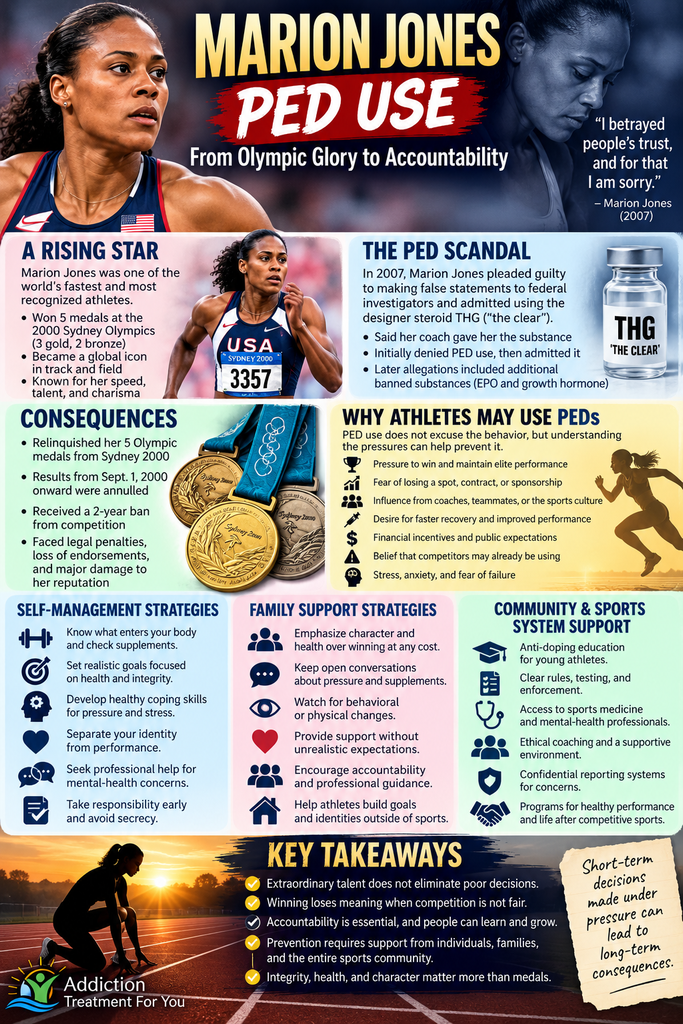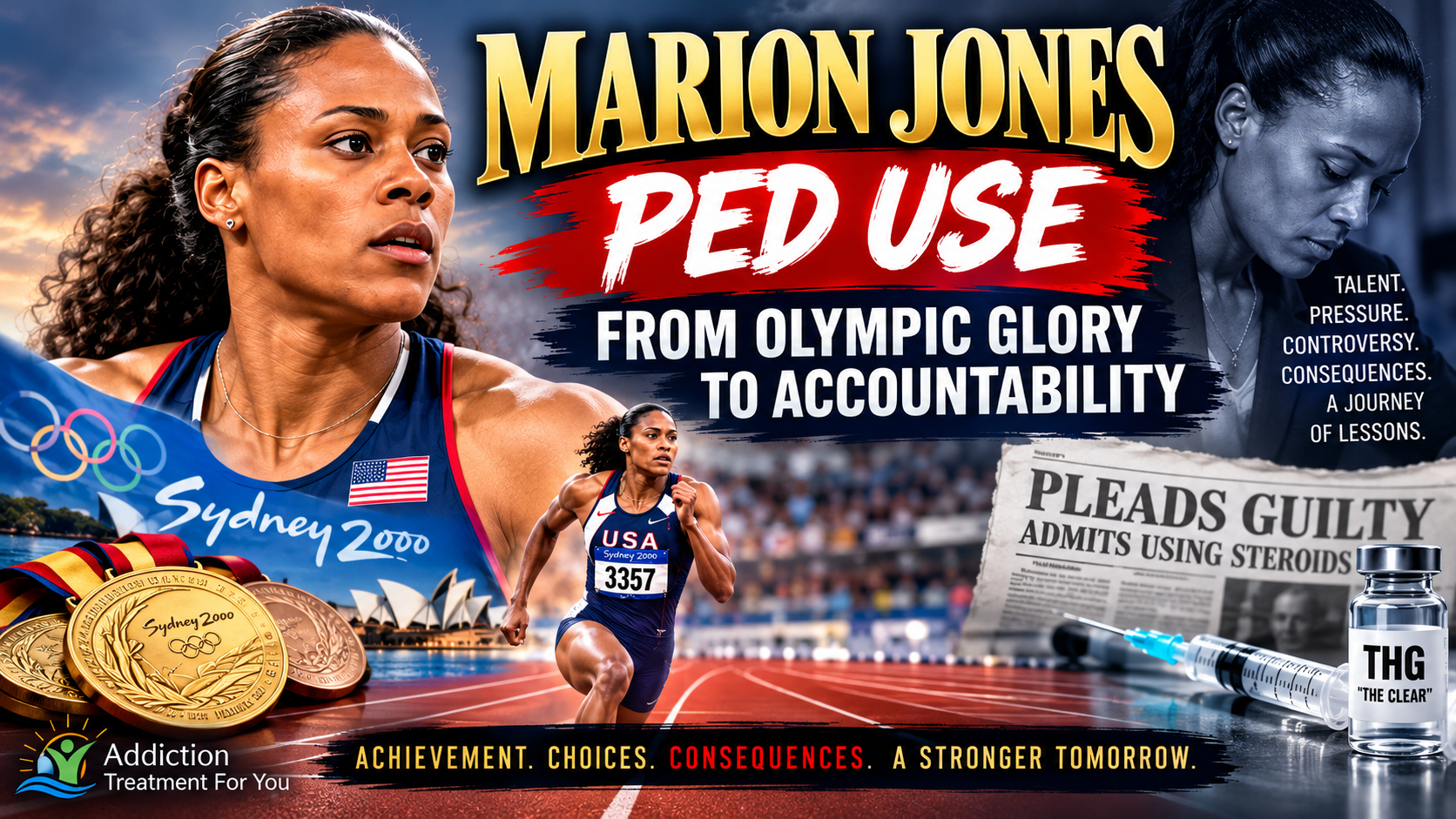
Marion Jones was once one of the world’s most recognizable athletes. At the 2000 Sydney Olympics, the American track-and-field star won three gold medals and two bronze medals, becoming an international symbol of speed and athletic achievement. Years later, however, her accomplishments became connected to one of the most significant performance-enhancing drug (PED) scandals in sports.
In October 2007, Jones pleaded guilty to making false statements to federal investigators and acknowledged using the designer steroid tetrahydrogestrinone (THG), commonly known as “the clear.” She admitted that she had lied to investigators when she previously denied using performance-enhancing drugs.
Her story is about more than doping. It provides an opportunity to discuss competitive pressure, secrecy, accountability, consequences, rebuilding after serious mistakes, and how individuals, families, coaches, and athletic communities can help create environments where health and integrity are valued alongside achievement.
The Rise of an Olympic Champion
Jones entered the 2000 Sydney Olympics as one of the world’s most celebrated track-and-field athletes. She ultimately left Sydney with five medals—three gold and two bronze.
Her performances made her an international sports celebrity. But questions about performance-enhancing drugs eventually became connected with Jones and the broader BALCO investigation, which examined the distribution of banned substances to elite athletes.
For years, Jones publicly denied using PEDs. That changed dramatically in 2007.
Marion Jones Admits Using Performance-Enhancing Drugs
On October 5, 2007, Jones appeared in federal court and pleaded guilty to two counts of making false statements to federal investigators, one concerning performance-enhancing drugs and another concerning an unrelated check-fraud matter.
Jones told the court that her coach, Trevor Graham, had given her a substance that he described as flaxseed oil. She later acknowledged that the substance was “the clear,” a designer anabolic steroid associated with BALCO. She said that by the time federal investigators questioned her in 2003, she realized she had been given a performance-enhancing drug—and nevertheless denied using it.
Federal prosecutors later alleged that her PED use was more extensive than her initial account, including THG, erythropoietin (EPO), and human growth hormone. That later allegation is important to distinguish from Jones’s original description of her drug use.
Losing Her Olympic Medals
The consequences were substantial.
Only days after her guilty plea, Jones relinquished the five medals she had won at the Sydney Olympics.
World Athletics, then known as the IAAF, subsequently disqualified Jones from competitions beginning September 1, 2000, annulled her individual results from that period, imposed a two-year period of ineligibility, and required the forfeiture and return of applicable medals and awards.
The consequences therefore extended far beyond public embarrassment. Her competitive record, reputation, career, finances, and relationships with fans and the sporting community were affected.
Accountability and Shame
One of the most significant moments in Jones’s story occurred outside the courthouse after she pleaded guilty.
She publicly acknowledged that she had betrayed people’s trust and accepted responsibility for making false statements to investigators. She also announced her retirement from track and field.
Accountability does not erase harm or automatically restore trust. However, accepting responsibility can be an important part of moving forward after serious mistakes.
There is a valuable distinction between guilt and shame.
Guilt can say, “I did something wrong.”
Shame can say, “I am permanently defined by what I did.”
Healthy accountability requires acknowledging harmful behavior without assuming that a person’s worst decision must become their entire identity.
Understanding the Pressures Behind PED Use
Understanding why athletes may use PEDs does not excuse doping. It can, however, help athletic organizations develop better prevention strategies.
Elite athletes can face extraordinary pressure related to performance, contracts, sponsorships, public expectations, injuries, aging, competition, and fear of losing their careers.
Risk factors surrounding PED use may include:
- Pressure to win or maintain elite performance.
- Fear of losing a position, scholarship, contract, or sponsorship.
- Desire for faster recovery from intense training.
- Influence from coaches, trainers, teammates, or peers.
- A sporting culture in which prohibited substances become normalized.
- Belief that competitors may already be doping.
- Financial incentives connected with winning.
- Poor understanding of supplements and prohibited substances.
- Fear of admitting mistakes after PED use has begun.
None of these pressures removes an athlete’s responsibility to follow anti-doping rules. They do demonstrate why prevention must involve more than simply telling athletes, “Don’t use drugs.”
Self-Management Strategies for Athletes
Athletes need tools to manage performance pressure before questionable shortcuts become attractive.
Helpful strategies include:
- Know what enters your body. Athletes should understand medications, supplements, and other substances they use and consult qualified professionals when uncertain.
- Ask questions. Treat secrecy around a substance or instructions not to discuss it as a warning sign.
- Develop realistic performance goals. Improvement should not come at the expense of health or integrity.
- Build coping skills for failure. Losing a competition or experiencing declining performance does not determine a person’s worth.
- Manage stress appropriately. Sleep, nutrition, recovery, counseling, mindfulness, and healthy social relationships can support psychological well-being.
- Separate identity from performance. A person is more than a medal, record, ranking, or athletic career.
- Seek professional assistance. Athletes struggling with substance use, body-image concerns, anxiety, depression, or extreme performance pressure should have confidential access to qualified healthcare professionals.
- Take responsibility early. Concealing one poor decision can create additional consequences.
Family Support Strategies
Families can provide important protection against unhealthy performance pressures.
Parents, spouses, partners, and other family members can:
- Emphasize character and health rather than winning at any cost.
- Ask athletes how they are coping emotionally, not simply how they are performing.
- Encourage open conversations about supplements and performance-enhancing substances.
- Watch for dramatic behavioral or physical changes.
- Encourage medical evaluation when substance use is suspected.
- Avoid creating unrealistic expectations surrounding athletic success.
- Support accountability without defining the person entirely by the mistake.
- Help athletes develop goals and identities outside competitive sports.
Families may experience their own anger, embarrassment, disappointment, or confusion when an athlete becomes involved in a doping scandal. Family counseling can sometimes help everyone communicate and establish healthier boundaries.
Community and Sports-System Support
Preventing PED use is also a community responsibility.
Schools, universities, athletic organizations, coaches, healthcare professionals, and governing bodies can create environments that reduce the pressure to use prohibited substances.
Helpful approaches include:
- Comprehensive anti-doping education beginning with young athletes.
- Clear information about prohibited drugs and supplements.
- Access to sports medicine and mental-health professionals.
- Confidential pathways for athletes to report concerns.
- Strong ethical standards for coaches and trainers.
- Consistent testing and enforcement of anti-doping rules.
- Education about supplement contamination and medication responsibilities.
- Programs that teach athletes healthy ways to improve performance.
- Support for athletes transitioning away from competitive sports.
Jones’s case also demonstrates why accountability involves protecting other competitors. PED use does not affect only the athlete using the substance. It can affect competitors who followed the rules, relay teammates, sporting records, sponsors, fans, and public confidence in competition.
The Difference Between Understanding and Excusing
Marion Jones’s story should not be reduced to either condemnation or sympathy.
Understanding the psychological and environmental pressures surrounding PED use does not mean excusing the behavior.
Likewise, recognizing serious wrongdoing does not require believing that a person is incapable of learning, changing, or contributing positively afterward.
Both ideas can exist together:
People should be accountable for their decisions, and they can grow beyond them.
Lessons From Marion Jones’s Journey
Jones’s experience provides several important lessons about performance-enhancing drugs and personal responsibility:
- Extraordinary talent does not eliminate vulnerability to poor decisions.
- Competitive pressure can influence judgment but does not remove personal responsibility.
- Secrecy can allow harmful behaviors to continue.
- Dishonesty can create consequences beyond the original misconduct.
- Coaches and athletic organizations have important responsibilities for athlete welfare.
- Winning loses meaning when competition is not fair.
- Admitting wrongdoing cannot erase the past, but accountability can become part of rebuilding one’s life.
Perhaps the most important lesson extends beyond athletics: short-term decisions made under pressure can produce long-term consequences.
Conclusion
Marion Jones’s journey from celebrated Olympic champion to admitting performance-enhancing drug use represents one of the most widely remembered doping cases in American track and field. She relinquished her five Sydney Olympic medals, had her competitive results from September 2000 onward annulled, and saw her reputation change dramatically.
Yet her story can also be used as an educational opportunity.
For individuals, prevention involves understanding risks, managing pressure, questioning suspicious substances, developing healthy coping strategies, and seeking help before a poor decision becomes a pattern. Families can emphasize health, character, communication, and accountability rather than achievement alone. Communities and sports organizations can provide education, testing, mental-health resources, ethical coaching, and environments where athletes do not believe winning requires sacrificing their health or integrity.
Marion Jones’s story ultimately reminds us that talent and success do not protect anyone from consequential choices. Medals may measure athletic achievement, but integrity, accountability, and the willingness to learn from mistakes are measured over a much longer journey.
Frequently Asked Questions
Here are some common questions:
1. Who is Marion Jones?
Marion Jones is a former American track-and-field star who became one of the most prominent athletes of the 2000 Sydney Olympics, originally winning five medals—three gold and two bronze. Her Olympic achievements were later annulled following her admission of performance-enhancing drug use.
2. Did Marion Jones admit to using performance-enhancing drugs?
Yes. In October 2007, Jones pleaded guilty to making false statements to federal investigators and admitted using the prohibited substance known as “the clear.” World Athletics subsequently recorded her admission that she had used the substance beginning September 1, 2000.
3. What was “the clear”?
“The clear” was the nickname for tetrahydrogestrinone, or THG, a designer anabolic steroid associated with the BALCO doping scandal.
4. Did Marion Jones ever test positive for PEDs?
Jones’s case is notable because she did not initially become known through a positive drug test. Her doping violations were ultimately established through her admission and the investigation surrounding BALCO.
5. Why did Marion Jones lose her Olympic medals?
After her admission, Jones returned the five medals she had received at the 2000 Sydney Olympics. World Athletics disqualified her from competition beginning September 1, 2000, annulled her individual results from that date, and required her to forfeit relevant medals and awards.
6. Did Marion Jones go to prison because she used steroids?
The distinction is important: her six-month federal prison sentence was imposed for lying to federal investigators, involving both her steroid use and an unrelated check-fraud investigation—not simply for taking a prohibited athletic substance.
7. Why might elite athletes turn to PEDs?
There is no single explanation. Factors include intense competitive pressure, financial incentives, fear of declining performance, expectations from others, goals for faster recovery, and environments where doping becomes normalized. These factors may help explain risk, but they do not excuse violations of anti-doping rules.
8. Are performance-enhancing drugs the same as drug addiction?
No. PED use should not automatically be described as addiction. Substance use disorder is a clinical diagnosis involving specific behavioral and functional criteria. Public evidence that an athlete used a prohibited substance does not, by itself, establish that the athlete had an addiction.
9. What can athletes do to reduce their risk of PED misuse?
Athletes can protect themselves by:
- Knowing exactly what medications and supplements they take.
- Checking substances against applicable anti-doping rules.
- Consulting qualified sports-medicine professionals.
- Developing healthy ways to cope with competition and performance pressure.
- Questioning coaches or trainers who encourage secrecy.
- Maintaining an identity and personal goals outside athletic performance.
- Seeking mental-health support when anxiety, perfectionism, body-image concerns, or performance pressure become overwhelming.
10. How can families support athletes facing intense performance pressure?
Families can emphasize health, effort, integrity, and personal development rather than making winning the athlete’s primary measure of worth. Open conversations about supplements, medications, coaching practices, stress, and expectations can also make it easier for athletes to ask for help before making risky decisions.
11. What role do coaches and sports organizations have in PED prevention?
They can provide clear anti-doping education, qualified medical guidance, confidential reporting mechanisms, mental-health services, appropriate testing, and coaching cultures that do not promote winning at any cost.
12. What can young athletes learn from Marion Jones’s experience?
Her case shows how decisions involving performance enhancement and dishonesty can have consequences that extend far beyond competition. Jones lost her results and medals, received a two-year period of ineligibility, and faced substantial legal and reputational consequences.
13. Did Marion Jones accept responsibility for what happened?
When she pleaded guilty in 2007, Jones publicly apologized, acknowledged betraying people’s trust, and announced her retirement from track and field. Accepting responsibility did not reverse the consequences, but it became an important part of the public account of her case.
14. Can someone rebuild their life after a major public mistake?
Yes. Accountability and personal growth can coexist. Rebuilding may involve acknowledging harm, accepting consequences, changing behavior, repairing relationships where possible, developing new goals, and separating one’s entire identity from a past mistake.
15. What is the central lesson from Marion Jones’s PED story?
Her experience illustrates that exceptional talent and achievement do not eliminate vulnerability to consequential decisions. It also demonstrates why prevention should combine personal responsibility with strong families, ethical coaching, education, healthcare support, and sports systems that prioritize fair competition and athlete well-being.
Video: