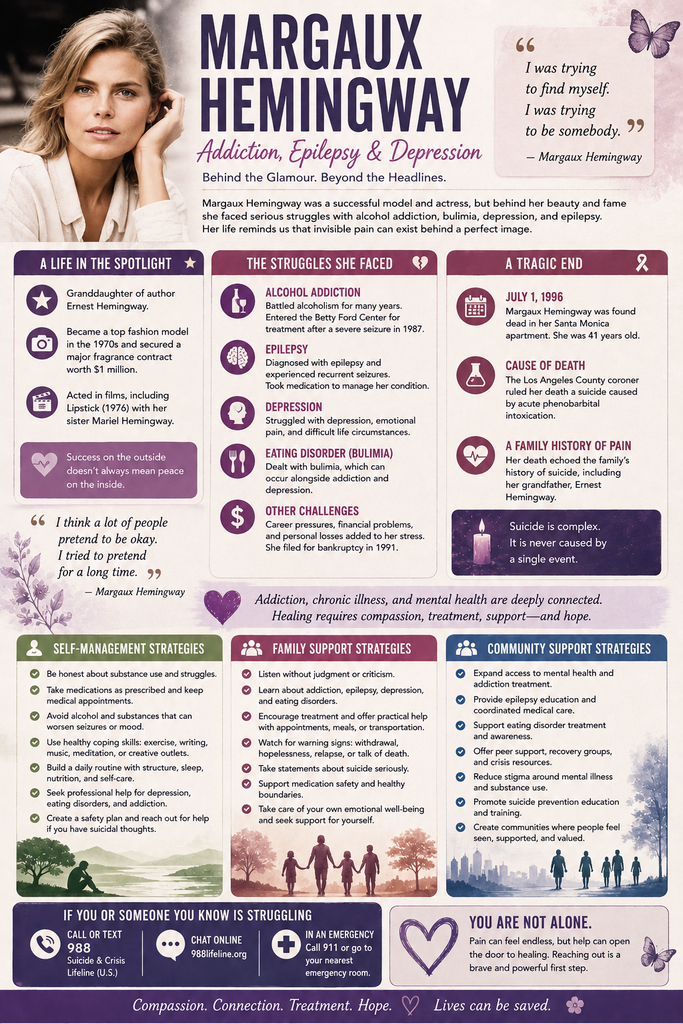
Margaux Hemingway began her career surrounded by fame and opportunity. As the granddaughter of celebrated author Ernest Hemingway, she rose to prominence as a fashion model in the 1970s, landed a major fragrance contract, and later pursued a career in acting. Behind her glamorous public image, however, she faced significant personal and health challenges, including alcohol problems, an eating disorder, depression, epilepsy, career setbacks, and financial difficulties. Her death at age 41 highlights how addiction, chronic illness, and mental health struggles can overlap and intensify one another, emphasizing the importance of comprehensive treatment, early intervention, and strong support systems.
Margaux Hemingway’s Rise to Fame
Standing six feet tall with a striking appearance and the famous Hemingway name, Margaux became one of the recognizable models of the 1970s. She also entered acting, appearing alongside her younger sister, Mariel Hemingway, in the 1976 film Lipstick.
Success, however, did not protect her from serious health and emotional difficulties. Over the years, reports described struggles involving alcoholism, bulimia, depression, and epilepsy.
Her experience challenges an important misconception: a person’s appearance, fame, wealth, or professional accomplishments do not tell us what is happening internally.
Alcohol Addiction and Recovery Attempts
Alcohol became a significant problem in Hemingway’s life. Following a severe seizure in 1987, she entered the Betty Ford Center for treatment. She later explained that the frightening experience had made her recognize that she needed to get well.
Seeking treatment was an important step. But recovery from addiction can be complicated when someone is simultaneously dealing with physical illness, eating disorders, depression, trauma, unstable relationships, or other major life stressors.
Addiction treatment therefore needs to address the whole person rather than concentrating exclusively on stopping alcohol or drug use.
Living With Epilepsy
Epilepsy added another difficult dimension to Hemingway’s life. She experienced seizures over many years and required medication to manage the condition.
Chronic illnesses can affect far more than physical health. Living with unpredictable symptoms may contribute to fear, loss of independence, frustration, social isolation, and emotional distress. Medication management can also become complicated when alcohol or other substances are involved.
For someone living with both addiction and a chronic medical condition, coordination among primary-care clinicians, specialists, addiction professionals, and mental-health providers can be especially valuable.
Depression and Bulimia
Hemingway also struggled with depression and bulimia. Eating disorders and substance-use problems can sometimes coexist, and both deserve specialized treatment rather than being dismissed as matters of willpower.
Her difficulties occurred amid other pressures, including changes in her career and serious financial problems. By 1991, she had filed for bankruptcy.
When multiple problems accumulate, treating only the most visible symptom may leave other important contributors untouched.
Margaux Hemingway’s Death
Hemingway was found dead in her Santa Monica apartment on July 1, 1996. She was 41.
Initially, the circumstances were unclear. There was no suicide note, and some friends questioned whether her epilepsy might have contributed to her death.
Subsequent toxicology testing changed the picture. The Los Angeles County coroner determined that Hemingway died from acute phenobarbital intoxication and ruled her death a suicide. Authorities reported extremely high concentrations of the barbiturate in her body.
Her death became even more poignant because of the Hemingway family’s history of suicide, including the death of her grandfather, Ernest Hemingway.
Family history can indicate vulnerability, but it does not determine an individual’s future. Suicide is complex and cannot be explained by genetics or a single event.
Understanding the Connection Between Addiction, Chronic Illness, and Mental Health
Margaux Hemingway’s life demonstrates how several health problems can overlap.
Alcohol misuse can worsen depression and interfere with judgment. Chronic illness can increase emotional stress. Eating disorders may coexist with depression or substance use. Financial, occupational, and relationship difficulties can add further pressure.
When these problems occur together, effective care may require an integrated approach addressing physical health, mental health, substance use, nutrition, safety, and social circumstances.
Self-Management Strategies
For someone experiencing similar challenges, self-management can complement professional care.
Helpful strategies may include:
- Be honest about alcohol and drug use. Healthcare professionals need accurate information to identify medication interactions and other risks.
- Take chronic illness seriously. Conditions such as epilepsy require appropriate medical evaluation, medication management, and follow-up.
- Avoid abruptly changing medications. Some medications can cause serious complications when suddenly discontinued. Changes should be discussed with the prescribing clinician.
- Recognize emotional triggers. Loneliness, grief, relationship problems, financial stress, chronic pain, and career changes may increase vulnerability.
- Develop healthier coping mechanisms. Exercise when medically appropriate, creative activities, relaxation techniques, structured routines, and supportive relationships may help.
- Address eating-disorder symptoms early. Bulimia and other eating disorders can cause serious medical complications and deserve specialized treatment.
- Avoid using alcohol to manage emotional or physical symptoms. Alcohol may temporarily numb distress while worsening underlying problems.
- Stay socially connected. Isolation can intensify depression and make it harder for others to recognize deterioration.
- Seek professional treatment early. Depression, addiction, eating disorders, and chronic illness are easier to address when care begins before a crisis develops.
- Create a suicide-safety plan when appropriate. A plan may identify warning signs, coping strategies, supportive contacts, professionals, crisis services, and ways to reduce access to potentially lethal means.
Family Support Strategies
Families cannot cure addiction, epilepsy, depression, or eating disorders, but they can become an important part of a person’s support system.
Families can:
- Listen without judgment or shame.
- Learn about addiction, depression, eating disorders, and chronic illness.
- Encourage appropriate medical and mental-health treatment.
- Help coordinate appointments when the individual wants assistance.
- Watch for significant behavioral changes, increasing isolation, hopelessness, or worsening substance use.
- Take statements about death or suicide seriously.
- Ask directly about suicidal thoughts when concerned.
- Encourage medication safety and appropriate medical follow-up.
- Avoid enabling harmful substance use while maintaining compassion.
- Establish healthy boundaries.
- Encourage connection with recovery and peer-support communities.
- Seek counseling or support for themselves when caregiving becomes overwhelming.
Family members should also understand that relapse or worsening symptoms are signals to reassess treatment rather than reasons to shame the person.
Community Support Strategies
Margaux Hemingway’s story also demonstrates why people with complex health needs benefit from communities that offer multiple types of services.
Communities can:
- Expand access to evidence-based addiction treatment.
- Provide affordable mental health and psychiatric services.
- Improve access to eating-disorder treatment.
- Support people living with epilepsy and other chronic illnesses.
- Integrate behavioral healthcare with primary and specialty medical care.
- Provide peer-recovery and family-support programs.
- Increase suicide-prevention education.
- Train community members to recognize warning signs of emotional crisis.
- Reduce stigma surrounding addiction and mental illness.
- Improve continuity of care following hospitalization or rehabilitation.
- Provide housing, employment, transportation, and financial-support resources when social problems interfere with recovery.
A person with several interconnected conditions should not have to navigate completely separate systems without coordination.
What Margaux Hemingway’s Journey Can Teach Us
Margaux Hemingway should be remembered for more than the circumstances of her death. Her life illustrates how complicated human suffering can become when addiction, chronic illness, eating disorders, depression, social pressures, and other challenges overlap.
Her story also reminds us not to judge wellness by appearances. Someone may look successful, physically healthy, confident, or socially connected while privately struggling.
Most importantly, suicide should never be reduced to one cause. Depression, addiction, chronic medical conditions, family history, stressful life events, access to lethal means, and many other factors may interact differently for every individual.
Conclusion
Margaux Hemingway’s journey moved from extraordinary early success to years marked by alcoholism, bulimia, depression, epilepsy, and other significant pressures. She sought help at different points in her life, demonstrating that her story was not simply one of illness but also one of repeated efforts to recover.
Her death by suicide at 41 underscores the importance of treating addiction, mental illness, eating disorders, and chronic medical conditions together whenever they overlap. Recovery requires more than personal determination. It can require appropriate medical treatment, mental-health care, addiction services, family involvement, social connection, and communities capable of supporting people through periods of profound vulnerability.
Margaux Hemingway’s story can therefore be approached not as a sensational tragedy, but as a reminder to recognize suffering early, treat the whole person, reduce stigma, strengthen support systems, and take suicidal thoughts seriously.
Frequently Asked Questions
Here are some common questions:
1. Who was Margaux Hemingway?
Margaux Hemingway was an American fashion model and actress and the granddaughter of author Ernest Hemingway. She became a major fashion figure during the 1970s and received a highly publicized $1 million contract to represent Babe perfume. She later pursued acting, including a role alongside her sister, Mariel Hemingway, in the 1976 film Lipstick.
2. Did Margaux Hemingway struggle with alcohol addiction?
Yes. Hemingway publicly struggled with alcoholism. Her alcohol problems became particularly serious during the 1980s, and she eventually sought treatment at the Betty Ford Center.
Her experience demonstrates that addiction can affect people regardless of beauty, fame, financial success, or social status.
3. Did Margaux Hemingway go to rehabilitation?
Yes. After a period of heavy drinking and a serious seizure, Hemingway entered the Betty Ford Center for treatment. Seeking treatment represented an important attempt to address her alcohol problems and rebuild her health.
4. Did Margaux Hemingway have epilepsy?
Yes. Hemingway lived with epilepsy and experienced seizures. She used medication to help control the condition.
Epilepsy is a neurological disorder that requires appropriate medical evaluation and management. Alcohol use can also complicate seizure disorders, making communication between patients and their healthcare professionals particularly important.
5. Did alcohol contribute to Margaux Hemingway’s seizures?
Contemporary accounts connected at least one severe seizure with both heavy alcohol use and her epilepsy. However, seizures can have multiple causes, and it would be inappropriate to attribute every seizure she experienced solely to alcohol.
6. Did Margaux Hemingway struggle with depression?
Yes. Contemporary reports described Hemingway as having experienced depression along with alcoholism and other significant personal and health difficulties.
Depression can affect motivation, concentration, sleep, relationships, and the ability to cope with stressful circumstances. When depression occurs alongside addiction or chronic illness, coordinated treatment can become especially important.
7. Did Margaux Hemingway have an eating disorder?
Yes. Hemingway struggled with bulimia as well as significant concerns surrounding her weight.
Eating disorders can have serious physical and psychological consequences. When an eating disorder occurs alongside depression or substance misuse, each condition deserves appropriate assessment and treatment.
8. How did Margaux Hemingway die?
Margaux Hemingway was found dead in her Santa Monica apartment in July 1996. She was 41 years old.
Toxicology testing subsequently found a massive concentration of phenobarbital, a barbiturate. The Los Angeles County coroner determined that she died from acute phenobarbital intoxication and ruled her death a suicide.
9. Was Margaux Hemingway’s death initially thought to be related to epilepsy?
There was uncertainty immediately following her death, and some friends believed epilepsy might have been responsible. Toxicology testing later demonstrated a massive phenobarbital overdose, leading the coroner to officially classify the death as suicide.
10. Why is Margaux Hemingway’s story important for understanding co-occurring conditions?
Her experience demonstrates how multiple conditions can overlap. Addiction, depression, epilepsy, eating disorders, relationship difficulties, career pressures, and financial problems may interact rather than existing independently.
Treatment is therefore often most effective when healthcare professionals consider the whole person rather than focusing on only one diagnosis.
11. What self-management strategies may help someone facing similar challenges?
Helpful strategies can include being honest with healthcare professionals about alcohol and substance use, following an epilepsy treatment plan, taking medications only as prescribed, recognizing emotional triggers, maintaining healthy routines, staying socially connected, developing healthier coping skills, and seeking professional treatment for depression, addiction, or eating-disorder symptoms.
Self-management should complement professional treatment rather than replace it.
12. How can families support someone struggling with addiction and depression?
Families can listen without judgment, learn about addiction and mental illness, encourage professional care, support appropriate medication management, watch for significant changes in behavior, maintain healthy boundaries, and take statements about hopelessness, death, or suicide seriously.
Family members may also need counseling or peer support for their own emotional well-being.
13. How can families support someone who also has epilepsy?
Families can learn seizure first aid, encourage regular medical follow-up, help the person follow their prescribed treatment plan, and understand potential triggers identified by the individual’s healthcare team.
Family members should also communicate concerns about alcohol or medication misuse to healthcare professionals when appropriate.
14. What role can communities play?
Communities can improve access to addiction treatment, psychiatric services, epilepsy care, eating-disorder treatment, crisis intervention, and peer-support programs.
Healthcare systems can also improve outcomes by coordinating mental health, addiction, and medical services instead of requiring people with complex conditions to navigate disconnected systems.
15. Does having a family history of suicide mean someone will die by suicide?
No. A family history may be one risk factor, but it does not determine someone’s future.
Suicide is complex and usually involves interactions among multiple biological, psychological, social, environmental, and situational factors. Family history should encourage awareness and early intervention rather than create a sense of inevitability.
16. What suicide warning signs should families take seriously?
Warning signs can include talking about wanting to die, expressing intense hopelessness, withdrawing from others, giving away possessions, dramatically changing behavior, increasing alcohol or drug use, researching methods of suicide, or obtaining potentially lethal substances.
Any concerning statements or behaviors deserve attention, especially when several warning signs occur together.
17. Should you ask someone directly if they are thinking about suicide?
Yes. When there is concern, asking directly and compassionately about suicidal thoughts can help begin an important conversation. Asking about suicide does not mean encouraging suicide.
If the person is in immediate danger, obtain emergency assistance and, when it is safe, do not leave them alone.
18. What can Margaux Hemingway’s journey teach us?
Her story demonstrates that outward success does not guarantee emotional or physical well-being. Addiction, chronic illness, depression, and eating disorders can exist behind a glamorous public image.
It also demonstrates why recovery may require more than treating one problem. Medical care, addiction treatment, mental-health services, family support, healthy relationships, and community resources may all have important roles.
19. How should Margaux Hemingway’s death be discussed?
Her death should be discussed respectfully and without romanticizing or sensationalizing suicide. Margaux Hemingway was much more than the circumstances surrounding her death.
Her story can instead encourage conversations about addiction treatment, chronic-illness management, depression awareness, eating-disorder treatment, suicide prevention, and compassionate support.
20. What is the most important message from Margaux Hemingway’s story?
Perhaps the strongest lesson is that visible success can coexist with invisible suffering.
Margaux Hemingway’s experiences remind us to recognize distress early, treat addiction and mental-health conditions seriously, provide coordinated care for chronic illnesses, reduce stigma, and remain connected to people who may be struggling.
Video: The heartbreaking story you didn’t know about Margaux Hemingway #shorts #biography